Home ›
Turntable Speakers › Can You Put a Turntable on Top of a Speaker? The Loop That Decides
Turntable Speakers
Can You Put a Turntable on Top of a Speaker? The Loop That Decides
PBy the Pickpedia Team·2 picks compared·Last verified October 2026
Affiliate disclosure: As an Amazon Associate, Pickpedia earns from qualifying purchases. Links on this page are paid links, and we may earn a commission at no extra cost to you. This never affects our picks or scores.
This page contains affiliate links. If you buy through one we may earn a
commission, at no cost to you.
The usual answer is no, the vibration will make the needle skip. The failure
is real but the diagnosis is wrong, and the wrong diagnosis is why the rule gets
treated as a law of nature when it is actually a design problem with a known
solution. A stylus skips when it loses contact with the groove wall, which takes
a large sudden lurch. What goes wrong when a turntable sits on a speaker is
quieter, starts at a much lower level, and is not really about the needle at all.
It is a loop.
A cartridge cannot tell which thing moved
Here is the mechanism, and it is the whole post. A moving magnet cartridge
generates a voltage from the motion of the stylus relative to the cartridge body.
That is all it measures. It does not measure the groove, it does not measure the
room, it measures one part of itself moving against another part of itself.
So consider two situations. In the first, the body is still and the groove
wall pushes the stylus sideways. The stylus has moved relative to the body, and a
voltage comes out. In the second, the groove does nothing at all, but the whole
plinth and the cartridge body bolted to it get shifted sideways by whatever is
underneath, while the stylus tip stays put in the groove it is tracking. The body
has moved relative to the stylus, by the same distance, and the same voltage comes
out.
Three cuts, three product categories. A base built for this attacks the middle
one, which is the only cut you cannot make yourself with a pad or a switch.
Identical signals, different causes, and nothing downstream can separate them.
Everything the cabinet does to the plinth is therefore indistinguishable from
music, and gets treated as music.
Why this is worse for vinyl than for anything else
Put a streamer, a CD player or a games console on a speaker and nothing
happens, because none of them has a transducer reading mechanical motion. That is
the first half of why records are the special case. The second half is the gain,
and it is the part people underestimate.
A moving magnet cartridge puts out a few thousandths of a volt. The very next
thing in the chain is a phono stage, which as a rule of thumb multiplies that by
around a hundred before the signal even reaches a volume control. And it does not
do it evenly. Records are cut with the bass reduced and the treble lifted, and
the standard replay curve undoes that on the way back, which means a phono stage
applies roughly another factor of ten at the bottom of the band relative to the
middle. Those are the published characteristics of the format rather than figures
we measured.
Now add the third coincidence. A tonearm and cartridge together are a mass on
a spring, and as a rule of thumb for common combinations that system resonates
somewhere around 8 to 12 Hz, which is below anything you hear as a note. So the
most heavily amplified part of the chain, the most mechanically responsive part
of the chain, and the part of the spectrum where a speaker cabinet physically
shakes hardest all land in the same place.
That is why the symptom is not a skip. It is the woofers visibly moving on a
quiet passage, a thickening and smearing of the bass that gets worse as you turn
up, and then quite suddenly a low rumbling howl once the round trip gain reaches
one, because a loop that reaches unity gain does not get gradually worse, it
oscillates. Everything below that threshold is still colouration you are
listening through, which is the part most people never notice they have.
Which is why it is a design problem, not a prohibition
A loop with gain can have its gain reduced, and there are exactly three places
to do it, marked on the drawing above.
You can break the mechanical path, which is what isolation feet and platforms
do, and we went through those separately in
best speaker isolation pads. You can
filter the electrical path, which is what a rumble or subsonic filter does, by
removing the band where the loop is weakest before it reaches the amplifier. Or
you can attack the middle term and reduce how much the cabinet moves in the first
place, which is the only one of the three you cannot retrofit, because it has to
be designed into the enclosure.
An
Andover Audio Spinbase 2
turntable speaker system is a product built entirely around that middle cut.
It is a powered base meant for a turntable to stand directly on top of it, and
the maker states that its patented ISOGroove technology prevents feedback from any
turntable placed there. Its record also lists a built-in phono input, so a moving
magnet cartridge connects with no separate phono stage, plus Bluetooth, analog,
optical digital and USB inputs, an IR remote covering input, volume and tone, and
a one year manufacturer warranty.
Two things in that record deserve reading with the mechanism in mind. The
built-in phono stage is not just a convenience: it means the hundredfold
amplification described above happens inside the same box that is designing
against the loop, rather than in a component bought separately with no knowledge
of what it is sitting on. And the honest gap is the one our record flags plainly,
that no isolation measurement is published for the anti-feedback claim, alongside
no dimensions, no power rating and no driver details, which is awkward on a
product a turntable has to physically fit. The claim is a maker's claim, and the
number that would let you check it does not exist. Our
review of the
Spinbase 2 sets out the rest, and
best turntables covers the deck that goes on
top.
When coupling does not matter at all
It is worth seeing the opposite case, because it makes the rule precise. A
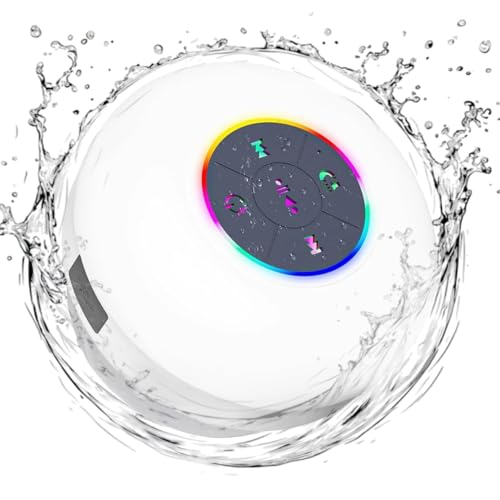
Luzsco Bluetooth shower
speaker is designed to do the exact thing audio advice warns against: its
suction cup deliberately bonds the cabinet rigidly to a hard tiled wall, with no
decoupling anywhere. Its record lists IPX4 splash resistance, which the maker is
clear is not waterproof or submersible, Bluetooth so the phone stays out of the
spray, a built-in LED and a mini body that is explicitly not a deep bass speaker.
Nobody considers that rigid mount a fault, and the reason is the mechanism above:
there is no transducer downstream reading motion, so the loop has nowhere to
close. Vibration is only a problem when something is listening to it. Details in
our
review
of the Luzsco shower speaker, which is a product for a completely different
job and included here only to mark where the rule stops applying.
The honest limit
If you already own a turntable and a pair of speakers, the cheapest fix is not
a purchase at all. Move them. Putting the deck on a different piece of furniture
from the speakers breaks the mechanical path more completely than any pad,
costs nothing, and is the one intervention that is guaranteed to work. A wall
shelf for the turntable does the same thing. If the floor is suspended timber and
the problem persists, that is the path talking, and the answer is still geometry
rather than gear.
A base designed for a turntable to sit on is worth it for one specific
situation, which is that you have one shelf and you are not going to get another.
That is a real constraint and this format exists because of it. Just be clear
about what you are buying into: a single enclosure cannot give you the stereo
separation that two spaced speakers do, and on this particular record the central
engineering claim is unmeasured. Buy it for the shelf, not for the
specification.
And the limit nothing addresses. Every cartridge tracking every record is
already reading a little of the room, because the loop is never fully open, only
quiet. Turning it up enough will find the threshold on any system in any room.
What you are choosing is how much headroom you have before you get there, and the
cheapest way to buy headroom is still distance.
Can You Put a Turntable on Top of a Speaker? The Loop That Decides at a glance
Luzsco Bluetooth Shower Speaker with LED (Mini Portable)
Splash-proof music in the shower, pool or outdoors
Suction cup mounts it hands-free anywhere smooth
IPX4 is splash-proof only, not waterproof or submersible
Why you can trust this guide
We compared these picks using verified manufacturer specifications, current retailer listings, and patterns in owner feedback, alongside editorial research. We focus on measurable differences such as performance, capacity, usability, and build quality. Pickpedia does not present editorial research as laboratory testing, and we do not claim hands-on testing unless it was actually performed.
Best for Anyone wanting a complete record setup on one shelf, with no separate amplifier or speaker stands
8.6/ 10 Pickpedia editorial score
A powered speaker base designed to sit under a turntable, using patented ISOGroove anti-feedback technology, with a built-in phono input plus Bluetooth, analog, optical digital and USB, and an IR remote for input, volume and tone.
BrandAndover Audio
ModelSpinbase 2
Part numberAAMD4SB2BK01NA
TypePowered speaker base for turntables
Anti-feedbackISOGroove, patented
AmplificationDual Direct Drive
Phono inputYes
WirelessBluetooth
Wired inputsAnalog, optical digital, USB music files
RemoteIR, for input, volume and tone
GrillHeathered fabric wrap
FinishBlack
DimensionsNot published on the listing
Power ratingNot published on the listing
Warranty1 year manufacturer
Pros
Patented ISOGroove technology lets a turntable sit directly on top
Built-in phono input, so no separate preamp is needed
Bluetooth, analog, optical digital and USB inputs as well
IR remote covers input, volume and tone
Tone controls, not just volume
Heathered fabric wrap grill reads as furniture
One box replaces a phono stage, amplifier and speakers
Warranty clearly stated at 1 year from the manufacturer
Cons
No dimensions published, on a product a turntable must physically fit
No power rating or driver details given
Dual Direct Drive amplification is named but not explained
Single enclosure means narrower stereo separation than spaced speakers
No isolation measurement published for the anti-feedback claim
Best for Splash-proof music in the shower, pool or outdoors
8.6/ 10 Pickpedia editorial score
A compact, lightweight Bluetooth shower speaker with a suction cup mount and a built-in LED, rated IPX4 splash-proof (the maker states it is not waterproof), for showers, pools, beaches and float trips.
BrandLuzsco
TypePortable Bluetooth shower speaker
Water ratingIPX4 splash-proof (not waterproof)
ConnectionBluetooth wireless
MountSuction cup for smooth surfaces
LightBuilt-in LED
SizeCompact, lightweight mini
ColourWhite
Pros
Suction cup mounts it hands-free anywhere smooth
IPX4 splash-proof for showers and poolside
Bluetooth keeps your phone away from water
Light and portable for beach, pool and floats
Built-in LED adds fun
Very affordable and giftable
Cons
IPX4 is splash-proof only, not waterproof or submersible