Tools & DIY 11 Wheel Chocks that Keep Vehicles From Rolling
P
By the Pickpedia Team
·11 picks compared
·Last verified October 2026
Affiliate disclosure: As an Amazon Associate, Pickpedia earns from qualifying purchases. Links on this page are paid links, and we may earn a commission at no extra cost to you. This never affects our picks or scores.
Quick answer
For most garages, a heavy solid rubber chock with a molded handle and non-slip pads keeps a parked vehicle steady on smooth concrete. Pick pairs for cars and trailers, floor-mounted wedges for consistent parking spots, and small rubber blocks if you only need to steady a floor jack wheel.
11 Wheel Chocks that Keep Vehicles From Rolling at a glance
Why you can trust this guide
We compared these picks using verified manufacturer specifications, available manuals and documentation, current retailer listings, and patterns in owner feedback, alongside editorial research. We focus on measurable differences such as performance, capacity, usability, and build quality. Pickpedia does not present editorial research as laboratory testing, and we do not claim hands-on testing unless it was actually performed.
How we chose: We compared 11 chocks across grip material, size, holding claims, and how each suits garage floors versus jack-wheel stabilizing.
Wheel chocks look simple, yet the material and base design decide whether a tire actually stays put on slick garage concrete. Solid rubber grips better than hard plastic, while a wide wedge angle matches the tire and resists sliding. Weight and a built-in handle also change how quickly you can set them.
Not every product here does the same job. Some are full tire chocks for cars, trailers, and campers. Others are small rubber blocks made to steady the caster wheel of a floor jack during lifting. We sorted them so you can match the right one to your task instead of guessing.
Our top picks
MaxxHaul molds these from premium-grade solid rubber, which resists cracking, crushing, and deformation under vehicle weight far better than plastic. Non-slip traction pads grip pavement, gravel, and garage floors to hold a tire and reduce rollaway risk, and the oil-resistant body shrugs off rain, snow, and UV. A built-in molded handle lets you place and pull them without tools or metal rings. Compact 8 by 4 by 6 inch dimensions tuck behind tires or into storage for cars, trucks, trailers, and RVs. The main tradeoff is weight, since solid rubber is heavier to carry than the light plastic chocks, though that heft is exactly what improves grip.
MaterialSolid molded rubber
Size8 x 4 x 6 in
Pack2 chocks
HandleBuilt-in molded
Pros
- Solid rubber resists crushing
- Strong traction on concrete
- Molded handle for easy use
Cons
- Heavier to carry
- Only two in the pack
Check price on Amazon ›
PR1ME builds these from UV-stabilized polypropylene, so they stay light enough to toss into a compartment without ropes or bulk. Two integrated EVA pads add grip on asphalt, concrete, gravel, and smooth garage floors, and deep tread grooves aim to lock the tire rather than slide. Rounded finger-safe edges and bright yellow color help you place them fast in low light. Each chock measures 8 by 4-5/8 by 4 inches, stacks for storage, and holds tires up to 26 inches. As a plastic-bodied chock, owners note it favors lighter loads over the toughest heavy-duty duty that molded rubber handles.
MaterialUV-stabilized polypropylene
BaseDual EVA anti-slip pads
Size8 x 4-5/8 x 4 in
FitsTires up to 26 in
Pros
- Very light and rope-free
- Dual EVA pads grip smooth floors
- Bright color aids visibility
Cons
- Plastic body less rugged than rubber
- Best kept to lighter loads
Check price on Amazon ›
This compact rubber block is made to stop the caster wheel of a floor or trailer jack from creeping while you lift. Its textured surface grips smooth garage concrete and uneven outdoor ground, which reduces the small jack movement that can throw off a lift. Lightweight and easy to carry, it tucks under a vehicle or into a storage bin without eating room. Reviewers treat it as a jack stabilizer, not a full vehicle chock, so it holds a single jack wheel rather than blocking a loaded tire. Keep it as a helper for safer jacking, alongside proper stands.
TypeJack wheel stabilizer
MaterialRubber
GripTextured surface
UseUnder floor or trailer jack
Pros
- Steadies a rolling jack wheel
- Grips smooth concrete
- Small and easy to store
Cons
- Not a full vehicle tire chock
- Holds one jack wheel only
Check price on Amazon ›
Sized for a 6 inch wheel, this rubber stopper is shaped to match several jack sizes, so one block covers car, boat, and RV trailer jacks without changes. Its single-wheel locking design anchors the jack caster and limits accidental rolling during maintenance. A reinforced body adds stability so the jack does not slip mid-repair, and the shape adapts to garages, parking lots, or campgrounds. Because it targets a single jack wheel, it works as a stabilizer rather than a chock for a parked, loaded tire. Reviewers suggest confirming your jack wheel diameter before buying to get the snug fit it relies on.
Wheel size6 in
MaterialRubber
DesignSingle-wheel lock
UseCar, boat, RV jacks
Pros
- Fits multiple jack sizes
- Reinforced for stability
- Works in many settings
Cons
- Sized for 6 in wheels
- Stabilizer, not a tire chock
Check price on Amazon ›
Built from high-strength material with a wear-resistant surface, this block is meant for frequent, heavy jack use. It functions as a garage stopper that holds a jack wheel in place, which protects you during routine and emergency lifting. The grippy construction keeps it firm on smooth garage floors or uneven outdoor surfaces, cutting the risk of jack drift. It doubles as a boat trailer or camper stabilizer, so it moves easily between garage, lot, and campsite. As with the other 6 inch blocks here, it steadies a single jack wheel and is not a substitute for chocking a loaded vehicle tire or using jack stands.
Wheel size6 in single
MaterialHigh-strength, wear-resistant
GripFirm on smooth floors
UseFloor jack stabilizer
Pros
- Wear-resistant for frequent use
- Holds jack wheel firmly
- Adapts to many locations
Cons
- Single jack wheel only
- Not a loaded-tire chock
Check price on Amazon ›
This two-pack of polypropylene chocks aims to keep a parked vehicle from creeping, with a base that sits against the tire of a truck or trailer to hold it steady. The curved surface lets each chock sit flush to the wheel, and the PP material resists impacts, wear, and water. A handle and cord make them more convenient and safer to pull out after use. Owners fit them to trailers, caravans, motorcycles, forklifts, floor jacks, and general household loads. Since the body is plastic rather than solid rubber, reviewers lean on them for lighter, moderate duty rather than the heaviest vehicles on a slope.
MaterialPP plastic
Pack2 chocks
SurfaceCurved, flush to tire
ExtrasHandle and cord
Pros
- Curved face sits flush
- Handle and cord for removal
- Handles many light uses
Cons
- Plastic favors lighter loads
- Less grip than rubber
Check price on Amazon ›
Katzden takes a different approach with a steel parking block rather than a loose wedge. It uses corrosion-resistant plated steel, so the plate stands up to a garage environment, and a zinc-rich primer under polyester powder coating adds protection. Standing 4.3 inches tall and weighing about 5.7 pounds, it marks a consistent stopping point for regular vehicles so you park in the same spot each time. Signal red keeps it visible on the floor. As a positioning stop, it guides where a tire lands rather than wedging against a wheel to prevent rolling, so pair it with a true chock if you need roll protection on any incline.
MaterialPlated steel, SS400
Height4.3 in (110 mm)
WeightAbout 5.7 lb
FinishZinc primer, powder coat
Pros
- Durable steel build
- Corrosion-resistant finish
- High-visibility red
Cons
- Positions rather than blocks rolling
- Needs floor mounting to stay put
Check price on Amazon ›
This rubber jack block leans on abrasion-resistant material and a special finish built for repeated, intensive use in varied weather. Made for a 6 inch jack wheel, it anchors the caster so your floor or trailer jack stays put through frequent shop and roadside work. A compact dock-block shape slips into a car or toolbox, which suits travel, camping, and home garages. The wear-resistant layer is meant to cut how often you replace it. Reviewers again treat this as a jack-wheel stabilizer, so it holds a single jack caster and should not stand in for chocking a loaded vehicle tire or setting proper stands.
Wheel size6 in
MaterialAbrasion-resistant rubber
FinishWear-resistant layer
UseJack wheel stabilizer
Pros
- Tough, wear-resistant rubber
- Compact for toolbox storage
- Built for frequent use
Cons
- Single jack wheel only
- Not for loaded tires
Check price on Amazon ›
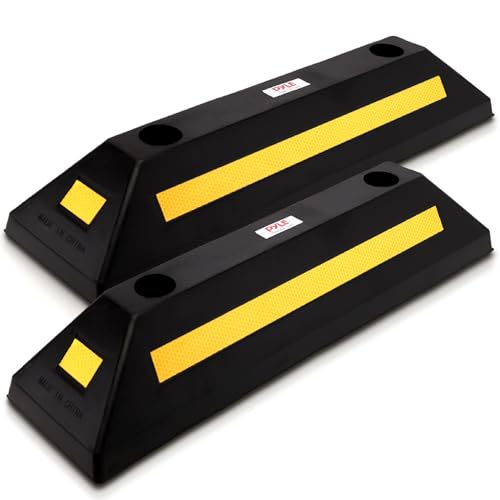
Pyle sizes these longer than a typical wedge, at 21.7 inches long by 5.9 wide by 3.5 tall, and molds them from high-density rubber for durability. Each stopper is rated to support up to 33,000 pounds, so they suit heavy vehicles such as buses, forklifts, and commercial trucks. A bright yellow reflective strip improves visibility, helping you park with precision day or night. Marine-grade waterproof material handles heat, rain, and snow, and the design works on asphalt, gravel, and uneven ground for front or rear tires. These act as long parking curbs, so they position and stop tires best when anchored to the floor rather than left loose.
Size21.7 x 5.9 x 3.5 in
MaterialHigh-density rubber
LoadUp to 33,000 lb each
VisibilityReflective yellow strip
Pros
- Very high load rating
- Reflective strip for safety
- All-weather rubber
Cons
- Works best when anchored
- Long shape needs floor space
Check price on Amazon ›
TONDA designs these wedges for floor mounting, using built-in holes so you can bolt them down as a fixed parking stop for repeated use. That helps you halt at the same spot and reduces the chance of backing into a wall. A textured triangular shape gives a stable contact surface against the tire while parked. Each chock measures 8 by 4.7 by 4.7 inches and weighs 1.65 pounds, and the set stacks and nests for storage. Four black chocks cover multiple spots or vehicles across a garage, driveway, or workshop. To get the full benefit you need to mount them, since loose on a slope they offer less holding than heavier solid rubber.
Pack4 chocks
Size8 x 4.7 x 4.7 in
Weight1.65 lb each
MountingBuilt-in floor holes
Pros
- Bolts down for fixed spots
- Four-pack covers many spaces
- Stackable for storage
Cons
- Needs mounting hardware
- Lighter than solid rubber
Check price on Amazon ›
OULEME rounds out the list with four tough rubber chocks that are UV-resistant and weatherproof for outdoor use. A triangular shape follows the angle of the tire, and anti-skid texturing on both the bottom and surface builds friction and grip. Each chock measures 8 by 5 by 4 inches, weighs 2.45 pounds, and uses removable eyebolts for handling. The four-pack suits trucks, trailers, RVs, and boat trailers where you want to chock more than one wheel at once. Solid rubber makes each heavier than plastic, so carrying a full set takes more effort, though the weight and texture are what deliver the grip owners want on a slope.
Pack4 chocks
Size8 x 5 x 4 in
Weight2.45 lb each
MaterialUV-resistant rubber
Pros
- Four rugged rubber chocks
- Anti-skid top and bottom
- Removable eyebolts
Cons
- Heavier to carry as a set
- Bulkier than plastic wedges
Check price on Amazon ›
What to look for
Rubber versus plastic
Material decides most of the performance. Solid rubber grips smooth concrete, resists crushing, and holds heavier vehicles without sliding. Plastic chocks weigh less and ask nothing of your arms, but they work best for lighter trailers and moderate loads. On a slick or oily garage floor, rubber pads win.
Match the chock to the job
Not every block here chocks a vehicle. Several 6 inch rubber blocks are made to steady a floor jack wheel during lifting, not to hold a parked tire. Full tire chocks wedge against the wheel. Parking blocks and curbs mark a stopping position. Know which task you have before buying.
Size, weight, and fit
Check the chock size against your tire, and for jack blocks confirm the caster diameter. A wide wedge angle matches the tire curve and resists rolling. Heavier chocks grip better but take more effort to place, so a molded handle or eyebolt makes daily use easier.
Mounting and placement
Loose chocks help on flat ground, but floor-mounted wedges and parking curbs give repeatable positioning and stronger holding. On any incline, place chocks snug against the downhill side of the tires. For lifting, always pair chocks with jack stands rather than trusting a jack alone.
Frequently asked questions
Do I need one chock or two?
For a parked car on a flat garage floor, a single chock behind a tire adds security. On a slope, or when lifting, use a pair on the downhill side and never rely on the parking brake alone.
Are rubber chocks better than plastic?
On smooth or oily garage concrete, solid rubber grips better and handles heavier loads. Plastic chocks are lighter and easier to carry, which suits trailers, caravans, and lighter household duty.
What is a jack wheel chock?
It is a small rubber block that steadies the caster wheel of a floor or trailer jack so the jack does not roll while lifting. Several products here are jack stabilizers, not chocks for a loaded tire.
Can chocks replace jack stands?
No. Chocks stop wheels from rolling, but they do not support a lifted vehicle. Always set rated jack stands under the frame before working underneath, and use chocks on the wheels that stay on the ground.
How do I stop chocks from sliding?
Choose a non-slip rubber base with textured pads, place the chock flush against the tire, and clean oil off the floor. For a permanent spot, floor-mounted wedges and parking blocks stay fixed once bolted down.
Will these fit my tire size?
Check each chock size against your wheel. Wedge chocks here fit common car, truck, trailer, and RV tires, and some list a maximum tire diameter. Jack blocks are sized to a caster wheel instead, often 6 inches.
Do parking blocks stop rolling?
A steel or rubber parking block mainly marks a consistent stopping position so you park in the same place. For roll protection on an incline, add a true wedge chock against the tire as well.
Are these good for RVs and trailers?
Yes. Solid rubber four-packs suit RVs, campers, and boat trailers where you chock more than one wheel. Lighter plastic pairs work for smaller trailers and easy transport between sites.
The verdict
MaxxHaul Solid Rubber Wheel Chock, 2-Pack,...
9.2/10
For most garages, the MaxxHaul solid rubber two-pack is our top pick, since its molded rubber, traction pads, and handle grip concrete and resist crushing. Choose the Pyle stops for heavy vehicles, TONDA if you want bolt-down parking positions, and the OULEME four-pack for RVs and trailers. The lighter PR1ME set suits easy carrying, while the 6 inch rubber blocks are for steadying a floor jack wheel, not chocking a loaded tire.
Check price on Amazon ›
Our top pick, secure checkout via Amazon
Note: Availability and specifications change often. Always confirm the current details on Amazon before buying.