Tools & DIY 6 Welding Tables for Small Home Workshops
P
By the Pickpedia Team
·6 picks compared
·Last verified September 2026
Affiliate disclosure: As an Amazon Associate, Pickpedia earns from qualifying purchases. Links on this page are paid links, and we may earn a commission at no extra cost to you. This never affects our picks or scores.
Quick answer
For a small shop, pick a table sized to your work with real load capacity and a solid fixture-hole layout. Portable folding models save floor space, while mobile heavy-duty carts suit steady daily welding. Match hole spacing to your clamps, and confirm the top thickness handles your typical projects.
6 Welding Tables for Small Home Workshops at a glance
Why you can trust this guide
We compared these picks using verified manufacturer specifications, available manuals and documentation, current retailer listings, and patterns in owner feedback, alongside editorial research. We focus on measurable differences such as performance, capacity, usability, and build quality. Pickpedia does not present editorial research as laboratory testing, and we do not claim hands-on testing unless it was actually performed.
How we chose: We compared six welding tables across worktop size, fixture-hole layout, load capacity, mobility, and storage that matters in a tight shop.
Small workshops reward tables that earn their footprint. A good welding surface gives you a flat steel top, enough fixture holes to clamp work square, and legs that stay planted while you strike an arc. Owners in cramped garages care most about size, stability, and whether the table folds or rolls out of the way.
We looked at cold-rolled and carbon steel tops, fixture-hole counts, height adjustment, and folding versus rolling designs. Every claim below is grounded in the maker's stated specifications and features. Nothing here was bench-tested in a lab, so treat scores as editorial judgement to help you shortlist quickly.
Our top picks
CAMMOO pairs a 36 by 18 inch cold-rolled steel top with black oxide treatment and an anti-rust coating, so it shrugs off heat and corrosion. Ninety-four 5/8 inch holes plus four tool slots give plenty of clamping options for its size. Reinforced 3.5mm legs and a 2.8mm top carry a stated 1200 pound load without wobble. Three inch swivel casters roll it around, then lock with fixed glides for steady precision work. Assembly takes minutes with pre-fitted wheels. The compact top suits smaller projects, so anyone building long frames may find the surface tight.
Tabletop36 by 18 in cold-rolled steel
Load capacity1200 lbs stated
Fixture holes94 at 5/8 in
Mobility3 in locking swivel casters
Pros
- Strong stated load for a compact top
- Dense 5/8 inch hole grid for clamps
- Locking casters plus fixed glides for stability
Cons
- Smaller surface limits long workpieces
- Wheels add height some may not want
Check price on Amazon ›
VEVOR gives you a roomy 40 by 24 inch carbon steel top, so bigger weldments fit without hanging over the edge. A stated 800 pound static and 600 pound dynamic rating covers most hobby and shop tasks. The standout is 216 fixture holes at 5/8 inch, letting you position clamps almost anywhere. A double-layer storage board and a side board with 11 hooks keep tools close. Four wheels, two braked, make it easy to reposition and lock. The larger footprint asks for more floor room, so the tightest corners may struggle to house it comfortably.
Tabletop40 by 24 in carbon steel
Load capacity800 lbs static, 600 lbs dynamic
Fixture holes216 at 5/8 in
StorageDouble-layer board, 11 hooks
Pros
- Generous worktop for larger builds
- Very dense fixture-hole pattern
- Two-tier storage plus 11 side hooks
Cons
- Bigger footprint needs more floor space
- Lower load rating than some rivals
Check price on Amazon ›
WORKESS blends a folding frame with serious capacity, so it works in shops short on permanent space. A 14 gauge galvanized top on a powder-coated frame resists wear, rust, and corrosion. The 42 by 21 inch surface carries 0.8 inch holes and slots for flexible clamping, and it holds a stated 1000 pounds with four locking hooks for safety. Seven height settings run from 27.7 to 36.6 inches to match your task. Legs tuck fully under, folding to a 3.7 inch slab that stands on its own with carry handles. Setup is quick, though folding tables can flex slightly more than fixed benches.
Tabletop42 by 21 in, 14 ga galvanized
Load capacity1000 lbs stated
Height range27.7 to 36.6 in, 7 levels
Folded depth3.7 in, self-standing
Pros
- Folds thin and stands on its own
- Seven-step height adjustment
- High stated capacity with locking hooks
Cons
- Folding frames may flex under side load
- Hole spacing less dense than some rivals
Check price on Amazon ›
Olympia leans into flexibility with a tilting, height-adjustable top that angles your weldment for easier access. A zinc-plated steel surface resists rust and carries adjustment slots that grip different clamp types well. Fold the top flat for storage, or tilt it to position work at a comfortable angle. Wheels and a carry handle move it without emptying the tool tray first, handy when shifting around a packed garage. Owners report it suits lighter and mid-range jobs. Olympia does not publish a headline load figure here, so confirm capacity fits your heaviest planned work before buying.
TabletopZinc-plated steel, slotted
TopTilting and folding
HeightAdjustable
MobilityWheels plus carry handle
Pros
- Tilting top angles work for access
- Folds flat for storage
- Moves with tools still on the tray
Cons
- No clear published load rating
- Slots suit clamps more than fixture pins
Check price on Amazon ›
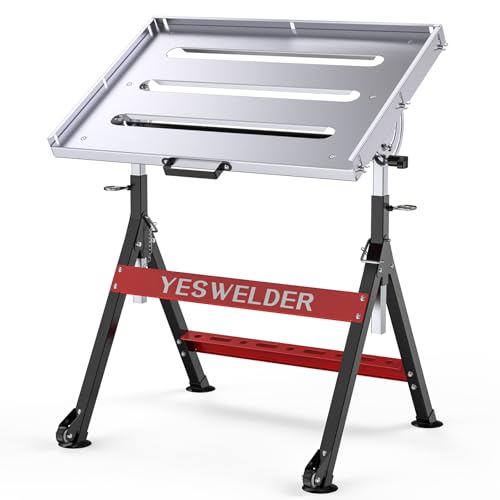
YESWELDER targets cramped shops with a folding carbon steel table that stores at just 7.5 inches thick, sliding behind a door with ease. Four height settings from 30 to 37 inches ease back strain on long sessions, and the top tilts to multiple angles for varied welds. Three sides carry adjustable vertical steel guide rails that clamp workpieces for hands-free, repeatable results. The 20 by 30 inch surface fits small builds well, and wheels plus a reinforced handle make it mobile. A stated 400 pound capacity covers hobby work, though heavy structural jobs sit outside its comfort zone.
Tabletop20 by 30 in carbon steel
Load capacity400 lbs stated
Height range30 to 37 in, 4 levels
Folded thickness7.5 in
Pros
- Very thin folded profile for storage
- Guide rails enable hands-free clamping
- Tilting top and four heights
Cons
- Lower load rating than heavier tables
- Compact top limits large weldments
Check price on Amazon ›
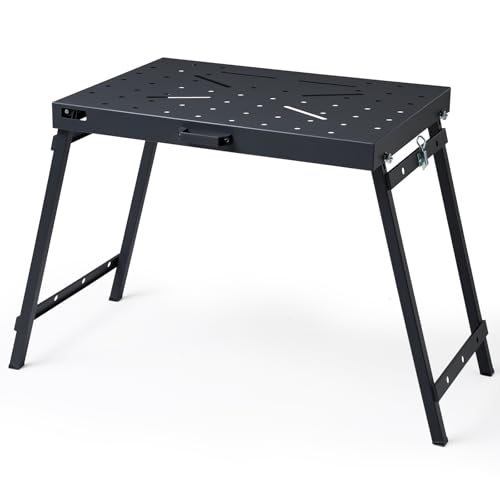
OLBRUS focuses on repeatable accuracy with 0.63 inch fixture holes spaced a consistent 2.6 inches apart, so jigs and clamps land exactly where you plan. Heavy-gauge steel construction gives a stated 1000 pound capacity for large, heavy materials during welding, assembly, and repair. The frame folds in seconds for compact storage, which fits garages and shops of any size. Six integrated tool slots keep clamps and pliers within reach to streamline your workflow. OLBRUS emphasizes the hole grid and folding over a rolling base, so buyers wanting built-in casters should check the configuration before ordering.
Fixture holes0.63 in, 2.6 in spacing
Load capacity1000 lbs stated
FrameFoldable heavy-gauge steel
Tool slots6 integrated
Pros
- Evenly spaced holes for precise fixturing
- High stated load capacity
- Folds quickly for compact storage
Cons
- Mobility base not emphasized
- Fewer tool-storage features than rivals
Check price on Amazon ›
What to look for
Match the top size to your work
A welding table should fit your typical project with room to clamp around it. Compact 30 to 36 inch tops suit brackets and small frames in tight garages. Wider 40 inch surfaces handle gates and larger weldments but eat floor space. Measure your busiest project, then add margin for clamps and fixtures.
Read the fixture-hole layout
Holes let you pin fixtures and clamps square, which decides how easily you build accurate joints. Denser grids, like 5/8 inch holes on close centers, give more mounting points. Consistent spacing matters for repeatable jigs. Slotted tops favor edge clamps, while drilled grids suit welding pins and hold-downs.
Check capacity and steel thickness
Stated load ratings tell you what a table supports, but top thickness and leg gauge shape real steadiness. Thicker plates resist warping under heat, and reinforced legs limit wobble during grinding. Compare the numbers against your heaviest planned material, and leave headroom rather than working at the stated limit.
Decide between folding and rolling
Small shops often choose one space-saving trick. Folding tables collapse thin and slide behind a door, ideal when the table lives elsewhere between jobs. Rolling carts stay assembled and move on locking casters, better for steady daily welding. Some tilt or adjust height, adding comfort on long sessions.
Frequently asked questions
What size welding table works for a small shop?
A top between 30 and 40 inches wide covers most home projects. Smaller surfaces free up floor room, while wider tops handle longer weldments. Pick the smallest table that still fits your typical work with space to clamp.
Do I really need fixture holes?
Holes make it far easier to clamp and pin work square, which improves joint accuracy. A denser grid gives more mounting points for jigs and hold-downs. If you build repeat parts, prioritize consistent hole spacing over a plain flat surface.
How much load capacity should I look for?
Match the stated rating to your heaviest material with headroom to spare. Many shop tables here list 800 to 1200 pounds. Working well below the limit keeps the surface steady and reduces flex during grinding and clamping.
Are folding welding tables stable enough?
Folding designs trade a little rigidity for compact storage. Models with locking hooks or braces stay solid for typical hobby and repair work. For very heavy structural welding, a fixed or thicker table generally feels steadier.
Can I move a welding table around the shop?
Several options here roll on casters, often with brakes on two wheels for locking. Folding models add carry handles instead. Choose rolling if you reposition often, and folding if you store the table between sessions.
What tabletop material resists heat best?
Cold-rolled and carbon steel tops with anti-rust or galvanized coatings handle welding heat and resist corrosion. Thicker plates warp less under repeated arcs. Coatings help with rust but can wear near the arc, so expect some marking over time.
Does height adjustment matter?
Adjustable height lets you set a comfortable working level and reduce back strain on long jobs. Tables with multiple steps, such as 30 to 37 inches, adapt to different users and tasks. A tilting top adds angle options for tricky joints.
Is assembly difficult on these tables?
Most models here advertise quick, tool-light setup, with some shipping wheels pre-fitted. Folding tables often need little more than unfolding and locking. Reading the included instructions first usually avoids missteps and gets you welding sooner.
The verdict
CAMMOO 1200LBS Welding Table, 36" x 18" Po...
9.1/10
The CAMMOO 1200LBS table is our top overall pick, blending a heat-resistant top, dense hole grid, and locking casters in a compact form. Choose VEVOR for a roomier surface and heavy storage, WORKESS or OLBRUS when folding and high capacity matter, and YESWELDER for the tightest garages with hands-free clamping. Olympia suits welders who value a tilting, adjustable top. Match size, holes, and capacity to your work, then buy with confidence.
Check price on Amazon ›
Our top pick, secure checkout via Amazon
Note: Availability and specifications change often. Always confirm the current details on Amazon before buying.