Tools & DIY 6 Welding Gloves for Hand Protection and Grip
P
By the Pickpedia Team
·6 picks compared
·Last verified September 2026
Affiliate disclosure: As an Amazon Associate, Pickpedia earns from qualifying purchases. Links on this page are paid links, and we may earn a commission at no extra cost to you. This never affects our picks or scores.
Quick answer
For most welders, a 16-inch cowhide glove with Kevlar stitching and a cotton lining covers MIG and stick work while shielding the forearm. TIG welders needing finger feel do better with thinner goatskin. Match leather thickness to the heat and dexterity your task demands.
6 Welding Gloves for Hand Protection and Grip at a glance
Why you can trust this guide
We compared these picks using verified manufacturer specifications, available manuals and documentation, current retailer listings, and patterns in owner feedback, alongside editorial research. We focus on measurable differences such as performance, capacity, usability, and build quality. Pickpedia does not present editorial research as laboratory testing, and we do not claim hands-on testing unless it was actually performed.
How we chose: We compared six welding gloves across leather type, cuff length, stitching, lining, and stated heat resistance to sort heavy shielding from fine dexterity.
Welding gloves sit between your skin and flying sparks, so leather choice and seam construction matter more than looks. Thick cowhide blocks spatter and radiant heat but dulls finger feel, while goatskin stays supple for detailed passes. Cuff length decides how much forearm stays covered.
This roundup groups six options by what they do best, from long-cuff MIG and stick protection to nimble TIG work. Every claim below is drawn from the maker specifications and how reviewers describe daily use. Read each limitation before you decide.
Our top picks
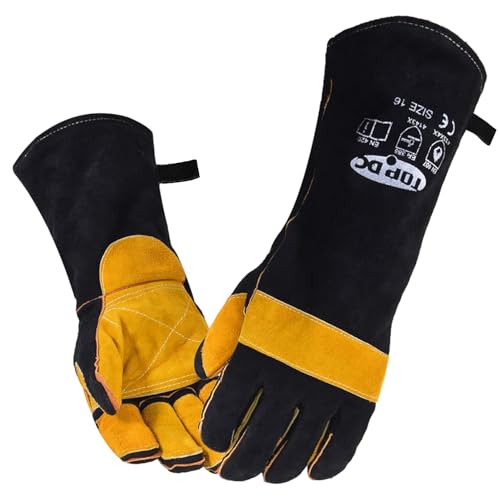
Built from 1.2mm natural cowhide with reinforced Kevlar and double leather stitching across fingers, palm, and back, these gloves are rated to withstand up to 932F. A soft cotton lining adds breathability, and the 16-inch build with a 7.5-inch sleeve shields the forearm from sparks and hot coals. Reviewers reach for them beyond welding, using them at the fire pit, grill, and furnace. The trade-off is dexterity, since the thick leather and padding make fine finger movements harder, so precise TIG passes feel clumsy. For general shielding, though, they cover a lot of ground.
Leather1.2mm cowhide
Cuff length16 inches
Heat ratingup to 932F
StitchingKevlar, double leather
Pros
- Long 16-inch cuff guards the forearm
- Cotton lining stays breathable in extended use
- Kevlar stitching resists melting at seams
Cons
- Thick leather limits fine finger control
- Bulk feels heavy for delicate TIG work
Check price on Amazon ›
Caiman pairs supple goat grain palms with a gold split cowhide back, a combination reviewers credit for control on detailed TIG passes. Its Kontour shaping follows the hand for finger alignment, while a patented wrist design keeps the fit secure and reduces slippage. Combination palm reinforcement and a drag patch add protection where the glove meets hot metal and welding guns. Owners note the goatskin feels thinner than heavy cowhide, which is the point for dexterity but means less bulk between skin and spatter. Cuff coverage is shorter here, so it suits fine work more than heavy overhead shielding.
PalmGoat grain leather
BackSplit cowhide
FitKontour wrist
ReinforcementPalm and drag patch
Pros
- Goat grain palm gives strong finger feel
- Kontour wrist reduces slippage
- Reinforced palm adds durability at wear points
Cons
- Thinner leather offers less spatter bulk
- Shorter cuff covers less forearm
Check price on Amazon ›
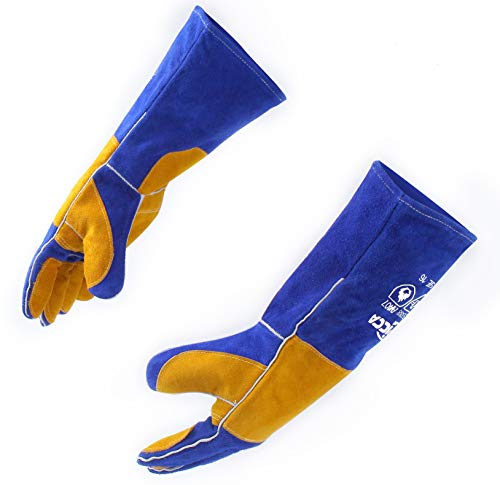
RAPICCA layers fireproof leather over an insulating aluminum foil middle and a flame retardant cotton liner, a stack rated to resist up to 932F. Double leather-reinforced padding sits on fingers, palms, elbows, and backs, and Kevlar stitching holds the seams together under heat. The 16-inch length with 7.5-inch sleeves guards the forearm against sparks, grinding debris, and open flame. Welders use them for stick, MIG, and flux-core, plus forge and blacksmith tasks. All that insulation adds bulk, so the same padding that shields well also trims fingertip sensitivity, making fine detail slower than with thin goatskin.
LayersLeather, foil, cotton liner
Cuff length16 inches
Heat ratingup to 932F
StitchingKevlar
Pros
- Aluminum foil layer adds heat insulation
- Long cuff and sleeve protect the forearm
- Handles stick, MIG, and flux-core work
Cons
- Heavy insulation reduces fingertip feel
- Bulk slows precise detail passes
Check price on Amazon ›
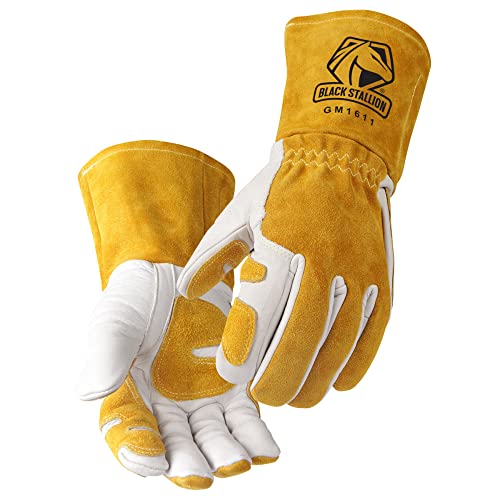
Black Stallion leans on dense top grain cowhide, whose tight fiber structure helps shield hands from sparks, slag, and radiant heat while resisting punctures. Reinforced patches on the palm, thumb, and index finger take the friction of handling metal, tools, and welding guns. Kevlar stitching keeps seams from melting or igniting, and DragPatch side padding plus RestPatch wrist support add insulation and ergonomic comfort. The maker describes testing details of material and construction to hold quality standards. The glove reads more heavy-duty than nimble, so the sturdy build and padding make it less suited to fine, low-amperage TIG detail.
LeatherTop grain cowhide
ReinforcementPalm, thumb, index
StitchingKevlar
PaddingDragPatch, RestPatch
Pros
- Dense cowhide resists punctures and abrasion
- Reinforced patches survive heavy handling
- Wrist padding supports long sessions
Cons
- Sturdy build limits fine dexterity
- Heavier feel than goatskin TIG gloves
Check price on Amazon ›
vclpower uses 1.2mm natural cowhide rated to resist up to 662F, with reinforced Kevlar stitching to strengthen the seams around fire pits, stoves, and general welding. A soft cotton lining absorbs sweat and keeps hands cooler, while the 14-inch cuff extends forearm coverage without stiffening flexibility. Owners spread its use across grilling, gardening, camping, and warehouse handling, and the maker points to shops and maintenance crews for repeat multi-user duty. The stated heat ceiling sits lower than the 932F cowhide options here, so for sustained high-temperature welding it offers less margin than the heavier-rated gloves.
Leather1.2mm cowhide
Cuff length14 inches
Heat ratingup to 662F
StitchingKevlar
Pros
- Flexible 14-inch cuff without much stiffness
- Cotton lining absorbs sweat
- Handy across grill, garden, and shop tasks
Cons
- Lower stated heat ceiling than rivals
- Shorter cuff than 16-inch options
Check price on Amazon ›
Tillman keeps things simple with durable top grain goatskin built for reusable, multi-project TIG work. An abrasion-resistant construction protects the hands during welding, and the ambidextrous orientation lets either hand slip into either glove. A pull-on closure makes them quick to get on and off between passes, and the pair comes in a large adult size to fit most welders. Goatskin stays supple for the finger feel TIG demands, which naturally means less bulk against heavy spatter than thick cowhide. Sizing runs to large only here, so smaller hands may find the fit loose.
LeatherTop grain goatskin
DesignAmbidextrous
ClosurePull-on
SizeLarge
Pros
- Supple goatskin keeps finger feel high
- Ambidextrous fit simplifies use
- Quick pull-on closure between passes
Cons
- Offered in large size only
- Thin leather suits light TIG over heavy work
Check price on Amazon ›
What to look for
Match leather to the job
Cowhide brings density that blocks spatter and radiant heat, making it the default for MIG and stick work. Goatskin stays thin and supple, so it wins when TIG passes need real finger feel. Decide which trade-off, protection or dexterity, your task leans on before anything else.
Watch the cuff length
A 16-inch glove with a long sleeve shields the forearm from sparks and grinding debris, useful for overhead and heavy work. Shorter 14-inch cuffs stay flexible and lighter for mixed tasks. Longer is safer near heat, but it can feel bulky for quick, close jobs.
Check stitching and reinforcement
Kevlar stitching resists melting and igniting where ordinary thread fails, so seams hold under heat. Reinforced patches on the palm, thumb, and index finger take the friction of guns and metal. These details often decide how long a glove lasts more than the leather alone.
Balance lining and dexterity
A cotton or insulated liner adds breathability and heat resistance, and some gloves add a foil layer for extra insulation. That padding raises the heat ceiling but trims fingertip sensitivity. If your work is detailed, favor a thinner build; if it is hot and heavy, accept the extra bulk.
Frequently asked questions
What leather is best for welding gloves?
Cowhide is dense and resists sparks, slag, and punctures, which suits MIG and stick work. Goatskin is thinner and more supple, so it favors TIG passes that need finger control. Pick based on whether protection or dexterity matters more for your task.
How much heat can these gloves resist?
Stated ratings among these picks range from about 662F on the vclpower up to 932F on the TOPDC and RAPICCA cowhide gloves. Higher ratings usually mean more layers and padding. Always treat maker numbers as guidance, not a promise about your exact conditions.
Do I need a 16-inch cuff?
Longer cuffs shield the forearm from sparks, hot coals, and grinding debris, which helps with overhead and heavy welding. For lighter, close-in tasks a 14-inch cuff stays more flexible. Choose length based on how much spatter reaches your arm.
Which glove works best for TIG welding?
TIG needs finger feel, so thinner goatskin like the Caiman or Tillman gives more control than heavy cowhide. The Caiman adds a shaped wrist and reinforced palm. Thicker gloves protect more but make fine, low-amperage detail harder.
Why does Kevlar stitching matter?
Ordinary thread can melt, drip, or ignite near welding heat, letting seams fail. Kevlar stitching resists those temperatures, so the glove holds together longer under sparks and radiant heat. It is a small detail that strongly affects durability.
Can I use welding gloves for grilling and fire pits?
Yes, many owners use these cowhide gloves for grills, fire pits, wood stoves, and campfires. The same heat and spark resistance that helps at the weld carries over to the backyard. Just confirm the cuff length covers as much arm as you want shielded.
How do I get the right fit?
Fit shapes both safety and control, so a loose glove slips and a tight one strains. The Tillman comes in large only, while others offer broader sizing. Measure your hand and check size charts before you choose, especially for detailed work.
How long do welding gloves last?
Lifespan depends on use, heat exposure, and how much the leather flexes and abrades. Reinforced patches and Kevlar seams extend it, and quality top grain leather holds up longer than thin splits. Inspect for cracks and worn seams, and replace gloves that no longer shield well.
The verdict
TOPDC Welding Gloves 16-Inch 932F Heat Res...
9.1/10
The TOPDC earns Best Overall for pairing 16-inch coverage, Kevlar stitching, and a 932F rating that suits most MIG and stick work. RAPICCA goes further on heat with its foil layer, while Black Stallion is the most rugged for heavy handling. TIG welders should look at the supple Caiman or the nimble, ambidextrous Tillman. vclpower fits mixed welding and yard tasks. Match leather thickness and cuff length to your own heat and dexterity needs.
Check price on Amazon ›
Our top pick, secure checkout via Amazon
Note: Availability and specifications change often. Always confirm the current details on Amazon before buying.