Tools & DIY 10 Water Pressure Test Kits for Home Plumbing Checks
P
By the Pickpedia Team
·8 picks compared
·Last verified October 2026
Affiliate disclosure: As an Amazon Associate, Pickpedia earns from qualifying purchases. Links on this page are paid links, and we may earn a commission at no extra cost to you. This never affects our picks or scores.
Quick answer
For most homes, a simple gauge with a 3/4-inch garden hose thread reads spigot pressure in seconds. Plumbers pressure-testing full lines want a hand pump like the Reed HTP300. Choose by task: quick spot checks favor gauges, while leak-testing sealed systems needs a pumping tester.
10 Water Pressure Test Kits for Home Plumbing Checks at a glance
Why you can trust this guide
We compared these picks using verified manufacturer specifications, available manuals and documentation, current retailer listings, and patterns in owner feedback, alongside editorial research. We focus on measurable differences such as performance, capacity, usability, and build quality. Pickpedia does not present editorial research as laboratory testing, and we do not claim hands-on testing unless it was actually performed.
How we chose: We compared eight water pressure test kits across hand pumps, electric pumps and dial gauges, weighing pressure range, thread fit, adapter selection and whether each can hold a sealed line.
Checking water pressure sounds technical, but the right tool makes it a two-minute job. Some testers are pocket gauges that screw onto a spigot; others are full pumps built to pressurize a sealed line and hold it. Which one fits depends entirely on what you are testing.
This roundup groups both kinds so you can match a tool to your task. Every entry is described from its listed specifications and features, with owner-reported strengths and one honest limitation noted for each. Reviewers consistently flag connection fit as the detail that decides whether a tester works out of the box.
Our top picks
Reed builds the HTP300 as a portable hydrostatic pump rated to 300 PSI, aimed at testing water meters, plumbing lines, pressure vessels, solar setups, and sprinkler systems. Reviewers note it handles modest irrigation lines well and stays haulable between jobs. The manufacturer even suggests manual pumps for people who test only occasionally, so this leans toward regular use. One real catch: hoses are sold separately, so plan to source connections before your first test. For anyone pressurizing sealed lines rather than spot-checking a faucet, it covers a wide range of plumbing work reliably.
TypeHydrostatic test pump
Max pressure300 PSI
TestsLines, vessels, solar, sprinklers
HosesSold separately
Pros
- Wide 300 PSI testing range
- Portable between job sites
- Covers many system types
Cons
- Hoses not included
- More tool than casual users need
Check price on Amazon ›
This manual pump reaches 2.5MPa and pairs an aluminum housing with a large dial for clear reading. It suits water or hydraulic oil as a medium, so you can test pressure vessels, pipes, and valves. The listing offers helpful context: normal tap water sits near 0.3MPa, high-rise units around 0.4MPa, and pipes are typically pressurized to 0.8MPa to 1.0MPa for testing. Owners describe installation and operation as straightforward. One limitation is the generic listing detail, which leaves build quality harder to judge before it arrives. For steady hand-pumped testing with an easy-to-read face, it earns a look.
TypeManual hydraulic pump
Max pressure2.5MPa
HousingAluminum
MediaWater or hydraulic oil
Pros
- Large, easy-to-read dial
- Works with water or oil media
- Simple to install and use
Cons
- Sparse listing detail on build
- Manual pumping takes effort
Check price on Amazon ›
This kit centers on a glycerin-filled gauge reading 0 to 200 PSI, then adds five adapters to reach almost any connection. Included are a 3/4-inch female garden hose thread gauge, a garden hose quick connect, 3/8-inch and 1/4-inch tube fittings, a 1/2-inch NPT adapter, and a stop valve adapter. That spread covers home, garden, irrigation, sprinkler, and light industrial use. Glycerin filling helps steady the needle against vibration. Installation is a matter of picking the right head and twisting it on. The trade-off is keeping track of small adapters, which are easy to misplace between uses.
Range0 to 200 PSI
GaugeGlycerin filled
Adapters5 included
Main thread3/4-inch female GHT
Pros
- Five adapters cover most fittings
- Glycerin damps needle bounce
- Fits home and garden systems
Cons
- Small adapters easy to lose
- Not built for sealed-line testing
Check price on Amazon ›
TNEHOD targets mid-range pressure here, listing 2.5 to 6.3 MPa, roughly 363 to 914 psi, for light commercial and industrial testing. A 4.5 liter tank pumps 13 mL per stroke, which owners say means quick pressurization and fewer refills. At about 2.9 kg it stays light enough to carry into cramped spots, and the universal G1/2-inch port makes leak-free connections simple. Being fully manual, it needs no power and works on pipelines, vessels, valves, and boilers. The honest downside is the effort involved: hand pumping to higher pressures gets tiring, so it favors shorter tests over all-day marathon use.
Pressure2.5 to 6.3 MPa
Tank4.5 L
Weight2.9 kg
PortG1/2-inch
Pros
- Reaches mid-range test pressures
- Light and portable
- No power source needed
Cons
- Hand pumping gets tiring
- Overkill for basic faucet checks
Check price on Amazon ›
The FDC500 swaps hand pumping for a 110V electric motor, running single phase at 50/60 Hz and reaching 180 psi. A 2 gallon per minute flow rate pressurizes lines quickly, which matters when you are testing several runs in a session. It ships with a 10-foot water hose plus NPT 3/4-inch, 1/2-inch, and 1-inch fittings, so most common connections are covered out of the box. Reviewers point to water pipe systems, heating, oil installations, and air conditioning as target uses. The main limit is its 180 psi ceiling, which is lower than manual pumps here, so very high-pressure tests fall outside its range.
Power110V, 50/60 Hz
Max pressure180 psi
Flow rate2 GPM
Included10 ft hose, 3 fittings
Pros
- Electric operation saves effort
- Fast 2 GPM pressurizing
- Comes with hose and fittings
Cons
- Lower 180 psi ceiling
- Needs a power outlet
Check price on Amazon ›
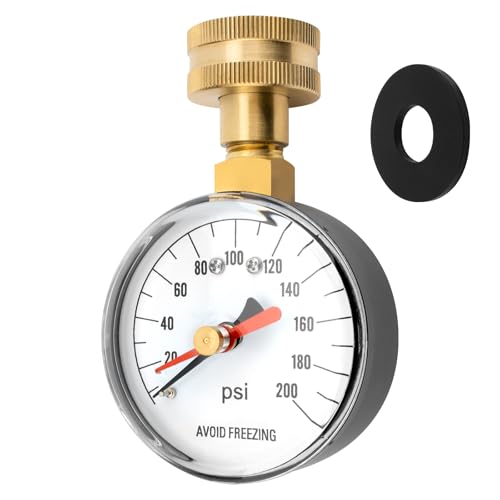
This gauge reads 0 to 200 PSI through a copper alloy tube sensing element built for accurate results. Its standout feature is a red max-pressure hand that holds the highest reading, letting you capture spikes that stress appliances and decide whether a regulator is needed. A standard 3/4-inch garden hose thread screws straight onto a spigot, washing machine outlet, or water heater drain valve for an instant reading, no plumbing skills required. Owners like it for household pressure, irrigation checks, and light maintenance. The limitation is scope: it reads pressure at a connection point but cannot pressurize or leak-test a sealed line the way a pump does.
Range0 to 200 PSI
ElementCopper alloy tube
FeatureRed max-pressure hand
Thread3/4-inch GHT
Pros
- Captures peak pressure readings
- Screws on with no tools
- Durable copper alloy sensor
Cons
- Reads a point, not full lines
- Cannot pressurize sealed systems
Check price on Amazon ›
OEMTOOLS aims this kit at vehicles, testing pressure caps and cooling systems for leaks rather than household plumbing. It includes three popular radiator adapters plus a cap adapter, fitting most domestic and foreign cars and light trucks with large-style caps. A hand pump and tester head with a 12-inch hose drive a 0 to 30 PSI gauge that reads in both PSI and kPA, with color-coded labels for quick reading. Each cap has a rotating lever for fine adjustment and safe release, and a sturdy case keeps it organized. The clear limitation is purpose: its low 0 to 30 PSI range and automotive fittings make it wrong for testing home water lines.
UseRadiator and cap testing
Range0 to 30 PSI
Adapters3 radiator, 1 cap
Hose12-inch
Pros
- Fits most cars and light trucks
- Dual PSI and kPA readout
- Comes in a storage case
Cons
- Automotive use, not plumbing
- Narrow 0 to 30 PSI range
Check price on Amazon ›
Supply Giant bundles a 0 to 160 PSI gauge with a test tee, a snifter valve, and a swivel hose connector, so you can charge a line and hold it. An M by F ball valve shut-off lets you seal in pressure and watch for drops, which is how you confirm a system is tight. Owners describe the readings as accurate and clear, and the swivel connector eases awkward hookups. This makes it a practical middle ground between a bare gauge and a full pump. The honest limit is its 160 PSI ceiling and reliance on existing line pressure, since it reads and holds rather than pumping pressure up on its own.
Range0 to 160 PSI
IncludesTest tee, snifter valve
ConnectorSwivel hose
Shut-offM x F ball valve
Pros
- Ball valve holds pressure
- Swivel connector eases hookup
- Clear, accurate readings
Cons
- Relies on existing line pressure
- 160 PSI ceiling
Check price on Amazon ›
What to look for
Gauge or pump: pick by task
A screw-on gauge reads the pressure already in a line, perfect for checking a faucet, hose bib, or filter. A test pump adds pressure to a sealed system and holds it so you can hunt leaks. Decide which job you have before anything else, because the two tools rarely overlap.
Match the connection first
Most household gauges use a 3/4-inch garden hose thread, while filtration gauges use small quick-connect fittings and pumps often use NPT or G-thread ports. Reviewers say a mismatch is the top reason a tester disappoints. Check what your spigot, valve, or system actually accepts, and favor kits that bundle several adapters.
Read the pressure range
Home water usually sits well under 100 PSI, so a 0 to 160 or 0 to 200 range leaves comfortable headroom. Line and vessel testing can demand far higher pressure, which is where MPa-rated manual pumps come in. Automotive cooling kits run a narrow 0 to 30 PSI, so never cross-use them with plumbing.
Handy extras worth having
A glycerin-filled dial steadies the needle against vibration for a cleaner read. A red max-pressure hand records spikes you would otherwise miss. A ball valve or snifter valve lets you seal in pressure and confirm a system holds. These small features often separate a quick guess from a trustworthy result.
Frequently asked questions
Do I need a pump or just a gauge?
If you only want to know the pressure at a tap or hose, a screw-on gauge is enough. If you need to pressurize a sealed line and check for leaks, choose a hydrostatic test pump instead.
What thread do most home gauges use?
A 3/4-inch garden hose thread is standard, letting the gauge attach to outdoor spigots, washing machine outlets, and water heater drain valves without tools.
What is a normal home water pressure reading?
Household supplies typically read comfortably under 100 PSI. Consistently high readings can stress appliances, which is why gauges with a peak-holding red hand are useful for spotting spikes.
Can I test my radiator with a plumbing gauge?
No. Use a dedicated radiator kit like the OEMTOOLS 27065, which has automotive cap adapters and a 0 to 30 PSI range built for cooling systems, not water lines.
Why are hoses sometimes sold separately?
Some pumps, such as the Reed HTP300, leave hoses out so buyers match connections to their own system. Confirm what is included before you order to avoid a delayed first test.
What does a snifter valve do?
A snifter valve, paired with a ball valve shut-off, lets you seal pressure into a line and watch whether it holds, which is how you confirm a system has no leaks.
Is an electric pump better than a manual one?
An electric pump like the SANTANTOOOL FDC500 pressurizes faster with less effort, but manual pumps reach higher pressures and need no outlet. Pick based on your pressure target and where you work.
Will a pressure gauge tell me if my water is safe to drink?
No. Pressure and water quality are separate questions, and a gauge measures only force in the line. To check for lead, bacteria or hardness you need a water quality test kit, which is a different product that usually sends a sample to a lab.
The verdict
Reed Tool HTP300 Hydrostatic Test Pump, 30...
9.2/10
For genuinely testing a system, the Reed HTP300 hand pump is our top pick, holding 300 PSI on a sealed line so you can find a leak instead of guessing at it. For a quick spigot reading, the 0-200 PSI faucet gauge with its peak-holding red hand takes seconds. The TNEHOD and manual 2.5 MPa pumps suit larger pipework, the SANTANTOOOL electric pump saves the arm work, and the Supply Giant snifter kit confirms a leak without a full pump. The OEMTOOLS kit answers a cooling system question rather than a plumbing one.
Check price on Amazon ›
Our top pick, secure checkout via Amazon
Note: Availability and specifications change often. Always confirm the current details on Amazon before buying.