Tools & DIY 6 Water Leak Shutoff Systems for Peace of Mind
P
By the Pickpedia Team
·6 picks compared
·Last verified September 2026
Affiliate disclosure: As an Amazon Associate, Pickpedia earns from qualifying purchases. Links on this page are paid links, and we may earn a commission at no extra cost to you. This never affects our picks or scores.
Quick answer
For whole-home protection, a main-line system that monitors flow and auto-closes the valve is the safest choice. Systems using LoRa keep working during WiFi or power loss. Sensor-based kits suit renters and single high-risk spots like water heaters, laundry rooms, and under-sink areas.
6 Water Leak Shutoff Systems for Peace of Mind at a glance
Why you can trust this guide
We compared these picks using verified manufacturer specifications, available manuals and documentation, current retailer listings, and patterns in owner feedback, alongside editorial research. We focus on measurable differences such as performance, capacity, usability, and build quality. Pickpedia does not present editorial research as laboratory testing, and we do not claim hands-on testing unless it was actually performed.
How we chose: We compared six water leak shutoff systems across install type, connectivity, sensor coverage, and how fast each closes the valve.
Water damage strikes more homes than fire, yet many people only react after a ceiling stains or a floor buckles. A shutoff system watches your plumbing around the clock and cuts the supply before a slow drip turns into a flood. Some install on the main line and monitor every drop, while others sit beside a single appliance and react to contact.
Choosing well means matching the system to your home and comfort with tools. Renters and single trouble spots do fine with sensor-and-valve kits, while owners wanting full coverage lean toward main-line monitors. Below, each option is ranked on how it fits real households, based on specifications and what owners report.
Our top picks
Installed on the main line, the Moen Flo watches flow, pressure, and temperature continuously and shuts the supply before a leak spreads. Daily MicroLeak tests hunt for hidden abnormalities, and its FloSense pattern learning grows sharper the longer it runs. Owners get alerts through the app and can close water from anywhere. Moen device data shows 60% of new owners uncover a hidden leak within their first month. One catch is reliance on the app and connectivity for remote features, so its full intelligence assumes a steady home network rather than working purely offline.
Install typeMain water line
Pipe size3/4 inch
MonitorsFlow, pressure, temperature
ControlMoen Flo app, remote
Pros
- Continuous whole-home monitoring
- Daily automated leak tests
- Learns your household water patterns
Cons
- Remote features depend on connectivity
- Main-line install may need a plumber
Check price on Amazon ›
This kit pairs three leak sensors, a smart valve controller, an EVO valve operator, and a hub into one no-plumbing package. Its device-to-device link lets sensors trigger the valve directly, so protection holds even through power loss or a network outage. LoRa range reaches up to a quarter mile, covering basements, attics, and far storage rooms. Sensors run up to five years on battery, and alerts arrive by app, SMS, or email. Because SMS alerts are metered, heavy notification users may lean on app and email instead. Alexa, Google, IFTTT, and Home Assistant integrations round it out.
Kit contents3 sensors, valve controller, operator, hub
RangeUp to 1/4 mile LoRa
Sensor batteryUp to 5 years
IntegrationsAlexa, Google, IFTTT, Home Assistant
Pros
- Works offline via device-to-device control
- Long LoRa range for far rooms
- No plumbing needed to install
Cons
- Free SMS alerts are limited per month
- Multiple pieces to place and manage
Check price on Amazon ›
Mounted at the main line, this system closes the supply within seconds of detecting a leak and keeps protecting even during an internet outage. LoRa connectivity reaches up to 1640 feet and pushes through walls and mechanical rooms where WiFi struggles. Both wired and wireless sensors ship in the box, and it supports up to eight wireless sensors for wider coverage. Automatic valve self-testing every 15 days helps prevent sticking or corrosion. Loud audible alerts sound the moment moisture is found. It fits standard 3/4 inch and 1 inch pipes with basic tools, though main-line work still suits confident DIYers most.
Install typeMain water line
Shutoff speedWithin about 15 seconds
RangeUp to 1640 ft LoRa
Sensor supportUp to 8 wireless
Pros
- Fast automatic cutoff at the main
- Works without WiFi via LoRa
- Self-tests valve to prevent sticking
Cons
- Main-line install suits confident DIYers
- Sensor expansion adds to setup
Check price on Amazon ›
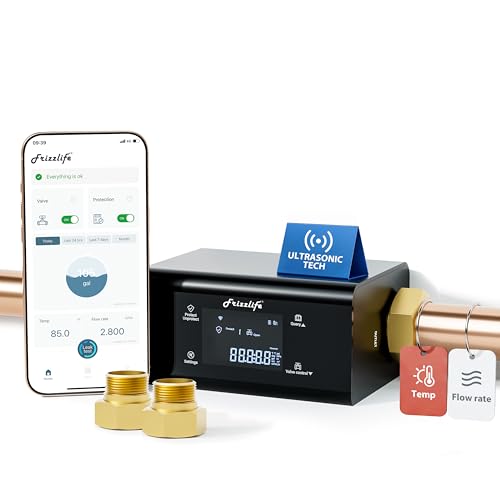
The Frizzlife LP365 leans on ultrasonic sensing to catch flow changes as small as 0.01 GPM, which helps it flag micro leaks others miss. It sends alerts by SMS, phone call, and app, then closes the valve automatically to stop further damage. Through the Smart Life app you can watch real-time flow, temperature, and either temperature or pressure depending on model. It carries NSF/ANSI 61 and 372 certification and links with other smart devices. Settings adjust to household size and habits to cut false alarms. One limitation is that remote monitoring and usage insight assume a connected app, so it favors always-on households.
SensitivityDetects down to 0.01 GPM
SensingUltrasonic flow monitoring
CertificationNSF/ANSI 61 & 372
AlertsSMS, phone call, app
Pros
- Very fine leak sensitivity
- Detailed real-time usage data
- Certified materials for drinking water
Cons
- Full insight relies on app connection
- Feature set varies by model version
Check price on Amazon ›
Built around solid brass 3/4 inch NPT ball valves, the E-SDS unit installs on standard plumbing and targets one high-risk spot like a water heater or laundry hookup. When its probe touches water, the valve closes within about two seconds and an 80 dB alarm with flashing LEDs warns you fast. The included sensor cable runs nearly 20 feet to reach floors, drains, and tight corners. Manual open, close, and reset buttons make restoring service after a repair simple. It handles hot water applications for broader placement. Unlike app-based systems, it offers no remote alerts, so it protects best when someone is nearby to hear it.
Valve3/4 inch NPT solid brass
ResponseCloses within about 2 seconds
Alarm80 dB with LED indicators
Sensor cable19.68 ft reach
Pros
- Very fast contact-triggered cutoff
- Durable brass ball valve
- Loud local alarm plus lights
Cons
- No remote app alerts
- Covers one area per sensor probe
Check price on Amazon ›
The iSpring LS43 installs on the whole-house pipe and closes its 3/4 inch NPT ball valve automatically when a sensor spots trouble. Its controller connects up to eight detection sensors, and two ship in the box, so coverage can grow room by room over time. Reviewers note the straightforward setup and simple operation. Backing it up is a one-year warranty with lifetime support from iSpring. As a sensor-triggered system rather than a continuous flow monitor, it reacts to standing water at a sensor instead of catching slow hidden drips inside a wall, so smart placement of the sensors matters most.
Install typeWhole-house pipe
Valve3/4 inch NPT auto shut-off
Sensor capacityUp to 8, two included
Support1-year warranty, lifetime help
Pros
- Expands to eight sensors
- Simple install and operation
- Lifetime brand support
Cons
- Reacts to standing water at sensors
- Relies on good sensor placement
Check price on Amazon ›
What to look for
Main-line monitors versus sensor kits
Main-line systems sit on your incoming pipe and watch every drop of flow, catching slow hidden leaks before they surface. Sensor-and-valve kits react when water touches a probe near a known trouble spot. Owners wanting full coverage lean toward monitors, while single appliances often need only a well-placed sensor.
Why connectivity type matters
WiFi links are convenient but drop during outages, exactly when a burst pipe might strike. Systems using LoRa or direct device-to-device control keep protecting through power loss and network downtime. If reliability during a storm matters to you, favor a design that closes the valve without needing the internet.
Installation and pipe fit
Check your pipe diameter first, since most systems target 3/4 inch and some add 1 inch support. Sensor kits usually need no plumbing and suit renters, while main-line valves ask for confident DIY skills or a plumber. Reviewers note that matching the valve threads to existing plumbing saves the most hassle.
Alerts and response speed
Look at how fast a system closes the valve and how it warns you. Contact sensors can cut water within about two seconds, and loud local alarms help when someone is home. App, SMS, and email alerts add remote awareness, though metered messaging means it helps to know which channels stay free.
Frequently asked questions
Do I need a plumber to install these systems?
It depends on the type. Sensor-and-valve kits often require no plumbing and mount beside an appliance. Main-line monitors tie into your incoming pipe and suit confident DIYers, though many owners hire a plumber for peace of mind and a clean fit.
Will a shutoff system work during a power outage?
Some will. Kits with device-to-device control or battery-backed valves keep closing water even when power or internet drops. WiFi-only systems may lose remote features during an outage, so check the specifications if outage reliability is important to you.
What pipe sizes do these fit?
Most target standard 3/4 inch plumbing, and a few also support 1 inch pipes. Always confirm your main-line diameter and thread type before buying, since matching the valve to existing plumbing is the key to a smooth install.
How fast do they shut off the water?
Response varies by design. Contact sensors can close a valve within about two seconds of touching water, while some main-line systems act within roughly 15 seconds of detecting an abnormal flow. Faster cutoff means less standing water to clean up.
Can I add more sensors later?
Many systems support expansion. Several controllers connect up to eight sensors, letting you start with a couple and add coverage room by room. This flexibility suits households that want to protect trouble spots gradually rather than all at once.
Do these detect slow hidden leaks inside walls?
Main-line flow monitors are best at this, since they watch continuous flow and can flag tiny abnormalities. Sensor-only kits react to standing water at a probe, so they catch leaks where you place the sensor rather than inside a sealed wall.
What kind of alerts will I receive?
Options range from loud local alarms and flashing lights to app notifications, SMS, email, and phone calls. Some SMS allowances are metered per month, so many owners rely on app and email alerts for everyday awareness and save texts for urgent events.
Are these systems safe for drinking water?
Certain models carry NSF and ANSI certification for materials in contact with drinking water. If that matters for your home, check the product listing for certification details, since not every system publishes the same standards.
The verdict
Moen Flo Shutoff, 3/4" Automatic Water Lea...
9.3/10
For most homes, the Moen Flo earns Best Overall with continuous main-line monitoring, daily leak tests, and app control. Renters and DIYers should look at the YoLink kit, which installs without plumbing and keeps working offline. Want the fastest main-line cutoff without WiFi? The 15-second LoRa system fits. For a single water heater or laundry hookup, the E-SDS delivers quick contact shutoff and a loud alarm. Match the system to your pipes and comfort with tools.
Check price on Amazon ›
Our top pick, secure checkout via Amazon
Note: Availability and specifications change often. Always confirm the current details on Amazon before buying.