Tools & DIY 5 RV Solar Controllers for Reliable Camp Power
P
By the Pickpedia Team
·5 picks compared
·Last verified October 2026
Affiliate disclosure: As an Amazon Associate, Pickpedia earns from qualifying purchases. Links on this page are paid links, and we may earn a commission at no extra cost to you. This never affects our picks or scores.
Quick answer
Match your controller to your panel and battery. Small maintenance jobs suit a compact PWM unit, while larger arrays gain from MPPT tracking. For a turnkey camp setup, a Renogy starter kit pairs a panel with a 30A PWM controller and lithium compatibility, based on listed specifications.
5 RV Solar Controllers for Reliable Camp Power at a glance
Why you can trust this guide
We compared these picks using verified manufacturer specifications, available manuals and documentation, current retailer listings, and patterns in owner feedback, alongside editorial research. We focus on measurable differences such as performance, capacity, usability, and build quality. Pickpedia does not present editorial research as laboratory testing, and we do not claim hands-on testing unless it was actually performed.
How we chose: We compared five solar power components across efficiency, controller type, battery compatibility, weather sealing, and safety certifications.
Keeping an RV battery topped up off grid comes down to the charge controller doing its job quietly. Some listings bundle a panel and controller together, others sell a standalone regulator, and a couple round out a system with switching and heater control. Sorting them by real function matters more than headline wattage.
This roundup groups five options by what each actually does, drawing only on manufacturer specifications and owner feedback. PWM units suit modest maintenance charging, MPPT regulators claim gains on bigger arrays, and supporting hardware handles isolation and specialty heating. Read each entry for who it genuinely fits.
Our top picks
Renogy bundles a 100W panel rated at 22.5% cell efficiency with its Wanderer 30A PWM controller, giving newcomers a ready starting point. The maker cites roughly 500Wh of daily generation depending on sunlight, and each panel gets 100% EL testing for hidden cracks. Battery support spans AGM, Gel, Flooded, and Lithium, and the array can expand toward 400W. Adding the separate BT-1 module unlocks Bluetooth monitoring through the DC Home app with over-voltage and under-discharge warnings. One limitation: Bluetooth monitoring needs that extra module, so tracking is not included out of the box.
Controller30A PWM Wanderer
Panel efficiency22.5% cell
Battery typesAGM, Gel, Flooded, Lithium
Expansion limitUp to 400W
Pros
- Complete panel and controller kit for beginners
- Broad battery chemistry support including lithium
- Long material coverage plan on the panel
Cons
- Bluetooth monitoring requires a separate BT-1 module
- PWM controller less efficient than MPPT on large arrays
Check price on Amazon ›
SOLPERK aims this 20W monocrystalline kit at maintenance charging for a 12V battery left idle. The included 8A controller uses a three-stage design to guard against overcharging, over-voltage, and short circuits, and the maker says it draws no power from the battery itself. Two indicator lights show charging status at a glance. A 360-degree adjustable bracket helps aim the panel, and connections are described as plug and play. Battery support covers LiFePO4, Lithium Ion, AGM, SLA, GEL, and more. The trade-off is scale: 20W suits trickle upkeep, not powering appliances or fast recharging a depleted bank.
Panel20W monocrystalline
Controller8A three-stage
Battery typesLiFePO4, AGM, SLA, GEL
Mounting360-degree adjustable bracket
Pros
- Adjustable bracket helps track the sun
- Three-stage controller protects against overcharge
- Plug-and-play connections simplify setup
Cons
- 20W output suits maintenance, not heavy loads
- Small controller amperage limits future expansion
Check price on Amazon ›
Reaching for a standalone regulator, this unit uses maximum power point tracking across 12V and 24V systems at a 100A rating. An LCD shows charge and discharge current, cumulative generation, and temperature, with adjustable parameters and power-off memory. Dual USB ports supply up to 2.5A for small devices. Protections listed include overheating, overcurrent, short circuit, and open circuit, plus automatic recovery and anti-backflow circuitry. Light control with delay handles automated setups. Buyers should note this is a controller only, sold without a panel, and the very high amperage rating is worth verifying against your actual array before relying on it.
TypeMPPT 100A
System voltage12V / 24V auto
DisplayLCD with memory
USB outputDual, up to 2.5A
Pros
- MPPT tracking aims to lift array performance
- Detailed LCD readout with adjustable settings
- Dual USB ports charge small devices directly
Cons
- Sold as controller only, no panel included
- High amperage claim worth verifying for your array
Check price on Amazon ›
MISOL takes a different path, controlling a separated pressurized solar hot water setup rather than charging a battery. It suits one collector array, one storage tank, one pump, and auxiliary heating on 110V. Three temperature sensors ship in the box, one pt1000 and two NTC10K, reading collector temperatures across a wide range and tank temperatures to 110 degrees Celsius. Measuring accuracy is stated at plus or minus 2 degrees. The housing measures 187mm by 128mm by 46mm. Be clear on intent: this manages solar thermal heating, so RVers seeking battery charge control should look at the PWM or MPPT units instead.
FunctionSolar hot water control
Voltage110V
Sensors1 pt1000, 2 NTC10K
AccuracyPlus or minus 2 C
Pros
- Purpose-built for solar thermal hot water
- Includes three temperature sensors
- Wide collector temperature measuring range
Cons
- Not a battery charge controller
- Runs on 110V, not a 12V RV setup
Check price on Amazon ›
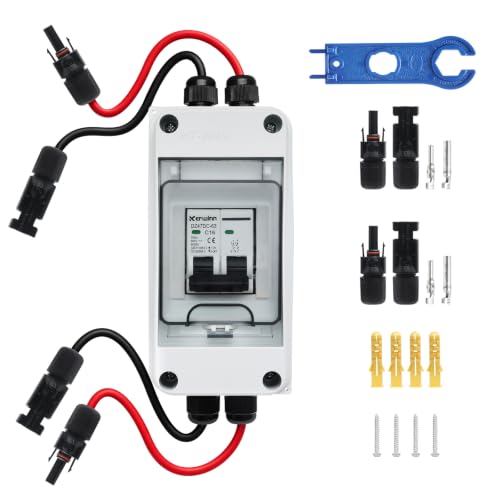
KERWINN rounds out a system with a disconnect switch rather than charge control. Rated at 30A and 1000V with no polarity, this miniature circuit breaker box lets you isolate the panel side for service or emergencies. An IP65 rating targets water and dust resistance, and the maker calls the housing durable and firmly sealed against deforming. A transparent window shows the internal state at a glance, and installation is described as plug and play. Listed uses include RVs, homes, and off-grid systems. Remember this is a switch, not a regulator, so it complements a controller rather than replacing one.
Rating30A / 1000V
TypeMiniature circuit breaker
SealingIP65 waterproof
FeatureTransparent viewing window
Pros
- Adds safe isolation and a service shutoff
- IP65 sealing suits outdoor mounting
- Viewing window shows switch state clearly
Cons
- It is a disconnect switch, not a charge controller
- No monitoring or charging features
Check price on Amazon ›
What to look for
PWM versus MPPT
PWM controllers keep things simple and suit small panels charging a nearby 12V battery. MPPT regulators track the panel's optimal operating point and tend to shine on larger arrays or higher-voltage strings. Match the controller type to how much power you plan to move, not just to a headline amperage figure.
Size to your array and battery
A controller's amp rating should comfortably exceed your array's expected current, with headroom for future panels. Check the maker's expansion limit, like the Renogy kit's stated 400W ceiling. Undersizing forces the controller to work hot, while oversizing a tiny 8A unit onto a large bank simply will not keep up.
Battery chemistry compatibility
Confirm the controller supports your battery type before buying. Several units here list AGM, Gel, Flooded, and Lithium including LiFePO4, but charge profiles differ. A controller that manages lithium correctly protects both runtime and longevity, so read the compatibility line carefully rather than assuming.
Monitoring and safety extras
Readouts range from two status lights to a full LCD, and some monitoring needs an add-on module, as with Renogy's Bluetooth option. Protections against overcharge, short circuit, and over-discharge guard your bank. A separate disconnect switch adds a clean way to isolate the panel side during service.
Frequently asked questions
What does a solar charge controller actually do?
It sits between the panel and battery, regulating voltage and current so the battery charges safely. It prevents overcharging, over-voltage, and in many cases over-discharge, which protects battery life and keeps your RV power reliable.
Is PWM or MPPT better for an RV?
PWM works well for small panels feeding a matched 12V battery and keeps setups simple. MPPT tends to extract more from larger arrays or mismatched voltages. Choose based on array size and how much power you need, not just the label.
Can these controllers charge a lithium battery?
Several listings state support for LiFePO4 and Lithium Ion alongside AGM, Gel, and Flooded types. Always confirm the specific unit lists your chemistry, since lithium needs the correct charge profile to stay healthy.
Do I need a separate disconnect switch?
A disconnect switch like the KERWINN unit lets you safely isolate the panel side for service or emergencies. It is not required for charging, but many owners add one for safer maintenance on RV and off-grid systems.
Why is a solar water heater controller in this list?
The MISOL unit controls a solar thermal hot water system, not battery charging. It appears here because it shows up under solar controller searches, but RVers wanting battery charge control should pick a PWM or MPPT regulator instead.
How much power will a small kit generate?
Renogy cites an average near 500Wh per day from its 100W panel, varying with sunlight. A 20W maintainer like the SOLPERK is meant for trickle upkeep, so expect far less and treat it as maintenance rather than a power source for appliances.
Will these hold up to weather outdoors?
Panels in these kits list IP-rated boxes and connectors plus wind and snow load ratings, and the KERWINN switch carries an IP65 seal. Mounting matters too, so aim for secure fixings and check each unit's stated sealing before permanent installation.
Can I add more panels later?
Some kits state an expansion limit, such as Renogy's support for up to 400W. Check that both the controller's amperage and the maker's stated ceiling allow growth, since a small 8A controller will not accept a much larger array.
The verdict
Renogy 100W 12V Solar Panel Starter Kit wi...
9.1/10
For a complete, beginner-friendly start, the Renogy 100W kit pairs a tested panel with a flexible 30A PWM controller and lithium support. Keeping a parked battery healthy suits the compact SOLPERK maintainer, while larger banks lean toward the 100A MPPT regulator with its LCD readouts. The MISOL controller serves solar hot water rather than charging, and the KERWINN switch adds safe isolation to any setup. Match the piece to your real job.
Check price on Amazon ›
Our top pick, secure checkout via Amazon
Note: Availability and specifications change often. Always confirm the current details on Amazon before buying.