Tools & DIY 7 Ratcheting Crimping Tools for Solid Connections
P
By the Pickpedia Team
·7 picks compared
·Last verified October 2026
Affiliate disclosure: As an Amazon Associate, Pickpedia earns from qualifying purchases. Links on this page are paid links, and we may earn a commission at no extra cost to you. This never affects our picks or scores.
Quick answer
Pick a ratcheting crimper by the connectors you use most. For insulated terminals, a compound-action tool with a force dial gives clean, uniform crimps. Heat-shrink work suits dedicated dies, multi-die kits cover mixed jobs, and thick battery cable needs a hydraulic tool.
7 Ratcheting Crimping Tools for Solid Connections at a glance
Why you can trust this guide
We compared these picks using verified manufacturer specifications, available manuals and documentation, current retailer listings, and patterns in owner feedback, alongside editorial research. We focus on measurable differences such as performance, capacity, usability, and build quality. Pickpedia does not present editorial research as laboratory testing, and we do not claim hands-on testing unless it was actually performed.
How we chose: We compared seven ratcheting crimping tools across wire-gauge range, die coverage, adjustable force, and handle comfort.
A ratcheting crimper only releases once full pressure has been applied, so every connection comes out consistent instead of guessed by hand feel. That single trait separates a reliable joint from one that loosens under vibration in a boat, car, or trailer.
Our picks span single-purpose insulated crimpers, heat-shrink specialists, versatile multi-die kits, and a hydraulic tool for heavy battery cable. We grounded each summary in stated specifications and features, noting where a tool fits and where owners might hit a limit.
Our top picks
Klein builds this tool around three color-coded cavities for red, blue, and yellow insulated terminals spanning 22 to 10 AWG stranded copper. A compound-action design drives more pressure into each squeeze, and the built-in ratchet forces a full cycle so crimps stay uniform. A dial lets you fine-tune applied force, and the cavity design produces a consistent result from either side of the tool. It handles insulated terminals well, but that is its whole focus. Owners wanting heat-shrink or non-insulated support will need a separate tool, since this one commits fully to insulated work.
Wire range22 to 10 AWG stranded copper
Cavities3 color-coded (red, blue, yellow)
ActionCompound with force dial
MechanismFull-cycle ratchet
Pros
- Compound action reduces hand effort
- Adjustable dial tunes crimp force
- Consistent result from either side
Cons
- Insulated terminals only
- No interchangeable dies
Check price on Amazon ›
Plustool tunes its die specifically for heat-shrink connectors from AWG 22 to 10, and the colored nests speed up matching a terminal to the right slot. Reviewers note the ratchet self-opens once enough force is applied, so crimps stay uniform without crushing the insulation. A quick-release lever frees the jaws at any position, and the cushioned, non-slip handle aims to cut hand fatigue on long sessions. A star wheel adjusts crimp height for different projects. It stays narrow in scope, though. Since it targets heat-shrink terminals, mixed jobs with non-insulated or open-barrel lugs fall outside its range.
Wire rangeAWG 22 to 10
Best withHeat-shrink connectors
AdjustmentStar-wheel crimp height
ReleaseQuick-release lever
Pros
- Color-coded nests speed die selection
- Will not damage heat-shrink insulation
- Cushioned non-slip grip
Cons
- Focused on heat-shrink terminals
- No included die alternatives
Check price on Amazon ›
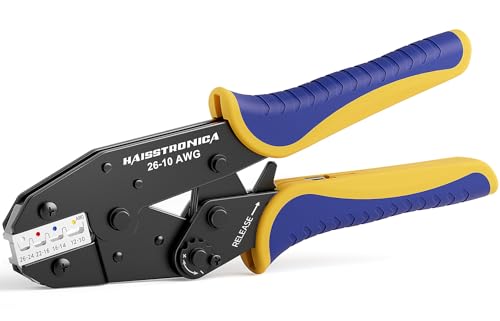
haisstronica stretches its heat-shrink range to AWG 26 to 10, reaching finer wires than many rivals in this group. Precision-forged jaws are built to complete a firm crimp in one pass, and reviewers describe the ratchet action as smooth with a clean release. The nylon non-slip handle keeps operation comfortable, and an inner quick-release lever opens the jaws when you need to reset. The maker pairs the tool with a satisfaction guarantee and a replacement warranty. Coverage is still limited to heat-shrink connectors, so anyone crimping insulated spade terminals or bare lugs will want a broader kit alongside it.
Wire rangeAWG 26 to 10
Best withHeat-shrink connectors
JawsPrecision-forged
HandleNylon non-slip
Pros
- Reaches fine 26 AWG wire
- Firm single-pass crimp
- Backed by warranty coverage
Cons
- Heat-shrink connectors only
- No adjustable force dial noted
Check price on Amazon ›
This kit ships six AWG-marked chrome-plated dies covering heat-shrink, insulated and nylon terminals, non-insulated lugs, open-barrel terminals, cable-end sleeves, and even solar connectors. Jaws forged from 40CR steel aim for a firm one-pass crimp, and the ratchet runs a full cycle before releasing automatically. A star wheel adjusts crimp force, and a hard case with a reference card keeps everything organized. It is the widest-coverage option here. The trade-off is die swapping: you fully remove screws on both sides and realign each new die before tightening, which slows quick changes between terminal types.
Dies6 interchangeable, AWG-marked
CoverageHeat-shrink, insulated, non-insulated, open-barrel, sleeves, solar
Jaw steel40CR forged
StorageHard case with reference card
Pros
- Six die sets cover most terminals
- Chrome-plated dies with clear AWG marks
- Case and reference card included
Cons
- Die changes need screw removal and realignment
- Bulkier than a single-purpose crimper
Check price on Amazon ›
For thick cable that hand crimpers cannot manage, Brileine applies 10 tons of force across a range of 12 AWG up to 2/0. Nine hexagonal dies cut by EDM wire process crimp copper, aluminum, and stainless lugs, and the maker states they run more precise than cast dies. The ergonomic non-slip handle and simplified on-off control aim to ease repeated cycles and quick die swaps. This is a heavy-duty tool, not a fine-wire one. Its lower limit sits at 12 AWG, so small signal and terminal work still needs a lighter ratcheting crimper.
Crimp force10 tons
Wire range12 AWG to 2/0
Dies9 hexagonal, EDM-cut
MaterialsCopper, aluminum, stainless
Pros
- Handles heavy 2/0 cable
- EDM dies rated more precise than cast
- Works across three metals
Cons
- Not suited to fine wire below 12 AWG
- Larger and heavier to handle
Check price on Amazon ›
PLYVUIR pairs a heavy-duty crimper with six chrome-plated interchangeable dies for heat-shrink, insulated, non-insulated, and open-barrel terminals, all stored in a hard case. Forged jaws create a firm crimp in one motion, and the ratchet releases automatically for a solder-like joint without crushing the connector. A comfortable non-slip PVC handle, quick-release lever, and adjustable crimp force round out the design, and an included card guides die selection. Coverage is broad and setup is friendly for beginners. Like other multi-die kits, though, changing jaws between terminal types adds steps compared with a fixed single-purpose tool.
Dies6 chrome-plated, interchangeable
CoverageHeat-shrink, insulated, non-insulated, open-barrel
AdjustmentAdjustable crimp force
HandleNon-slip PVC with quick release
Pros
- Beginner-friendly with reference card
- Broad terminal coverage in one case
- Adjustable force and quick release
Cons
- Die swaps slow quick changes
- Not for heavy cable lugs
Check price on Amazon ›
Pliertool covers AWG 26 to 10 heat-shrink connectors and adds a dedicated white die tuned for fine 26 to 24 gauge wires, a feature reviewers point to for delicate work. The full ratcheting cycle self-opens once optimal force is reached, keeping crimps uniform without harming the insulation, and a quick-release lever frees the jaws anywhere in the stroke. An ergonomic cushioned grip and star-wheel force adjustment support long sessions on household and automotive circuits. As with other heat-shrink specialists, its scope stays fixed to those connectors, so a separate tool is needed for non-insulated or open-barrel terminals.
Wire rangeAWG 26 to 10
Fine-gauge dieWhite, tuned for 26 to 24 AWG
AdjustmentStar-wheel crimp height
ReleaseQuick-release lever
Pros
- Dedicated fine-gauge die option
- Consistent self-opening ratchet cycle
- Cushioned ergonomic handle
Cons
- Limited to heat-shrink connectors
- No die set for other terminals
Check price on Amazon ›
What to look for
Why a ratchet matters
A ratcheting crimper locks through a full stroke and releases only when correct pressure lands. That removes guesswork, so joints resist pulling loose under vibration. Plain pliers-style crimpers depend on hand feel, which drifts as you tire and produces uneven results across a project.
Match the tool to your connectors
Insulated terminals, heat-shrink connectors, non-insulated lugs, and open-barrel terminals each want a matching die profile. A single-purpose tool crimps its one type cleanly, while a multi-die kit trades some speed for wide coverage. Buy for the connectors you actually reach for most.
Wire gauge and range
Every crimper lists an AWG span, and staying inside it is what makes a joint hold. Fine electronics work leans toward tools reaching 26 AWG, general wiring lives around 22 to 10, and thick battery or welding cable needs a hydraulic tool rated for 2/0.
Comfort and adjustment
Long sessions reward a cushioned, non-slip handle and a labor-saving compound or ratchet action. A star wheel or force dial lets you tune crimp height for different connectors. A quick-release lever helps when a terminal shifts mid-stroke and you need to reset the jaws.
Frequently asked questions
What does a ratcheting crimper do differently?
It engages a locking mechanism through the full crimp stroke and releases only after correct force is applied. That guarantees a uniform crimp every cycle, unlike pliers-style tools that rely on how hard you happen to squeeze.
Which tool suits insulated terminals best?
The Klein 3005CR is built purely for insulated terminals, with three color-coded cavities from 22 to 10 AWG and a compound action plus force dial. If insulated spades and rings are your main work, a dedicated tool like this stays simplest.
Can one tool handle every connector type?
A multi-die kit such as the 6-piece set or PLYVUIR covers heat-shrink, insulated, non-insulated, open-barrel, and more by swapping jaws. The trade-off is that changing dies takes extra steps compared with a fixed single-purpose crimper.
What do I need for thick battery cable?
Standard hand crimpers stop around 10 AWG. For lugs on battery or welding cable up to 2/0, the Brileine hydraulic tool applies 10 tons of force through hexagonal dies and works on copper, aluminum, and stainless.
How do I pick the right die or cavity?
Match the die to both the connector type and the wire gauge marked on the tool. Color-coded nests and included reference cards make this quicker. Using the wrong cavity produces a loose or over-crushed crimp that can fail later.
Will these tools damage heat-shrink insulation?
Tools designed for heat-shrink connectors, like the Plustool, haisstronica, and Pliertool options, shape the crimp so the insulation stays intact. Owners report clean results when the correct die and gauge are used.
What does the star wheel or force dial adjust?
It changes crimp height, which controls how much pressure the jaws apply before the ratchet releases. Dialing it correctly for a given connector keeps crimps tight without deforming the terminal.
Are these worth it for occasional DIY use?
Yes. A ratcheting tool makes consistent joints even for beginners, and kits with a hard case and reference card lower the learning curve. Owners doing automotive, marine, trailer, or appliance wiring tend to find the reliability worthwhile.
The verdict
Klein Tools 3005CR Ratcheting Insulated Te...
9.2/10
The Klein 3005CR is our top pick for anyone crimping insulated terminals, thanks to its compound action and adjustable force. For heat-shrink work, the Plustool, haisstronica, and Pliertool tools each crimp cleanly across their gauges, with Pliertool reaching the finest wires. Choose the 6-piece kit or PLYVUIR when jobs mix many terminal types, and step up to the Brileine hydraulic tool for heavy battery and welding cable.
Check price on Amazon ›
Our top pick, secure checkout via Amazon
Note: Availability and specifications change often. Always confirm the current details on Amazon before buying.