Tools & DIY 7 Portable Generators for Camping and Outages
P
By the Pickpedia Team
·7 picks compared
·Last verified September 2026
Affiliate disclosure: As an Amazon Associate, Pickpedia earns from qualifying purchases. Links on this page are paid links, and we may earn a commission at no extra cost to you. This never affects our picks or scores.
Quick answer
Match the generator to your load. Dual fuel gas units like the Westinghouse and DuroMax handle whole home backup during outages, while quiet inverter and battery stations from WEN, EcoFlow, Anker, and Jackery suit camping and sensitive electronics. Tomahawk adds welding capability for jobsite work.
7 Portable Generators for Camping and Outages at a glance
Why you can trust this guide
We compared these picks using verified manufacturer specifications, available manuals and documentation, current retailer listings, and patterns in owner feedback, alongside editorial research. We focus on measurable differences such as performance, capacity, usability, and build quality. Pickpedia does not present editorial research as laboratory testing, and we do not claim hands-on testing unless it was actually performed.
How we chose: Seven portable generators compared across running watts, fuel type, weight, noise, and outlet mix for both camping trips and home outages.
Choosing a portable generator means balancing how much power you need against how far you plan to carry it. Heavy dual fuel units keep a house running through an outage but stay parked outdoors. Compact battery stations slip into a trunk and run phones and CPAP machines silently at a campsite.
We grouped these seven around real use. Some are engine driven with big surge headroom, others are lithium power stations that recharge from solar. Each entry below leans on published specifications and owner reports, with an honest note on where it falls short.
Our top picks
Running 9500 watts on gasoline and peaking at 12500, this Westinghouse carries enough headroom to run a refrigerator, well pump, and lights together. It switches to propane for 8500 running watts, and the remote key fob start means you never leave a warm house during a storm. A 6.6 gallon tank stretches run time up to 12 hours, and the transfer switch ready L14-30R outlet makes panel hookup clean. The VFT display shows voltage, frequency, and lifetime hours. Owners note it is heavy and loud, so plan a fixed outdoor spot and a wheel kit for moving it.
Running Watts9500 gas / 8500 propane
FuelDual fuel gas and propane
Run TimeUp to 12 hours
StartRemote, electric, recoil
Pros
- Big surge headroom for home loads
- Dual fuel flexibility
- Remote start and transfer switch ready
Cons
- Heavy to reposition
- Runs loud under load
Check price on Amazon ›
At just 46 pounds, this WEN inverter is easy to lift into a trunk and set up at a campsite. Its 149cc engine produces up to 3600 surge watts and 2900 rated watts, enough for a small RV, a fan, and device charging. Inverter technology keeps the sine wave clean, so phones, tablets, and laptops stay protected. A fuel shutoff burns off carburetor fuel before it stops, which helps storage between trips. Outlets include two 120V receptacles, a TT-30R RV plug, a 12V DC port, and two USB ports. Rated output is modest, so it will not back a whole house.
Surge Watts3600
Rated Watts2900
Weight46 pounds
Outlets120V, TT-30R RV, 12V, USB
Pros
- Light and easy to carry
- Clean power for electronics
- RV ready outlet
Cons
- Limited rated output
- Not for large home loads
Check price on Amazon ›
Weighing only 7.7 pounds, the RIVER 2 slides into a backpack and delivers silent power off grid. Its 256Wh LFP battery pushes up to 600W, running as many as six small appliances at once through a spread of AC, USB-C, and USB ports. What sets it apart is speed. A wall outlet refills it in about an hour, and 110W solar input reaches full in roughly 2.3 hours. The LFP cells are rated beyond 3000 cycles, close to a decade of regular use, backed by a 5-year service window. Capacity is small, so it suits phones, cameras, and a laptop rather than power tools or a fridge for long.
Capacity256Wh LFP
OutputUp to 600W
AC RechargeAbout 1 hour
Weight7.7 pounds
Pros
- Very fast recharge
- Pocketable weight
- Long cycle LFP cells
Cons
- Small capacity
- Not for heavy appliances
Check price on Amazon ›
This Anker pairing reaches 4020Wh with a 3000W peak, enough to keep a fridge running for around 35 hours on low idle draw. Its 314Ah LFP cells carry a 10,000 cycle rating, which Anker frames as a 15-year lifespan for daily use. Each unit stays compact at about 8 by 11 by 13 inches and 35.7 pounds, lighter than many rivals in its class. Six recharge paths cover AC, solar up to 400W, a car outlet, or a generator, and eight outlets split across front and rear for a tidy setup. There is no 12V DC port, so plan around that if your gear needs it.
Capacity4020Wh
Peak Output3000W
Cycle Rating10,000 cycles
Weight35.7 pounds each
Pros
- Long fridge backup runtime
- Very high cycle life
- Six recharge options
Cons
- No 12V DC port
- Heavier as a two unit set
Check price on Amazon ›
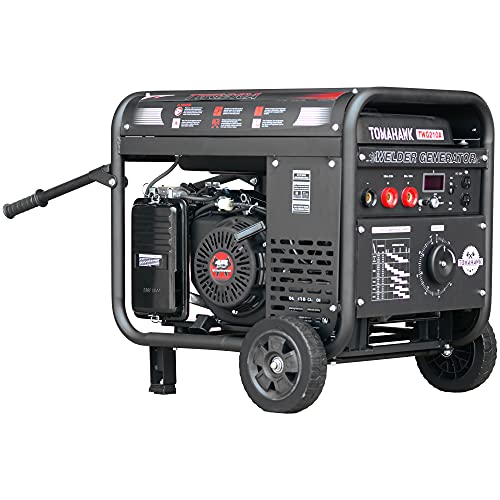
Built for crews working away from shore power, this Tomahawk pairs a 15 HP engine with a 210 amp Stick and TIG welder plus a 2000 watt generator. The inverter design holds a stable sine wave, which owners report gives steadier arcs than older machines. It can weld and run electric tools at the same time, and the 60 percent duty cycle covers steady fabrication. An electronic reader and knob make amperage easy to dial, and it welds material from 1/8 through 3/8 inch. Generator output is limited to 2000 watts, so treat power as a welding companion rather than a household backup.
Weld Output210 amps
Duty Cycle60 percent
Generator Watts2000
Engine15 HP
Pros
- Combines welding and tool power
- Stable inverter arc
- Simple amperage control
Cons
- Low general power output
- Specialized for welding tasks
Check price on Amazon ›
A 439cc OHV DuroMax engine gives the XP10000E 10,000 starting watts and 8000 running watts, enough for lights, refrigerators, air conditioners, and high amperage tools. Electric start gets it going quickly, and MX2 technology lets you pull full power from each 120V outlet or split between 120V and 240V. It stays EPA and CARB approved, so it is legal to run in all 50 states, a real plus for California owners. Gas only operation means no propane flexibility, and like most engine units this size it is heavy and loud, so keep it outdoors and well ventilated.
Starting Watts10,000
Running Watts8000
Engine439cc OHV
ApprovalEPA and CARB
Pros
- Strong output for tools
- Dual voltage MX2 outlets
- Legal in all 50 states
Cons
- Gas only, no propane
- Heavy and loud
Check price on Amazon ›
Weighing only 7.5 pounds, the Explorer 300 packs 292Wh into a body lighter than many rivals, with an integrated handle for hikes and camp setups. It powers six devices through two AC outlets, a 100W USB-C PD port, two USB-A ports, and a 120W car port, handling laptops, drones, cameras, and a CPAP through the night. A 300W rated output with 600W surge covers most small gear. LiFePO4 cells are rated beyond 4000 cycles, which Jackery frames as more than a decade of service. Solar pairing reaches 80 percent in about 2.8 hours with a 100W panel, though that panel is sold separately.
Capacity292Wh LiFePO4
Rated Output300W, 600W surge
Weight7.5 pounds
PortsAC, USB-C, USB-A, car
Pros
- Very light and portable
- Runs CPAP and small gear
- Long life LiFePO4 cells
Cons
- Solar panel not included
- Modest capacity for big loads
Check price on Amazon ›
What to look for
Match watts to your real load
Add up what you plan to run at once, then leave headroom for startup surge on motors and compressors. A refrigerator, a few lights, and a fan sit well under a mid size gas unit, while a whole house needs the bigger dual fuel machines. Battery stations list capacity in watt hours, which tells you how long they last, not just how much they push.
Gas engine or battery station
Engine generators run as long as you feed them fuel and suit outages and jobsites, but they are loud and must stay outdoors. Lithium power stations are silent, safe indoors, and recharge from solar, though their runtime is capped by battery size. Many campers keep a small battery unit for electronics and a gas unit for heavier needs.
Weight and portability
A generator only helps if you can move it where you need it. Compact stations under ten pounds ride in a backpack, while ten kilowatt gas units need a wheel kit and two hands. Check the handle design and footprint before buying, especially if stairs or a truck bed are involved.
Outlets and recharge options
Look at the outlet mix against your gear. RV owners want a TT-30R or 14-50R plug, home backup needs a transfer switch ready outlet, and device users benefit from USB-C. For battery units, more recharge paths, wall, solar, and car, mean fewer times you are stuck waiting with a dead pack.
Frequently asked questions
What size generator do I need for a house during an outage?
For essentials like a fridge, lights, and a well pump, a unit running 8000 to 9500 watts usually covers it. The Westinghouse and DuroMax here fall in that range. Add up your must run appliances and their startup surge, then pick a model with headroom above that total.
Can I run a generator indoors?
Never run a fuel burning generator indoors, in a garage, or near open windows, since exhaust carries carbon monoxide. Battery power stations like the EcoFlow, Anker, and Jackery produce no exhaust, so those are the safe choice for indoor use during an outage.
What is the difference between running watts and starting watts?
Running watts is the steady power a unit supplies continuously, while starting watts is the brief surge available when a motor kicks on. Refrigerators and pumps draw a spike at startup, so always check that the surge figure clears your largest motor load.
Are dual fuel generators worth it?
Dual fuel units run on gasoline or propane, which gives you flexibility when one supply runs short. Propane stores longer and burns cleaner, while gasoline delivers slightly more output. The Westinghouse switches between both, handy when a long outage makes fuel hard to find.
How long do battery power stations last per charge?
Runtime depends on capacity in watt hours divided by your load. A 292Wh Jackery keeps phones and a CPAP going overnight, while the 4020Wh Anker set can back a fridge for around 35 hours. Bigger draws drain any battery faster than device charging.
Can these charge from solar panels?
Yes, the EcoFlow, Anker, and Jackery accept solar input, though panels are often sold separately. Solar makes a battery station self sufficient for off grid camping. The Anker takes up to 400W and the EcoFlow reaches full in roughly 2.3 hours with 110W of input.
Which generator is quietest for camping?
Inverter and battery units run far quieter than open frame gas generators. The WEN inverter is designed for low noise, and the EcoFlow and Jackery battery stations are effectively silent. Campgrounds with quiet hours are a good reason to skip a loud engine model.
Do I need a transfer switch for home backup?
To power hardwired circuits safely you need a transfer switch, which isolates your home from the utility line and prevents backfeed. The Westinghouse is transfer switch ready with an L14-30R outlet. For plug in appliances only, a heavy duty extension cord works without one.
The verdict
Westinghouse 12500 Watt Dual Fuel Portable...
9.3/10
The Westinghouse 12500 Watt dual fuel unit is our top overall pick for outages, with big surge headroom and remote start. Choose the DuroMax for heavy tool loads, and the Tomahawk if you weld off grid. For silent camping power, the Jackery and EcoFlow keep electronics safe, while the Anker set backs a fridge for hours. Match the machine to your real load and how far you carry it.
Check price on Amazon ›
Our top pick, secure checkout via Amazon
Note: Availability and specifications change often. Always confirm the current details on Amazon before buying.