Tools & DIY 6 Pipe Inspection Cameras for Clearer Line Views
P
By the Pickpedia Team
·6 picks compared
·Last verified October 2026
Affiliate disclosure: As an Amazon Associate, Pickpedia earns from qualifying purchases. Links on this page are paid links, and we may earn a commission at no extra cost to you. This never affects our picks or scores.
Quick answer
Pick a pipe inspection camera by matching cable reach and screen to your job. Short handheld borescopes suit walls, HVAC, and engine bays, while long reels with locators handle full sewer runs. Waterproof rating, LED brightness, recording, and battery runtime decide daily usefulness more than headline resolution.
6 Pipe Inspection Cameras for Clearer Line Views at a glance
Why you can trust this guide
We compared these picks using verified manufacturer specifications, available manuals and documentation, current retailer listings, and patterns in owner feedback, alongside editorial research. We focus on measurable differences such as performance, capacity, usability, and build quality. Pickpedia does not present editorial research as laboratory testing, and we do not claim hands-on testing unless it was actually performed.
How we chose: We compared six pipe inspection cameras across cable length, waterproofing, lighting, screen size, and recording, ranging from pocket borescopes to full sewer reels.
Choosing a pipe inspection camera comes down to how far you need to see and how dirty the environment gets. A plumber tracing a sewer line needs long cable and a locator, while a mechanic peering behind a dashboard wants a short, steerable probe. Screen size, LED brightness, and waterproof rating shape what you actually catch on camera.
This roundup lines up six models grounded in their published specifications, from compact handheld scopes to reel systems built for underground runs. Owners report that cable stiffness, battery runtime, and recording options matter as much as pixel counts. We flag one honest limitation for each so you can weigh trade-offs before committing.
Our top picks
This reel system targets professionals who need reach and image quality together. Its mid-flex push cable handles small diameters from 1.5 to 5 inches and tight turns up to 100 feet, so it threads runs that stiffer cables jam. The APX camera pairs an HDR sensor with a TiltSense inclinometer for clearer in-pipe viewing, and auto-image flip keeps the bottom of the pipe at the bottom of your screen. High-efficiency LEDs improve color accuracy in dark lines. A lightweight, compact case aids portability between jobs. One battery and charger are included in this configuration. The main trade-off is capability aimed at trade users rather than occasional homeowners.
Reachup to 100 ft
Pipe range1.5 to 5 in
CameraAPX HDR with TiltSense
Screen aidauto-image flip
Pros
- Long reach on a flexible push cable
- HDR sensor with inclinometer readout
- Auto-image flip keeps orientation correct
Cons
- Aimed at pros, heavy on capability
- Battery and charger set, not a full monitor kit
Check price on Amazon ›
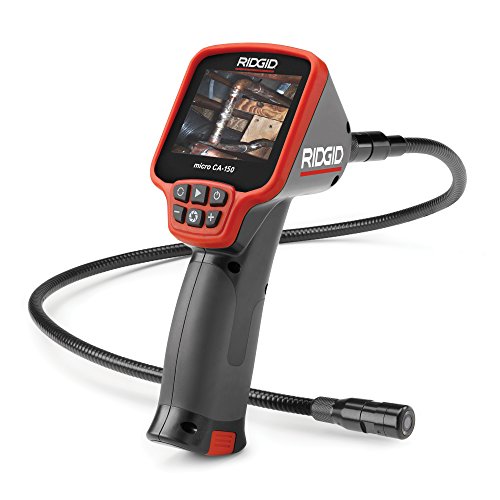
Built for close inspections rather than long sewer runs, this handheld unit ships with a 3 foot cable plus mirror, hook, and magnet accessories for retrieving dropped parts. Four adjustable LEDs on the camera head brighten dark cavities, and a 3.5 inch color display gives fast diagnosis in tight or hidden spaces. It holds up to 20 still images for later playback, and reviewers note the one-hand ergonomic grip steadies guidance through cramped gaps. The short cable is the obvious limit here, so it suits walls, vents, and engine bays rather than underground pipe work. Runs on the four AA batteries included.
Cable length3 ft
Display3.5 in color
LEDs4 adjustable
Power4 AA batteries
Pros
- Includes mirror, hook, and magnet accessories
- Compact one-hand grip for tight spaces
- Stores up to 20 still images
Cons
- Short cable rules out sewer runs
- Still images only, no video capture
Check price on Amazon ›
Combining a 130 foot camera with a pipe locator, this Forbest kit is built for finding where a problem actually sits underground. A built-in 512Hz transmitter pairs with any 512Hz receiver, so you can pinpoint the camera head from the surface. The flexible head carries 12 LEDs, and the fiberglass semi-rigid cable bends up to 90 degrees for varied pipe layouts. A 7 inch monitor shows the run, and clips save to an SD card, backed by a 1 year limited warranty with US service centers. The rechargeable battery gives up to 4 hours of continuous work. That runtime is modest for very long outdoor sessions, so plan charging around bigger jobs.
Cable length130 ft
Locator512Hz transmitter
Monitor7 in LCD
Runtimeup to 4 hrs
Pros
- Built-in 512Hz locator for buried lines
- Long 130 ft waterproof cable
- Records clips to SD card
Cons
- Battery runtime is modest for long jobs
- Semi-rigid cable is bulkier to transport
Check price on Amazon ›
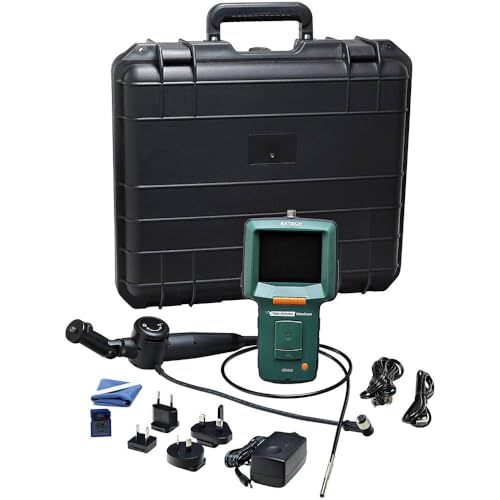
The Extech HDV540 leans into precise close-up work with an articulating probe tip that adjusts up to a 240 degree viewing angle, letting you look around corners inside a cavity. Its wired handset carries a non-detachable 6mm flexible probe about 1 meter long with a macro lens for fine detail. A 3.5 inch color LCD shows a 320 by 240 image, and the waterproof IP67 probe survives damp inspections. Storage is generous, holding more than 20,000 images on the included 4GB SD card. The short 1 meter probe keeps it in the close-inspection category rather than long sewer duty, so match it to detailed diagnostic tasks.
Probe6mm, 1 m
Articulationup to 240 degrees
Display3.5 in color LCD
WaterproofingIP67 probe
Pros
- Articulating tip sees around corners
- Macro lens for fine close-up detail
- Large image storage on included card
Cons
- Short 1 m probe limits reach
- Modest screen resolution for the class
Check price on Amazon ›
Ease of handling is the headline here, thanks to a twist-unlock reel that coils or releases the cable in about a second instead of fighting two tiny screws. A true 1080P lens feeds a bright 7 inch IPS screen with 16x zoom, so cracks, clogs, and rust show clearly. Recording runs to a built-in DVR with a 32GB card, with instant playback and USB-C or SD transfer to a PC. The IP68 head shrugs off wet or flooded pipes, six adjustable LEDs light dark runs, and included sleeves fit small or large pipes. Its 5000mAh battery lasts over 8 hours. There is no built-in signal locator, so tracing exact buried depth needs a separate tool.
Resolution1080P, 16x zoom
Screen7 in IPS
StorageDVR, 32GB card
Battery5000mAh, 8+ hrs
Pros
- One-second twist-unlock cable reel
- Bright 1080P IPS screen with zoom
- Long battery runtime with USB-C top-up
Cons
- No built-in 512Hz locator
- Reel adds bulk over handheld scopes
Check price on Amazon ›
This phone-connected borescope trades a dedicated screen for portability and a sharp 1920 by 1440 image from a slim 7.9mm probe. It links to iOS 9 and Android 7 devices through an app, so your phone becomes the display. The 16.4 foot semi-rigid cable balances flexibility with enough stiffness to push, and the IP67 probe works underwater up to about 3.28 feet for an hour. Eight adjustable LEDs brighten dark cavities, and bundled magnet, hook, and mirror tips extend its reach into cars, engine bays, and wiring. Owners note iOS devices tend to show clearer images, while some Android models can look slightly softer, which is worth checking against your phone.
Resolution1920 x 1440
Probe7.9mm
Cable16.4 ft semi-rigid
WaterproofingIP67 probe
Pros
- Sharp image from a slim probe
- Uses your phone, no extra screen
- Ships with magnet, hook, and mirror tips
Cons
- Image clarity varies by phone model
- App reliance means no standalone display
Check price on Amazon ›
What to look for
Match cable length to the job
Reach decides everything. Handheld scopes with a few feet of cable suit walls, vents, and engine bays, while sewer runs demand reels stretching 100 feet or more. Buying too little cable strands you mid-inspection, so size it to your longest expected line.
Waterproofing and lighting
Pipes are wet and dark. Look for IP67 or IP68 rated heads that survive flooded lines, and adjustable LEDs so you can dial brightness up in deep sections. Weak lighting hides the cracks and blockages you bought the camera to find.
Screen, resolution, and recording
A bright 7 inch screen reads far easier than a dim compact panel, and 1080P or HD sensors reveal fine detail. Onboard recording to an SD card or DVR lets you save evidence and review footage later, which owners find useful for sharing findings.
Locators and battery runtime
If you need to dig or repair, a built-in 512Hz transmitter lets a receiver pinpoint the camera head from the surface. Check battery runtime too, since long outdoor sessions can outlast a 4 hour charge unless the unit accepts a USB-C top-up.
Frequently asked questions
How long a cable do I need?
Match it to your longest run. A few feet works for walls and engines, but sewer and drain lines often need 100 feet or more, so err toward extra reach rather than coming up short mid-inspection.
What does IP67 or IP68 mean here?
Both indicate a sealed probe that resists dust and water. An IP68 head can sit in flooded pipes, while IP67 probes handle brief shallow submersion, so pick based on how wet your typical lines get.
Do I need a pipe locator?
Only if you plan to dig or repair. A 512Hz transmitter paired with a receiver marks exactly where the camera head sits underground, which saves guesswork before breaking ground on a buried line.
Can these cameras record video?
Some do. Reel systems and larger monitors often save clips to an SD card or built-in DVR, while compact handhelds may only hold still images, so confirm recording if you need footage.
Phone-connected or standalone screen?
Phone borescopes are light and lean on an app for the display, while standalone units carry their own monitor. Standalone screens avoid app quirks, but phone scopes pack smaller for travel.
Will a stiff cable navigate bends?
Semi-rigid and mid-flex cables push through gentle turns, and articulating tips help around corners. Very tight radii still challenge stiffer reels, so check the rated turn radius against your pipe layout.
How much battery runtime should I expect?
It varies widely. Some units run around 4 hours while others exceed 8 on a charge, and models with USB-C input can extend sessions from a power bank when the internal battery runs low.
Are these suitable for beginners?
Many are. Twist-unlock reels, plug-and-play screens, and one-hand grips lower the learning curve, though pro reel systems assume more familiarity with pipe inspection and locating workflows.
The verdict
SeeSnake microREEL APX & CSX Via System wi...
9.3/10
For pros needing reach and clean in-pipe images, the SeeSnake microREEL earns Best Overall with its flexible cable and HDR sensor. Homeowners wanting a simple, bright setup should look at the ChoosePRO reel, while the RIDGID CA-150 and Extech HDV540 excel at close reach-ins behind walls and machinery. Choose the Forbest kit when locating buried lines matters, and the phone-based endoscope when packing light is the priority.
Check price on Amazon ›
Our top pick, secure checkout via Amazon
Note: Availability and specifications change often. Always confirm the current details on Amazon before buying.