Tools & DIY 7 Noncontact Voltage Testers for Safer Wiring Work
P
By the Pickpedia Team
·7 picks compared
·Last verified October 2026
Affiliate disclosure: As an Amazon Associate, Pickpedia earns from qualifying purchases. Links on this page are paid links, and we may earn a commission at no extra cost to you. This never affects our picks or scores.
Quick answer
Pick a non-contact tester rated for the circuits you check, with clear light and sound alerts. Klein's NCVT1P suits most home and pro work with its wide 50 to 1000V range and CAT IV 1000V rating. Owners who probe doorbells or thermostats want an adjustable low-range model instead.
7 Noncontact Voltage Testers for Safer Wiring Work at a glance
Why you can trust this guide
We compared these picks using verified manufacturer specifications, available manuals and documentation, current retailer listings, and patterns in owner feedback, alongside editorial research. We focus on measurable differences such as performance, capacity, usability, and build quality. Pickpedia does not present editorial research as laboratory testing, and we do not claim hands-on testing unless it was actually performed.
How we chose: We compared 7 non-contact voltage testers on detection range, safety rating, sensitivity control, and alert clarity.
A non-contact voltage tester lets you confirm live wires without touching bare conductors, which is the first safety check before any repair. Every model here glows or beeps when it senses AC voltage, but they differ in range, sensitivity settings, and how they signal strength.
We leaned on published specifications, listed safety ratings, and what reviewers note about everyday use. No alarm alone never proves a circuit is dead, so we favored testers with self-test features and a habit of checking a known live source first.
Our top picks
Klein's NCVT1P covers a broad 50 to 1000V AC window, so it reads breakers, outlets, switches, and light fixtures without contact. A green LED confirms the tester is working, then it flashes red and beeps when voltage appears, which removes guesswork in bright or dim spots. Auto power-off saves the battery, and the compact clip-on body carries 2 meter drop protection. Its CAT IV 1000V rating reassures owners doing service work. One limit is the single fixed range, so it lacks a low-sensitivity mode for very small signals like thermostat or doorbell wiring.
Detection range50 to 1000V AC
Safety ratingCAT IV 1000V
AlertsGreen ready LED, red flash and beep
Drop protection2 meters
Pros
- Wide 50 to 1000V range covers most home and pro jobs
- High CAT IV 1000V safety rating
- Green LED confirms the unit is actually working
Cons
- Single fixed range, no low-sensitivity mode
- No signal strength percentage display
Check price on Amazon ›
Fluke's 1AC II keeps things straightforward: the tip glows red and a beeper sounds when voltage is present. Continuous self-test runs the whole time, so you always know the pen is live rather than dead, a detail electricians value. Its 90 to 1000V AC window fits standard household and commercial circuits, and an audible or silent mode lets you work quietly on a busy site. The pocket size makes it easy to keep on hand. The main trade-off is sensitivity, since the range starts at 90V and misses the low-voltage doorbell or thermostat wiring that adjustable models can catch.
Detection range90 to 1000V AC
Self-testContinuous
AlertsRed tip glow and beep
ModesAudible or silent
Pros
- Continuous self-test confirms it is always working
- Simple, distraction-free operation
- Silent mode for quiet job sites
Cons
- Starts at 90V, so it skips low-voltage wiring
- No adjustable sensitivity or strength readout
Check price on Amazon ›
KAIWEETS layers extra feedback onto a standard pen. As voltage rises or you move closer to the source, the beep speeds up and an on-screen percentage climbs, while the screen turns red for live and green for neutral. Dual ranges of 12 to 1000V and 70 to 1000V adapt from doorbells to mains, and a bar graph shows relative intensity. A built-in flashlight, low-power warning, and auto power-off round it out, with a CAT III 1000V and CAT IV 600V rating. The richer display draws more attention to reading a screen, which some find busier than a plain glow-and-beep pen.
Detection range12 to 1000V, 70 to 1000V AC
Safety ratingCAT III 1000V, CAT IV 600V
FeedbackScreen percentage and bar graph
ExtrasFlashlight, auto power-off
Pros
- Percentage and bar graph show signal strength
- Dual range handles low and standard voltage
- Color screen separates live from neutral
Cons
- Busier display than a simple beep pen
- More features mean more to learn
Check price on Amazon ›
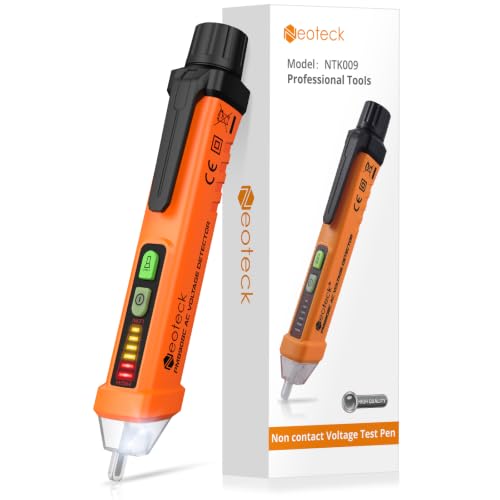
Neoteck aims at simple everyday safety checks with a 12 to 1000V AC range. Different alarm sounds and LED levels help you tell a live wire from neutral, and it works on breakers, switches, outlets, fixtures, and cords. A built-in emergency flashlight adds handy light in tight or dark corners. Carrying a CAT III 600V and CE certification, it targets hobbyists, homeowners, and new homeowners making that first important safety check. The listing specifically warns it is not suited to testing Christmas lights, so keep it to standard wiring rather than low-power decorative strings.
Detection range12 to 1000V AC
Safety ratingCAT III 600V
AlertsTiered sound and LED
ExtraEmergency flashlight
Pros
- Simple design suits first-time users
- Wide 12 to 1000V range for home checks
- Flashlight helps in dark corners
Cons
- Not suitable for Christmas light testing
- Lower CAT III 600V rating than pro pens
Check price on Amazon ›
YOWEXA offers selectable high sensitivity near 12 to 1000V and low sensitivity near 48 to 1000V, chosen before you start detecting. Comparing signal strength across two wires or socket holes helps identify the live conductor, with stronger signals marking the hot side. When AC voltage appears, the pen beeps and lights one to three indicators by strength, so faster beeps and more lights mean a closer source. A CAT III 1000V and CAT IV 600V rating, ABS housing, low-battery alert, flashlight, and auto shutoff cover the basics. Note you should not switch sensitivity mid-detection, and it handles AC checks only.
Detection range12 to 1000V, 48 to 1000V AC
Safety ratingCAT III 1000V, CAT IV 600V
SensitivityHigh or low, set before use
ExtrasFlashlight, low-battery alert
Pros
- Two sensitivity levels for fine or standard work
- Three-step strength indicator
- Strong CAT III 1000V, CAT IV 600V rating
Cons
- Cannot switch sensitivity during detection
- AC checks only, no DC support
Check price on Amazon ›
Proster defaults to a 48 to 1000V range and drops to 12 to 1000V when you raise sensitivity, giving three selectable steps of high, medium, and low. That flexibility helps distinguish live from neutral at close range across different wiring. Both audible and visual alarms guard against a missed reading, and ABS with PVC construction handles routine wear. Auto power-off conserves the battery, an LED torch lights dark corners, and a low-voltage LED prompts a battery change. A short press of the S button changes sensitivity while a long press works the flashlight. Reading the correct mode takes a moment of habit before probing.
Detection range12 to 1000V, 48 to 1000V AC
SensitivityHigh, medium, low
AlertsAudible and visual
ExtrasFlashlight, low-battery LED
Pros
- Three sensitivity steps for varied wiring
- Durable ABS and PVC housing
- Low-battery LED prompts timely changes
Cons
- Defaults to higher 48V range on power-up
- Mode selection takes habit to master
Check price on Amazon ›
MXCOIRTP packs an NCV sensing probe with three sensitivity modes into a slim pen. Powering on starts in low mode with one buzz, then the S button steps to medium and high with two and three buzzes, so you hear which mode is active. Different alarm tones and indicator lights show voltage presence and strength on wires, outlets, and switches. A detection light plus a tail flashlight help in the dark, and a pen hook keeps it in a shirt pocket. Auto power-off triggers after 3 minutes idle. The tail flashlight only works when the tester is off, which is worth remembering mid-job.
Detection range3 ranges from 12V AC
SensitivityLow, medium, high
FeedbackBuzz count marks each mode
ExtrasDetection light, tail flashlight
Pros
- Three sensitivity modes with audible confirmation
- Slim pocket-carry design with hook
- Tail flashlight plus detection light
Cons
- Tail flashlight only works when tester is off
- Auto power-off after just 3 minutes idle
Check price on Amazon ›
What to look for
Match the range to your work
Most home wiring runs at standard mains voltage, so a 50 to 1000V or 90 to 1000V pen handles outlets, switches, and breakers well. If you check doorbells, thermostats, or irrigation wiring, choose a model with a low-sensitivity mode reaching down near 12V. A wider window covers more jobs but can pick up faint stray signals.
Read the safety rating
CAT ratings describe how much surge energy a tester withstands at a given voltage. A CAT IV 1000V pen suits work closer to the service entrance, while CAT III 600V fits typical indoor circuits. Higher ratings add a margin of protection, so service pros lean toward the strongest rating their work demands.
Check the alert style
Clear feedback matters when your hands are busy. Look for both a bright light and an audible beep, and consider models that speed up the beep or show a strength bar as you near the source. A ready light or continuous self-test confirms the pen is working rather than silently dead.
Always verify on a known source
No alarm alone proves a wire is dead, since dead batteries, shielding, or the wrong mode can hide voltage. Test the pen on a circuit you know is live before and after each check. This simple habit catches a failing unit and keeps your safety check honest.
Frequently asked questions
How does a non-contact voltage tester work?
It senses the electromagnetic field around an energized AC conductor without touching bare metal. When the tip nears a live wire, outlet, or cord, the field triggers a light and a beep. This lets you confirm voltage safely before you open or handle wiring.
Can it tell live from neutral?
Many models help you distinguish them by comparing signal strength at close range. The live wire usually gives a stronger light or faster beep than the neutral. Some testers show this with a percentage or a red versus green screen, but confirm on a known source first.
What does the CAT rating mean?
CAT ratings describe how safely a tester handles voltage surges in a given environment. CAT IV covers the service entrance, CAT III covers fixed indoor circuits, and higher voltage numbers add margin. Choose a rating that matches or exceeds the circuits you plan to check.
Why does it need a low-sensitivity mode?
Low-voltage wiring like doorbells, thermostats, and irrigation lines carries a weaker field. A low-sensitivity or adjustable range lets the pen detect these small signals. Without it, a tester starting near 90V may miss them, so adjustable models suit anyone working beyond standard mains.
Is a beep enough to trust a wire is dead?
No. A missing alarm can result from a dead battery, shielding, the wrong sensitivity mode, or a faulty pen. Always test on a known live circuit before and after checking, and treat every wire as energized until proven otherwise.
Do these testers work on DC?
Most non-contact pens here detect AC voltage only and are not meant for DC circuits or automotive systems. The listings state AC use, so use a different tool for DC work. Reviewers note trying to check DC with an AC pen gives no reliable reading.
Can I check Christmas lights with one?
Not always. At least one model here specifically warns against testing decorative light strings, since their low power can confuse the sensor. For holiday lights, follow the maker's guidance and lean on a tester rated for that low-power range if the listing allows it.
How long do the batteries last?
Runtime depends on use, but auto power-off features stretch it by shutting the pen down after a few idle minutes. Several models flash a low-battery LED when the cell drops, prompting a change. Owners report swapping batteries occasionally rather than frequently with normal home use.
The verdict
Klein Tools NCVT1P Non-Contact Voltage Tes...
9.3/10
For most people the Klein NCVT1P is the top pick, pairing a wide range, a high CAT IV 1000V rating, and a ready light that confirms it works. Fluke's 1AC II rewards those who want proven simplicity with continuous self-test. Reach for KAIWEETS if you want a strength percentage, or the YOWEXA, Proster, and MXCOIRTP if adjustable sensitivity for low-voltage wiring matters. Neoteck keeps first-time home checks simple. Always verify on a known live source.
Check price on Amazon ›
Our top pick, secure checkout via Amazon
Note: Availability and specifications change often. Always confirm the current details on Amazon before buying.