Tools & DIY 7 Flooring Nail Guns for Faster Board Installs
P
By the Pickpedia Team
·7 picks compared
·Last verified October 2026
Affiliate disclosure: As an Amazon Associate, Pickpedia earns from qualifying purchases. Links on this page are paid links, and we may earn a commission at no extra cost to you. This never affects our picks or scores.
Quick answer
For solid tongue and groove hardwood, a dedicated flooring cleat nailer or 2-in-1 stapler drives fasteners at the correct angle with a mallet. Pick a tool matching your board thickness, then confirm it accepts the cleat or staple your flooring calls for. Lighter bodies help during long installs.
7 Flooring Nail Guns for Faster Board Installs at a glance
Why you can trust this guide
We compared these picks using verified manufacturer specifications, available manuals and documentation, current retailer listings, and patterns in owner feedback, alongside editorial research. We focus on measurable differences such as performance, capacity, usability, and build quality. Pickpedia does not present editorial research as laboratory testing, and we do not claim hands-on testing unless it was actually performed.
How we chose: We compared seven pneumatic flooring nailers and staplers across fastener range, board thickness support, weight, and jam clearing, based on published specifications.
Installing hardwood or engineered planks goes faster when the fastener sits at the right angle and depth every strike. Mallet actuated flooring tools do that job, seating cleats or staples through the tongue so the finished surface stays clean. Choosing well starts with your board thickness and the fastener type your flooring maker specifies.
Our lineup mixes true flooring nailers with lighter 2-in-1 brad and staple guns that owners also use for trim and general woodwork. We grounded every note in each maker's stated features, then flagged one honest limitation per tool. Read the buying guide below before you match a model to your project.
Our top picks
Bostitch built this around mallet actuated driving, so each swing seats a 15.5 gauge staple or 16 gauge L shaped cleat cleanly through the tongue. It handles fasteners from 1-1/2 inches to 2 inches, and the non-marring interchangeable base plates cover flooring from 1/2 inch through 3/4 inch. Owners like the longer handle and rubber grip during full day sessions, and the kit ships with a mallet, oil, wrenches, and a 1/4 inch air fitting. One limitation is the mallet only design, which asks for more physical rhythm than a purely trigger fired tool over very long runs.
Fastener types15.5 ga staples, 16 ga L cleats
Fastener length1-1/2 in to 2 in
Flooring range1/2 in to 3/4 in
ActuationMallet pneumatic
Pros
- Mallet driving seats fasteners consistently
- Interchangeable non-marring base plates
- Complete kit with mallet, oil, and wrenches
Cons
- Mallet rhythm gets tiring on long runs
- Solid flooring focus, not a trim tool
Check price on Amazon ›
This 3PLUS tool covers both camps, firing 15.5 gauge staples and 16 gauge L cleats from 1-1/2 inches to 2 inches, so you match whatever your flooring calls for. Interchangeable plates suit all common floor sizes, and the removable long reach handle plus included white rubber mallet keep you upright while working across a room. Reviewers note it drives well in both hardwood and engineered planks. The loading step matters here, since L cleats need the nail head slotted into the magazine correctly, and skipping that can cause feed hiccups until you get the routine down.
Fastener types15.5 ga staples, 16 ga L cleats
Fastener length1-1/2 in to 2 in
HandleRemovable long reach
IncludedMallet with white rubber
Pros
- Accepts staples and L cleats
- Interchangeable plates for all floor sizes
- Long reach handle saves your back
Cons
- L cleat loading needs careful seating
- Occasional feed hiccups if loaded wrong
Check price on Amazon ›
At only 3.1 pounds, this Metabo HPT stapler eases wrist strain across a full day, which is why it carries a long Pro Preferred nod from Builder and Developer Magazine. It shoots 1/4 inch 18 gauge staples from 1/2 inch to 1-9/16 inches, and the tool-less depth adjustable base spans 5/16 inch to 7/16 inch for solid hardwood plus 1/2 inch to 5/8 inch for engineered boards. Sequential actuation keeps placement accurate, and the 360 degree exhaust points air away from your face. Its limitation is the staple-only design, so if your flooring spec requires cleats, look elsewhere.
Fastener1/4 in 18 ga staples
Fastener length1/2 in to 1-9/16 in
Depth range5/16 in to 5/8 in
Weight3.1 lb
Pros
- Light 3.1 pound body limits fatigue
- Tool-less depth adjustment
- Adjustable 360 degree exhaust
Cons
- Staples only, no cleat option
- 18 gauge suits thinner engineered work
Check price on Amazon ›
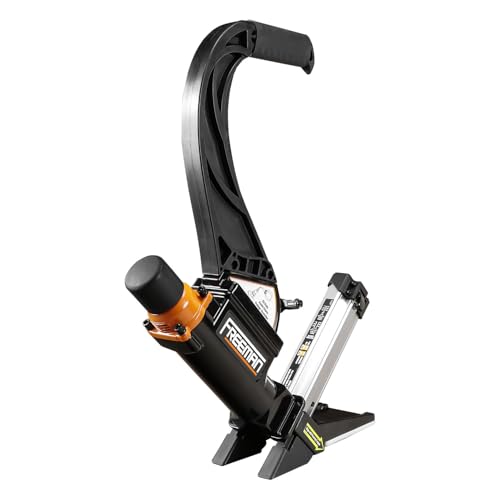
Freeman trimmed roughly two pounds versus comparable flooring nailers using a high density plastic handle and light strike bumper, so long shifts feel easier. This 2-in-1 drives 16 gauge L cleats and 15.5 gauge 1/2 inch crown staples from 1-1/2 inches to 2 inches, covering most tongue and groove hardwoods like oak, maple, cherry, and walnut. An aluminum body with heat treated steel parts holds up to steady use, while a semi-quick jam release opens the drive blade fast. Two no-mar base plates protect finished surfaces on 5/8 inch to 3/4 inch flooring. It skips the thinner 1/2 inch boards some rivals reach.
Fastener types16 ga L cleats, 15.5 ga staples
Fastener length1-1/2 in to 2 in
Flooring range5/8 in to 3/4 in
BodyAluminum, heat treated steel
Pros
- About two pounds lighter than rivals
- Semi-quick jam release
- Two no-mar base plates included
Cons
- Does not cover 1/2 inch flooring
- Mallet driving still required
Check price on Amazon ›
NuMax stretches compatibility to three fastener families, handling 16 gauge T cleats and L cleats plus 15.5 gauge 1/2 inch crown staples from 1-1/2 inches to 2 inches. That range means you can match nearly any tongue and groove hardwood without buying a second tool. The aluminum body and heat treated steel parts resist knocks, the ergonomic handle reduces fatigue on long shifts, and two no-mar plates let you jump between 1/2 inch and 3/4 inch flooring. A long reach fiberglass mallet with padded grip ships in the box. Being mallet driven, it still leans on your swing rather than a trigger for each fastener.
Fastener types16 ga T and L cleats, 15.5 ga staples
Fastener length1-1/2 in to 2 in
Flooring range1/2 in to 3/4 in
IncludedFiberglass mallet, 2 plates
Pros
- Three fastener types supported
- Covers 1/2 inch to 3/4 inch flooring
- Long reach mallet included
Cons
- Mallet driven, not trigger fired
- Broad range can confuse first-timers
Check price on Amazon ›
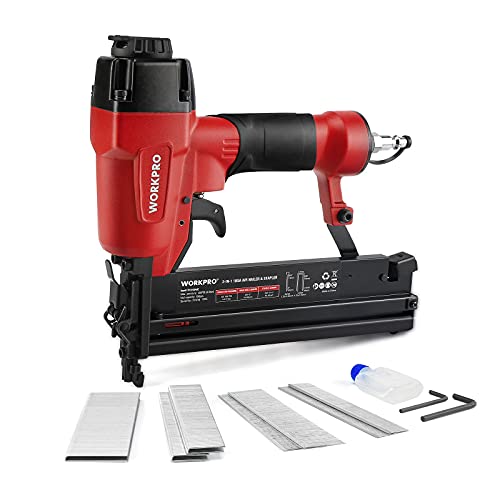
WORKPRO aims this 2-in-1 at people juggling many jobs, taking 18 gauge brad nails from 5/8 inch to 2 inches and 18 gauge staples from 5/8 inch to 1-9/16 inches. It runs at 60 to 100 PSI through a 1/4 NPT inlet, with a depth control wheel to protect softer surfaces. A 360 degree adjustable exhaust, tool-free jam clearing, and continuous shot mode round out a practical package, and the kit adds 400 brad nails and 300 staples plus lubricant. Just note this is a general brad and staple gun, not a dedicated angled flooring cleat nailer, so it fits secondary flooring tasks better than full plank installs.
Fasteners18 ga brads and staples
Brad length5/8 in to 2 in
Pressure60 to 100 PSI
Air inlet1/4 NPT
Pros
- Handles flooring, trim, and upholstery
- Tool-free jam clearing
- Ships with brads, staples, and oil
Cons
- Not an angled flooring cleat nailer
- 18 gauge limits heavy plank duty
Check price on Amazon ›
DOTOOL keeps things approachable, driving 18 gauge brad nails from 5/8 inch to 2 inches and 1/4 inch crown staples from 5/8 inch to 1-5/8 inches over a 60 to 120 PSI range. A nail view window helps you avoid dry firing and the dent it leaves, while tool-free jam clearing and a 360 degree exhaust keep work moving. The generous starter kit includes 1000 fasteners, a carry case, hex wrenches, lubricant, and safety glasses, so beginners can start right away. Depth is adjusted by changing pressure rather than a dedicated wheel, which gives less precise control than tools with a dial.
Fasteners18 ga brads, 1/4 in staples
Brad length5/8 in to 2 in
Pressure60 to 120 PSI
Included1000 fasteners, case, glasses
Pros
- Nail view window prevents dry fire
- Large starter kit with case
- Tool-free jam clearing
Cons
- Depth set by pressure, less precise
- Light 18 gauge, not for thick planks
Check price on Amazon ›
What to look for
Match the tool to your board thickness
Flooring plates and depth ranges exist for a reason. Solid hardwood usually wants a mallet driven cleat nailer sized for 1/2 inch through 3/4 inch stock, while thinner engineered planks pair better with an 18 gauge stapler. Check your flooring maker's stated thickness and fastener before choosing, since the wrong plate can mar a finished surface.
Cleats versus staples
Cleats grip with barbed sides and flex slightly as wood moves with humidity, which many installers prefer for solid hardwood. Staples hold very firmly but allow less movement. Some makers specify one or the other, so read the flooring instructions first. Multi-format tools that accept both give you room to follow whatever the spec demands.
Weight and handle comfort
Installing a room means hundreds of strikes, so a lighter body and a long reach handle genuinely reduce fatigue. Tools near three pounds, or those trimmed a couple pounds below rivals, keep your wrist fresher late in the day. A padded or rubber grip and an upright handle also save your back over long stretches.
Jams, exhaust, and air setup
Every pneumatic tool jams eventually, so a tool-free or semi-quick jam release saves real frustration. A 360 degree adjustable exhaust points air away from your face and the fresh floor. Confirm the PSI range and the 1/4 inch NPT inlet suit your compressor, and keep the tool oiled as the maker directs for smooth firing.
Frequently asked questions
Do I need a dedicated flooring nailer or will a brad gun work?
For full solid hardwood installs, a dedicated angled cleat nailer or flooring stapler seats fasteners through the tongue at the correct angle. A 2-in-1 brad and staple gun suits lighter engineered work, repairs, and trim, but it is not built to drive angled cleats across a whole floor.
What fastener length should I use?
Most flooring tools here accept fasteners from 1-1/2 inches to 2 inches, with brad style tools starting near 5/8 inch. Follow your flooring maker's recommendation, since length depends on board thickness and subfloor. Using a too-short fastener weakens hold, while too long can reach through thin material.
Cleats or staples for hardwood?
It depends on the flooring specification. Cleats flex slightly as wood expands and contract with seasonal humidity, which suits many solid hardwoods. Staples grip harder with less give. Check your manufacturer's guidance, and consider a multi-format tool if you want to keep both options open.
Do these tools include an air compressor?
No. Every pneumatic model here connects to a separate air compressor that you supply. Confirm the tool's PSI range, often around 60 to 120, and its 1/4 inch NPT inlet match your compressor before your first install.
Will these mar a finished floor surface?
Dedicated flooring tools ship with non-marring or no-mar base plates that protect the visible surface while you drive fasteners through the tongue. Keep the correct plate installed for your board thickness, and the finished face should stay clean.
How do I clear a jam?
Many tools offer tool-free or semi-quick jam release that opens the drive blade quickly. Disconnect the air line first, clear the stuck fastener, then reconnect and test fire into scrap. Regular oiling as the maker directs reduces how often jams happen.
Which tool is lightest for long days?
The Metabo HPT stapler stands out at only 3.1 pounds, and the Freeman claims roughly two pounds less than comparable flooring nailers. A lighter body plus a long reach handle noticeably cuts wrist and back fatigue when you are installing a whole room.
Can I use these tools for other projects?
The 2-in-1 brad and staple guns from WORKPRO and DOTOOL handle upholstery, trim, molding, framing, and general woodwork alongside light flooring. Dedicated flooring nailers focus on plank installs and are less suited to those secondary tasks.
The verdict
Bostitch Staples Flooring Pneumatic Nailer
9.2/10
The Bostitch flooring nailer earns our top pick for consistent mallet driving, a complete kit, and support across common solid hardwood thicknesses. Choose the Metabo HPT when a light 3.1 pound body matters most on long days, or the NuMax when you want three fastener types on one tool. DIYers mixing flooring with trim and upholstery will get more use from the WORKPRO or DOTOOL 2-in-1 guns. Match the tool to your board first, then buy.
Check price on Amazon ›
Our top pick, secure checkout via Amazon
Note: Availability and specifications change often. Always confirm the current details on Amazon before buying.