Tools & DIY 5 Finish Nailers for Smooth Cabinet and Trim Jobs
P
By the Pickpedia Team
·5 picks compared
·Last verified September 2026
Affiliate disclosure: As an Amazon Associate, Pickpedia earns from qualifying purchases. Links on this page are paid links, and we may earn a commission at no extra cost to you. This never affects our picks or scores.
Quick answer
For clean cabinet and trim work, a 16 or 15 gauge finish nailer holds heavier molding, while an 18 gauge brad nailer suits delicate trim without splitting. Match gauge to your material, then weigh corded pneumatic reliability against cordless freedom based on how you actually work.
5 Finish Nailers for Smooth Cabinet and Trim Jobs at a glance
Why you can trust this guide
We compared these picks using verified manufacturer specifications, available manuals and documentation, current retailer listings, and patterns in owner feedback, alongside editorial research. We focus on measurable differences such as performance, capacity, usability, and build quality. Pickpedia does not present editorial research as laboratory testing, and we do not claim hands-on testing unless it was actually performed.
How we chose: We compared five finish and brad nailers across gauge range, actuation modes, depth control, and portability.
Finish nailers decide how smooth your cabinets, casings, and crown molding turn out. Gauge matters most here, since a 15 or 16 gauge tool grips thicker stock while an 18 gauge brad nailer leaves smaller holes on fragile trim. Actuation style, depth adjustment, and jam clearing separate a frustrating afternoon from a clean one.
Our picks lean on published specifications, owner reports, and the features each maker lists. Some run on an air compressor, one goes fully cordless, and another handles three fastener types at once. Read each entry with your own projects in mind, then pick the gauge and power style that fit how you build.
Our top picks
Metabo HPT built the NT65M2S around 16 gauge finish nails from 1 inch up to 2.5 inches, covering most molding, chair rail, and cabinet work. A selective actuation switch flips between bump fire and sequential fire, so you choose speed or precision per task. At 3.7 pounds it stays balanced through long sessions, and tool-free depth adjustment sets nail heads cleanly across different materials. Builder and Developer Magazine has named it a preferred nailer for many years running, per the listing. Being pneumatic, it needs an air compressor and hose, which limits where you can carry it.
Nail gauge16 gauge
Nail length1 in to 2.5 in
Weight3.7 lbs
ActuationBump and sequential
Pros
- Lightweight and well balanced for long jobs
- Switchable bump and sequential firing
- Tool-free depth adjustment for varied stock
Cons
- Requires an air compressor and hose
- Sixteen gauge leaves larger holes than brad nailers
Check price on Amazon ›
This 3PLUS driver takes 15 gauge angled DA style nails from 1.25 to 2.5 inches, and its angled magazine reaches into corners a straight nailer cannot. Tool-free depth adjustment sets fasteners flush across changing material for a professional finish. A work contact element blocks accidental firing, while the no-mar tip guards visible surfaces. Owners note the 360 degree adjustable exhaust keeps air off your face and the workpiece, and the quick jam release simplifies maintenance. An interchangeable trigger switches between single shot and bump fire. Like other pneumatic tools, it depends on a compressor, and the heavier 15 gauge nails suit sturdier trim more than delicate pieces.
Nail gauge15 gauge angled
Nail length1.25 in to 2.5 in
ActuationSingle and bump
Exhaust360 degree adjustable
Pros
- Angled magazine reaches tight corners
- Adjustable exhaust directs air away
- Quick jam release eases upkeep
Cons
- Needs a compressor to run
- Heavier gauge less suited to fine trim
Check price on Amazon ›
DEWALT designed this brad nailer for 18 gauge nails from 5/8 inch to 2 inches, leaving tiny holes that vanish under a little filler. A maintenance-free motor helps keep the work surface free of staining, and rear exhaust pushes debris away from the piece. Tool-free depth-of-drive adjustment uses detents to seat nail heads consistently, while a tool-free jam release clears stuck fasteners fast. An adjustable belt hook keeps it within reach on a ladder or bench. Reviewers value the light nail holes for trim and paneling. Because it runs on air, you still need a compressor, and 18 gauge lacks the holding grip of thicker finish nails.
Nail gauge18 gauge
Nail length5/8 in to 2 in
Depth adjustTool-free with detents
ExtrasBelt hook, rear exhaust
Pros
- Small holes suit delicate finish work
- Tool-free jam release and depth detents
- Motor helps avoid surface staining
Cons
- Compressor and hose still required
- Lighter grip than 15 or 16 gauge nails
Check price on Amazon ›
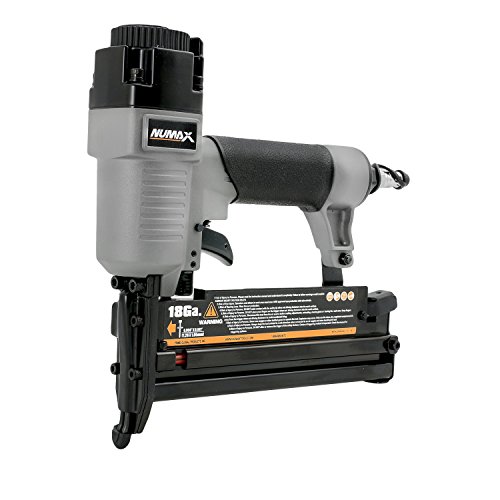
NuMax packs three tools into one body, driving 16 gauge straight finish nails, 18 gauge brads, and 18 gauge narrow crown staples. That range covers baseboards, cabinet backing, chair rail, crown molding, and window casing without switching guns. A one-piece hardened steel drive blade aims for durability, and the hand-turned depth wheel adjusts driving depth for each material. A reload indicator shows remaining fasteners so you avoid dry firing. Owners find the body rugged yet light enough for extended runs. The trade-off with any multi-tool is compromise, and dedicated single-purpose nailers may feel more refined for one specific job.
Fastener types16 GA finish, 18 GA brad, staples
Finish nail length3/4 in to 2 in
Depth adjustHand-turn wheel
FeatureReload indicator
Pros
- Handles nails and staples in one tool
- Reload indicator prevents dry firing
- Hardened steel drive blade for durability
Cons
- Multi-tool trades some refinement per task
- Pneumatic design needs a compressor
Check price on Amazon ›
RYOBI cuts the cord with the P322, an 18 gauge brushless AirStrike brad nailer that runs on ONE+ HP 18V batteries. No compressor, hose, or gas cartridge means you grab it and go, which owners find handy for quick trim tasks and ladder work. The brushless motor targets longer runtime and consistent driving, and included non-marring pads protect finished surfaces. It ships as a tool only, so you supply the battery and charger, and buyers already in the RYOBI system benefit most. As an 18 gauge brad tool, it fits light trim rather than heavy molding that calls for thicker finish nails.
Nail gauge18 gauge
Power18V brushless cordless
IncludedNon-marring pads, manual
FormatTool only
Pros
- Fully cordless with no compressor needed
- Brushless motor for steady driving
- Non-marring pads protect surfaces
Cons
- Battery and charger sold separately
- Brad gauge unsuited to heavy molding
Check price on Amazon ›
What to look for
Match Gauge to the Material
Gauge drives your whole decision. A 15 or 16 gauge finish nailer holds thick casing, crown, and cabinet parts, leaving a slightly larger hole to fill. An 18 gauge brad nailer suits thin trim, paneling, and delicate stock where splitting is a risk and holes should nearly disappear.
Actuation Modes Matter
Sequential firing drives one nail per full trigger pull, giving placement accuracy for finish work. Bump firing lets you drive fast by holding the trigger and tapping the nose. Tools with a selectable switch let you pick precision or speed as the job changes, which suits mixed trim days.
Air Versus Cordless
Pneumatic nailers stay light in hand and drive consistently, but tether you to a compressor and hose. Cordless models free you to move around a room or up a ladder, trading a bit of weight for a battery. Choose based on how mobile your work needs to be.
Depth Control and Jam Clearing
Tool-free depth adjustment lets you seat nail heads flush or slightly countersunk across changing materials, which protects a clean finish. A tool-free jam release saves real frustration mid-project. Features like no-mar tips and adjustable exhaust also help keep finished surfaces unmarked and air off your face.
Frequently asked questions
What gauge nailer is best for trim and cabinets?
For heavier casing, crown, and cabinet parts, a 15 or 16 gauge finish nailer gives stronger holding. For thin, delicate trim, an 18 gauge brad nailer leaves smaller holes and reduces splitting. Many finishers keep both on hand for different stages.
Do I need an air compressor for these nailers?
Most finish and brad nailers here are pneumatic, so they require a compressor and hose. The RYOBI P322 runs on an 18V battery instead, so it needs no compressor at all, only a charged pack from the same system.
What is the difference between bump fire and sequential fire?
Sequential fire drives one nail per complete trigger pull for careful placement. Bump fire lets you drive rapidly by holding the trigger and bumping the nose against the surface. Several tools here offer a switch or interchangeable trigger to use either mode.
Will a finish nailer split thin molding?
Thicker 15 and 16 gauge nails can split narrow or fragile trim. For that work, an 18 gauge brad nailer is safer because its smaller diameter puts less stress on the wood while still holding light pieces in place.
Can one tool handle both nails and staples?
The NuMax 3-in-1 drives 16 gauge finish nails, 18 gauge brads, and 18 gauge narrow crown staples from a single body. That flexibility suits varied projects, though dedicated single-purpose nailers can feel more refined for one specific task.
How does depth adjustment help my finish?
Tool-free depth adjustment sets how far each nail drives, so heads sit flush or slightly below the surface across different materials. Getting this right means less filling and sanding, and a cleaner final look on visible trim and cabinet faces.
Is a cordless brad nailer strong enough for finish work?
A cordless 18 gauge brad nailer like the RYOBI P322 handles light trim, paneling, and small moldings well. For heavier crown or thick casing, a 15 or 16 gauge finish nailer gives more holding grip than an 18 gauge brad tool.
What features protect my finished surfaces?
Look for no-mar or non-marring tips that guard visible wood, adjustable exhaust that directs air away from the workpiece, and motors designed to avoid staining. These details keep cabinet faces and trim clean while you fasten.
The verdict
Metabo HPT 16 Gauge Finish Nailer NT65M2S
9.2/10
The Metabo HPT NT65M2S earns our top pick, pairing a broad 16 gauge nail range with switchable firing and a light, balanced body for daily trim and cabinet work. Choose the 3PLUS 15 gauge for heavy molding and tight corners, the DEWALT brad nailer for delicate finish work, the NuMax 3-in-1 when versatility counts, and the cordless RYOBI P322 to skip the compressor entirely. Match gauge and power style to your projects.
Check price on Amazon ›
Our top pick, secure checkout via Amazon
Note: Availability and specifications change often. Always confirm the current details on Amazon before buying.