Thrustmaster T16000M FCS Flight Sim Joystick Review
Hall-effect sensing and three swappable parts make this the rare flight stick that works properly in either hand.

| Brand | Thrustmaster |
|---|---|
| Model | 2960773 |
| Type | Single flight stick |
| Sensors | H.E.A.R.T magnetic, patented |
| Buttons | 16, with physical identification marks |
| Hat switch | 8 way point of view |
| Best for | Left-handed pilots, and anyone who wants drift-free sensing without a throttle unit |
Product Overview
Most flight sticks are right-handed and that is the end of it. The T16000M is built the other way: three removable and swappable components let you configure the grip for your dominant hand, which makes it one of very few sticks a left-handed pilot can use as designed rather than tolerate.
The sensing is the other headline. Thrustmaster uses its patented H.E.A.R.T magnetic sensor technology, which reads stick position without a sliding electrical contact. Potentiometer sticks wear at that contact and develop centre drift and dead spots. Magnetic sensing has no wiper to wear, so accuracy holds rather than degrading with hours flown.
Four independent axes cover pitch, roll, yaw and throttle, with yaw on a built-in twist. That means the stick handles rudder without pedals and gives you a throttle axis without a second unit, which is the difference between a stick you can fly on its own and one that needs company.
Score Breakdown
This verdict is based on the manufacturer's stated specifications, the current Amazon listing and its product images, the confirmed materials and design, real buyer ratings, and our research into the product category. Scores are consistent editorial judgments, not laboratory measurements, and we did not receive a paid sample.
Key Features
Thrustmaster's patented magnetic sensor technology reads position with no sliding contact, so accuracy does not degrade into drift and dead spots.
Parts are physically removed and refitted to configure the stick for a left or right dominant hand, rather than leaving lefties to adapt.
Raised braille style marks let you find a button by feel, which is the only way a high button count becomes genuinely usable in flight.
Pitch, roll, yaw and throttle on one unit, with yaw from twisting the handle, so a complete flight model works without pedals.
View changes on a dedicated hat switch, which in flight is the control reached for more often than almost any other.
Load or build detailed button maps per title, so one stick serves space, combat and civil aviation without recompromising the layout.
Design and Build Quality
The stick measures 8.18 inches long by 9.44 wide and 7.79 high, weighing 1.89 pounds. It is noticeably lighter than a full HOTAS set, which is the trade for being a single unit, and finish is black throughout.
Ambidextrous configuration works through three removable parts rather than software. You physically swap them to suit the hand you fly with, so the grip, rests and control positions end up where your fingers actually sit. That is a mechanical solution to a problem most manufacturers simply ignore.
The 16 action buttons carry braille style physical identification, meaning raised marks you can feel. The point is that you never look away from the screen to find a button, which in a dogfight or on approach is exactly when you cannot afford to. An eight way point of view hat handles view changes. Model and part number are both 2960773, with a one year warranty.
Performance in Everyday Use
Sixteen buttons plus an eight way hat is a generous count for a single stick, and the physical identification marks are what make the count usable. A stick with twenty unmarked buttons is a stick where you learn four and guess at the rest. Raised marks let you build a genuine map by feel.
Four axes on one unit is the practical strength. Pitch and roll come from the stick, yaw from twisting the handle, and throttle from its own axis, so you can fly a complete flight model without buying pedals or a throttle quadrant. Thrustmaster makes the point directly: the built-in twist rudder eliminates the need for separate pedals.
Profiles run through Thrustmaster's T.A.R.G.E.T programming software, where you load or build per-title button maps. That is more setup than a preconfigured stick asks for, but it is also what lets one stick serve a space sim, a combat title and civil aviation without recompromising the layout each time.
The honest limit is throttle feel. A twist axis and a throttle axis on the stick body are not the same as a lever you set and leave. For precise power management, this stick is a strong base to which a throttle unit is later added rather than a finished solution.
How It Performs: The Evidence
| Decision factor | What we found | Evidence and measurement | Score | Why it matters |
|---|---|---|---|---|
| Sensing | Patented H.E.A.R.T magnetic sensors | Listing states drift free accuracy that never degrades thanks to patented H.E.A.R.T magnetic sensor technology | 9.5 | Potentiometer wear is the usual reason an older stick loses its centre |
| Handedness | Three removable and swappable components | Listing states a fully ambidextrous design with three removable and swappable components | 9.5 | Almost no flight stick is genuinely usable left handed |
| Button count and feel | 16 buttons with braille style identification, plus an 8 way hat | Listing states 16 action buttons with braille style physical identification and an 8 way POV hat | 9.0 | Buttons you cannot find by feel are buttons you do not use in flight |
| Axis coverage | Four independent axes including twist rudder | Listing states four independent axes covering pitch, roll, yaw and throttle with a built in twist rudder | 8.5 | Decides whether the stick flies a complete model on its own |
| Throttle control | Throttle on an axis, not a lever | Listing lists throttle among the four axes, with no separate throttle unit included | 7.0 | A lever you set and leave is more precise than an axis on the stick body |
| Profiles | T.A.R.G.E.T programming software | Listing states profiles can be loaded or created in Thrustmaster's T.A.R.G.E.T software | 8.5 | Per-title maps let one stick cover genres with different control needs |
| Footprint | 8.18 by 9.44 by 7.79 inches, 1.89 lb | Dimensions and weight confirmed in the listing specifications | 9.0 | A single light unit suits desks that cannot host a two-piece HOTAS |
Who Should Buy It
- Left-handed pilots who have run out of options
- Combat flight simulators
- Space sims needing per-title profiles
- Desks with room for one unit only
- A first stick intended to grow with a throttle later
- Pilots who need twin throttles, or anyone wanting a preconfigured plug and fly setup
- No separate throttle lever, only a throttle axis on the stick
- Needs software setup rather than flying preconfigured
- One year warranty, shorter than some rivals
Full Specifications
How It Compares
| Feature | Thrustmaster | Typical budget | Premium option |
|---|---|---|---|
| Sensing | Magnetic, patented H.E.A.R.T | Potentiometer | Magnetic with force feedback |
| Handedness | Ambidextrous, parts swap | Right handed only | Separate left handed model |
| Button identification | Raised physical marks | Unmarked | Backlit labels |
| Throttle | Axis on the stick | Axis on the stick | Separate lever or quadrant |
| Rudder | Built-in twist | Built-in twist | Dedicated pedals |
| Profiles | T.A.R.G.E.T software | In-game binding only | Manufacturer suite with onboard memory |
Alternatives Worth a Look
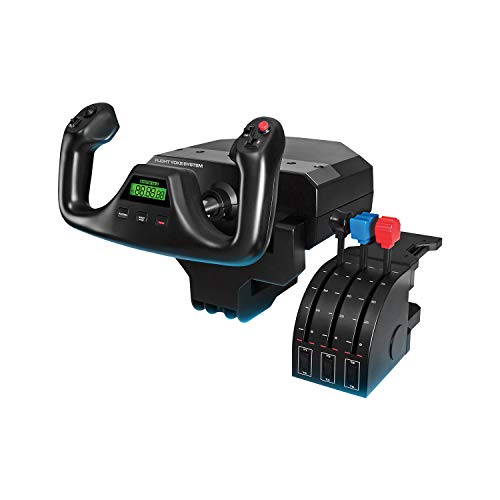

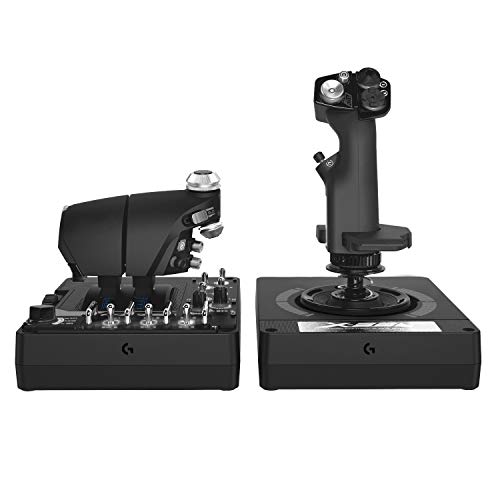
The sensible single-stick choice, and the obvious one if you fly left-handed. H.E.A.R.T magnetic sensing means the accuracy you get on day one is the accuracy you get in a year, the three swappable parts genuinely solve handedness rather than gesturing at it, and sixteen marked buttons plus four axes let it fly a complete flight model alone. Add a throttle unit later if power management becomes the thing you care about.
Frequently Asked Questions
Can left-handed pilots actually use this?
Yes, and that is the point of it. The listing describes a fully ambidextrous design with three removable and swappable components you fit to suit your dominant hand. Most flight sticks are moulded right handed with no alternative, so this is a genuine difference rather than a marketing line.
What is H.E.A.R.T sensing and does it matter?
It is Thrustmaster's patented magnetic sensor technology, and yes. Magnetic sensing reads stick position without a sliding electrical contact, so there is no wiper to wear. That is what stops an older stick developing centre drift and dead spots as the hours build up.
Do I need rudder pedals with it?
Not to start. Yaw is handled by twisting the handle, and Thrustmaster states the built-in twist rudder removes the need for separate pedals. Pedals are still more precise and free your hands, but the stick flies a complete flight model without them.
Does it include a throttle?
It has a throttle axis but not a separate throttle lever. Four independent axes cover pitch, roll, yaw and throttle on the stick itself. If precise power management matters to you, treat this as a base to which a throttle unit is added later.
How many buttons does it have?
Sixteen action buttons plus an eight way point of view hat switch. The buttons carry braille style raised identification marks, which is what makes a count that high usable: you find the button by feel instead of looking away from the screen.
Is it plug and play?
The hardware works on connection, but profiles run through Thrustmaster's T.A.R.G.E.T programming software where you load or build per-title button maps. Expect to spend time there if you fly several different genres with different control needs.
How big is it on a desk?
8.18 inches long by 9.44 wide and 7.79 high, at 1.89 pounds. That is compact and light for a flight stick, which suits a desk that cannot host a two-piece HOTAS. The low weight does mean it is less planted than a weighted base.
What warranty does it carry?
One year, per the manufacturer information on the listing. The part and model number are both given as 2960773, which is worth noting when matching accessories or checking a return against the right revision.
This review is based on the manufacturer's stated specifications, the current product listing and its images, the confirmed dimensions, weight, sensor technology, button and axis count, software and warranty, and our own research into how flight stick sensing and ergonomics differ. It is editorial analysis, not laboratory testing, and we have not flown with this unit ourselves. Where a figure was not confirmed by the listing, we left it out.