Thrustmaster T-Flight Hotas X Flight Stick and Throttle Review
A detachable throttle and twelve programmable buttons make this the sensible first step out of a gamepad.

| Brand | Thrustmaster |
|---|---|
| Model | 2960703 |
| Type | HOTAS, joystick with detachable throttle |
| Buttons | 12 action buttons, fully programmable |
| Axes | 5, fully programmable |
| Rudder control | Handle rotation or progressive tilting lever |
| Best for | First-time flight sim pilots moving off a gamepad |
Product Overview
HOTAS stands for hands on throttle and stick, and it describes the layout real aircraft use: one hand flies, the other manages power. The Thrustmaster T-Flight Hotas X puts both in one package, and the throttle detaches so you can spread the two units across a desk or bolt them to a cockpit frame.
What makes it a sensible starting point is that it arrives preconfigured. Thrustmaster lists plug and play operation with all functions already mapped, so a first flight does not begin with an hour of binding keys. The twelve action buttons and five axes are fully programmable when you want to change that, and an onboard memory keeps your profile even after the unit is unplugged.
Two details separate it from a plain joystick. Rudder input can come either from twisting the handle or from a progressive tilting lever, so you can choose the motion that suits you. And a dedicated preset button swaps between programmes mid flight, which matters when one aircraft wants a different layout to the next.
Score Breakdown
This verdict is based on the manufacturer's stated specifications, the current Amazon listing and its product images, the confirmed materials and design, real buyer ratings, and our research into the product category. Scores are consistent editorial judgments, not laboratory measurements, and we did not receive a paid sample.
Key Features
The throttle separates from the stick, so you can run a compact joined setup on a desk or split the two units across a cockpit frame.
Enough controls for pitch, roll, yaw, throttle and view, with buttons left for gear, flaps, brakes and trim.
A dial on the stick changes how much force it takes to move, which is a physical adjustment rather than a software curve.
Yaw comes either from twisting the handle or from a progressive tilting lever, so you can pick the motion that feels controlled.
One button swaps between whole programmes mid flight, another instantly exchanges any two functions without leaving the cockpit.
Custom programming is retained in the unit even after it is disconnected, so a profile survives moving between machines.
Added mass in the base is listed specifically to keep the stick planted when you pull against it.
Design and Build Quality
The unit measures 10.43 inches long by 10 wide and 9.47 high, and weighs 4.32 pounds. That weight is the point: Thrustmaster lists a weighted base specifically for stability, which is what stops a stick walking across the desk when you pull hard on it. Finish is black throughout.
The throttle is described as real size and ergonomically shaped, with a wide hand rest to keep the wrist neutral over a long session. It separates from the joystick entirely. Keep the two joined for a compact desktop footprint, or split them for a wider, more aircraft-like stance.
The stick itself carries a resistance dial. Turning it changes how much force the stick needs, which is a mechanical adjustment rather than a software one, and it is unusual at this level. Thrustmaster covers the unit with a one year warranty, and the part and model number are both listed as 2960703.
Performance in Everyday Use
Control count is the figure that decides whether a HOTAS replaces your keyboard or just supplements it. Twelve action buttons plus five axes is enough for the core flight set: pitch, roll, yaw, throttle and a view axis, with buttons left over for gear, flaps, brakes and trim. A multi-directional hat handles panoramic view, which is the control most pilots reach for most often.
The trigger is dual purpose by design, listed for wheel brakes in civil flying and rapid fire in military titles. A mapping button lets any function be swapped with any other instantly, so a layout that feels wrong in the air can be corrected without leaving the cockpit. That pairs with the preset button for switching whole programmes mid session.
Rudder deserves a note. Many entry sticks give you a twist axis and nothing else. This one offers twisting or a progressive tilting lever, so pilots who find twist imprecise have a second option without buying pedals. It is not a substitute for proper rudder pedals, but it is more than most sticks at this level provide.
How It Performs: The Evidence
| Decision factor | What we found | Evidence and measurement | Score | Why it matters |
|---|---|---|---|---|
| Control count | 12 action buttons and 5 axes, all programmable | Listing states 12 action buttons and 5 axes are entirely programmable | 9.0 | Decides whether the HOTAS replaces keyboard commands or only supplements them |
| Throttle layout | Full size throttle that detaches from the stick | Listing describes a detachable, real size, ergonomically designed throttle control | 9.0 | Determines how you can arrange the units on a desk or a cockpit frame |
| Stick tension | Adjustable by a mechanical dial | Listing states a high precision joystick with adjustable resistance | 9.0 | Stick weight is personal, and a dial avoids living with one fixed spring |
| Rudder control | Handle rotation or a progressive tilting lever | Listing states dual rudder control via handle rotation or progressive tilting lever | 8.5 | Twist-only sticks frustrate pilots who want finer yaw without buying pedals |
| Setup effort | Preconfigured controls, plug and play | Listing states all functions are pre-configured for immediate use | 9.5 | A first session spent binding keys is where many new sim pilots give up |
| Profile handling | Preset button plus onboard memory | Listing states a preset button switches programmes while playing and built-in memory saves programming when disconnected | 9.0 | Different aircraft want different layouts, and reprogramming each time is friction |
| Stability | Weighted base, 4.32 lb total | Listing states a weighted base for greater stability; weight confirmed at 4.32 pounds | 8.0 | A light stick slides on a desk exactly when you need precision |
| Construction | Plastic body, one year warranty | No metal internals stated in the listing; warranty listed as one year | 7.5 | Sets how long it survives heavy use and how far it can be upgraded |
Who Should Buy It
- First flight sim setup after a gamepad
- Civil aviation and airliner simulators
- Military combat flight titles
- Desk setups that need the throttle moved aside
- Players who switch between several aircraft profiles
- Pilots who need twin throttles, a force feedback base, or helicopter collective controls
- Plastic construction rather than metal internals
- Single throttle lever, not a dual-engine pair
- No force feedback in the base
Full Specifications
How It Compares
| Feature | Thrustmaster | Typical budget | Premium option |
|---|---|---|---|
| Throttle | Detachable, full size | Fixed to the stick base | Separate dual-lever quadrant |
| Programmable buttons | Twelve, plus five axes | Fewer, and often not remappable | More, on premium metal sticks |
| Stick tension | Mechanical resistance dial | One fixed spring | Swappable cam and spring kit |
| Rudder input | Twist or tilting lever | Twist only | Dedicated rudder pedals |
| Setup effort | Preconfigured, plug and play | Manual binding required | Manual binding plus driver profiles |
| Profile storage | Onboard memory, survives unplugging | Stored on the PC only | Onboard plus software suite |
| Base feedback | Spring and dial, no motors | Spring only | Force feedback motors |
Alternatives Worth a Look
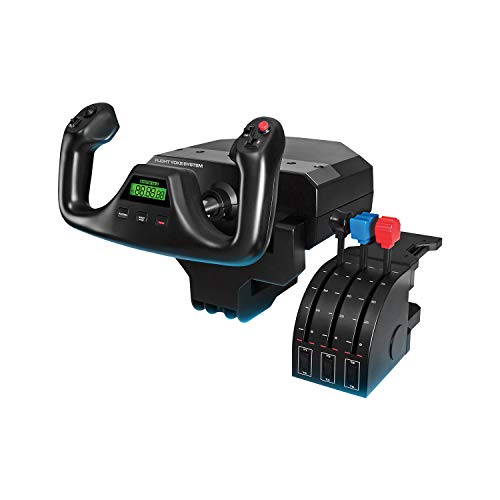
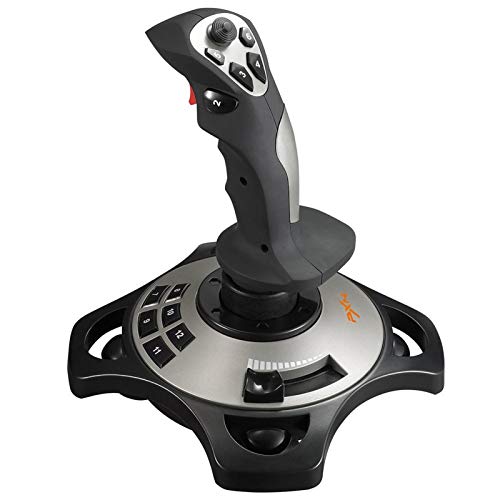

A genuinely sensible first HOTAS. The detachable throttle, twelve programmable buttons and a mechanical resistance dial deliver most of what a beginner needs, and the preconfigured setup means you fly on day one instead of binding keys. Pilots chasing metal construction, twin throttles or force feedback will outgrow it, but as the step off a gamepad it is hard to argue with.
Frequently Asked Questions
Does the throttle really come apart from the stick?
Yes. Thrustmaster lists the throttle as detachable and real size, so you can keep the two units joined for a compact desktop footprint or separate them to sit either side of a chair or mount them on a cockpit frame.
How many controls does it have?
Twelve action buttons and five axes, and the listing states all of them are entirely programmable. There is also a multi-directional hat switch for panoramic view, a dual purpose trigger, a preset button and a mapping button.
Can I adjust how stiff the stick feels?
Yes, and mechanically rather than in software. The stick carries a resistance dial that changes the force needed to move it, which is unusual on an entry level flight stick and means you are not stuck with one fixed spring weight.
Do I need rudder pedals as well?
Not to start. Yaw can come from twisting the handle or from a progressive tilting lever, so you get two options in the box. Pedals are still more precise and free up your hands, but this covers rudder well enough to learn on.
Is it plug and play or does it need configuring?
Plug and play. The listing states all functions arrive pre-configured for immediate use, so your first flight does not start with binding keys. You can reprogramme everything later, and the unit remembers your profile even when unplugged.
Will it work on a console?
This listing is specified for PC over USB. Thrustmaster has sold console variants of the T-Flight line in the past, so check the exact listing against your platform before ordering rather than assuming compatibility.
Does it have force feedback?
No. The base is a spring and dial arrangement with no motors, which is normal at this level. Force feedback bases exist but sit in a different class of product entirely, both in build and in what they ask of your desk.
How big is it on a desk?
The set measures 10.43 inches long by 10 inches wide and 9.47 inches high, weighing 4.32 pounds. Joined together that is a compact footprint for a HOTAS. Separating the throttle spreads the same mass over more desk width.
What warranty does it carry?
One year, per the manufacturer information on the listing. The part number and model number are both given as 2960703, which is worth noting if you need to match accessories or check a return against the right revision.
This review is based on the manufacturer's stated specifications, the current product listing and its images, the confirmed dimensions, weight, control count and warranty, and our own research into what flight sim controllers at this level typically offer. It is editorial analysis, not laboratory testing, and we have not flown with this unit ourselves. Where a figure was not confirmed by the listing, we left it out rather than estimate it.