TAOKIHAI 1.5 Inch Schedule 40 PVC Ball Valve, 2 Pack Review
A pair of slip-socket PVC shut-off valves with EPDM seals and a T-handle, built in one piece.
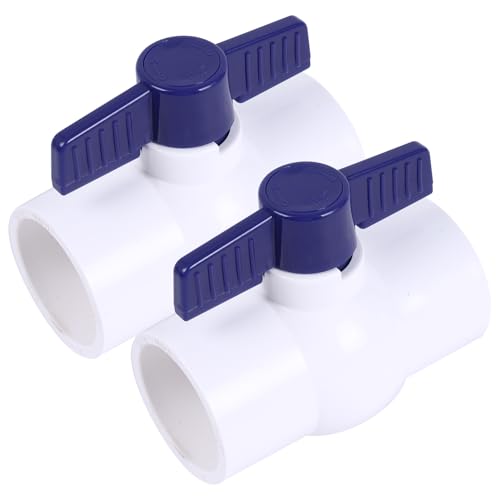
| Brand | TAOKIHAI |
|---|---|
| Size | 1-1/2 inch |
| Schedule | SCH40 |
| Quantity | 2 |
| Connection | Slip socket, solvent weld |
| Body | One-piece PVC |
| Best for | Pool, irrigation and cold water pipework where a permanent solvent-welded shut-off is wanted |
Product Overview
A ball valve is the right kind of shut-off for water pipework because of how it closes. A quarter turn takes it from fully open to fully shut, and when open the bore is straight through, so it barely restricts flow at all.
That matters more on a pool or irrigation line than on a tap. Those systems are pumped, and every restriction costs pump pressure, so a valve that gets out of the way when open is doing real work for the system's efficiency.
Schedule 40 is the pipe pressure schedule, and it tells you the wall thickness class rather than a specific rating. It is the common standard for domestic and pool PVC pipework, so a Schedule 40 valve sits naturally in that pipework without adapters.
Two valves in a pack is a sensible quantity, because isolation almost always needs a pair. Putting a valve on each side of a pump, a filter or a heater is what lets you service that item without draining the whole system.
Score Breakdown
This verdict is based on the manufacturer's stated specifications, the current Amazon listing and its product images, the confirmed materials and design, real buyer ratings, and our research into the product category. Scores are consistent editorial judgments, not laboratory measurements, and we did not receive a paid sample.
Key Features
Fully open to fully shut in a quarter turn, and when open the bore is straight through so it barely restricts flow.
Pool and irrigation systems are pumped, so every restriction costs pressure, and a valve that gets out of the way earns its place.
The correct elastomer for water service, handling chlorinated water and resisting the ozone and ultraviolet that degrade other rubbers outdoors.
The common wall thickness class for domestic and pool PVC pipework, so the valve fits that pipework without adapters.
Isolation almost always needs two, one each side of a pump, filter or heater, so that item can be serviced without draining the system.
No body joints to leak, which is the strongest way to make a PVC valve, with the trade that it cannot be opened for service.
Gives leverage in both directions and does not protrude the way a lever does, so it is less easily knocked open in a pump housing.
These valves live in wet environments by definition, and a smooth handle on a stiff valve with wet hands simply will not turn.
Design and Build Quality
The connection type is the single most important thing to understand and the listing does not make it clear enough. Slip sockets are solvent welded, which means the pipe is glued into the valve with PVC cement and the joint is chemically fused.
That has a consequence worth being blunt about. TAOKIHAI describes the sliding connection as allowing simple installation and removal, and the installation part is true: solvent welding is quick and needs no tools. Removal is not. A solvent-welded joint cannot be unscrewed, and taking the valve out means cutting the pipe.
So plan the installation knowing it is permanent. That is not a flaw, because solvent-welded joints are the most reliable connection PVC offers, but it means deciding valve position before gluing rather than after.
The seal is an EPDM O-ring, and EPDM is the correct elastomer for water service. It handles chlorinated water, which matters on a pool line, and resists the ozone and ultraviolet exposure that degrade other rubbers in outdoor plant.
One-piece construction gives a strong body with no joints to leak, and a trade worth knowing. A one-piece valve cannot be opened to replace the seal, so when the O-ring eventually hardens the whole valve is replaced rather than serviced.
Performance in Everyday Use
The T-handle is a better choice than a lever for this application. A T-handle gives leverage in both directions and does not protrude in a way that can be knocked open, which on an isolation valve in a pump housing is a genuine advantage.
TAOKIHAI describes the handle as non-slip, which matters because these valves live in wet environments by definition. A smooth plastic handle on a stiff valve with wet hands is exactly the situation where you cannot get it to move.
The application list is coherent for PVC: swimming pools, lawn sprinkler systems, hose nozzles, irrigation, sewage, aquariums and pool aerators. All are cold water or low-pressure drainage, which is where PVC belongs.
What the listing does not publish is a pressure rating or a temperature limit, and both are significant omissions on a valve. PVC loses strength as it warms, which is why PVC pipework is not used for hot water, and a valve body is the component under most stress in a line.
Treat it as cold water only, therefore, and do not use it on compressed air. PVC under air pressure fails by shattering rather than splitting, which makes it a genuine hazard, and that applies to the pipework trade generally rather than to this product specifically.
How It Performs: The Evidence
| Decision factor | What we found | Evidence and measurement | Score | Why it matters |
|---|---|---|---|---|
| Valve type | Ball valve with socket design for on off control | Listing states the shut off ball valve's socket design allows easy ON/OFF control, providing precise fluid regulation for an optimal flow rate | 9.5 | A ball valve's bore is straight through when open, so it barely restricts flow, which matters on a pumped pool or irrigation line |
| Seal material | Built-in EPDM O-ring | Listing states a one-piece construction with built-in EPDM O-ring ensuring a tight leak-free seal, suited to water treatment systems including swimming pools | 9.5 | EPDM handles chlorinated water and resists the ozone and ultraviolet exposure that degrade other elastomers in outdoor plant |
| Body construction | One piece | Listing states one-piece construction alongside the built-in O-ring | 9.2 | No body joints to leak, with the trade that the valve cannot be opened to replace the seal when it eventually hardens |
| Handle | Non-slip T-handle | Listing states a non-slip handle ensuring smooth effortless opening and closing, with a durable T-handle to control flow | 9.4 | T-handles give leverage both ways and sit out of the way, and non-slip matters because these valves live in wet places |
| Material properties | PVC with impact strength and corrosion resistance | Listing states it is crafted from high-quality PVC offering superior impact strength and corrosion resistance for long-lasting outdoor use | 9.0 | Corrosion resistance is PVC's main advantage over metal valves in pool and irrigation service |
| Quantity | Two valves | Listing states the set includes 2 pieces of 1-1/2 inch ball valves | 9.3 | Isolation almost always needs a pair, one either side of the pump or filter being serviced |
| Applications | Pools, sprinklers, irrigation, aquariums, sewage | Listing names indoor and outdoor plumbing, irrigation, sewage systems, aquariums and pool aerators | 9.2 | All are cold water or low-pressure drainage service, which is where PVC pipework belongs |
| Connection type | Slip socket described as easy to remove | Listing states the set has a sliding connection for simple installation and removal | 5.0 | Slip sockets are solvent welded and chemically fused, so the joint cannot be unscrewed and removal means cutting the pipe |
| Rating disclosure | No pressure or temperature figures | The listing states the size and SCH40 schedule but publishes no pressure rating or temperature limit | 3.5 | PVC loses strength as it warms, which is why it is not used for hot water, and the valve body is the most stressed part of a line |
Who Should Buy It
- Swimming pool pipework
- Lawn sprinkler and irrigation systems
- Isolating a pump or filter for service
- Aquarium and pond plumbing
- Pool aerators
- Cold water and low-pressure drainage
- Hot water, compressed air, or any line you expect to dismantle later
- Slip sockets are permanent, and removal means cutting the pipe
- The listing calls the connection easy to remove, which it is not
- One-piece body cannot be opened to replace the seal
- No pressure rating published
- No temperature limit published
- Not for hot water, and never for compressed air
Full Specifications
How It Compares
| Feature | TAOKIHAI | Typical option | Higher-tier option |
|---|---|---|---|
| Valve type | Ball, quarter turn | Gate | Ball |
| Flow restriction when open | Minimal | Higher | Minimal |
| Connection | Slip socket, permanent | Threaded | Union, removable |
| Seal material | EPDM | Not stated | EPDM |
| Serviceable seal | No, one piece | No | Yes, union body |
| Handle | Non-slip T-handle | Lever | T-handle |
| Pressure rating stated | No | No | Stated |
| Quantity | Two | One | Two |
Alternatives Worth a Look


The right valve type and the right seal material for pool and irrigation work: a quarter-turn ball valve barely restricts flow when open, which matters on pumped systems, and EPDM handles chlorinated water and outdoor exposure. Two in a pack suits isolation, which almost always needs a pair. The thing the listing understates is that slip sockets are solvent welded, so the installation is permanent and removal means cutting the pipe. No pressure or temperature rating is published.
Frequently Asked Questions
Can I unscrew these to remove them later?
No, and this is the most important thing to know. Slip sockets are solvent welded, meaning the pipe is glued in with PVC cement and chemically fused. The listing mentions simple removal, but a welded joint cannot be unscrewed and taking the valve out means cutting the pipe.
So should I avoid them?
Not at all. Solvent-welded joints are the most reliable connection PVC offers, which is why they are standard. It simply means deciding where the valve goes before you glue it, rather than treating the position as something you can change afterwards.
Can I replace the seal when it wears?
No. The body is one piece, so it cannot be opened to service the O-ring. When the EPDM eventually hardens, the valve is replaced rather than repaired, which is normal at this type and worth factoring into where you install it.
Why is EPDM the right seal for this?
Because of what it resists. EPDM copes with chlorinated water, which matters on a pool line, and it holds up against the ozone and ultraviolet exposure that degrade other rubbers in outdoor pipework. It is the standard choice for water service.
What pressure can it take?
Not published, which is a real omission on a valve. The SCH40 designation tells you the wall thickness class rather than a specific rating. Ask the seller if your system runs at any meaningful pressure rather than assuming.
Can I use it for hot water?
No. PVC loses strength as temperature rises, which is exactly why PVC pipework is not used for hot water lines anywhere. No temperature limit is published either, so treat these as cold water and low-pressure drainage only.
What about compressed air?
Never. PVC under air pressure fails by shattering rather than splitting, which makes it a genuine injury hazard. That applies to PVC pipework generally rather than to this product in particular, but it is the one use to rule out absolutely.
Why do I need two?
Because isolation usually does. Fitting a valve on each side of a pump, filter or heater is what lets you service that component without draining the whole system, which is the normal reason for putting shut-offs in a line at all.
This review is based on the manufacturer's stated specifications, the current product listing and its images, the stated size and pipe schedule, the socket connection type, the stated one-piece construction and EPDM seal, the handle description, the quantity and the named applications, plus our own research into how solvent-welded joints differ from threaded ones, why EPDM suits chlorinated water, why ball valves restrict flow less than other types, and why PVC is unsuitable for hot water and compressed air. It is editorial analysis, not laboratory testing. We have not fitted these valves, and we have noted that no pressure or temperature rating is published.