Logitech G X56 H.O.T.A.S Throttle and Joystick Review
Twin throttles, hall-effect sensors and a four-spring system put this a clear tier above an entry HOTAS.
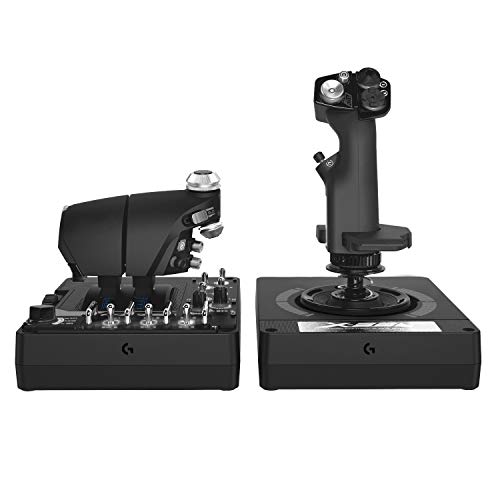
| Brand | Logitech G |
|---|---|
| Model | 945-000058 |
| Type | HOTAS, separate joystick and twin throttle |
| Programmable controls | More than 189 |
| Main axes | 16-bit aileron and elevator, hall-effect sensors |
| Stick force | Advanced 4-spring system |
| Best for | Space and combat sim pilots who have outgrown a single-throttle stick |
Product Overview
The X56 is a two-unit HOTAS: a joystick and a separate twin-throttle module, each on its own USB connection. That is the first thing to plan for, because it needs two USB 2.0 ports and a stretch of desk, where an entry level set gets by on one port and half the space.
What you get for that is control density. Logitech lists more than 189 programmable controls across the pair, which is enough to put almost every function in a space or combat sim under your hands rather than on the keyboard. Two mini analog sticks add pitch, roll, yaw and six-way translation, plus gimballed weapon control handled separately from the craft itself.
The other half of the pitch is adjustability. An advanced four-spring system changes how much force the stick needs, swapped mechanically rather than tuned in software. The twin throttles carry a friction adjuster and a throttle lock, so you can set how freely the levers move and hold a setting in place.
Score Breakdown
This verdict is based on the manufacturer's stated specifications, the current Amazon listing and its product images, the confirmed materials and design, real buyer ratings, and our research into the product category. Scores are consistent editorial judgments, not laboratory measurements, and we did not receive a paid sample.
Key Features
Enough across the stick and throttles to put flight, thrust, targeting and systems under your hands and leave the keyboard out of it.
The 16-bit aileron and elevator axes read position magnetically, with no wiper contact to wear into drift or dead spots.
Stick force is changed by swapping springs, a mechanical adjustment you set to your own preference rather than a software curve.
Two levers with a friction adjuster for resistance and a throttle lock to hold a position, suiting twin-engine and split-thrust flying.
Pitch, roll and yaw plus six-way translation, and gimballed weapons controlled separately from the craft itself.
Lighting colour is set in software, so the controller can match the rest of a build rather than fixing one colour.
Logitech positions the controls so button feel and shape distinguish them, which is what you rely on when a headset hides your hands.
Design and Build Quality
Together the units measure 11.54 inches long by 12.24 wide and 9.06 high, weighing 6.922 pounds. That mass is doing work: a HOTAS that shifts under load is a HOTAS you fight rather than fly. Finish is black throughout, with RGB backlighting you set in software to match the rest of a build.
Sensing is the part that separates this from entry level sticks. Logitech specifies 16-bit aileron and elevator axes using hall-effect sensors, which read position magnetically with no wiper contact to wear. Potentiometer-based sticks develop drift and dead spots over time, and hall-effect designs are the standard answer to it.
The four-spring system ships as interchangeable springs rather than a dial, so stick weight is a physical choice you make once and can revisit. Cable length is listed at 2 metres, and the part and model number are both 945-000058. System requirements are Windows 11, 10, 8.1 or 7 with two USB 2.0 ports.
Performance in Everyday Use
Control count is the headline and it is not marketing padding. More than 189 programmable controls across a stick and twin throttles covers the full set a space sim asks for: flight, thrust, power management, targeting, countermeasures and comms, with room left over. In a combat flight title it means the keyboard stops being part of the loop.
The mini analog sticks are what make it suit space sims specifically. Beyond pitch, roll and yaw you get backwards, forwards, up, down, left and right translation, which is how a spacecraft actually manoeuvres, plus gimballed weapons aimed independently of the hull. A conventional HOTAS has no clean way to express that.
Twin throttles matter for twin-engine aircraft and for anything where you split thrust between two sources. The friction adjuster sets how much resistance the levers have, and the throttle lock holds a position so a lever does not creep. Both are mechanical controls, which is the right call for something you adjust mid flight by feel.
Logitech also calls the layout out as suited to VR, on the reasoning that when you cannot see the controls you navigate by button shape and feel. That is a design claim rather than a measurement, but the logic holds: distinct shapes under the fingers are what let you fly blind.
How It Performs: The Evidence
| Decision factor | What we found | Evidence and measurement | Score | Why it matters |
|---|---|---|---|---|
| Control count | More than 189 programmable controls across both units | Listing states +189 programmable controls | 9.5 | Decides whether the keyboard leaves the loop entirely |
| Axis sensing | 16-bit aileron and elevator on hall-effect sensors | Listing states accurate 16-bit aileron and elevator axis with hall-effect sensors | 9.5 | Hall-effect avoids the drift and dead spots potentiometers develop |
| Stick force | Four interchangeable springs | Listing states adjustable stick force via an advanced 4-spring system | 9.0 | Stick weight is personal and a mechanical swap outlasts a software curve |
| Throttle control | Twin throttles with friction adjuster and throttle lock | Listing states twin throttles with friction adjuster and throttle lock | 9.5 | Twin-engine and split-thrust flying needs two levers, not one |
| Space sim controls | Mini analog sticks covering six-way translation and gimballed weapons | Listing states control of pitch, roll, yaw, six directions of translation and separately gimballed weapons | 9.5 | Conventional HOTAS layouts have no clean way to express translation |
| Stability | 6.922 lb across two units | Weight confirmed at 6.922 pounds in the listing specifications | 9.0 | A HOTAS that slides under load is one you fight rather than fly |
| Setup effort | Software configuration and two USB 2.0 ports | Listing states system requirements of Windows 11, 10, 8.1 or 7 and 2x USB 2.0 ports | 7.0 | This is a configure-then-fly product, unlike preconfigured entry sets |
| Desk requirement | 11.54 by 12.24 by 9.06 inches across separate units | Dimensions confirmed in the listing specifications | 8.0 | Two-piece setups need width an all-in-one stick does not |
Who Should Buy It
- Space sims needing six-way translation
- Military combat flight titles
- Twin-engine aircraft that split thrust
- VR flying where you cannot see the controls
- Pilots upgrading from a single-throttle HOTAS
- Beginners wanting something preconfigured, or desks without room for two separate units
- Requires two USB 2.0 ports
- Needs software setup rather than flying out of the box
- Takes noticeably more desk space than a single-piece HOTAS
Full Specifications
How It Compares
| Feature | Logitech G | Typical budget | Premium option |
|---|---|---|---|
| Pieces | Two separate units | One joined unit | Stick, throttle and pedals separately |
| Programmable controls | More than 189 | Around a dozen | Comparable, on modular panels |
| Main axis sensing | Hall-effect, 16-bit | Potentiometer | Hall-effect with force feedback |
| Stick force | Four interchangeable springs | One fixed spring | Cam and spring kits |
| Throttles | Twin, friction adjuster and lock | Single lever | Dedicated throttle quadrant |
| Setup | Software configuration | Preconfigured, plug and play | Software plus per-aircraft profiles |
| Ports needed | Two USB | One USB | Two or more USB |
Alternatives Worth a Look
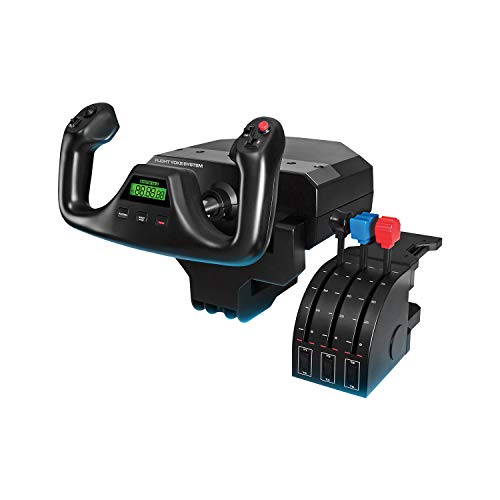


A serious HOTAS for pilots who have run out of buttons. Hall-effect sensing on the main axes, four interchangeable springs and twin throttles with a friction adjuster are the things that separate a lasting setup from a starter one, and more than 189 programmable controls means the keyboard can leave the loop entirely. It asks for two USB ports, desk space and time in the software, so it is a step up rather than a first purchase.
Frequently Asked Questions
How many controls does the X56 actually have?
Logitech lists more than 189 programmable controls across the joystick and the twin throttle unit together. That is enough to cover flight, thrust, power, targeting, countermeasures and comms in a space or combat sim without reaching for the keyboard.
What are hall-effect sensors and why do they matter?
They read stick position magnetically rather than through a sliding electrical contact. Potentiometer sticks wear at the contact point and develop drift and centre dead spots over time. The X56 uses hall-effect sensing on its 16-bit aileron and elevator axes, which avoids that wear path.
Can I change how stiff the stick feels?
Yes, mechanically. The X56 ships with an advanced four-spring system, so you swap in the spring that matches the weight you want rather than adjusting a software curve. It is a one-time fitting you can revisit if your preference changes.
Why twin throttles instead of one?
Because twin-engine aircraft and many spacecraft split thrust between sources, and one lever cannot express that. The pair also carries a friction adjuster to set how freely they move and a throttle lock to hold a position, both adjusted by hand rather than in software.
Is it good for space sims specifically?
That is where it stands out. The mini analog sticks add backwards, forwards, up, down, left and right translation on top of pitch, roll and yaw, plus gimballed weapons controlled separately from the craft. A conventional flight HOTAS has no clean mapping for six-way translation.
Does it work in VR?
Logitech positions it for VR, on the basis that distinct button shapes and feel let you find controls you cannot see. That is a design argument rather than a measured claim, but the reasoning is sound: in a headset you navigate a control set by touch.
What does it need from my PC?
Two USB 2.0 ports, since the joystick and throttle connect separately, and Windows 11, 10, 8.1 or 7. The cable length is listed at 2 metres. Plan the port count before ordering, because this is not a single-cable device.
Is it plug and play?
Not in the way an entry HOTAS is. With this many controls you configure it in software to suit each title, which is the trade for the control count. If you want to fly within minutes of unboxing, a preconfigured set is the better starting point.
How much desk space does it take?
The pair measures 11.54 inches long by 12.24 wide and 9.06 high, weighing 6.922 pounds. Because the units are separate you can spread them to either side of a keyboard or chair, but the total width needed is more than a one-piece stick.
This review is based on the manufacturer's stated specifications, the current product listing and its images, the confirmed dimensions, weight, control count, sensor type, cable length and system requirements, and our own research into what HOTAS setups at this level typically offer. It is editorial analysis, not laboratory testing, and we have not flown with this unit ourselves. The listing's warranty text was truncated where we read it, so we have not stated a warranty period.