Acer OHR727 Kids Bluetooth Headphones Review
An 85dB limiter that meets US safety standards, 110 hours of playtime, and earcups sized for growing ears.
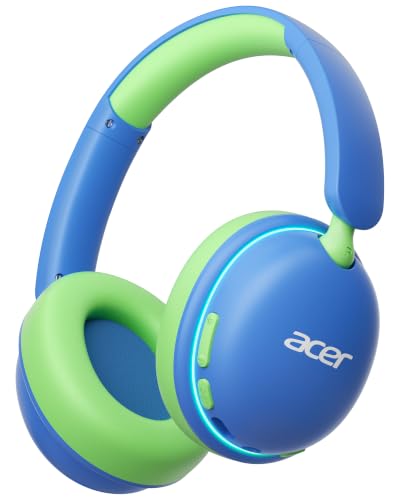
| Brand | Acer |
|---|---|
| Model | OHR727 |
| Type | Over-ear wireless |
| Volume limit | 85dB, stated to meet US safety standards |
| Playtime | 110 hours |
| Fast charge | 10 minutes for 4 hours |
| Best for | School, online classes and long journeys, where volume limiting and battery life both matter |
Product Overview
The one specification that matters most on children's headphones is the one most listings bury, so start there: Acer builds in an 85dB volume limiter and states it meets US safety standards. That cap is the entire point of buying headphones made for children rather than shrinking down adult ones, because a child handed an unlimited pair will find the top of the dial and stay there.
Around that sits a genuinely strong set of numbers. Acer quotes 110 hours of playtime, which is the figure that separates this from most of the category, and a 10 minute charge over USB-C adds 4 hours. For a school term, a week of car journeys or a long flight, that is the difference between charging nightly and charging occasionally.
The fit has been thought about too. The over-ear openings measure 54 by 40mm, which Acer describes as engineered for growing ears to eliminate pressure points, and the earcups are directional, set at 90 degrees on the left and 10 degrees on the right. That asymmetry looks odd written down but it is how a cup sits flat against the side of a head rather than fighting it.
Score Breakdown
This verdict is based on the manufacturer's stated specifications, the current Amazon listing and its product images, the confirmed materials and design, real buyer ratings, and our research into the product category. Scores are consistent editorial judgments, not laboratory measurements, and we did not receive a paid sample.
Key Features
Built in and stated to meet US safety standards, which is the entire reason to choose headphones made for children over adult ones.
Enough for a school term of use between charges, with a 10 minute Type-C charge adding 4 hours when someone forgets.
Over-ear openings of 54 by 40mm with directional cups at 90 degrees left and 10 degrees right, to avoid the pressure points children notice.
Quoted as lag-free and stable up to 33 feet, which matters because most of the use is video and virtual learning.
Lets a child answer in an online class rather than only listen, with clear voice pickup.
Built for classroom desks and backpack drops, with a Children's Product Certificate issued for it.
Five colours that pulse with the music. A feature for a younger child and a dealbreaker for an older one.
Design and Build Quality
Children break things, so construction matters more here than acoustics. Acer uses shatterproof materials and positions them specifically for surviving classroom desks and backpack drops, which are the two ways these actually die. The headphones are CPC certified, meaning a Children's Product Certificate has been issued for them, which is a regulatory step rather than a marketing claim.
Weight gets attention because a child notices it long before an adult does. Acer calls the build ultra-lightweight, and the over-ear design with 54 by 40mm openings is intended to rest around the ear instead of pressing on it. Pressure points are what make a child pull headphones off after twenty minutes, so the opening size and the directional cups are doing real work rather than decorating the listing.
The LED lights will divide buyers. Acer fits 5 colour lights that pulse with the rhythm, aimed squarely at making a child enjoy wearing them. For a six year old on a school bus that is a feature. For a twelve year old it is a reason to refuse, so match this to the age rather than assuming it appeals across the range. The version listed here is Blue Green.
Warranty is recorded as 1 year, and the model is OHR727. That is a normal term, and it is at least stated clearly, which is more than several children's audio brands manage.
Performance in Everyday Use
Battery life is where this pulls away from the field. One hundred and ten hours is not a figure you need to think about weekly, and Acer frames it for week-long school days, cross-country road trips and camping. The 10 minute top-up giving 4 hours is the more practically useful number, because the real scenario is a child who forgot to charge and a car leaving in fifteen minutes.
Connection is handled by Bluetooth 6.0, which Acer quotes as stable and lag-free up to 33 feet. Lag matters more for children than adults because so much of the use is video and virtual learning, where audio drifting behind lips is immediately noticeable and quietly maddening. A built-in HD microphone covers the other half of online classes, so a child can answer rather than only listen.
On the volume cap, be clear about what it does and does not give you. The 85dB limiter is built in and Acer states it meets US safety standards, which protects hearing during school classes and general listening. What the listing does not describe is any way to adjust it downward, so if you want a lower ceiling for a very young child, this is a fixed decision rather than a setting. For most school-age use 85dB is the accepted guideline.
Sound is described as stereo and the headphones are clearly tuned for speech and video rather than for critical music listening. That is the right priority for the job. There is no mention of active noise cancelling anywhere in the listing, so on a plane or a noisy bus a child will still raise the volume to compete with the background, which is exactly the moment the limiter earns its place.
How It Performs: The Evidence
| Decision factor | What we found | Evidence and measurement | Score | Why it matters |
|---|---|---|---|---|
| Volume limiting | Built-in 85dB limiter, stated to meet US safety standards | Listing states a built-in 85dB volume limiter that meets US safety standards to protect hearing during school online classes | 9.5 | A child handed an unlimited pair will find the top of the dial and stay there |
| Battery life | 110 hours of playtime | Listing states 110 hours of battery life, suited to week-long school days, road trips and camping | 9.8 | It removes nightly charging, which is the usual point of failure with children's devices |
| Fast charging | A 10 minute Type-C charge adds 4 hours | Listing states a 10-min Type-C charge adds 4 hours of power | 9.5 | The real scenario is a flat pair and a car leaving in fifteen minutes |
| Fit | 54 by 40mm over-ear openings with directional cups | Listing states large 54x40mm over-ear openings to eliminate pressure points, with directional earcups at left 90 degrees and right 10 degrees | 9.3 | Pressure points are why children pull headphones off after twenty minutes |
| Connection | Bluetooth 6.0, stable up to 33 feet, with an HD microphone | Listing states lag-free stable audio up to 33ft with Bluetooth 6.0 and a built-in microphone for clear voice pickup | 9.0 | Lag is immediately noticeable on video, which is most of what children use these for |
| Durability | Shatterproof materials, CPC certified | Listing states the headphones are CPC-certified and built with shatterproof materials to survive classroom desks or backpack drops | 9.3 | Classroom desks and backpacks are how children's headphones actually break |
| Noise isolation | No active noise cancelling mentioned | The listing describes stereo sound and the volume limiter but makes no reference to active noise cancelling | 7.0 | On a noisy bus a child raises the volume to compete, which is when the cap matters most |
| Volume cap adjustment | No lower setting described | The listing presents the 85dB limiter as built in, with no mention of an adjustable level | 7.5 | Parents of very young children may want a ceiling below the general guideline |
Who Should Buy It
- School and online classes
- Long car journeys and flights
- Camping and weeks away from a charger
- Younger children who enjoy the lights
- Parents who want a hearing-safe volume cap
- Older teenagers who will find the LED lights childish, or anyone needing active noise cancelling
- The 85dB cap is fixed, with no lower setting for a young child
- No active noise cancelling, so background noise is not blocked
- The 5 colour LED lights will not appeal to older children
- Tuned for speech and video rather than critical music listening
Full Specifications
How It Compares
| Feature | Acer | Typical budget | Premium option |
|---|---|---|---|
| Volume cap | 85dB, meets US safety standards | None, full adult volume | Limited, no standard cited |
| Playtime | 110 hours | Around a day | Shorter |
| Fast charge | 10 minutes for 4 hours | None | None |
| Bluetooth | 6.0 | Older version | Current version |
| Microphone | Built-in HD | None | Built in |
| Durability | Shatterproof, CPC certified | Plastic, no certification | Reinforced |
| Noise cancelling | None | None | Active |
| Warranty | 1 year | Not stated | 1 year |
Alternatives Worth a Look


The right priorities in the right order. An 85dB limiter that Acer states meets US safety standards is the reason to buy headphones made for children, and 110 hours of playtime with a 4 hour top-up from ten minutes of charging removes the usual nightly charging chore. Earcup openings of 54 by 40mm with directional cups address the pressure points that make children take headphones off, and shatterproof materials with CPC certification cover how these actually get treated. The limiter is fixed rather than adjustable, and the LED lights suit a younger child more than an older one.
Frequently Asked Questions
How loud can they actually get?
Acer builds in an 85dB volume limiter and states it meets US safety standards. That cap is the main reason to buy headphones made for children rather than adult ones, because the limit applies no matter what the connected device is set to. It protects hearing during school classes and everyday listening.
Can I set the volume limit lower?
Not according to the listing. The 85dB limiter is presented as built in, with no adjustable level described. For most school-age children 85dB is the accepted guideline, but if you want a lower ceiling for a very young child, treat this as a fixed decision rather than a setting you can change.
How often will I need to charge them?
Rarely. Acer quotes 110 hours of playtime, which covers weeks of normal school use. The more useful figure day to day is the fast charge: 10 minutes on Type-C adds 4 hours, which covers the situation where nobody remembered to charge and you are about to leave.
Will they fit a small child comfortably?
That is what the design targets. The over-ear openings measure 54 by 40mm, which Acer describes as engineered for growing ears to eliminate pressure points, and the earcups are directional at 90 degrees on the left and 10 degrees on the right so they sit flat against the head rather than pressing in.
Can my child use them for online classes?
Yes. There is a built-in HD microphone for voice pickup, and Bluetooth 6.0 is quoted as lag-free and stable up to 33 feet. Lag matters for class video because audio drifting behind lips is distracting, so the current Bluetooth version is a sensible thing to have here.
Will they survive being thrown in a backpack?
Acer uses shatterproof materials and names classroom desks and backpack drops specifically, which are the two ways children's headphones usually die. They are also CPC certified, meaning a Children's Product Certificate has been issued, and the warranty is stated as 1 year.
Do they block out background noise?
No, there is no active noise cancelling mentioned anywhere in the listing. On a plane or a noisy bus a child will tend to raise the volume to compete with the background, and that is precisely the situation where the 85dB cap does its job by refusing to go higher.
Will an older child like them?
Possibly not. The 5 colour LED lights pulse with the music and are aimed at making a younger child enjoy wearing them, which is charming at six and embarrassing at twelve. The sound is tuned for speech and video rather than critical music listening, so match these to a primary school age.
This review is based on the manufacturer's stated specifications, the current product listing and its images, the confirmed volume limit and standards claim, battery and charging figures, Bluetooth version and range, earcup dimensions and angles, microphone, certification, materials, colour, model number and warranty term, plus our own research into how children's headphones are specified and why volume limiting matters. It is editorial analysis, not laboratory testing. We have not listened to these headphones or measured their output, and we have noted where the listing is silent, such as on noise cancelling and on adjusting the volume cap.