PBy the Pickpedia Team·5 picks compared·Last verified October 2026
Affiliate disclosure: As an Amazon Associate, Pickpedia earns from qualifying purchases. Links on this page are paid links, and we may earn a commission at no extra cost to you. This never affects our picks or scores.
This page contains affiliate links. If you buy through one we may earn a
commission, at no cost to you.
Before anything else: close the umbrella when the wind gets up, and close it
whenever you leave the patio. Nothing on this page is an argument for leaving one
open. A large canopy that comes over can injure somebody, and the arithmetic below
exists to show you how small the margins are, not to find you a wind speed you can
get away with.
With that said, the question has a clean answer and it is not the one the market
gives you. A base does not resist tipping with its weight. It resists with its
weight multiplied by how far that weight sits from the edge it would tip over. That
product is a moment, and a moment is what the wind applies too: a force multiplied
by the height at which it acts. Compare weights and you are comparing one of the
four numbers that matter. We carry two bases from the same maker where that
distinction changes the answer, and one of them has 41 percent more ballast and
155 percent more holding power.
The four numbers, and the one everybody leaves out
Tipping is a balance of moments about the downwind edge of the base.
On the wind's side: the force on the canopy, multiplied by the height of the
canopy above the ground. On the base's side: the ballast weight, multiplied by the
horizontal distance from where that weight acts to the tipping edge. Stay with the
base's side bigger and it stands. That is the whole of it, and it has an immediate
consequence: for the same mass, a wide flat base beats a tall narrow one, because
the lever arm is longer. Weight and footprint are not alternatives. They
multiply.
Now the wind force, which needs one quantity and one correction. The quantity is
dynamic pressure. In the units patio makers use, it is 0.00256 times the square of
the wind speed in miles per hour, giving pounds per square foot. So 10 miles per
hour is 0.256 pounds per square foot, 20 is 1.024, 30 is 2.304. Note what the
square does: 20 is four times the force of 10, and 30 is nine times. "It was fine
all summer" is therefore worth nothing as evidence, because the summer you observed
probably never contained the gust that matters.
The correction: a patio canopy is not a sail
Here is where our own writing has misled, and it is worth taking apart properly
because the mistake makes the force look about five times larger than it is.
Our guide to
choosing
a patio umbrella says: "A canopy is a big sail. It needs serious weight at the
bottom to stay upright, so the base matters as much as the umbrella." The
conclusion is right and the metaphor imports the wrong area. A sail is a vertical
surface, and horizontal wind meets all of it. A patio canopy is a roughly
horizontal surface, and horizontal wind meets its edge.
Do it with numbers. A 9 foot round canopy has a plan area of pi times 4.5
squared, which is 63.6 square feet. Seen from the side, which is how the wind sees
it, you get the diameter multiplied by the canopy's rise from rim to hub, perhaps
1.5 feet on a shallow market canopy. That is at most 13.5 square feet treating it
as a rectangle, and about 6.8 if you treat the silhouette as the triangle it
actually resembles. Call it 13.5 and you are being conservative. The plan area
overstates the horizontal drag by roughly a factor of five.
So at 20 miles per hour, with a drag coefficient of 1.0, the horizontal force on
that canopy is 1.024 times 13.5, which is about 14 pounds. Acting at 6.5 feet up,
that is 90 pound feet of overturning moment. At 25 miles per hour it is 22 pounds
and 140 pound feet. At 30 it is 31 pounds and 202 pound feet. Those are small
numbers, and they are the honest ones.
The same umbrella on two bases from the same maker. Tipping is a moment balance
about the downwind edge, so the base's own radius multiplies its weight, and the
wider base wins by more than its weight suggests.
Two of our bases, worked
A
Home Zone Living 21 inch
heavy duty umbrella base publishes both numbers you need: up to 119 pounds of
water fill, in a 21 inch square footprint. With the pole at the centre, the lever
arm to any edge is 10.5 inches, which is 0.875 feet. Restoring moment: 119 times
0.875, which is 104 pound feet. Set that against the canopy above and it is holding
at 20 miles per hour with a little in hand and losing somewhere around 22. Our own
record is honest that an empty base offers little anchoring weight and that water
fill can freeze, and it fairly notes every figure is maker stated. Details in our
Home Zone
Living 119 pound base review.
Now a
Home Zone Living 168 pound
fillable cantilever base, from the same maker, which publishes up to 168 pounds
across four interlocking panels forming 38 inches by 38 inches by 4 inches. Lever
arm 19 inches, which is 1.583 feet. Restoring moment: 168 times 1.583, which is
266 pound feet.
Put the two side by side. The ballast ratio is 168 over 119, which is 1.41. The
moment ratio is 266 over 104, which is 2.55. The wider base is worth almost twice
what its weight advantage suggests, and the whole difference is the footprint.
That is the answer to the question, and it is why a base rated in pounds alone
cannot be compared to another base rated in pounds alone.
And then the sobering half, which is the square law again. Going from 104 to 266
pound feet, a 2.55 times improvement, moves the static tipping speed by the square
root of 2.55, which is 1.6. In round numbers, from the low twenties to the mid
thirties of miles per hour. Two and a half times the holding power buys sixty
percent more wind speed. There is no amount of ballast that scales the way weather
does, which is the real reason every maker tells you to close the canopy and why
that advice is not a disclaimer.
The cantilever is a different problem, and the numbers say how different
An offset umbrella puts its mast to one side and hangs the canopy out on an arm.
That means the canopy's own weight is already acting through a long lever before
any air moves.
Take the 38 inch base above, whose tipping edge is 1.583 feet from the mast, and
a canopy and arm assembly whose centre of mass sits perhaps 5.5 feet out. The
canopy is then 3.92 feet beyond the tipping edge. If that assembly weighs 30
pounds, it applies 118 pound feet of permanent overturning moment, which is 44
percent of the base's 266. A cantilever spends nearly half its base's capacity
standing still on a windless day. At 20 pounds it is 29 percent and at 40 pounds it
is 59 percent, and no cantilever listing we carry publishes the mass of the canopy
and arm separately from the whole product, so you cannot pin this down. What is
certain is the geometry: the load sits outside the footprint, which is the
unavoidable feature of the design and the real reason these need what they need.
Our guide to
anchoring an offset patio
umbrella safely gets to the right place by instinct, saying that "offset
umbrellas throw shade from the side, so their bases carry more leverage than
center-pole stands" and that they "demand heavy anchoring, often well over 100lb
filled". Both sentences are correct. What was missing is that the leverage is
quantifiable from the offset distance and the canopy mass, and that it is spent
before the wind arrives, which is a sharper reason to size generously than any rule
of thumb.
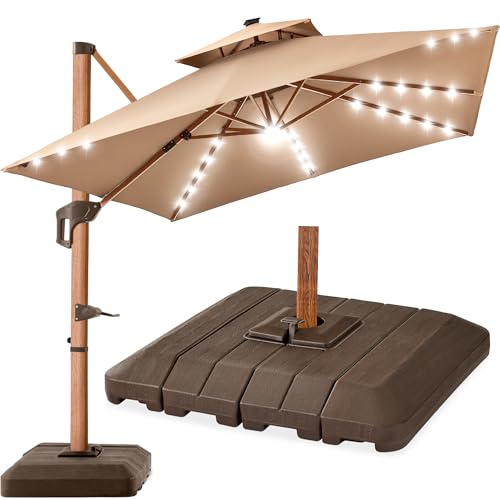
The actual cantilever we carry is a
Best Choice Products 10
foot cantilever patio umbrella with its base included, and it publishes the most
useful pair of figures on the site for this subject: the four piece base takes 308
pounds of sand or 220 pounds of water. Divide and you get 1.40, which is the bulk
density of dry sand against water, and it is exactly the number you would predict
for one cavity filled two ways. So choosing sand over water in that base is worth
40 percent more restoring moment, from the same box, for the price of carrying it.
That is a far larger gain than you could buy by moving up a base size, and it is
free. Our record on it notes the canopy shades 136 square feet and the base is a
genuine plus, which it is, and that wind and durability claims are maker stated.
The base's own footprint is not published, so its lever arm cannot be computed and
the 308 pounds cannot be turned into pound feet. See our
Best
Choice Products 10 foot cantilever review.
The biggest canopy we carry, and why it is a different shape of risk
A
Home Zone Living 15 by 9
foot double head patio umbrella publishes a 213 pound structure, a vented
canopy, included stabilizing sandbags and a span of 15 by 9 feet. That is a twin
canopy on a centre pole rather than a cantilever, so the static offset problem
above does not apply to it. What does apply is area. Seen edge on across its 15 foot
face, with the same 1.5 foot rise, the silhouette is about 22.5 square feet, two
thirds more than the 9 foot round. At 20 miles per hour that is 23 pounds of force
and 173 pound feet at a 7.5 foot centre of pressure, and at 30 it is 52 pounds and
389 pound feet. The 213 pounds is real holding mass, and the footprint it acts over
is not published, so once again the pound feet cannot be closed out.
Two things in that listing are worth reading properly. The vents are not
decoration: a vent lets pressure equalise through the canopy instead of building
under it, which attacks the lift term below rather than the drag term. And the
included sandbags are sand rather than water, which the 1.40 ratio above says is
the better of the two choices. Our record calls the 213 pounds the trade-off and a
semi permanent installation, which is the right framing. See our
Home
Zone Living 15 by 9 foot double head review.
Lift is the term that makes all of this an underestimate
Everything above is horizontal drag on a static canopy, and that is the easy
case. The hard case is that a canopy is a horizontal surface in a moving fluid,
which makes it a lifting surface, and lift acts on the plan area rather than on the
silhouette. That is a factor of nearly five more area for any vertical load to work
on.
Put a number on how little it takes. If the airflow has even a 10 degree upward
component, which happens routinely as wind lifts over a fence, a hedge or the edge
of a deck, then at 20 miles per hour a 9 foot canopy with a normal force
coefficient of one sees 1.024 times 63.6 times the sine of 10 degrees, which is
about 11 pounds of vertical load. That is already comparable to the 14 pounds of
horizontal drag, from a flow angle you cannot see. Tilt the canopy on its own tilt
mechanism and you have done the same thing deliberately. Vertical load subtracts
from the ballast that is holding you down, and if it is not symmetric it applies a
moment of its own.
So read the tipping speeds above as what they are: static, drag only, on an
assumed drag coefficient and an assumed canopy rise, with no gust factor, no lift
and no flutter. Real gusts run well above the mean wind speed, real canopies flap
and shed vortices, and every one of those effects makes the real margin smaller
than the arithmetic. None of them makes it larger. That is the reason we will not
name a safe wind speed for any base on this site, and why the only genuinely safe
configuration is a closed canopy.
The post of ours that already had this right
One of our ten gets the mechanism, and it is the one about the smallest base.
Our guide to
choosing a base for a
table mounted umbrella says: "With a table umbrella, the base stabilizes rather
than fully anchors. The table holds the pole upright, while the base adds bottom
weight to resist tipping and sway." That is exactly right, and here is why in the
language of this page. Threading the pole through a table adds a second support
part way up, so the pole is restrained at two heights instead of one. The wind load
is then mostly carried as a horizontal push into the table rather than as a moment
into the base, and what reaches the base is much smaller. The same guide ends with
"Steadiness, not sheer mass, is the goal", which is the correct conclusion and the
only place on the site where mass is put in its place.
Which is also how to read a
Home Zone Living 40 pound
half round fillable base. Forty pounds is a quarter of the big cantilever base,
and the listing is clear it is for 6 to 10 foot table umbrellas with a pole up to
1.9 inches. Its own cons field in our record says, in as many words, that "40lb
stabilizes rather than anchors" and that it is "meant to pair with a table, not
stand alone". That is honest, correct, and the arithmetic backs it: 40 pounds on
even a generous arm cannot resist the 90 pound feet that a 9 foot canopy generates
at 20 miles per hour, and it does not have to, because the table is taking the
load. Used as the maker intends it is sized correctly. Used freestanding it is not
a base. Our record also carries one defect worth flagging: the fill capacity is
published as "Up to 40lb (17L)", which mixes a mass with a volume, and 17 litres of
water weighs 37.5 pounds rather than 40. Details in our
Home Zone
Living 40 pound half round review.
Three problems in our own records, and one in the market
Having worked the arithmetic, three of our published figures do not survive
it.
First, the 119 pound base publishes its fill capacity as "Up to 119 lb (100 kg)".
Those are not the same quantity. 119 pounds is 54.0 kilograms, and 100 kilograms is
220.5 pounds. The two halves of that single spec line disagree by a factor of 1.85,
which is the difference between a base that holds a 9 foot umbrella at 20 miles per
hour and one that holds it at 30. We have reproduced the listing's own figure, and
the figure contradicts itself.
Second, the 168 pound base publishes "Up to 168lb (76kg) water or sand". The
metric conversion is correct this time, 168 pounds is 76.2 kilograms. The problem is
the words water or sand. One cavity cannot deliver the same weight of both, and the
cantilever listing above proves it by publishing 308 for sand against 220 for
water from its own box. If 168 pounds is the water figure, the sand figure should be
around 235. If it is the sand figure, water gives you about 120, which quietly puts
it alongside the 21 inch base on weight while keeping its footprint advantage. The
listing does not say which, and that ambiguity is worth more than any spec on the
page.
Third, a correction to our own planning for this article rather than to a live
page: we had this down as four bases spanning an eleven times weight range. We
carry three standalone bases, at 40, 119 and 168 pounds, which is a 4.2 times
range, plus the base bundled with the cantilever at 308 pounds of sand, which takes
the published range to 7.7 times. The fourth product in that list turned out to be
an outdoor rug.
And the problem that belongs to the whole market rather than to us: of the four
bases and bundled bases we carry, two publish a footprint dimension and two do not.
Without a footprint you cannot compute a lever arm, which means you cannot compute
a restoring moment, which means the published weight is the only thing you have and
it is, as this page has spent a thousand words establishing, the wrong number on
its own. Nobody publishes a drag coefficient, a canopy rise, a tested wind rating
with a stated method, or the mass of a cantilever's canopy and arm.
The honest limit
Our guide to
choosing a
patio umbrella base that actually holds opens with "a wobbling umbrella comes
down to the base" and advises you to "check the umbrella span first, then pick a
base rated at or above it". Half of that is right. Span does set the canopy area,
and area scales with the square of span, so a bigger canopy really does need more.
What it leaves out is that the base's own radius is the other multiplier, and a
rating in pounds carries no information about it. A 119 pound base on a 21 inch
footprint and a hypothetical 119 pound base on a 38 inch footprint are rated
identically and differ by 81 percent in what they will hold.
So the three free moves, in order of how much they are worth. Fill with sand
rather than water, which the published figures say is 40 percent more restoring
moment from the same box. Put the pole through a table if you have one, which takes
most of the moment off the base entirely and is the reason a 40 pound stand works at
all. And place the umbrella against a wall or in the lee of the house rather than
in the open, because the force depends on the square of the local wind speed, and
sheltering knocks a large fraction off that speed before it is squared.
Then the move that is worth more than all of them, and it is the one the
makers, our own guides and the second Quora question all land on independently:
close it. Crank it down and close it when the wind gets up, close it when you go
inside, and take it down before a storm rather than after. A closed canopy has a
silhouette of perhaps one square foot instead of thirteen, which takes the whole
problem away rather than resisting it.
Why Umbrella Base Weight Is the Wrong Number at a glance
Home Zone Living 40lb Half Round Fillable Umbrella Base
steadying table-mounted umbrellas against walls and windows
Flat back saves space against walls
40lb stabilizes rather than anchors
Why you can trust this guide
We compared these picks using verified manufacturer specifications, current retailer listings, and patterns in owner feedback, alongside editorial research. We focus on measurable differences such as performance, capacity, usability, and build quality. Pickpedia does not present editorial research as laboratory testing, and we do not claim hands-on testing unless it was actually performed.
This Home Zone Living base is a 21 inch square, water-fillable stand that anchors patio umbrellas up to 11 feet. Fill it for up to 119 pounds of hold, then roll it into place on built-in wheels. Made from weather-resistant HDPE, it arrives pre-assembled and converts into a table or planting box. Best for patios, poolsides, and backyards.
Best for anchoring offset and cantilever patio umbrellas without drilling
8.6/ 10 Pickpedia editorial score
This Home Zone Living base anchors offset and cantilever patio umbrellas using fillable weight. It holds up to 168lb of water or sand across four interlocking HDPE panels. It suits cantilever umbrellas from 6 to 11ft in diameter. Empty transport is easy, and hidden spouts keep the look clean. Overall footprint measures 38 inches square.
Best for Covering a full patio seating area with adjustable offset shade
8.6/ 10 Pickpedia editorial score
Best Choice Products makes a 10-foot square cantilever patio umbrella with an included fillable base. A heat-pressed woodgrain finish covers industrial-grade steel, and the four-piece base takes 308 lbs of sand or 220 lbs of water. The UV-resistant polyester canopy shades 136 square feet with a cooling vent. A foot pedal rotates the offset shade 360 degrees across 100 preset angles, and 33 solar LED lights add evening ambiance.
Canopy size10 feet square, 136 square feet shade
PoleIndustrial-grade steel, woodgrain finish
BaseFour-piece fillable, included
Sand capacity308 lbs
Water capacity220 lbs
LED lights33 solar-powered
Light charge and run7 to 8 hours, 4 to 5 hours
Dimensions120 by 120 by 105 inches
Pros
Offset design frees up table and seating space
Large canopy shades 136 square feet
Fillable base included, up to 308 lbs of sand
Foot pedal rotates shade across 100 angles
Woodgrain steel pole looks warmer than plain metal
Built-in 33 solar LED lights for evening use
Cons
Solar lights run only four to five hours per charge
Best for wide shade over large patios and poolside seating
8.4/ 10 Pickpedia editorial score
This Home Zone Living double head umbrella spans 15 by 9 feet in beige, built for wide backyard or poolside shade. Thirty-six solar-powered LED lights add evening ambiance. A vented canopy improves airflow and stability, while Grade A fade-resistant fabric covers a heavy-duty steel frame. The structure weighs 213lb and includes stabilizing sandbags.
Best for steadying table-mounted umbrellas against walls and windows
8.2/ 10 Pickpedia editorial score
This Home Zone Living half round base fills with up to 40lb of water or sand to steady table-mounted umbrellas. Its flat back sits neatly against walls and windows. An adjustable knob fits poles up to 1.9 inches wide, and reinforced HDPE handles outdoor use. It suits umbrellas from 6 to 10ft in diameter and transports easily when empty.