Home ›
Home & Kitchen › Why Stainless Steel Rusts After You Scrub It, and Why the Rust Is Not the Steel
Home & Kitchen
Why Stainless Steel Rusts After You Scrub It, and Why the Rust Is Not the Steel
PBy the Pickpedia Team·3 picks compared·Last verified October 2026
Affiliate disclosure: As an Amazon Associate, Pickpedia earns from qualifying purchases. Links on this page are paid links, and we may earn a commission at no extra cost to you. This never affects our picks or scores.
This page contains affiliate links. If you buy through one we may earn a
commission, at no cost to you.
If rust freckles appeared on a stainless sink, grate or board a day or two
after you scrubbed it, the most likely explanation is that the rust is not your
stainless steel. It is the brush. Those are particles of ordinary steel left
behind in the surface, corroding where they sit, and the steel underneath them is
very probably fine. Once you know that, the fix changes completely, because
scrubbing harder with the same tool makes it worse every time.
Stainless steel is not a rustproof metal, it is a metal wearing a film
Start with what the word stainless is actually describing. Stainless steel is
mostly iron, and iron rusts. What stops it is that the alloy carries enough
chromium, generally quoted as at least about 10.5 percent by weight, for the
chromium at the surface to grab oxygen and build a layer of chromium oxide over
everything. That layer is only a few nanometres thick, it is transparent, and it
is the entire corrosion resistance of the material. Corrosion people call it the
passive layer. There is no coating, no plating and no treatment involved. It is
the metal reacting with the air.
So a stainless object is better thought of as iron that is being continuously
protected by something it makes itself. That framing is what makes the rest of
this predictable, and it is the part the question gets backwards: the protection
is not a property of the surface you can wear away, it is a property of the alloy
that keeps regenerating.
A scratch is not the problem, which is where the wrong assumption lives
The natural assumption is that scrubbing scratched off the protection and
exposed bare iron. It is a reasonable guess and it is not what happens, for one
reason that is worth sitting with.
The left side is what people worry about and it repairs itself. The right side is
what actually causes the orange freckles, and no amount of further scrubbing with
the same tool will clear it.
Look at the left panel. When an abrasive cuts a groove in stainless steel, it
removes the film, and it also exposes fresh metal along every surface of that
groove. That fresh metal contains the same chromium as the rest of the alloy,
because the chromium is dissolved all the way through rather than sitting on top.
Put that newly exposed chromium in contact with air or aerated water and it builds
a new oxide film across the groove within minutes. The scratch is permanent. The
vulnerability is not. This is why our own guide to
metal utensils
on stainless steel cookware can tell you that scratches from a steel turner
are cosmetic, and be right.
Now the right panel, which is the case nobody is told about. A brush with plain
carbon steel bristles, or ordinary steel wool, or a pad that was used last week on
something mild steel, does not only abrade. It sheds. It presses small fragments
of its own metal into the surface it is cleaning and leaves them there. Those
fragments are plain steel. There is no chromium in them, so there is nothing for
them to build a film out of, and they do the only thing plain steel does in a damp
kitchen: they rust. The orange mark is the fragment turning to iron oxide, plus a
stain bleeding outward onto stainless steel that is not itself corroding at all.
The industry name for the fragments is free iron, and for the result, iron
contamination.
And there is a second order problem that stops this being purely cosmetic. A
rusting particle sitting on the film holds water and corrosion product trapped
underneath itself, against the surface, indefinitely. As a general rule in
corrosion, a passive film does badly under a permanently wet deposit that excludes
oxygen, and given long enough a genuine pit can start under one. So contamination
rust is worth removing rather than ignoring, not because it is dangerous today but
because leaving it in place is how a cosmetic problem eventually becomes a real
one.
How to tell this apart from the real thing
Three signs, and they are easy to read once you know they are different
problems.
Contamination rust turns up as discrete freckles, or as streaks that follow the
direction you scrubbed in, and it arrives after a cleaning session rather than
after use. Run a fingernail or a non-metallic pad over it and it lifts, leaving
clean bright metal with no crater underneath.
Real corrosion of the steel itself leaves a pit. The mark does not come off
because it is a hole, and you can usually feel it. The commonest cause is not
abrasion at all but chloride attack, which is a separate mechanism worth naming:
chlorides from salt, from brine, and from bleach break down the passive film
locally in a way that scratching does not. Which is why leaving bleach to stand in
a stainless sink, or leaving a salty pan to soak overnight, does more real damage
than any brush.
The third sign is where it is. Freckles in a ring where a cast iron pan sat, or
along the line a steel scourer travelled, are telling you their own origin.
The repair follows from the diagnosis. Take the iron off rather than grinding
at the surface: a non-metallic abrasive, or a brush whose own bristles are
stainless, then a mild acid such as citric or oxalic or a proprietary stainless
cleaner, which dissolves iron oxide far faster than it touches chromium oxide.
Rinse well and dry. Then stop putting the iron back, which is the only part that
actually prevents a recurrence.
What our own records publish about the tools
This matters more than the cleaning method, because the method is free and the
tool is the recurring cause.
A
cordless electric grill
brush with two heads is the useful case in our catalogue, because its record
states the bristle material rather than leaving you to guess. It lists model
LZ-8057, a head that pivots through 180 degrees, three speeds between 300 and 400
RPM, and two interchangeable and replaceable heads: a stainless steel wire brush
and a scouring pad. A stainless bristle still sheds, but what it sheds carries
chromium and can passivate, which is exactly the difference the diagram turns on,
and the pad head means you can work with no metal at all when you want to. The
maker also states over 90 minutes of runtime, a three hour USB-C recharge, and
gloves and a manual in the box, and the unit is 16.34 by 5.31 by 2.95 inches.
Its record is blunt about the gaps, and two of them bear on this page directly.
Nothing is published about bristle retention, and no battery capacity or IP rating
is published behind the runtime claim or the outdoor storage suggestion. The
retention gap matters because a loose bristle you swallow is a far more serious
problem than any rust spot, and that hazard is covered in full in our guide to
cleaning
a grill safely, which is worth reading before you choose any wire tool. The
record is also clear this is for routine cleaning and not for restoring a badly
neglected or rusted grate. Our
review of
the TOYOKID brush has the rest.
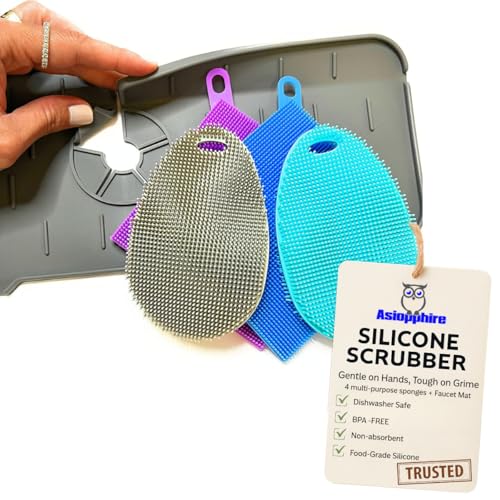
If you would rather remove the variable entirely, a
silicone dish scrubber
set cannot contaminate anything, because there is no metal in it to shed. Its
record lists one faucet mat plus four dual sided sponges, two square and two oval,
in BPA free food grade silicone, dishwasher safe, with colour coded hanging hoops,
and the maker states the bristles resist trapped odours and rinse clean. For sinks
and stainless cookware that is the whole problem solved by subtraction. The honest
trade is in its own record: stiff silicone feels nothing like a plush sponge,
baked on grime may still need more than this, and no sponge or mat dimensions are
listed. See our
review of
the Asiopphire set.
One more thing worth naming, because it is unusual in our data. Almost no
listing tells you which stainless you are buying, and an
oversized stainless steel
cutting board is the exception: its record states food grade 304 stainless
steel, with a heavy 14 gauge core, sizes from 11.8 by 15.7 up to 19.6 by 31.5
inches, a 1 inch folded anti-slip lip plus a silicone mat, double sided use with
rounded corners and a non-porous surface. As a rule of thumb, 304 is the common
austenitic grade usually described as 18 percent chromium and 8 percent nickel,
and that chromium figure is the number this entire page depends on. Its record is
also candid about the cost of a hard surface: steel dulls knife edges faster than
wood or plastic, and it is best paired with a softer board for daily chopping, a
trade we set out in
cutting
boards compared. Details in our
review of
the RIZIZMVG board.
The honest limit
The thing this page is really recommending costs nothing. Do not use a carbon
steel brush or plain steel wool on stainless, do not use a pad or brush that has
been near mild steel or cast iron, dry the surface instead of leaving it wet, and
do not leave bleach or brine standing in a stainless sink. That list prevents
almost every rust spot people ask about, and none of it is a purchase.
For the marks already there, the cheapest effective treatment is very likely
already in your kitchen. A cut lemon or a spoon of citric acid, left on the spot
for a few minutes and then rinsed and dried, removes iron oxide without touching
the chromium oxide underneath. If that clears it, you have also confirmed the
diagnosis, because contamination lifts and a pit does not.
And the limit worth stating plainly: if the mark does not lift, it is not
contamination, and nothing on this page will fix it. A pit is missing metal.
Polishing the area will make it less visible and will not put the metal back, and
on a sink or a worktop that is usually where the sensible response is to accept it
and change what caused it rather than to buy a tool.
Why Stainless Steel Rusts After You Scrub It, and Why the Rust Is Not the Steel at a glance
Baking, pastry, raw-meat hygiene and counter protection
Heavy 14-gauge 304 steel, will not warp
Dulls knife edges faster than wood or plastic
Why you can trust this guide
We compared these picks using verified manufacturer specifications, current retailer listings, and patterns in owner feedback, alongside editorial research. We focus on measurable differences such as performance, capacity, usability, and build quality. Pickpedia does not present editorial research as laboratory testing, and we do not claim hands-on testing unless it was actually performed.
Best for Routine cleaning of curved or angled grill grates
8.2/ 10 Pickpedia editorial score
A cordless rotary grill cleaner, model LZ-8057, with a head that pivots through 180 degrees to follow angled and curved grates, three speeds running between 300 and 400 RPM, and two interchangeable heads: a stainless wire brush and a scouring pad. The maker states over 90 minutes of runtime, a three hour USB-C recharge, and includes gloves and a cable.
BrandTOYOKID
ModelLZ-8057
TypeCordless rotary grill brush
Head movement180 degree pivot
Speeds3, light, medium and heavy duty
Rotation300 to 400 RPM
Heads suppliedStainless steel wire brush and scouring pad, both replaceable
Stated runtimeOver 90 minutes continuous
ChargingUSB-C, 3 hours to full, cable included
Also includedProtective gloves and user manual
AssemblyArrives fully assembled
Dimensions16.34 x 5.31 x 2.95 in
ColourBlack
Battery capacityNot published
IP ratingNot published
Pros
Head pivots 180 degrees to follow curved and angled grates
Three speeds with a published 300 to 400 RPM range
Wire brush and scouring pad heads both included
Both heads are replaceable
USB-C charging rather than a proprietary charger
Protective gloves and a manual in the box
Arrives fully assembled
Cons
Outdoor storage claimed with no IP rating published
No battery capacity or voltage behind the 90 minute claim
Nothing published about bristle retention
16.34 in overall, shorter than a long handled manual brush
Best for Reusable, easy-to-sanitize dish scrubbing
8.2/ 10 Pickpedia editorial score
Asiopphire pairs a silicone faucet mat with four dual-sided scrubbing sponges for kitchen cleanup. The set includes two square sponges and two oval sponges, each made from BPA-free, food-grade silicone. The maker states the bristles resist trapped odors and rinse clean, and the sponges are dishwasher safe. Color-coded hanging hoops help avoid cross-contamination. It suits households swapping smelly cloth sponges for reusable silicone.
Best for Baking, pastry, raw-meat hygiene and counter protection
9.0/ 10 Pickpedia editorial score
An oversized food-grade 304 stainless steel cutting board with a heavy 14-gauge core, a naturally cool non-stick surface for baking, a 1-inch anti-slip lip and included silicone mat, rounded safe corners and a non-porous sanitary surface, available in multiple sizes.
BrandRIZIZMVG
TypeStainless steel cutting and pastry board
MaterialFood-grade 304 stainless steel
ThicknessHeavy-duty 14-gauge core
Sizes11.8x15.7 up to 19.6x31.5 inches
Stability1-inch folded anti-slip lip plus silicone mat
DesignDouble-sided, rounded R-corners
HygieneNon-porous, non-toxic, easy clean
ColourSilver
Pros
Heavy 14-gauge 304 steel, will not warp
Naturally cool surface, superb for baking
Most sanitary, non-porous surface for raw meat
Anti-slip lip and silicone mat included
Safe rounded corners, doubles as a heat shield
Essentially lifetime durable
Cons
Dulls knife edges faster than wood or plastic
Heavy and, in big sizes, large to store
Best paired with a softer board for daily chopping