PBy the Pickpedia Team·5 picks compared·Last verified October 2026
Affiliate disclosure: As an Amazon Associate, Pickpedia earns from qualifying purchases. Links on this page are paid links, and we may earn a commission at no extra cost to you. This never affects our picks or scores.
This page contains affiliate links. If you buy through one we may earn a
commission, at no cost to you.
They mostly have not stopped working. They have reached the number of charge
and discharge cycles they were specified for, which in a garden light is a
surprisingly small number, and they got there on schedule.
The giveaway is the order the symptoms arrive in. A solar light that has been
flooded or whose switch has corroded goes dark all at once. A solar light that has
simply aged goes dim first, for weeks, and the dimness is the diagnosis.
Dim is a battery symptom, and it is a voltage symptom
An LED is not a bulb. A filament glows in proportion to the power you hand it
and will glow faintly on half a volt. An LED passes almost no current until the
voltage across it reaches its threshold, then its current rises very steeply. So
the brightness of a solar light is set by the voltage its cell can hold up while
current is being pulled out of it, not by how much charge is left in the cell.
Two things happen to a small rechargeable cell as it is cycled. It loses
capacity, which shortens the night. And its internal resistance rises, which means
that every milliamp the LED draws costs more voltage inside the cell than it used
to. The second effect is the one people misread as a fault, because a cell can
still be holding plenty of charge and yet be unable to deliver it at a voltage the
LED will answer to.
Why dim arrives before dead. The LED needs voltage, not just charge, and a tired
cell cannot hold its voltage up while current is being drawn out of it.
The cycle arithmetic, which is the whole answer
A garden light does something a battery engineer would wince at. It discharges
its cell as far as the circuit allows, every single night, and then fills it again
the next day. That is 365 deep cycles a year.
Cycle life for a small nickel metal hydride cell is quoted in the hundreds at
that depth, not the thousands, and the depth is the reason. Run the same cell to
half empty and you get several times as many cycles out of it; run it flat and the
count collapses. So one to two seasons of full-night running is not a defect, it is
the design, and it follows from arithmetic that was knowable before anyone bought
anything.
Our own
guide
to how solar garden lights work says the battery gradually holds less charge
after a few years. A few years is too generous for a light that genuinely runs all
night, every night, and the correction matters because it changes what you do about
it: at a few years you shrug and buy new lights, at one to two seasons you buy a
cell for pennies.
Now read the runtime figures again, because they are brightness figures
Here is the part that reframes the whole category. The energy a solar light can
spend in a night cannot exceed what its panel collected that day, and the panel's
ceiling is set by its area and by the sun, both of which you can look up.
Full noon sunlight delivers roughly 1,000 watts per square metre. A garden stake
panel about 1.6 inches square is 16.5 square centimetres, so it intercepts about
1.65 watts of light, and a cheap cell converting at fifteen percent can make about
a quarter of a watt at its very best. Over a good day worth four and a half full
sun hours, that is about 1.1 watt hours. That is the entire budget.
So take a set of
Twinkle solar garden lights
in an 8 pack, which publish a 6 to 8 hour charge giving a stated 14 to 16 hours
of light from fifteen flickering LEDs behind a 3D laser film, in a waterproof ABS
and acrylic body. Spread 1.1 watt hours over 15 hours and you get about 73
milliwatts of LED power. Share that between fifteen LEDs and each one is running at
about five milliwatts, which is roughly an eighth of what an ordinary indicator LED
on an appliance draws. At the efficiency these run at, the whole stake is putting out
something in the region of five to seven lumens. A household candle is about
twelve.
That is not a criticism of the product, which says so itself: its own record
lists decorative ambient light only, not bright task or security lighting, and that
the charge and runtime figures are the maker's best case. It is a way of reading the
specification. A long published runtime on a solar light is a statement about how
little the LED is drawing, which is to say about how dim it is, and the two numbers
cannot both be large. Our
review of the Twinkle solar
garden lights has the rest.
The same reading makes a striking claim make sense. A set of
AGPTEK solar driveway lights
with three colour modes and an IP67 alloy body publishes 30 hours of runtime
after a 5 hour solar charge, six LEDs, five modes, a 2 ton pressure rating, and a
detachable stake. Thirty hours of light from five hours of charging means the LEDs
must be spending power at roughly a sixth of the rate the panel was gathering it.
Run the same area arithmetic on a panel about two inches square and you get perhaps
1.2 watt hours a day, which over 30 hours is about 40 milliwatts across six LEDs.
And then notice what the record says is missing: brightness in lumens is not
listed. The 30 hour figure and the absent lumen figure are the same fact written
two different ways. Details in our
review
of the AGPTEK driveway lights, and the category view is in our
guide to choosing solar
driveway lights that last.
A
linseyCove outdoor solar
clip light with IP65 and three modes is the most internally consistent of the
three, publishing a 6 to 8 hour charge for 8 to 12 hours of light, a polycrystalline
panel, coverage up to 30 square metres and a dusk to dawn sensor. Eight to twelve
hours is a modest claim and the coverage figure is at least stated, which makes the
pair of numbers checkable against each other rather than only against the night.
Its own record carries the caveat that matters most for everything below: winter
daylight will reduce charging. See our
review of the
linseyCove clip light and our
guide to choosing and
placing solar clip lights.
Where the energy balance stops closing, and the listing tells you
The budget above is per square inch of panel, so the moment a product's appetite
grows faster than its panel, the design has to find power somewhere else. Watch for
a second input, because it is an admission.
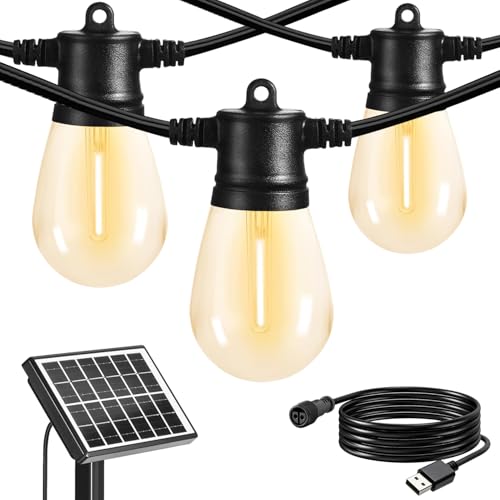
A run of
SUNTHIN 100ft solar string
lights with USB recharging publishes 100 feet of shatterproof bulbs, a dusk to
dawn sensor, an IP65 build, and a bundled USB cable so a power bank can keep the
string lit on cloudy days. That last feature is the honest part of the listing. A
hundred feet of bulbs asks for far more than a string light panel gathers, so the
USB port exists because the arithmetic does not close, and its own record is frank
that neither brightness nor runtime figures are provided at all. More in our
review
of the SUNTHIN solar string lights.
The extreme case is worth doing in full because it shows how far the gap can go.
A
RadiantFlux rechargeable
solar camping lantern with a 6600mAh cell publishes a stated 4000 lumens, three
modes, IP65, a magnetic back, a quarter twenty thread, a USB output for charging a
phone, and both solar and Type-C input. A 6600 milliamp hour lithium cell at 3.7
volts holds about 24 watt hours. A panel the size of the top of a lantern, call it
three inches square, gathers something like 4 watt hours on a good day. Filling that
cell from empty by sunlight alone would take about six good days.
And the output side settles it. Even if the 4000 lumen figure were conservative,
getting anywhere near it needs tens of watts, so a full cell is measured in tens of
minutes on high and a day of sunshine buys single-digit minutes. The Type-C port is
not a convenience, it is the power supply, and the panel is a trickle charger. Its
own record flags exactly the two things that follow: no wall adapter is included,
and the per-mode runtimes are not specified. Our
review
of the RadiantFlux solar lantern sets out what is and is not published. None of
this makes it a bad lantern. It makes it a rechargeable lantern with a solar panel
on it, which is a different product from a solar lantern, and the distinction is
worth having before you rely on one.
The honest limit
Every assumption above is marked because none of these listings publishes a panel
rating or a cell chemistry, which is the real gap in the category. Panel areas here
are estimated from the physical size of the products, cell efficiency is taken at
fifteen percent, and a good day is taken as four and a half full sun hours. Use your
own figures and the conclusions move, but they do not reverse, because the panel area
on a garden light is a couple of square inches and that ceiling is not negotiable.
The fix is almost free, and it is the cell. In most stake and path lights it is a
single standard rechargeable AA or AAA sitting under a screwed cover, and swapping it
restores the voltage, which restores the brightness. Two things to get right while
you are in there. Buy the low self discharge type, the ones sold pre-charged, because
an ordinary cell loses something like fifteen to twenty percent of its charge a month
just sitting there while the better sort loses roughly that much in a year, and in a
shaded winter garden that difference is most of the problem. And do not buy the
biggest capacity on the shelf: a cell three times the size takes three times as long
to fill from a panel that has not changed, so it will simply never reach full and you
will have bought a cell that lives permanently in the part of its range that ages
fastest.
Then stop asking them to go flat every night, because depth of discharge is the
single biggest lever on cycle life. Switching a decorative light off for part of the
week, or running a mode that quits before dawn rather than one that limps to it, is
free and it roughly multiplies the seasons you get.
And keep the two separate questions separate. How long a light runs on a full
charge is a different matter from how long the product lasts, and we did the first
one properly in
do solar lights stay on all
night, which compares the published runtime to the actual length of the night
month by month. This page is about the second. Together they explain almost every
complaint in the category without anything having broken.
Why Solar Garden Lights Go Dim After One Season at a glance
RadiantFlux Rechargeable Solar Camping Lantern, 6600mAh, 4000LM
camping and blackout lighting with backup power
Solar and Type-C charging cover trail and home
No 5V wall adapter included in the box
Why you can trust this guide
We compared these picks using verified manufacturer specifications, current retailer listings, and patterns in owner feedback, alongside editorial research. We focus on measurable differences such as performance, capacity, usability, and build quality. Pickpedia does not present editorial research as laboratory testing, and we do not claim hands-on testing unless it was actually performed.
Best for Adding a warm, starry, wireless glow to a garden, patio or path
8.4/ 10 Pickpedia editorial score
An easy, charming way to give a garden a warm, starry glow after dark, with no wiring and nothing to run. Each of the eight solar stake lights uses a 3D laser film and fifteen flickering LEDs to cast a sparkling starlight effect, an upgraded panel charges fast for a stated 14 to 16 hours of light, and the ABS and acrylic build is waterproof, frost-resistant and heat-resistant for year-round use. Decorative ambient lighting, best valued for atmosphere rather than as bright task or security lighting.
TypeSolar decorative stake lights
Pack8 lights
Effect3D laser film, star twinkle
LEDs15 flickering per light
ChargingUpgraded panel, 6 to 8 hrs
RuntimeStated 14 to 16 hrs
BuildABS + acrylic, waterproof, frost and heat resistant
SetupWireless, about 4 steps
Pros
3D laser film and 15 flickering LEDs cast a genuinely pretty star-twinkle effect
Solar and wireless: no wiring, nothing to run, automatic at night
Stated fast charge (6 to 8 hrs) gives a long 14 to 16 hour runtime
All-weather ABS and acrylic build, waterproof, frost and heat resistant
Eight in a pack for a real spread of light
Simple roughly four-step setup
Cons
Decorative ambient light only, not bright task or security lighting
Like all solar lights, runtime depends on a good charge and direct sun
Shaded spots and short overcast days reduce performance
Charge and runtime figures are the maker's best case
Best for driveways and docks that need drive-over lights
8.4/ 10 Pickpedia editorial score
These are wire-free solar driveway lights with a sealed IP67 aluminum alloy body rated to handle up to 2 tons of pressure. Six LEDs deliver three colors and five modes, from warm white to blue and yellow flashing. The maker states 30 hours of runtime after a 5 hour solar charge. A detachable stake and screw mounts suit driveways, decks, and docks.
Best for Small outdoor spots needing automatic dusk-to-dawn light
8.4/ 10 Pickpedia editorial score
linseyCove's solar clip light is a tool-free outdoor fixture for fences, gardens, decks, and pathways. A built-in light sensor turns it on at dusk and off at dawn. The maker states a full six to eight hour charge yields eight to twelve hours of light. Housing is ABS plus PC, rated IP65, and it clips on without tools or mounts with screws and hooks.
The SUNTHIN 100ft Solar String Lights bring wire-free glow to patios, decks and gardens. They charge by sun, switch on at dusk automatically, and switch off at dawn. Shatterproof plastic bulbs and an IP65 build handle snow, wind and rain. A USB cable lets you connect a power bank on cloudy days. Best for year-round outdoor decorating with no outlet needed.
Best for camping and blackout lighting with backup power
8.4/ 10 Pickpedia editorial score
The RadiantFlux is a rechargeable LED camping lantern that doubles as a power bank. It states 4000 lumens, a 6600mAh cell, three light modes, and an IP65 waterproof rating. Solar and Type-C charging keep it topped up, while a USB output charges a phone in a pinch. Hanging loops, a magnetic back, and a 1/4-20 thread add mounting options. It suits camping, outages, and all-weather outdoor use.
Battery6600mAh
Brightness4000 lumens (maker-stated)
Light modes3
Waterproof ratingIP65
ChargingSolar and Type-C input
OutputUSB port for phone charging
MountingLoops, magnetic back, 1/4-20 thread
IncludedUSB charging cable
Pros
Solar and Type-C charging cover trail and home
Built-in 6600mAh power bank tops up a phone
Three modes balance brightness and runtime
IP65 rating handles rain and damp
Magnet, loops, and tripod thread mount it anywhere