Home ›
Air Fryers › Why an Air Fryer Browns the Crust Before the Middle Cooks
Air Fryers
Why an Air Fryer Browns the Crust Before the Middle Cooks
PBy the Pickpedia Team·4 picks compared·Last verified October 2026
Affiliate disclosure: As an Amazon Associate, Pickpedia earns from qualifying purchases. Links on this page are paid links, and we may earn a commission at no extra cost to you. This never affects our picks or scores.
This page contains affiliate links. If you buy through one we may earn a
commission, at no cost to you.
Because the machine is better at the outside of the bread than at the inside, and
the gap is measurable. An air fryer is a small convection oven with an aggressive fan,
and what the fan raises is the rate at which heat crosses from the air into the
surface. That shortens the time before the crust browns almost exactly in proportion.
It shortens the time for the middle to reach temperature by much less, because once
the heat is inside the dough the fan has no further say.
For a 30 mm focaccia the numbers come out at 4.66 times faster at the surface and
2.55 times faster at the centre. The ratio between those, 1.83, is the whole
complaint. And there is a floor underneath all of it that no machine can pass: 9.2
minutes for that thickness, set by conduction through dough alone.
Two of our own pages already say this in words, correctly, and this page is the
arithmetic they were owed.
Clock one: the crust cannot brown until it is dry
Start with the surface, because it fails first and it is the reason food comes out
of the basket. A wet dough surface cannot get hot. While liquid water is evaporating
from it, every joule arriving goes into latent heat at 2,257 kilojoules per kilogram,
and the surface sits pinned near 100 degrees Celsius. Browning needs 140 to 170. So
the crust cannot begin to colour until the outer layer has dried out, and the time
that takes is simply the water in that layer divided by the flux arriving.
Take the outer millimetre of a dough at roughly 1,100 kilograms per cubic metre and
40 percent water. That is 0.44 kilograms of water for every square metre of surface,
and 993 kilojoules to evaporate it.
Now the flux. With air at 200 degrees and the surface pinned at 100, the driving
difference is 100 kelvin, and the flux is the heat transfer coefficient times that
difference. A conventional oven, where most of the heat arrives by radiation and
gentle natural convection, runs somewhere around 15 watts per square metre kelvin, so
1,500 watts per square metre, and the millimetre takes 662 seconds, or 11 minutes. An
air fryer runs around 70, so 7,000 watts per square metre, and it takes 142 seconds.
Two minutes and twenty four seconds.
Our page on why air fryer food is
not crispy is looking at the same physics from the opposite side and gets it
right: "A dry surface browns; a wet one just sizzles off steam until the moisture is
gone." That is this clock, exactly, and the figure attached to it is 142 seconds on a
dough surface.
Clock two: the centre does not care about the fan
The middle is a conduction problem and it runs on different machinery. What governs
it is the thermal diffusivity of the dough, about 1.3 times ten to the minus seven
square metres per second, and the square of the distance the heat has to travel. For a
30 mm focaccia with both faces exposed, that distance is 15 mm, and the natural time
scale is the distance squared over the diffusivity: 1,731 seconds.
How much of that you actually need depends on the Biot number, which is the
coefficient times the half thickness over the dough's conductivity. It is the ratio of
the resistance inside the dough to the resistance in the air film. In a conventional
oven it is 0.45, so most of the resistance is still in the air and improving the air
helps. In an air fryer it is 2.1, so most of the resistance has moved inside the
dough, where the fan cannot reach.
Run the slab solution for the centre reaching 96 degrees and the answers are 45.3
minutes in the oven, 17.7 minutes in the air fryer, and 9.2 minutes in a machine with
unlimited airflow. That last figure is the one worth memorising. It is the conduction
floor. No wattage, no temperature and no fan gets a 30 mm focaccia's middle to
temperature faster than 9.2 minutes, and the air fryer has already captured 76 percent
of the distance from the oven to that floor.
So the air fryer is faster at both jobs. It is just disproportionately faster at
the one you can see. In an oven the crust sits dry and browning for 75.6 percent of the
bake. In an air fryer that share is 86.7 percent. The crust is committed earlier, it
looks finished earlier, and the thing people do when food looks finished is take it
out.
Centre times are the one term solution for a slab with a convective surface, using a
dough thermal diffusivity of 1.3 times ten to the minus seven square metres per second
and a conductivity of 0.5 watts per metre kelvin, with air at 200 C, dough from 20 C
and the crumb taken as set at 96 C. Surface times are the latent heat needed to dry the
outer millimetre, 993 kilojoules per square metre, divided by the convective flux
available while the surface is pinned at 100 C. The two heat transfer coefficients, 15
for an oven and 70 for an air fryer, are representative values rather than published
ones, and they are the assumption the whole comparison rests on: scale both and every
time changes, but the 1.83 asymmetry between the two clocks does not, because it comes
from the structure of the problem rather than the size of the numbers.
What the wattage on the box is actually for
A Ninja Air Fryer Pro
AF141 publishes a 5 quart basket, 1750 watts and a 400 degree Fahrenheit ceiling,
and 1750 watts sounds like it ought to dominate everything above. Check it against
the transfer path.
A 180 mm round focaccia presents about 0.0254 square metres per face. At the 7,000
watts per square metre the convective coefficient delivers, that is 178 watts into the
top and the same into the bottom, so 356 watts total is crossing into the food. The
other 1,400 watts is heating the chamber, replacing what leaves through the vent, and
recovering after you open the drawer.
Which tells you what wattage buys. It is a recovery figure and a ceiling figure. It
decides how fast the chamber comes back after you pull the basket out to look, and
whether the machine can hold 450 degrees against its own losses. It does not decide
the rate at the food, because the rate at the food is set by the coefficient, and the
coefficient is the one number no air fryer listing we carry publishes. Not an airflow
in cubic feet per minute, not an air velocity, nothing. Across the whole category we
publish watts and degrees, and neither of them is the variable in the equation.
Two claims in our catalogue that survive the arithmetic
Worth doing, because not every published figure is wrong and these two are
defensible. A CHEFMAN 2 quart
mini air fryer states that it "cooks food up to three times faster than a
conventional oven". The arithmetic above gives 4.66 times at a surface and 2.55 times
at a centre, so three sits inside the range. For the kind of thin, high surface area
item a 2 quart basket actually holds, three is conservative. For a thick one it is
optimistic. "Up to" is doing honest work.
A Breville Smart Oven Air
Fryer states that its "super convection can cut cooking time by up to 30%". The
physical ceiling available to convection on a 30 mm slab is the whole distance from
45.3 minutes to 9.2, which is a 79.7 percent cut, so a claimed 30 is well inside what
the mechanism can deliver. Its five quartz elements and the stated aim of reducing cold
spots are addressing a different problem again, which is uniformity across the cavity
rather than depth into the food.
The sheet of paper that triples the problem
Here is the practical finding, and it is larger than anything else on this page. A
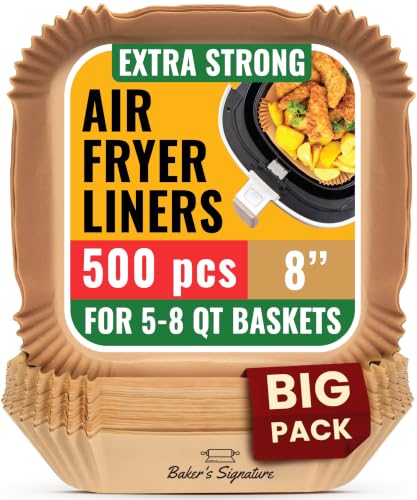
pack of 500 disposable air
fryer paper liners is a reasonable thing to own, rated to 450 degrees Fahrenheit,
silicone coated, sized for 5 to 8 quart baskets. Put one flat under a focaccia and you
have removed the underside of the bread as a heat path.
That is not a modest change. A slab heated on one face with the other insulated
behaves exactly like a slab of twice the thickness heated on both faces. So a 30 mm
focaccia on a solid liner is a 60 mm problem: the distance doubles, the natural time
scale goes up fourfold to 6,923 seconds, and the centre reaches 96 degrees at 53.7
minutes instead of 17.7.
Three times the centre clock. Meanwhile the top surface is unaffected, so its clock
is still 142 seconds and the crust is still committed in under two and a half minutes.
The liner has taken a bake that was 86.7 percent crust time and made it 95.6
percent.
Our guide on
using air fryer
liners without ruining airflow already gives the right instruction, saying to
"avoid liners that seal the whole basket floor" and to "leave gaps around the edges so
air moves under and around the food". It is right, and the number attached to it is
three times. A perforated liner, or one cut smaller than the food so the basket holes
stay open under it, keeps the second face working. A flat sheet across the whole floor
is the single most effective way to undercook the middle of anything thick.
Why thickness is the only lever that matters
Everything in the first panel is a factor of two or three. Thickness is a square
law, so it is the only variable with real authority.
At 20 mm the centre reaches temperature in 9.4 minutes. At 30 mm, 17.7. At 40 mm,
27.1. The pure square law would predict a factor of four between the thinnest and the
thickest, and the real factor is 2.9, because the Biot number rises with thickness too
and slightly offsets it. Either way, rolling a focaccia to two thirds of its thickness
takes 8 minutes off the centre and nothing off the crust, which is the only move on
this page that improves one clock without hurting the other.
And the second lever, which our own page already recommends. Our
air fryer cooking times guide says: "Baked
goods such as cakes and muffins can brown on top before the center sets, so lower the
temperature and cover loosely with foil if needed." Both halves of that are right and
the arithmetic says why. Lowering the air temperature reduces the surface flux
proportionally, so the surface clock stretches directly, while the centre clock
stretches much less because it is governed by diffusion rather than by the driving
difference. Covering loosely with foil does the same thing more sharply: it blocks the
jet, dropping the effective coefficient at the top surface to something like 25, which
pushes the surface clock from 142 seconds to 397 and the centre clock from 17.7
minutes to 30.8. You give up 13 minutes and buy back a 2.8 times lower surface flux, which
is the right trade whenever the crust is the thing failing.
The same page is also right that "Dense or thick foods gain less. A whole chicken or
a thick roast still needs time for heat to travel to the center, and rushing the
temperature only burns the outside." That sentence is the conduction floor, stated in
English, three years before anyone put 9.2 minutes next to it.
The honest limit
Every figure here rests on two heat transfer coefficients, 15 and 70, which are
representative values for the two machine types rather than numbers read off a
listing. If an air fryer is really at 50, its centre clock becomes about 20 minutes
rather than 17.7. If it reaches 100, about 15.5. The individual times move.
What does not move is the shape, and the shape is the answer. Whatever the two
coefficients are, the surface clock is inversely proportional to the coefficient and
the centre clock is not, because the centre clock is a diffusion time multiplied by a
weak function of the Biot number. So any machine that improves the air will always
improve the crust more than the crumb, and the better the airflow the wider that gap
gets. There is no air fryer setting, and no air fryer, for which this is not true.
Which means the fix was never going to be on the machine. It is a thinner dough, a
lower dial, a loose cover, a liner with the holes left open, and a thermometer in the
middle instead of a judgement from the top. None of those is a purchase, and together
they are worth more than the difference between any two air fryers in this
catalogue.
Why an Air Fryer Browns the Crust Before the Middle Cooks at a glance
Families or meal preppers who need a large-capacity, multi-functional air fryer.
Large 5-quart capacity fits up to 5 lbs of wings 4-in-1 functionality: Air Fry, Roast, Reheat, Dehydrate Air Crisp Technology reaches 400°F for crispy results Up to 75% less fat than traditional deep frying Powerful 1750-watt heating for fast cooking Nonstick basket and crisper plate for easy cleanup
No preset buttons for common foods Bulky design may take up significant counter space Manual temperature and time control may require learning curve Nonstick coating requires gentle handling to avoid scratches
Singles, couples, or small households with limited counter space.
Compact and space-saving design Cooks up to three times faster than an oven Digital touch screen with temperature up to 400°F Dishwasher-safe nonstick basket and rack Includes shake reminder for even cooking cETL approved with 1-year assurance
Only 2-quart capacity, not suitable for large batches 900W power may be lower than larger models No preset programs (based on specs) Requires manual shaking despite reminder
Families and home cooks who want a multi-functional countertop oven for air frying, roasting, baking, and slow cooking.
11 cooking functions in one appliance Super convection reduces cooking time by up to 30% Element iQ system with 5 quartz elements for even heating Large interior fits 13-inch pizza, 6 slices of toast, or 4.4 qt Dutch oven Air fry capability for crispy foods Digital PID temperature control for precise cooking
Large footprint takes up counter space No specific accessories included (e.g., air fry basket) unless listed May be overkill for simple toasting needs Learning curve for using all functions effectively
500 Pcs Disposable Air Fryer Paper Liners for 5 to 8 QT Baskets
fast cleanup after frequent air-frying
Large 500-count pack lasts a long time
Single-use disposables create waste
Why you can trust this guide
We compared these picks using verified manufacturer specifications, current retailer listings, and patterns in owner feedback, alongside editorial research. We focus on measurable differences such as performance, capacity, usability, and build quality. Pickpedia does not present editorial research as laboratory testing, and we do not claim hands-on testing unless it was actually performed.
Best for Families or meal preppers who need a large-capacity, multi-functional air fryer.
8.8/ 10 Pickpedia editorial score
The Ninja Air Fryer Pro AF141 is a 4-in-1 appliance that air fries, roasts, reheats, and dehydrates. With a 5-quart basket and 1750 watts, it handles family-sized portions. Its Air Crisp Technology reaches 400°F for crispy results with less oil. However, it lacks preset buttons and may be bulky for small kitchens.
Air Crisp Technology400℉ superheated air surrounds food for hot, crispy
4-in-1 FunctionalityFeatures 4 customizable cooking functions, Air Fry
Large CapacityThe 5-QT nonstick basket and crisper plate fit up to
Guilt-free Fried FoodsUp to 75% less fat than traditional air frying metho
Guilt-free Fried FoodsUp to 75% less fat than traditional air frying metho
Pros
Large 5-quart capacity fits up to 5 lbs of wings 4-in-1 functionality: Air Fry, Roast, Reheat, Dehydrate Air Crisp Technology reaches 400°F for crispy results Up to 75% less fat than traditional deep frying Powerful 1750-watt heating for fast cooking Nonstick basket and crisper plate for easy cleanup
Cons
No preset buttons for common foods Bulky design may take up significant counter space Manual temperature and time control may require learning curve Nonstick coating requires gentle handling to avoid scratches
Best for Singles, couples, or small households with limited counter space.
8.8/ 10 Pickpedia editorial score
The CHEFMAN 2 Qt Mini Air Fryer is a space-saving appliance designed for individuals or couples. It features a capacitive touch screen for precise temperature and time control up to 400°F, and cooks food up to three times faster than a conventional oven. The nonstick basket and rack are dishwasher safe, making cleanup simple. However, its 2-quart capacity is small, so it's not ideal for larger families or batch cooking.
Fast And EasyThis small air fryer comes prepared for any culinary
Supreme Space-saverThe square basket maximizes its 2-quart capacity. Ho
Compact StorageThis 2-quart air fryer is perfectly sized for health
Simple Clean-upThe nonstick 2-quart basket and rack are both dishwa
ResourcescETL approved with advanced safety technology for lo
Pros
Compact and space-saving design Cooks up to three times faster than an oven Digital touch screen with temperature up to 400°F Dishwasher-safe nonstick basket and rack Includes shake reminder for even cooking cETL approved with 1-year assurance
Cons
Only 2-quart capacity, not suitable for large batches 900W power may be lower than larger models No preset programs (based on specs) Requires manual shaking despite reminder
Best for Families and home cooks who want a multi-functional countertop oven for air frying, roasting, baking, and slow cooking.
8.8/ 10 Pickpedia editorial score
The Breville Smart Oven Air Fryer combines 11 cooking functions in a large countertop appliance. Its Element iQ system uses five quartz elements and digital temperature control to reduce cold spots, while super convection can cut cooking time by up to 30%. It handles everything from toast to slow cooking, making it a flexible addition to any kitchen.
FeatureThe Breville Smart Oven Air Fryer and Convection Ove
Element iQ SystemWith 5 independent quartz elements, smart algorithms
Super Convection TechnologConvection oven functionality can reduce cooking tim
11 Cooking FunctionsVersatile countertop oven with 11 cooking functions
Large CapacityLarge 13.5 x 11.5 x 5.5 inch interior with enough ro
Pros
11 cooking functions in one appliance Super convection reduces cooking time by up to 30% Element iQ system with 5 quartz elements for even heating Large interior fits 13-inch pizza, 6 slices of toast, or 4.4 qt Dutch oven Air fry capability for crispy foods Digital PID temperature control for precise cooking
Cons
Large footprint takes up counter space No specific accessories included (e.g., air fry basket) unless listed May be overkill for simple toasting needs Learning curve for using all functions effectively
This 500-piece pack of air fryer liners speeds cleanup for 5 to 8 quart baskets. Made from raw wood with a silicone coating, the liners are unbleached, BPA-free, PFAS-free, and rated up to 450 degrees Fahrenheit. They are waterproof, oil-proof, and non-stick. The maker lists them for Ninja, Cosori, and Instant Pot models, and they also work in ovens or microwaves.