Home ›
Electronics › Why a Centered Vocal Sits Slightly to One Side
Electronics
Why a Centered Vocal Sits Slightly to One Side
PBy the Pickpedia Team·4 picks compared·Last verified October 2026
Affiliate disclosure: As an Amazon Associate, Pickpedia earns from qualifying purchases. Links on this page are paid links, and we may earn a commission at no extra cost to you. This never affects our picks or scores.
This page contains affiliate links. If you buy through one we may earn a
commission, at no cost to you.
Usually it is not the song. The lead vocal is the only element in a normal mix
whose position you have an exact expectation of, because it is almost always dead
centre, which means it is the only one that can show you an imbalance that is
affecting absolutely everything. The vocal is not off centre. The vocal is the
ruler.
And the imbalance needed is tiny. Lateralisation saturates at roughly 10 decibels
of difference between your two ears, so one decibel moves the image a tenth of the way
across your head. One decibel is 12 percent more pressure in one ear. Ordinary
manufacturing tolerance on two drivers supplies half of it before you have put them
on.
The conversion that makes all of this easy
Your auditory system places a sound laterally using, among other things, the level
difference between the two ears. Feed both ears the same thing and the image is in the
middle of your head. Increase one side and the image moves toward it, roughly in
proportion, until at about 10 decibels it is pinned at that ear and more difference
changes nothing.
That gives a conversion worth memorising: multiply the decibel difference by ten to
get the percent of the way from centre to one ear. A 0.5 decibel imbalance is 5 percent
off centre. Two decibels is 20 percent. And the smallest interaural level difference
most listeners can detect at all is somewhere around half a decibel, so the threshold
of noticing and the threshold of mattering are nearly the same place.
Then look at what a decibel is in physical terms, because this is where the
intuition fails. One decibel is 10 to the power of one twentieth in pressure, which is
1.122, and 10 to the power of a tenth in power, which is 1.259. So an image you would
describe as very slightly left is one ear receiving 12 percent more sound pressure and
26 percent more acoustic power than the other. Those are not large numbers in any
manufacturing sense. They are the sort of numbers that fall out of two components built
on the same line on the same day.
The drivers alone predict it
A dynamic driver's sensitivity depends on its force factor, the product of the magnet
gap's flux density and the length of wire in it, divided by the moving mass. Every one
of those varies a little between units: magnets vary in remanence, gaps vary in width,
coils vary in turns and in glue mass, diaphragms vary in thickness.
Suppose two drivers end up 5 percent apart on force factor, which would be a tight
pair. That is 20 times the base ten logarithm of 1.05, which is 0.42 decibels, which is
4.2 percent off centre. At 10 percent apart it is 0.83 decibels and 8.3 percent off
centre. So a perfectly healthy pair of headphones with no fault of any kind sits a few
percent off centre, and a merely acceptable pair sits most of a tenth of the way
across.
Makers who care about this sort their drivers into matched pairs and publish a
channel balance figure, usually as plus or minus one or plus or minus three decibels.
Nobody we carry publishes one. Three of our own records say as much in their own
drawbacks, which is the honest way to handle it: a
Poly Blackwire 3325 stereo USB
headset lists among its weak points "No frequency response, driver size or mic
pattern published", and its record goes further and refuses to dress the gap up: What
Poly does not publish is the problem. Enhanced Audio is described only as Poly signature
audio quality and reliability. That is exactly right, and it means the figures on
this page are derived rather than read. Our
Blackwire 3325 headset review has
the rest.
Percentages take 10 dB of interaural level difference as a fully lateralised image, so
the percent off centre is ten times the decibel figure. Driver spreads convert as 20
log10 of the ratio. Insertion figures take a 7.5 mm canal bore, 44.2 square
millimetres in section, against 800 cubic millimetres of residual volume, with
pressure from a sealed source going as one over volume at low frequency. All five
figures are worked from the physics, because no listing in this category publishes a
channel balance tolerance.
The fit supplies more than the drivers do, and it changes every time
Now the variable that is yours rather than the factory's, and it is the larger one.
A sealed in-ear tip and your ear canal form a closed cavity. At low frequencies the
driver is not radiating into open air at all, it is squeezing a trapped pocket of it, so
the pressure it generates goes as one over the volume of that pocket. Make the pocket
smaller and the bass gets louder, by exactly the ratio of the volumes.
Put numbers on it. An ear canal of about 7.5 millimetres bore has a cross section of
44.2 square millimetres. Call the residual volume between the tip and the eardrum 800
cubic millimetres. Push one tip in a single millimetre further than the other and you
have removed 44.2 cubic millimetres, which is 5.5 percent of the pocket, which is 20
times the log of 1 over 0.945, or 0.49 decibels. Two millimetres is 11.1 percent and 1.02
decibels.
So a couple of millimetres of asymmetry, which is less than you can feel, is a tenth
of the way across your head. And it only does this to the bass, because the sealed
cavity argument only applies where the wavelength is long compared with the canal. The
treble is radiated and reflected rather than compressed, so it barely moves. That is why
the experience is so specific and so confusing: the voice and the bass drift toward one
side while the cymbals stay put, which no amount of staring at the mix will explain.
And it is the reason the problem comes and goes. If the driver spread and the fit
asymmetry happen to point the same way you get 1.84 decibels and an image 18 percent off
centre. If they oppose you get 0.19 decibels and 2 percent, which nobody notices. Same
headphones, same track, same ears, two sessions, two answers.
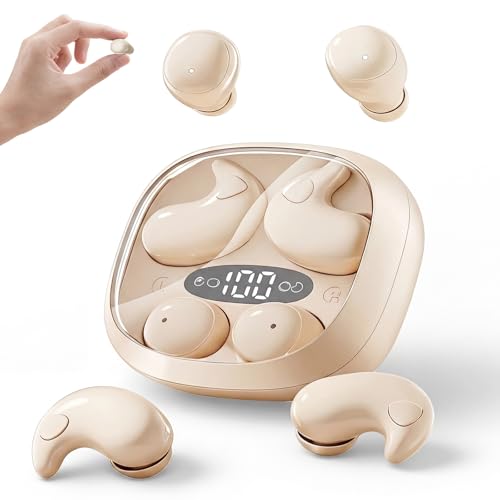
Which brings up a product designed to make that asymmetric on purpose. A
two in one set of flat sleep
earbuds for side sleepers exists specifically so that one earpiece can be pressed
into a pillow all night, and its record is clear about the geometry: the buds are
"ultra-thin and lightweight", the fit is "secure but pressure-free, resting gently in the
ear without the deep insertion that feels intrusive at bedtime", and "Soft ear tips form a
gentle seal". Read that with the arithmetic above. A gentle seal with shallow insertion is
a large residual volume, and a pillow pressing on one side of your head for six hours
reduces it on that side only. The record never mentions that this will shift the balance,
and for white noise and sleep stories it genuinely does not matter, which is a fair reason
for the omission. Worth knowing anyway if you also listen to music in bed. Our
sleep earbuds review has
the fit detail.
Your two ears are not identical either, and that is not a fault
The ear canal behaves as a tube closed at one end, so it has a quarter wave resonance
at the speed of sound divided by four times its length. At 343 metres per second a 25
millimetre canal rings at 3,430 hertz and a 27 millimetre canal at 3,176 hertz, which is
7.4 percent apart. Nobody's two canals are the same length, and that resonance is worth
roughly 10 decibels of gain at its peak, so two canals of slightly different length apply
slightly different gain curves to the same signal.
The consequence is that the offset you hear may be frequency dependent in a way no
headphone is responsible for. A vocal with most of its presence energy around 3
kilohertz is sitting right where the two canals disagree most. This is worth knowing
mainly because it tells you when to stop hunting for a fault, and because there is a
ten second test that separates it from everything else.
The free test, which beats every purchase in this article
Swap the earpieces. Put the left one on your right ear and the right one on your
left, or simply rotate a headband 180 degrees and wear it backwards for ten seconds.
Then listen to where the vocal is.
If the image stays on the same side of your head, the cause is downstream of the
hardware: your own ears, or the recording. If the image jumps to the other side, the
cause is the hardware, and you have identified it exactly, with no meter and no
purchase.
A Poly Blackwire 3310
monaural USB headset is useful here as the end of the scale rather than as a cure.
One earpiece is an infinite level difference, so the image is fully at one ear by
construction, and its record puts the trade plainly: You give up stereo imaging and
any pretence of media listening, and you gain situational awareness. It is also the
one headset in this article that ships with the swap test built in, because its
"180 degree pivoting speaker" exists so that the single earpiece can be worn on either
ear. It is the same headset as the 3325 above, from the same range, with the same boom
mic, differing in channel count and in having no 3.5 mm socket. If you want to hear what
10 decibels and beyond sounds like, borrowing one for a minute will tell you more than
any description. Our Blackwire
3310 review covers the contact centre case it is actually for.
Two more tests that are free. Play something you know to be mono, or switch on the
mono audio toggle that both major desktop and mobile platforms carry in their
accessibility settings. A mono signal is identical in both channels by construction, so
any offset you still hear is everything downstream of the file, which removes the
recording from the suspect list in one click. And then, if you have established that the
fault is in the hardware, the same accessibility panels carry a left and right balance
slider. Nulling a 1 decibel imbalance means trimming the loud side by about 11 percent of
its amplitude, which is a small nudge on that slider, and it is a complete fix that
involves buying nothing.
The case where the seal is not a variable at all
There is one category where the whole fit argument above simply does not arise, and it
is worth understanding as a trade rather than as a solution.
Baseus Bowie MC2 Air clip-on
open-ear earbuds work by not sealing anything. Their record is explicit: Instead of
a silicone tip pushed into your ear canal, soft air cushions and an extended ultra-thin
wave-shaped C-ring flex to different ear shapes, and "nothing seals the ear".
No seal means no trapped cavity, which means the one over volume relation has nothing
to act on, which means insertion depth cannot produce a bass imbalance. The driver spread
still can, and so can your canals, but the largest and most variable of the three terms
is gone. The honest other half is in the same record and the record states it without
being asked: bass will never hit as hard as a sealed tip delivers. There is less
bass to be imbalanced. That is the whole trade, and it is the same one our page on
open-ear
versus sealed headphones frames correctly as isolation against awareness, with the
imaging consequence simply not mentioned on either side. Our
Bowie MC2 Air review
has the specification.
The honest limit, and when it really is the record
The limit is blunt. The single number this entire page is about, channel balance
tolerance in decibels, is published by none of the five audio products touched here, and
in the wider catalogue it is published by none at all. Driver sensitivity is not published
either. Neither is frequency response. So the 0.42 and 0.83 decibel driver figures are
computed from assumed tolerances on the force factor, the insertion figures are computed
from an assumed canal bore and residual volume, and all of them are labelled as such in
the drawing. What the records do publish, to their credit, is that they publish nothing:
three of the four say so in their own drawbacks rather than inventing a figure, and that
is the behaviour to reward.
And yes, sometimes it really is the song. A lead vocal can be deliberately placed a
few degrees off centre, a double tracked lead can be panned narrow rather than stacked,
and a mono vocal with a reverb return that is wider on one side will read as offset even
though the dry voice is centred. Mixes from analogue sources can carry a genuine
interchannel time offset from head alignment, which the ear reads as position just as
readily as it reads level. None of that is detectable by listening harder. It is
detectable by swapping the earpieces, which takes ten seconds and settles the question
completely, and it is the only diagnostic in this article that works on the first
attempt.
One thing not to do: raise the volume. Interaural level difference is a ratio, so it
survives every volume change you can make. The image stays exactly where it was and
everything gets louder, which is the one outcome nobody wanted.
Why a Centered Vocal Sits Slightly to One Side at a glance
All-day comfort and staying aware of your surroundings
Ultra-light 4.9g clip-on, comfortable for hours
Open-ear cannot isolate outside noise
Why you can trust this guide
We compared these picks using verified manufacturer specifications, current retailer listings, and patterns in owner feedback, alongside editorial research. We focus on measurable differences such as performance, capacity, usability, and build quality. Pickpedia does not present editorial research as laboratory testing, and we do not claim hands-on testing unless it was actually performed.
Best for People who take calls on both a computer and a phone through one headset
8.6/ 10 Pickpedia editorial score
A stereo wired headset with USB-C, an included USB-A adapter and 3.5mm mobile connectivity, a flexible boom mic, 180 degree pivoting speakers and a dedicated Microsoft Teams button.
BrandPoly
Model2-214017-333
Wearing styleStereo, hi-fi
Computer connectionUSB-C
AdapterUSB-C to USB-A, included
Mobile connection3.5 mm
MicrophoneFlexible boom
Speaker articulation180 degree pivot
AdjustmentFully adjustable headband
CushionsPadded headband, soft ear cushions
PlatformMicrosoft Teams version, dedicated Teams button
Best for Comfortable bedtime listening for side sleepers
8.4/ 10 Pickpedia editorial score
A two-in-one set of ultra-flat, lightweight sleep earbuds for side sleepers, with a more in-ear and a flat pair in one charging case, a pressure-free fit and a gentle seal for white noise, podcasts and meditation.
Best for Contact centres and shared desks where awareness of the room matters
8.4/ 10 Pickpedia editorial score
A monaural wired headset with a flexible boom mic, 180 degree pivoting speaker, USB-C with an included USB-A adapter, and a dedicated Microsoft Teams button.
BrandPoly
Model2-214011-333
Wearing styleMonaural, one ear open
MicrophoneFlexible boom
Speaker articulation180 degree pivot
AdjustmentFully adjustable headband
ConnectionUSB-C
AdapterUSB-C to USB-A, included
Mobile connectionNone, computer only
PlatformMicrosoft Teams version, dedicated Teams button
Best for All-day comfort and staying aware of your surroundings
8.8/ 10 Pickpedia editorial score
Clip-on open-ear earbuds weighing 4.9 grams each, with soft air cushions and a flexible C-ring fit, 11mm titanium-coated drivers with SuperBass 2.0, a four-mic AI array for clear calls, up to 40 hours total playtime and IP67 waterproofing.