Why a Carry-On Limit Is Three Numbers and a Bag Has One
PBy the Pickpedia Team·7 picks compared·Last verified October 2026
Affiliate disclosure: As an Amazon Associate, Pickpedia earns from qualifying purchases. Links on this page are paid links, and we may earn a commission at no extra cost to you. This never affects our picks or scores.
This page contains affiliate links. If you buy through one we may earn a
commission, at no cost to you.
Whatever you are using, the litres on its label did not decide whether it fits. A sizer is a
box with three length limits and it applies them one at a time. A bag's capacity is the product
of three lengths multiplied together. You cannot recover three numbers from one, which means
there is no capacity below about 33 litres that guarantees a pass and no capacity below it that
guarantees a failure.
That is not a quibble. Two bags in this catalogue show it directly: on the only clue either
one gives about its shape, the 25 litre bag is 41 percent too deep for a personal item and the
20 litre bag fits. The larger bag is the one that fails, and nothing in either listing lets you
see it coming.
Start with the one bag that publishes everything
A
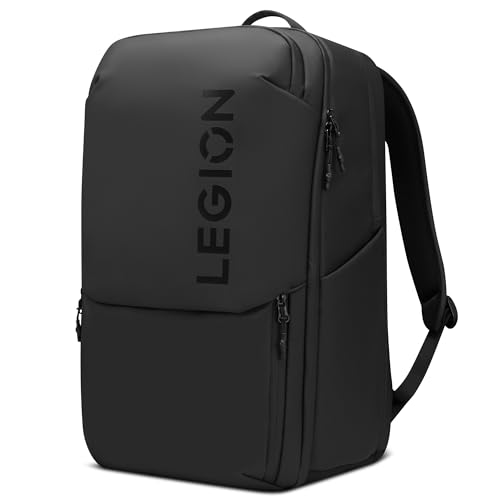
Lenovo Legion GB800 gaming laptop
backpack is, as far as this catalogue goes, unique. It publishes 21 litres, an external size
of 12.4 by 7.09 by 17.72 inches, a weight of 2.84 pounds, three main compartments, nineteen
pockets, a 180 degree opening main section, a water resistant PU coating, a luggage strap, dual
bottle pockets, and the specification that almost nobody prints: a maximum laptop of 290 by 30
by 430 millimetres, which is 11.42 by 1.18 by 16.93 inches.
Take the allowance that gets quoted most often for a personal item, 18 by 14 by 8 inches, and
remember that it is quoted rather than universal. Sort the bag's dimensions longest first and
set them against it:
17.72 against 18 leaves 0.28 of an inch, which is 1.56 percent. 12.4 against 14 leaves 1.60
inches, 11.4 percent. And 7.09 against 8 leaves 0.91 of an inch, also 11.4 percent. It passes on
all three, and the one that nearly stops it is the long dimension, with just over a quarter of an
inch in hand.
Now multiply the envelope out. 12.4 times 7.09 times 17.72 is 1,558 cubic inches, which is
25.536 litres. The listing says 21. So 4.536 litres of the space this bag
occupies in a sizer is wall, padding and the gap between panels: 17.76 percent of what
gets measured carries nothing. The sizer sees 25.5 and the label says 21, and both are
correct, and that single discrepancy is why the two questions are different questions.
The laptop figure is worth working as well, because it shows how little room is actually in
there. An 11.42 by 16.93 inch machine is a panel of 193.34 square inches. The bag's own panel is
12.4 by 17.72, which is 219.73. So the laptop occupies 87.99 percent of the bag's largest
face, and the 0.98 inches of spare width and 0.79 inches of spare height have to contain
the walls on both sides.
Our own record already draws the right conclusion from this and deserves the credit: "Measure
your machine against that rather than trusting the 17 inch screen figure, because gaming laptops
with thick cooling stacks often exceed the thickness a sleeve allows." That is exactly right, and
here is the figure behind it. A 17 inch chassis runs around 395 by 280 millimetres, so against
the published 430 by 290 there are 35 and 10 millimetres of total margin, which is 5 millimetres
a side on width. The thickness is tighter still: the limit is 30 millimetres and plenty of 17 inch
machines measure 27 to 32 at the hinge. Full details in our
review of the Lenovo Legion
GB800.
Everything geometric here is exact. A volume is the product of three lengths and a sizer applies
three limits independently, so volume below the box volume is necessary and not sufficient, and
the depth a volume forces at a fixed footprint is one division. The bulge relation is a shallow
parabolic arc, where the added volume per face is two thirds of the face area times the arc
height and the depth grows by twice that height, which gives two thirds of the face area as the
volume per inch of depth with nothing assumed beyond the arc shape. The published inputs are the
12.4 by 7.09 by 17.72 inch envelope, 21 litre capacity, 2.84 pound weight and 290 by 30 by 430
millimetre laptop maximum on the gaming pack, the 17.3 by 11.8 by 7.9 inches and 15.6 inch
laptop on the work backpack, the 20 litres, 0.83 pounds, 4.3 by 4.3 by 8.3 inch folded bundle
and 16 inch laptop pocket on the smaller packable, the 25 litres, 1.26 pounds, 9.5 by 7.1 by 3.2
inch folded bundle and 14 inch laptop sleeve on the larger one, the 30 litres and expandable
compartment on the camera pack, the 21 litres and rolltop on the photography pack, and the words
carry-on sizing on the duffel. Representative rather than published: the 18 by 14 by 8 inch
personal item box and the 22 by 14 by 9 inch carry-on box, which vary by carrier and are not a
product specification, the 12 by 7 inch daypack footprint, the laptop chassis sizes of about
14.0 by 9.7 and 12.6 by 8.7 inches, the 15.0 by 10.5 and 13.5 by 10.0 inch panels reconstructed
from the two laptop claims, and the parabolic arc. Exactly one bag in this catalogue publishes
both a volume and three dimensions, which is the gap the whole page is about.
Why litres cannot settle it, in two divisions
Here is the proof, and it needs no products at all.
Take a bag's most favourable possible shape: spread it out to the full footprint the box
allows, 18 by 14 inches, which is 252 square inches. The depth that a given volume then forces
is just the volume divided by 252. Twenty one litres is 1,281.50 cubic inches, so 5.086 inches
deep. Twenty five litres gives 6.054. Thirty litres gives 7.265. And 33.036 litres, which is the
box's own volume, gives exactly 8.000 inches.
So for every capacity below 33 litres there exists a shape that fits, with
room to spare. Volume is never the thing that stops you.
Now take an ordinary daypack footprint, 12 by 7 inches, which is 84 square inches, and let the
third dimension be the height. Twenty one litres stands 15.256 inches tall and passes
comfortably. Twenty five litres stands 18.162 inches, which is nine tenths of a percent over the
18 inch limit. Thirty litres stands 21.794 inches, which is 21.1 percent over a limit it
breaks while filling only 90.8 percent of the box's volume.
Identical litres, opposite verdicts, and the thing that decides between them is the aspect
ratio. Which no bag publishes. Our roundup of
travel backpacks ends its sizing note with "check airline
size limits before you fly", which is correct advice and the reason this page exists: the thing
you are checking against is three numbers and the thing on the label is one.
A different version of this failure has its own page here. Our piece on
why a 13 gallon bin is really a 16
gallon bucket works through volume against volume, where both sides are capacities and the
mismatch is in how each was measured. This one is volume against three lengths, where one side
is not a capacity at all.
The contradiction between our own two packable bags
A
WATERFLY 20L packable hiking
backpack publishes 20 litres, about 0.83 pounds, a fold down bundle of 4.3 by 4.3 by 8.3
inches with a storage bag, three zippered pockets, two side pockets each taking a one litre
bottle, a breathable back pad, a chest strap, a shoulder strap pocket for a phone up to 6.7
inches, and a main pocket that takes up to a 16 inch laptop.
A
WATERFLY 25L packable backpack
publishes 25 litres, 1.26 pounds, a fold down bundle of 9.5 by 7.1 by 3.2 inches, three zippered
pockets, two bottle pockets, a luggage strap, reflective strips, a whistle in the chest buckle,
and a main pocket that holds up to a 14 inch laptop.
The smaller bag takes the bigger machine. That is not a typing error, it is a shape statement,
and it is the only shape information either listing gives. Follow it through.
A 16 inch machine in a 16 by 10 aspect has a chassis around 14.0 by 9.7 inches, which is 135.8
square inches. A 14 inch machine in 16 by 9 is around 12.6 by 8.7, which is 109.6. So the 20
litre bag's main panel has to be at least 23.9 percent larger in area than the 25 litre bag's.
Give the 20 litre bag a plausible 15.0 by 10.5 inch panel, which is 157.5 square inches. Its
20 litres is 1,220.47 cubic inches, so its depth is 7.749 inches, which fits
under 8 with a quarter of an inch to spare.
Give the 25 litre bag a panel only as large as its 14 inch sleeve requires, 13.5 by 10.0, or
135 square inches. Its 25 litres is 1,525.59 cubic inches, so its depth is 11.30
inches, which is 41.3 percent over the limit.
The ratio of the two depths is 1.458, so the 25 litre bag is 45.8 percent
deeper than the 20 litre one on the only evidence available. The reconstructed panels
are representative and the conclusion is not sensitive to them: any pair of panels consistent
with a 16 inch sleeve in one bag and a 14 inch sleeve in the other puts the larger bag
substantially deeper, because the volume went somewhere and it did not go into the face.
Both bags do publish a dimension, and it is the folded one. The 25 litre bundle is 9.5 by 7.1
by 3.2, which is 215.84 cubic inches, or 3.537 litres: 14.15 percent of its open
capacity. The 20 litre bundle is 153.49 cubic inches, or 2.515 litres, which is 12.58
percent of its open 20. That is the genuine selling point of a packable bag stated numerically,
and it is a good one. You carry two and a half litres to have twenty. It just happens to be the
one dimension no sizer will ever ask about.
How a soft bag grows, and where the growth lands
A
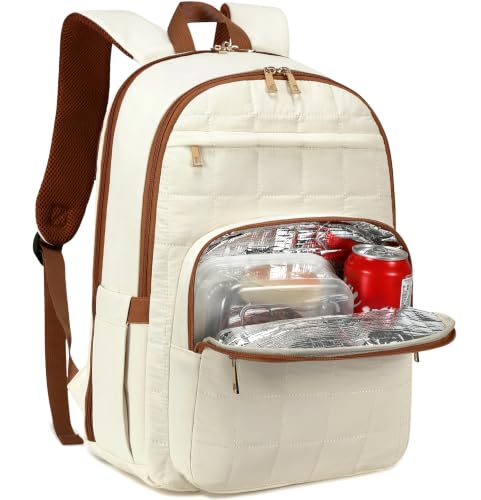
CAMTOP women's work backpack with a
lunch compartment publishes the opposite half of the information: three dimensions, 17.3 by
11.8 by 7.9 inches, a padded sleeve for a laptop up to 15.6 inches, an insulated lunch section,
a quilted exterior, a breathable mesh back panel, a luggage strap and water resistant fabric. It
publishes no capacity at all.
Multiply it out and the envelope is 1,612.71 cubic inches, which is 26.428 litres. Against 18,
14 and 8 the margins are 0.7 of an inch, 2.2 inches, and 0.1 of an inch. The
depth is the binding dimension and it has one tenth of an inch in hand.
Which matters because a rigid box does not grow and a soft bag does. When you overfill a
backpack the panels bow outward, and the bow lands almost entirely in the depth, because the
long and wide dimensions are set by seams and the depth is the one that is free to move.
Model each of the two large faces as a shallow arc of height s. The volume added by one face
is about two thirds of the face area times s, and the depth has grown by 2s because both faces
moved. So the volume added per inch of depth is two thirds of the face area, and all the
dependence on s cancels.
On a 17.3 by 11.8 inch face that is two thirds of 204.14, which is 136.09 cubic inches for
every inch of depth, or 2.230 litres an inch. Turn it over and the useful form
appears: 0.4484 inches of depth for every litre you pack past full.
The bag's 0.1 inch of depth headroom is therefore 0.223 litres. A rolled T-shirt is about that
much. One extra garment is the difference between walking on and repacking at the gate, and the
listing cannot tell you because it publishes no litres and the sizer does not care about litres
anyway. The right question for this bag is not how much it holds. It is whether its depth is
still 7.9 inches when it is full, and the answer is that it is not. Our guide to
choosing a work backpack
with a lunch compartment covers what goes in it; this is the arithmetic on whether it
closes.
Three bags sold on changing their volume, and none that says to what
A
Peak Design Everyday Backpack 30L
publishes 30 litres, FlexFold dividers, top and dual side access, a 100 percent recycled
weatherproof shell, a MagLatch top, separate sleeves for a laptop, a tablet and documents, a
sleeve that takes a 15 inch laptop or a 16 inch MacBook Pro, external carry straps, and an
expandable main compartment. Its own drawbacks include no bottle pocket, straps that dangle, and
that it "feels bulky fully expanded".
That last one is the problem in one phrase. Fully expanded is a different bag with different
dimensions, and neither the expanded capacity nor any dimension in either state appears. On the
arithmetic above, a 30 litre bag is the first capacity in this catalogue where shape becomes
decisive: at the full 18 by 14 footprint it is 7.265 inches deep and fits, and at a 12 by 7
footprint it is 21.794 inches tall and does not. Expansion moves it further into the second case,
by an amount nobody states.
A
WANDRD PRVKE Rolltop 21L V4
photography bundle does the same thing by a different route. It publishes 21 litres, a
rolltop closure that expands the main compartment, waterproof tarpaulin and ballistic nylon,
weather resistant zippers, an Essential Camera Cube, a waist strap and accessory straps, and its
own drawbacks note that the camera cube reduces room for other items. A rolltop is a variable
height bag by design, and height is the dimension that was already closest to its limit at 21
litres. On the fabric side we have taken that argument apart elsewhere, in
why a 1680D bag is not stronger than
a 600D one, so this page leaves denier alone and sticks to geometry.
And then the clearest absence of all. A
Vokelater No.10 sports duffel gym
bag publishes scratch resistant Oxford fabric, reinforced double stitching, a dedicated shoe
compartment, a shoulder strap, a soccer graphic, and the phrase "carry-on sizing".
A carry on limit is three lengths. That phrase asserts conformance to all three of them and
states none. It is the only claim on the listing that is purely dimensional and it is the only
claim with no dimension attached. The shoe compartment, which the record is right to call the
standout, is also the feature most likely to break the depth, since a pair of trainers is about
4.5 inches tall and that compartment runs the width of the bag.
What our records publish and what they leave out
Across the six bags above, exactly one publishes both a capacity and three dimensions. One
publishes three dimensions and no capacity. Four publish a capacity and no open dimensions, and
two of those four publish a folded dimension instead, which is the one measurement no gate will
ever take.
That is not a complaint about these particular listings, it is a description of the category.
The number that is easy to print is the one that cannot answer the question, and the three
numbers that answer it completely are a tape measure away from anybody who makes a bag.
There is one more quiet consequence. Because volume is a product of three lengths, a 10 percent
error in any single dimension is a 10 percent error in the stated litres, so two bags quoted at
the same capacity can differ by half an inch in every direction and nobody is lying. And because
the sizer tests each length separately, those half inches do not average out. They each get their
own chance to fail.
The honest limit, and the three numbers to carry
What is exact here is every piece of geometry. A volume is the product of three lengths, so
volume below the box volume is necessary and not sufficient, and that is a proof rather than an
observation. The depth a capacity forces at a fixed footprint is one division. The bulge relation
follows from a shallow parabolic arc and the arc height cancels, which is why two thirds of the
face area is a clean figure. The envelope of the gaming pack, 25.536 litres against a stated 21,
is multiplication.
What is representative is the boxes. An 18 by 14 by 8 inch personal item and a 22 by 14 by 9
inch carry on are the figures quoted most often and they are not a product specification, they
are not standardised, and they are the one input here that a carrier can change without telling
anybody. Also representative: the 12 by 7 inch daypack footprint, the laptop chassis sizes, and
the two panels reconstructed from the 16 inch and 14 inch sleeve claims. Shift any of those and
the specific inches move while the structure does not, because the structure is that one number
cannot encode three.
What this page deliberately does not compute is whether any of these bags will be accepted by
any particular airline, and the refusal is not caution. Sizer dimensions differ between carriers,
between a gate and a check in desk, and between the stated policy and the person holding it, and
none of those is a property of a bag. A page that produced a verdict would be inventing a
standard. Nor does it compute the real bulge profile of a loaded pack, which needs the panel's
bending stiffness and the compressive behaviour of whatever is inside it; the parabolic arc is
stated as an approximation and the figure that comes out of it, 0.4484 inches a litre, should be
read as the right order with the right sign rather than a measurement. And it says nothing about
how much a bag should weigh, because weight limits and size limits are separate rules and only
one of them is geometry.
Three numbers to carry instead. A capacity is one number and an allowance is three, so no
capacity under 33 litres either guarantees or forbids a fit. The dimension that fails is almost
always the depth, which on a soft bag grows about half an inch for every litre you add past full.
And the single most useful figure a bag can print is not its litres but its three measurements,
which in this catalogue exactly one bag out of six does.
Why a Carry-On Limit Is Three Numbers and a Bag Has One at a glance
Photographers and commuters who need a versatile, well-organized pack for daily use and travel.
Customizable FlexFold dividers for gear protection Multiple access points (top and dual side) Weatherproof 100% recycled shell Expandable main compartment with external carry straps Separate sleeves for laptop, tablet, and documents Durable hardware and clean design
No water bottle pocket 30L capacity may feel small for heavy packers MagLatch top may take practice to use smoothly External straps can dangle when not in use
Photographers and travelers who need a compact, weather-resistant backpack with quick camera access.
Weatherproof materials (tarpaulin, ballistic nylon, weather-resistant zippers) Rolltop design allows expandable storage Quick side access for camera retrieval Includes Essential Camera Cube for secure gear storage Adjustable waist strap for added support Accessory straps for tripod or extra gear
21L capacity is compact and may be limiting Camera cube reduces available space for other items Rolltop may require adjustment to access main compartment fully Weather resistance level not specified for heavy rain
Everyday gym, sport and light travel with dirty shoes kept apart
Dedicated shoe compartment keeps kit clean
Not a technical or waterproof holdall
Why you can trust this guide
We compared these picks using verified manufacturer specifications, current retailer listings, and patterns in owner feedback, alongside editorial research. We focus on measurable differences such as performance, capacity, usability, and build quality. Pickpedia does not present editorial research as laboratory testing, and we do not claim hands-on testing unless it was actually performed.
Best for Carrying a 17 inch gaming laptop plus its charger and peripherals daily
8.8/ 10 Pickpedia editorial score
A 21 litre gaming laptop backpack with three main compartments, nineteen specialised pockets, a 180 degree opening main section, an independent laptop compartment with tablet pocket and a water-resistant PU coating.
BrandLenovo
ModelGX41U39299
RangeLegion GB800
Capacity21 litres
Laptop sizeFits up to 17 inch
Maximum laptop dimensions11.42 x 1.18 x 16.93 in, 290 x 30 x 430 mm
Compartments3 main
Pockets19 specialised
Main compartment180 degree open angle
Laptop sectionIndependent, with tablet pocket
MaterialWater-resistant PU coating
Bottle pockets2
StrapsBreathable, ergonomic
TravelLuggage strap
Dimensions12.4 x 7.09 x 17.72 in
Weight2.84 lb
Warranty1 year manufacturer
ColourBlack
Pros
Three main compartments and nineteen specialised pockets
180 degree opening lays the main compartment flat
Independent laptop compartment with its own tablet pocket
Maximum laptop dimensions published, not just a screen size
Dual water bottle pockets rather than one
Water-resistant PU coating against rain and spills
Extra protection on the base for a heavy load
Luggage strap for sitting on a suitcase handle
Cons
Water-resistant, not waterproof
30 mm laptop thickness limit rules out some thick gaming machines
21 litres is daily carry rather than travel capacity
Best for Day hikes, travel and a spare bag that packs to nothing
9.0/ 10 Pickpedia editorial score
A 20-litre packable hiking daypack weighing about 0.83 pounds that folds into its own pouch, with a 16-inch laptop pocket, multiple zippered and side pockets, a breathable back and straps, a shoulder-strap phone pocket, and water-repellent, tear-resistant fabric.
Best for A packable spare bag for travel, day trips and light hiking
9.0/ 10 Pickpedia editorial score
A lightweight 25-litre packable backpack weighing 1.26 pounds that folds into its own pocket (down to 9.5 by 7.1 by 3.2 inches), with a 14-inch laptop sleeve, three zippered and two bottle pockets, a suitcase luggage strap, a breathable mesh back with ergonomic and chest straps, water-repellent tear-resistant material, and reflective strips and a buckle whistle, for travel, day trips and light hiking.
BrandWATERFLY
TypePackable daypack
Capacity25 L
Weight1.26 lbs
Folded9.5 x 7.1 x 3.2 in
Pockets14 in laptop, 3 zip, 2 bottle
TravelLuggage strap, breathable back
MaterialWater-repellent, tear-resistant
Pros
Folds into its own pocket to a tiny, light bundle
Unfolds to a well-organized 25-litre pack with a laptop sleeve
Luggage strap rides it securely on your suitcase
Breathable mesh back and ergonomic chest-strapped straps
Water-repellent, tear-resistant material and smooth two-way zipper
Reflective strips and an emergency buckle whistle
Cons
A lightweight day bag, not a heavy-duty or multi-day pack
Less structured and padded than a framed hiking backpack
Water-repellent, not fully waterproof for heavy rain
Best for commuters carrying a laptop and lunch together
8.6/ 10 Pickpedia editorial score
The CAMTOP women's work backpack combines an insulated lunch compartment with a padded sleeve that fits up to a 15.6 inch laptop. It suits teachers, nurses, and commuters who carry meals and electronics together. The maker lists 17.3 by 11.8 by 7.9 inch dimensions, multiple compartments, a quilted exterior, breathable mesh back panel, luggage strap, and water-resistant fabric.
Best for Photographers and commuters who need a versatile, well-organized pack for daily use and travel.
8.8/ 10 Pickpedia editorial score
The Peak Design Everyday Backpack 30L is a thoughtfully designed pack that balances camera protection with everyday usability. Its customizable FlexFold dividers and multiple access points make it easy to organize and retrieve gear. The weatherproof shell and expandable design add to its versatility for commutes and travel. However, the 30L capacity may feel tight for larger loads, and the lack of a dedicated water bottle pocket could be a drawback for some.
Everyday Backpack 30lA pack that adapts to your ever-changing gear, lifes
Custom OrganizationConfigurable FlexFold dividers keep photo or everyda
Expandable Design, RefinedThis camera backpack adjusts to your load with an ex
Pros
Customizable FlexFold dividers for gear protection Multiple access points (top and dual side) Weatherproof 100% recycled shell Expandable main compartment with external carry straps Separate sleeves for laptop, tablet, and documents Durable hardware and clean design
Cons
No water bottle pocket 30L capacity may feel small for heavy packers MagLatch top may take practice to use smoothly External straps can dangle when not in use
Best for Photographers and travelers who need a compact, weather-resistant backpack with quick camera access.
8.8/ 10 Pickpedia editorial score
The WANDRD PRVKE Rolltop 21L V4 Photography Bundle is a compact yet expandable travel backpack designed for photographers, travelers, and commuters. It includes the backpack, an Essential Camera Cube, an adjustable waist strap, and accessory straps for carrying a tripod or extra gear. Built with waterproof tarpaulin, 1680D ballistic nylon, and weather-resistant zippers, it offers solid protection against the elements. The rolltop design and quick side access make it flexible for daily use and travel.
Photography BundleThis bundle includes the PRVKE 21L V4 backpack, our
Creator's Travel BackpackDesigned for photographers, travelers, and commuters
Weatherproof Camera BackpaBuilt with waterproof tarpaulin, durable 1680D balli
Pros
Weatherproof materials (tarpaulin, ballistic nylon, weather-resistant zippers) Rolltop design allows expandable storage Quick side access for camera retrieval Includes Essential Camera Cube for secure gear storage Adjustable waist strap for added support Accessory straps for tripod or extra gear
Cons
21L capacity is compact and may be limiting Camera cube reduces available space for other items Rolltop may require adjustment to access main compartment fully Weather resistance level not specified for heavy rain
Best for Everyday gym, sport and light travel with dirty shoes kept apart
8.8/ 10 Pickpedia editorial score
A durable sports duffel gym bag in scratch-resistant Oxford fabric with reinforced double stitching, a dedicated shoe compartment to keep dirty footwear away from clean clothes, carry-on sizing and a classic soccer No.10 graphic, for gym, sport and travel.