Why a Breathable Jacket Fills With Water From the Inside
PBy the Pickpedia Team·5 picks compared·Last verified October 2026
Affiliate disclosure: As an Amazon Associate, Pickpedia earns from qualifying purchases. Links on this page are paid links, and we may earn a commission at no extra cost to you. This never affects our picks or scores.
This page contains affiliate links. If you buy through one we may earn a
commission, at no cost to you.
Mostly you cannot, and the reason is worth understanding because it kills the
instinct to solve it by buying a better jacket. The water on the inside of your shell
is largely not sweat. It is condensate. It left your skin as vapour and became liquid
again on the inner face of the shell, because that surface is around 20 kelvin below
the dew point of the air behind it, and a waterproof membrane is specifically designed
not to pass liquid water.
Once it has condensed, the only thing driving it out is the difference between the
vapour pressure of a cold film of water and the vapour pressure of the cold wet air
outside, which is 0.175 kilopascals. The rating on the jacket was measured across
3.55. So the shell is working on five percent of its headline figure, and the arithmetic
says what you already know: it does not keep up.
On paper the jacket is exactly good enough
Start with the two numbers that make this look like a solved problem. Walking uphill
under a pack produces vapour at something like 700 grams an hour, which is the middle
of the usual half to one litre range. A mid grade membrane is rated at 10,000 grams per
square metre per 24 hours. A jacket is about 1.8 square metres of fabric, so that is
18,000 grams per 24 hours, or 750 grams an hour.
Seven hundred against seven hundred and fifty. The specification matches the body
almost exactly, which is presumably not a coincidence, and it is why the figures get
printed. The trouble is entirely in the conditions those figures were measured under,
because a transport rate is never a property of a material on its own. It is a property
of a material and the difference applied across it.
The dew point decides everything, and it is not close
Air trapped between your skin and your insulation sits near your skin temperature
and near saturation. Call it 33 degrees Celsius at 95 percent relative humidity. Water's
saturation pressure at 33 degrees is 5.034 kilopascals, so that air carries 4.78, and
its dew point works out at 32.1 degrees.
Now the shell. It is a thin membrane with liquid water on its outside face, in 10
degree air. Nothing is keeping it warm, and evaporation from the wetted face is actively
cooling it, so its inner surface sits near ambient, perhaps 12 degrees. That is 20.1
kelvin below the dew point of the air touching it.
Which means the vapour does not reach the membrane as vapour. It reaches a surface
that is far too cold to let it stay vapour, and it condenses there, every time, in any
weather cold enough that you wanted a jacket. There is no version of this where it does
not condense. The only question is how fast the resulting liquid leaves.
And that is now a different and much smaller calculation, because the thing driving
vapour across the membrane is no longer your skin. It is the film. A film of liquid
water at 12 degrees has a vapour pressure of 1.403 kilopascals. The saturated air
outside at 10 degrees has 1.228. The difference is 0.175 kilopascals, which is 4.9
percent of the 3.55 the rating implies, so 750 grams an hour becomes 37.
Thirty seven grams an hour against seven hundred. Ninety five percent of what you
produce has nowhere to go, and it is already liquid, on the inside of your jacket, and
it reads exactly like sweat.
Vapour pressures are water's saturation values at each temperature from steam tables,
multiplied by the relative humidity. The dew point comes from the Magnus relation. The
10,000 grams per square metre per 24 hours rating and the 1.8 square metres of shell
are worked examples, because no apparel listing we carry publishes either figure. The
convection bar takes 33.9 grams of water per cubic metre inside against 9.40 outside,
so 24.5 grams leave with every cubic metre exchanged.
Stop raining and it improves, but not enough
Run the same sum on a dry cool day, which is instructive because it explains why the
jacket seems to work sometimes. With no water on the outer face there is no evaporative
cooling of the shell, so the inner face sits warmer, perhaps 18 degrees, whose
saturation pressure is 2.065 kilopascals. The outside air at 10 degrees and 50 percent
relative humidity carries 0.614. The difference is 1.451 kilopascals, which is 40.9
percent of nominal, so 307 grams an hour.
Better by a factor of eight, and still less than half of what the body is making. So
the honest statement about a waterproof breathable shell is that it reduces the rate at
which you get wet from the inside, and that is all it has ever done. The marketing
number is a laboratory ceiling. The field number is a fraction of it set by how cold and
how wet the outside of the garment is, which are exactly the conditions you bought it
for.
The limiting case, which we do sell
We do not carry a rain jacket, so nothing above is read off one of our records and
it is worth saying so plainly. What we do carry is the same mechanism with the dial
turned all the way to one end.
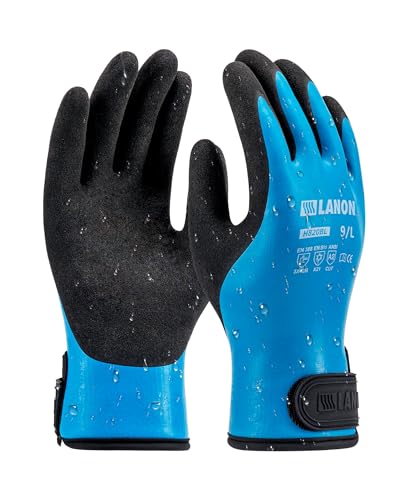
LANON waterproof double
latex coated winter work gloves are a complete vapour barrier. Their record
describes a "double layer of fully dipped latex over an acrylic nylon knit shell" with
"a brushed fleece lining" inside it. Fully dipped means no uncoated area anywhere, and
a continuous latex film has no micropores at all, so its vapour transmission is not
reduced, it is absent. Everything a hand produces stays inside.
Which makes one of its own stated drawbacks much more interesting than it looks. The
record lists "Insulation weakens after long water immersion", and its performance text
records that "LANON warns against soaking the gloves in cold water beyond ten minutes,
or the warm insulation weakens". The maker is describing water getting in from the
outside. But the arithmetic above says the liner will wet out from the inside too,
because the insulation sits between a vapour source and a cold impermeable film, which
is precisely the geometry that guarantees condensation in the loft. Lofted insulation
works by trapping still air, and water in the loft collapses it and conducts heat away
roughly twenty times faster than the air it replaced. The ten minute immersion warning
and the thing that happens after an hour of shovelling are the same failure arriving
from opposite directions, and the record only names one of them. Our
LANON winter
glove review has the certifications.
And it is worth correcting our own page on this, gently. Our guide to
choosing
insulated waterproof gloves for outdoor work recommends exactly this combination
and never mentions that putting the insulation inside the barrier is what makes the
insulation vulnerable. The recommendation is still right for cold wet work. The missing
sentence is that a fully sealed insulated glove has a duty cycle rather than a rating,
and the duty cycle is set by how long the loft takes to fill.
The partial barrier, and the honest remedy hiding in a pack size
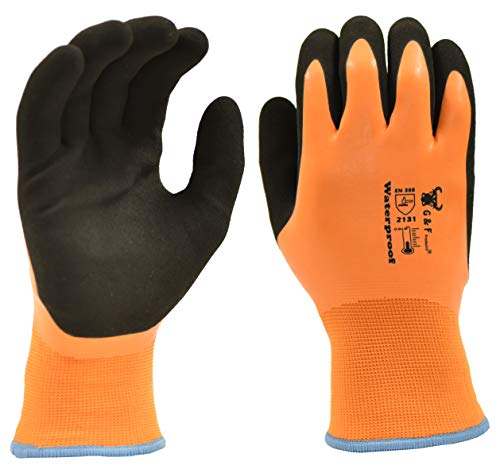
G and F waterproof winter
gloves with an HPT palm coating are the same idea built differently, and the
difference is the one that matters here. Only the palm side is coated: the record
specifies "a durable exterior latex coating" on "double-coated latex and foam palms"
over "a 7-gauge acrylic terry lining". The back of the hand stays open knit. So there is
an escape path for vapour, through an area neither record quantifies, and the glove is
correspondingly less waterproof on that side. One object, two requirements, and the
coated area is the dial between them.
The thing to notice is why the pack holds three pairs. The record says it directly:
"A three-pair pack means spares for rotation as gloves get wet or worn." That is a
concession that the waterproof glove gets wet, offered as the solution rather than as a
problem, and it is the correct solution. It is also the glove version of every genuinely
effective technique in this article: do not try to drive the water out through the
barrier, take the barrier off and let the water out the open end. Its cons add the other
half honestly, that "Prolonged submersion can eventually let moisture in". Our
G and F
winter glove review covers the rest.
The other end of the dial
PULI water resistant hiking
cargo pants sit at the opposite extreme and are the most honest garment in this
article, because of one line in their own drawbacks: "Water-resistant, not waterproof,
so heavy rain will eventually soak through."
That sentence is the trade stated correctly. A woven fabric with a repellent finish
and no membrane has no barrier to vapour at all beyond the air trapped in the weave, so
its transmission rate is enormous and it will never condense on its inner face in the way
a membrane does. The forfeit is that it has no hydrostatic resistance either, and in
sustained rain the water simply arrives. For anything short of that it is the better
garment to be moving in, and the arithmetic says why: it is operating on the whole 3.55
kilopascals rather than on 0.175 of it.
Worth noting that neither this listing nor any other apparel listing we carry
publishes a figure for either property. The record admits as much, noting that "No exact
fabric content or weight is stated in the listing". So the choice between repellent and
waterproof in our catalogue is made on adjectives. Our
PULI hiking
trouser review has the pocket detail that is actually its selling point.
What works, and it is convection rather than diffusion
Here is the number that ends the argument. Air inside a jacket at 33 degrees and 95
percent relative humidity holds 33.9 grams of water per cubic metre. Replacement air at
10 degrees and saturated holds 9.40. So every cubic metre of jacket air you throw away
and replace removes 24.5 grams of water, as vapour, without anything having to diffuse
through anything.
Exchange ten litres a second, which is a modest draught from an unzipped front while
walking, and that is 0.245 grams a second, or 882 grams an hour. Twenty four times what
the membrane manages in the rain, and more than your body is producing. Opening the
jacket is not a compromise on the jacket's function. It is between one and two orders of
magnitude better than the jacket's function, and it works best in exactly the conditions
where the membrane works worst, because cold outside air is dry in absolute terms no
matter what its relative humidity says.
Which is also why forced air is such a good idea when you can have it. A
solar fan bucket hat with two
brim fans is a small and slightly comic illustration of the right physics: its record
lists "Dual breathable mesh vents", "an internal sweatband", "quick-drying fabric" and
two fans running "5 to 16 hours" after a two hour charge, on three speeds. Every one of
those attacks the convective term rather than the diffusive one. The head is also the
one part of the body where the garment is not sealed at the bottom, so air genuinely
moves through it. Its honest limits are stated: "Fan output and battery life are
maker-stated", and there is no air flow figure published anywhere, so the hat cannot be
put on the chart above. Our
solar
fan hat review has the rest.
The second thing that works is buffering, and it is why wool keeps being
recommended. Wool absorbs water vapour into the fibre itself rather than holding it as a
film on the surface, and at high humidity its regain is around 30 percent of its dry
mass.
FALKE TK2 Explore merino wool
hiking socks describe "a three-layer build engineered to wick moisture away", which
is the surface transport story, and the fibre does something the record never mentions:
a 60 gram pair can take up about 18 grams of water inside the wool without feeling wet
or losing much of its loft. That is a buffer across a sharp burst of effort, not a
path to the outside, and it is the difference between a damp sock and a wet one. Its cons
are appropriately careful that "Exact fiber percentages are not listed", so the 30
percent figure is handbook wool rather than this sock. Our
FALKE merino sock
review has the sizing.
The honest limit, and the counterintuitive one
The limit is that none of the four numbers this page turns on is published by anybody
we carry. No MVTR, no hydrostatic head, no membrane type, no coated area. So the 10,000
grams per square metre per 24 hours, the 1.8 square metres, the 700 grams an hour and the
ten litres a second are all worked examples, chosen to be ordinary and labelled in the
drawing. What is not an assumption is the vapour pressure table, the dew point and the
arithmetic between them, and those are what produce the factor of twenty.
Then the free techniques, in order of how much the arithmetic says they are worth.
Open the front and the pit zips, because convection is worth 882 grams an hour against
the membrane's 37. Slow down, because the supply term is the only other large one and it
scales with how hard you are working. Take the hood down when it is not raining hard, for
the same convective reason, since the neck opening is the top of the chimney.
And the counterintuitive one, which falls straight out of the staircase in the
drawing. Wear less under the shell, not more. Insulation between your skin and the
membrane makes the membrane's inner face colder, which lowers the vapour pressure of the
condensate, which reduces the only gradient that is actually moving water out. A thick
fleece under a shell improves your comfort and makes the shell's job harder at the same
time. The usual advice to layer up under a waterproof is correct for warmth and wrong for
dryness, and nobody tells you that the two are in conflict.
Last, keep the outer face repellent. A wetted out outer face is cooled by its own
evaporation and holds liquid in the surface fabric, both of which pull the shell's
temperature down and shrink that 0.175 kilopascals further. Washing a shell properly and
re-treating the outside is the one maintenance task that moves a number on this page,
and it moves the right one.
Why a Breathable Jacket Fills With Water From the Inside at a glance
hikers wanting an anatomically shaped merino trail sock
Merino and synthetic blend balances warmth and durability
Sold as a single pair, not a multipack
Why you can trust this guide
We compared these picks using verified manufacturer specifications, current retailer listings, and patterns in owner feedback, alongside editorial research. We focus on measurable differences such as performance, capacity, usability, and build quality. Pickpedia does not present editorial research as laboratory testing, and we do not claim hands-on testing unless it was actually performed.
LANON winter work gloves suit warehouse workers, drivers, and cold-weather chores. A double layer of fully dipped latex delivers full-hand waterproofing, while a double warm liner and brushed fleece trap heat. Sandy latex adds slip resistance. The maker lists CE certification with EN 388:2016, EN 511:2006, and ANSI A2 ratings for reliable protection.
These G & F waterproof winter gloves come three pairs to a pack in a medium size, built for cold outdoor work. A 7-gauge acrylic terry lining traps heat while double-coated latex and foam palms grip snow, tools, and equipment. The double-layer coating aims to block water and wind, and the materials resist punctures during heavy-duty tasks.
Best for men wanting style-conscious hiking and travel pants
8.8/ 10 Pickpedia editorial score
PULI hiking pants for men combine a lightweight, water-resistant, breathable and stretchy fabric with a slim-fit cargo jogger cut. An elastic waistband and articulated knees support easy movement, while seven pockets, including a hidden phone pocket and cargo flap pockets, organize your gear. The easy-care fabric is machine washable with minimal wrinkling or shrinkage, and the design suits hiking, travel, golf and casual workouts.
Best for outdoor workers who want shade plus a steady breeze
8.2/ 10 Pickpedia editorial score
This is a wide brim bucket hat with two built-in fans and a USB rechargeable battery, made for gardeners, anglers, and outdoor workers who want shade plus airflow. The maker states UPF 50+ fabric blocks 98% of UV rays. Fans run on solar in direct sun or 5 to 16 hours after a 2 hour charge, with three speeds.
Best for hikers wanting an anatomically shaped merino trail sock
9.0/ 10 Pickpedia editorial score
FALKE TK2 Explore hiking socks pair insulating merino wool with durable synthetic fibers for a soft, breathable trail sock. Medium cushioning adds comfort, while a three-layer build wicks moisture to help prevent blisters. Flat seams at toe and heel cut friction, and gender-specific knitting shapes left and right feet. Sold as one pair, mid-calf, in US women's sizes 5-6 through 9.5-10.5.
MaterialMerino wool blended with synthetic fibers
CushioningMedium padding
ConstructionThree-layer moisture-wicking
SeamsFlat at toe and heel
FitGender-specific left and right knitting
LengthMid-calf
SizesUS women's 5-6 to 9.5-10.5
Model16445, one pair
Pros
Merino and synthetic blend balances warmth and durability
Three-layer build wicks moisture to fight blisters
Flat toe and heel seams reduce friction
Gender-specific knitting shapes left and right feet