PBy the Pickpedia Team·5 picks compared·Last verified October 2026
Affiliate disclosure: As an Amazon Associate, Pickpedia earns from qualifying purchases. Links on this page are paid links, and we may earn a commission at no extra cost to you. This never affects our picks or scores.
This page contains affiliate links. If you buy through one we may earn a
commission, at no cost to you.
No, because durability is not what the phrase is about. Food grade is a
compliance statement: it says the finished rubber has been assessed against the
limits for what can migrate out of it under defined conditions of repeated contact.
It is a statement about chemistry. It is not a stiffness, not a tear strength, not a
temperature rating and not a thickness, and a compound can hold the compliance and
still be the wrong rubber for the job in every mechanical respect.
The figure that decides whether a silicone article works is Shore A hardness, and
it is published almost nowhere. Across every silicone product on this site there is
not one. So the useful half of this post is not a buying recommendation, it is a
pair of tests you can do with your hands, and the arithmetic that says why they
work.
Two words that get read as one
Our
YESCOO silicone griddle
mat is the clearest example of the conflation, and not because the listing is
unusually bad. It is typical. Its specification table has a row labelled Material
reading food grade silicone and a row labelled Heat reading high temperature
resistant. One row is a compliance claim and the other row is an adjective where a
number belongs, and because they sit next to each other they get read as one fact
about a good material.
They are unrelated. Compliance testing looks at extractables. Temperature
capability depends on the cure system and the filler package: an addition cured
silicone and a peroxide cured one can hold identical compliance and differ in what
they tolerate, and neither cure system is ever named on a consumer listing. Our own
record is honest about the limits of what is being claimed, with a drawback line
saying the mat complements rather than replaces normal heat precautions and is not a
limitless shield, which is the right note to strike. More in the
YESCOO griddle mat review.
What Shore A actually measures
The test is ASTM D2240 and it is almost crude. A shaped indenter on a calibrated
spring is pressed against the rubber, and the instrument reports how far the indenter
sinks in. The scale is defined so that zero penetration reads 100 and 2.54
millimetres of penetration reads 0, and everything in between is linear. So one point
on the Shore A scale is exactly 0.0254 millimetres of indenter travel. Shore A 20 is
2.03 millimetres of penetration, Shore A 50 is 1.27, and Shore A 80 is 0.51.
That is a depth, not a stiffness, and the relationship between the two is where
everything interesting happens.
The dashed line is what the test does. The solid curve is what you care about. They
are not the same shape, which is why a hardness you can feel with a thumbnail tells
you more than you would expect.
Convert each hardness to a Young's modulus using Gent's standard relation and the
numbers come out like this. Shore A 20 is about 0.73 megapascals. Shore A 50 is about
2.46. Shore A 80 is about 9.35. Shore A 90 is about 21. So moving 60 points up a 100
point scale multiplies stiffness by nearly 13 times, and the last ten points
multiply it again by more than two. The scale looks like a percentage and behaves
like an exponent, which is exactly why a figure in the forties and a figure in the
seventies describe materials that behave nothing alike while sounding like
neighbours.
A drain stopper, and the number that decides whether it seals
Our
silicone shower drain hair
stopper, in a two pack describes itself as soft silicone that adapts to slightly
uneven drain surfaces, and lists as drawbacks that the suction fit varies on uneven
surfaces and that very textured drains may not seal well. Those two statements
bracket the whole problem, and the arithmetic sits inside them.
A suction seal has exactly one force available to press the lip into the
irregularities of the drain surround: the difference between atmospheric pressure
outside and the reduced pressure under the cup. At best that is about 101
kilopascals, and in practice much less. Now ask what stress the lip needs in order
to conform. Suppose the surround has a 0.2 millimetre bump over a 2 millimetre span,
which is an unremarkable amount of texture on a tiled or cast surface. The lip must
strain locally by roughly 0.2 over 2, which is 10 percent, and the stress required is
the modulus multiplied by that strain.
At Shore A 20 that is 0.73 megapascals times 0.1, which is 73 kilopascals.
Atmospheric pressure can supply that, with a little in hand. At Shore A 80 it is
9.35 megapascals times 0.1, which is 935 kilopascals, or about nine atmospheres.
There is no suction cup in the world that will deliver nine atmospheres, so a hard
lip simply bridges the bump and leaves a path around it, and the water finds it.
Same geometry, same drain, same product shape. One unpublished number decides
whether it works, and the margin is a factor of nine on a force that is capped by
the atmosphere. That is why the only honest thing a listing can say about a suction
seal is what ours says: that it varies with the surface. Record in the
silicone drain stopper
review.
A bag seal, and the thumb that has to close it
Our
Haakaa reusable silicone
food storage bags, a three pack close with what the listing calls an interlocking
dot seal, in 500, 1000 and 1500 millilitre sizes. An interlock works by interference:
one moulded feature is slightly larger than the groove it goes into, and closing it
means deforming the rubber by that difference along the length of the seam.
The force to do that is proportional to the modulus, which gives a very clean
ratio. If the interference is the same, the same seam at Shore A 70 needs 5.52
divided by 1.69, which is about 3.3 times the force of the same seam at Shore A 40.
A thumb run along a 20 centimetre seam has a fixed budget: comfortable sustained
pressure, a small contact patch, and one pass. Triple the required force and the
seam closes in some places and not others, which is a bag that looks shut and leaks
in a freezer drawer.
So the softer compound makes a better hand seal, and the trade is that it also
deforms more easily under its own contents, which is why the same listing notes the
bags stand upright thanks to a sturdier base, and that is geometry doing the job
hardness cannot. Record in the
Haakaa silicone
food storage bags review.
A mat, and why thickness beats hardness anyway
Here is the part that makes the missing number less tragic than it sounds.
Whether a sheet lies flat or curls is a bending problem, and the bending
stiffness of a sheet goes as the cube of its thickness. Double the thickness and
bending stiffness goes up eightfold. Go from one millimetre to three and it goes up
twenty sevenfold. Compare that with the 12.8 times you get from running the entire
span of the practical hardness range, from Shore A 20 to Shore A 80, and thickness is
the bigger lever by a comfortable margin.
Work the comparison directly. A one millimetre sheet at Shore A 80 has a
flexural rigidity per unit width of about 0.00104 newton metres. A two millimetre
sheet at Shore A 20, despite being the softest rubber on the chart, comes out at
about 0.00065, so it is still the floppier of the two. Take that soft sheet to three
millimetres and it reaches about 0.0022, which is more than twice the rigidity of the
hard thin one. Thin and hard behaves like stiff and crinkly; thick and soft behaves
like heavy and obedient.
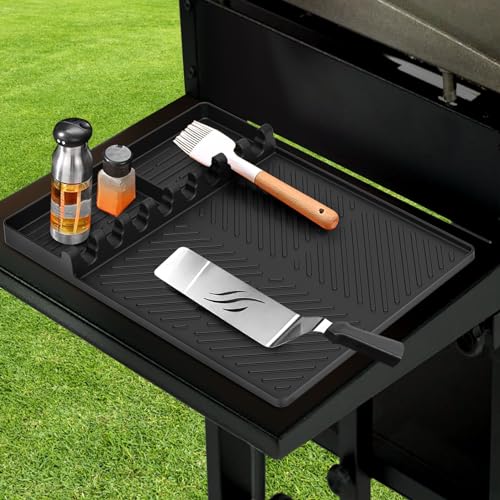
Which lets you read our
Vodolo silicone griddle tool
caddy mat properly. Its specification table lists Material as high quality
durable silicone and Size as large, holds a full tool set, and neither of those is a
specification: one is an adjective and the other is a use case. There is no
thickness, no hardness and no temperature. The record does flag the consequence
honestly, saying to keep it within silicone's heat limit and that it is not a hot pan
pad, while never stating what that limit is, because the listing does not. For a mat
whose whole job is to lie flat under a set of tools without creeping, thickness is
the figure you want and it is absent. Record in the
Vodolo griddle
mat review.
The same arithmetic also explains why the YESCOO mat above is described as both
high temperature resistant and thin and foldable, which pull against each other.
Silicone conducts heat at roughly 0.2 watts per metre per kelvin, so a two millimetre
sheet has a thermal resistance of about 0.01 square metre kelvins per watt. That is
not insulation by any useful measure; it is about a hundredth of what a thin camping
mat gives you. A thin mat protects a surface by being non combustible, by catching
grease and by introducing a tiny air gap, not by being a thermal barrier, and treating
it as a barrier is exactly the mistake the listing's thin and foldable selling point
invites. Our record is right to call it not a limitless shield.
One more place the word soft is doing the wrong job
Our
linseyCove makeup brush
cleaner soap with a silicone pad is worth reading as a specification puzzle. Its
table lists the pad texture as low friction, ridged and grooved, and the feature text
says a low friction pad texture cleans thoroughly while keeping brushes soft. A
cleaning pad works by shear: you drag loaded bristles across a surface and the
surface has to resist them enough to peel the product off. Low friction is the
opposite of that requirement, and the listing is selling the pad on the property
that works against its function while claiming the function in the same sentence.
What it almost certainly means is gentle, and what makes a textured pad gentle
rather than destructive is not the friction coefficient at all. It is the hardness of
the rubber and the radius of the ridges. A soft pad with generous radii deflects
around a bristle bundle and loads it over a wide contact; a hard pad with sharp
ridges concentrates the same hand force onto a line and breaks fibres. Neither the
hardness nor the ridge radius is published, and those are the two numbers that
decide it. Record in the
linseyCove
brush cleaner review.
The honest limit
Not one silicone product on this site publishes a Shore A hardness, a thickness, a
tear strength, an elongation at break or a cure system, and several publish
adjectives in fields that are labelled as specifications. So there is no better
listing to go and find, and asking a seller for a durometer figure on a drain cover
will not get you one. The arithmetic in this post is standard rubber engineering
applied to published geometry, not a measurement of any product here.
What is left is a hand test that costs nothing and is surprisingly
discriminating, because of the exponential curve in the drawing above.
Press a thumbnail into the article. If the nail sinks in easily and the dent
springs back slowly, you are somewhere in the twenties or thirties, which is the
right end for anything that has to seal against an imperfect surface or be pressed
shut by hand. If the nail barely marks it and the surface feels like a tyre tread,
you are in the seventies or above, which is right for anything that has to hold a
shape or resist a tool and wrong for anything that has to conform. The middle feels
like a pencil eraser. Three categories, one thumbnail, and because stiffness changes
by more than twelve times across that span, the categories are genuinely far apart
rather than a matter of taste.
Then measure the thickness, because that is the lever that matters more and the
one you can actually check. A ruler against the edge, or two fingers and a guess, will
separate a one millimetre sheet from a three millimetre one immediately, and the
difference between them is a factor of twenty seven in whether it lies flat. For a
mat, thick and soft beats thin and hard. For a seal, thin and soft beats anything
hard. For a scraper or a tool rest, hard beats soft and thickness barely matters.
And the limit worth keeping in view: for a drain cover or a tool mat the stakes
are a small annoyance, and the free fix for a stopper that will not seal is usually
not a better stopper. It is cleaning the drain surround so there is less texture to
bridge, which removes the problem from the equation entirely rather than asking the
rubber to solve it. Geometry first, then thickness, then the number nobody prints.
The Silicone Hardness Figure Nobody Publishes at a glance
linseyCove Makeup Brush Cleaner Soap and Silicone Pad
Deep-cleaning makeup brushes at home
Deep-cleans caked makeup brushes
Solid soap is a consumable you replace
Why you can trust this guide
We compared these picks using verified manufacturer specifications, current retailer listings, and patterns in owner feedback, alongside editorial research. We focus on measurable differences such as performance, capacity, usability, and build quality. Pickpedia does not present editorial research as laboratory testing, and we do not claim hands-on testing unless it was actually performed.
Best for Protecting decks, tables and surfaces during griddle and outdoor cooking
8.8/ 10 Pickpedia editorial score
A high-temperature-resistant, food-grade silicone griddle mat that isolates flames and heat to protect the deck, table or surface beneath a flat-top griddle, thin and foldable for outdoor barbecues, camping and picnics, easy to clean by wiping or in the dishwasher, and durable for repeated high-heat use.
BrandYESCOO
TypeSilicone griddle/heat mat
MaterialFood-grade silicone
HeatHigh-temperature resistant
PurposeIsolate heat, protect surfaces
PortabilityThin, light, foldable
CleaningWipe or dishwasher
UseGriddle, BBQ, camping, kitchen
Pros
High-temperature silicone isolates heat and protects surfaces
Saves decks, tables and trays from scorching and grease
Thin, light and foldable, easy to carry and store
Food-grade, non-toxic, odorless silicone
Wipe-clean or dishwasher safe for greasy cooking
Durable and reusable for repeated high-heat use
Cons
A protective mat to use with sensible heat safety, not a limitless shield
Complements rather than replaces normal fire and heat precautions
A two pack of soft silicone shower drain covers with a suction seal and multi-hole design that catch loose hair while water drains freely, for showers and bathtubs.
Best for Reducing single use plastic in the kitchen
9.4/ 10 Pickpedia editorial score
A three pack of food grade silicone storage bags with an interlocking dot seal that locks out leaks, stands upright, and is microwave, freezer and dishwasher safe.
BrandHaakaa
MaterialFood grade silicone, BPA free
Pack3 bags
Sizes16oz, 33oz, 50.7oz (500ml, 1000ml, 1500ml)
SealInterlocking leakproof dot seal
Safe forFreezer, microwave, dishwasher, sous vide
DesignStands upright, one piece, side hang loop
ColourTurquoise
Pros
Food grade silicone, plastic free and BPA free
Leakproof interlocking dot seal
Works in freezer, microwave and sous vide
Stands upright with a clear body
Dishwasher safe and easy to reuse
Three useful sizes in the pack
Cons
Do not fully seal when microwaving, leave a steam gap
Best for Keeping griddle tools tidy, clean and off the cooking surface
9.0/ 10 Pickpedia editorial score
A large durable silicone griddle tool caddy mat for Blackstone and similar griddles that keeps spatulas, scrapers and utensils neatly arranged and off the cooking surface, wipes clean in seconds, and works indoors or outdoors.
BrandVodolo
TypeSilicone griddle tool caddy mat
FitsBlackstone and similar griddles
MaterialHigh-quality durable silicone
SizeLarge, holds a full tool set
CleaningSmooth surface, wipes clean
UseIndoor or outdoor
ColourBlack
Pros
Gives all griddle tools a clean, tidy home
Keeps utensils off the cooking surface
Durable silicone stays put, no sliding
Wipes clean in seconds, no scrubbing
Works indoors and outdoors
Budget-friendly and genuinely useful
Cons
A tool caddy, not a cooking surface
Keep within silicone's heat limit, not a hot-pan pad
A makeup brush cleaning set pairing a solid cleansing soap with a low-friction textured silicone pad that lifts out old makeup and oil from brushes while keeping the bristles soft.
BrandlinseyCove
TypeMakeup brush cleaning soap and pad
IncludesSolid cleansing soap and silicone cleaning pad