Home ›
Home & Kitchen › How Much Hydrogen Can Water Actually Hold? Reading the PPB Figure on a Hydrogen Bottle
Home & Kitchen
How Much Hydrogen Can Water Actually Hold? Reading the PPB Figure on a Hydrogen Bottle
PBy the Pickpedia Team·2 picks compared·Last verified October 2026
Affiliate disclosure: As an Amazon Associate, Pickpedia earns from qualifying purchases. Links on this page are paid links, and we may earn a commission at no extra cost to you. This never affects our picks or scores.
This page contains affiliate links. If you buy through one we may earn a
commission, at no cost to you.
Before the question of whether hydrogen water does anything, there is a
smaller question that can actually be settled: can water hold the amount these
bottles say they put in it. For the generator in our own catalogue the answer is
that its headline figure is roughly three times the concentration water holds at
equilibrium under a full atmosphere of pure hydrogen. That does not make the
number a lie. It does tell you what kind of number it is, and the arithmetic takes
two lines.
Convert the figure first, because ppb hides the scale
Concentrations in parts per billion are easy to quote and hard to feel. In
water, one part per billion is one microgram per litre, so the conversion is just
decimal places.
The bottle in our catalogue is described by its maker as reaching up to 4,780
ppb of dissolved molecular hydrogen. That is 4,780 micrograms per litre, which is
4.78 milligrams per litre. Hold on to 4.78, because the only other number you
need is the one it has to be compared with.
The ceiling comes from Henry's law, and it is low
How much of a gas dissolves in a liquid is governed by Henry's law: at a given
temperature, the concentration that dissolves is proportional to the partial
pressure of that gas sitting above the liquid. Double the pressure of the gas and
you double the dissolved amount. Take the gas away and the dissolved amount goes
with it.
Hydrogen is a poorly soluble gas. As a rule of thumb from standard solubility
data rather than anything we measured, water at about 25 degrees Celsius with one
atmosphere of pure hydrogen above it holds roughly 1.6 milligrams per litre at
equilibrium, a figure often quoted as 1.57. In the units on the box that is about
1,600 ppb. And note the condition attached to it, because it is a strong one: one
full atmosphere of pure hydrogen, not air.
The dot can be true and the line still decides what you drink. A peak above the
ceiling is a transient state by definition, and the only published number is the
peak.
So the division is 4.78 divided by 1.6, which is almost exactly 3. The stated
figure sits about three times above the equilibrium ceiling. Put the other way
round, to hold 4.78 milligrams per litre as a resting concentration you would need
something like three atmospheres of pure hydrogen pressing on the water, in the
region of 44 psi, which is not what a rechargeable plastic drinking bottle
does.
Why that is not the same as calling the number false
Here is the part that keeps this honest, because supersaturation is a real and
completely ordinary state. A sealed can of fizzy drink is carrying far more
dissolved carbon dioxide than water holds at atmospheric pressure, which is
exactly why it fizzes when you break the seal: it was above its ceiling, and
opening it let it fall back. Electrolysis can do something similar on a small
scale, generating hydrogen right at the electrode surface and pushing the water
next to it above equilibrium for a while.
So a reading of 4,780 ppb taken at the right moment, in the right place, may
well be a genuine measurement. What it cannot be is a steady state. A figure above
the ceiling is by definition a figure that is on its way down, and the useful
question is not how high the peak was but what the concentration is when the water
reaches you.
That is where this gets worse rather than better, and the reason is the second
half of Henry's law. The atmosphere is not pure hydrogen. It contains hydrogen at
something under one part per million by volume, so the hydrogen partial pressure
above an open glass is close to zero, and the equilibrium concentration it implies
is a millionth or so of the 1.6 figure. In other words there is no plateau at the
dashed line in the diagram for the water to settle onto. Left open, it does not
decay to saturation and stop. It decays towards empty. Sealing the bottle, keeping
it cold, leaving no headspace and not shaking it all slow that down, and as a rule
of thumb nothing stops it.
Which means the specification that would actually matter is one no listing
publishes: the concentration some stated number of minutes after the cycle ends,
and how it was measured. The peak is the easiest figure to generate and the least
informative one to own.
What the bottle in our catalogue publishes
An
8 oz hydrogen water
bottle generator is the device the numbers above come from, and its record is
better than most at labelling its own claims. It lists SPE and PEM electrolysis
with a dual chamber design, a BPA free PCTG body, one-touch operation, a
rechargeable 8 oz capacity, and up to 4,780 ppb explicitly marked as maker stated,
with the listing attributing it to hydrogen-specific testing. Our own record is
equally explicit that the concentration figure is maker stated rather than lab
verified by us, and we have not measured it either.
Two more things on that record deserve reading alongside the arithmetic. The
first is the capacity, because 8 fluid ounces is about 237 millilitres, so even at
the full stated 4.78 milligrams per litre a whole bottle contains in the region of
1.1 milligrams of hydrogen, and at the equilibrium ceiling it would be about 0.38
milligrams. Whatever you believe dissolved hydrogen does, these are the quantities
involved. The second is the limit the record states plainly: it infuses hydrogen
and does not filter or purify anything, so it needs clean drinkable water going
in, and the power adapter details are not specified in the listing. Details in our
review
of the 8 oz hydrogen generator, and the broader checklist is in
how to choose a hydrogen water
bottle.
Whether any of this is worth drinking is a question about human physiology that
this page is not equipped to settle, and we are not going to pretend otherwise. We
make no health claim for hydrogen water in either direction. What the arithmetic
does give you is a way to read a competing listing: convert the ppb figure to
milligrams per litre, divide by 1.6, and you know immediately whether you are
being quoted a resting concentration or a peak.
The part that actually affects you daily
One unglamorous note, because it applies to any bottle you refill every day and
has nothing to do with hydrogen. An electrolysis bottle has a chamber, a lid and
sealing rings that stay permanently damp, and that geometry is where biofilm grows
in every reusable bottle. A
cup lid and bottle
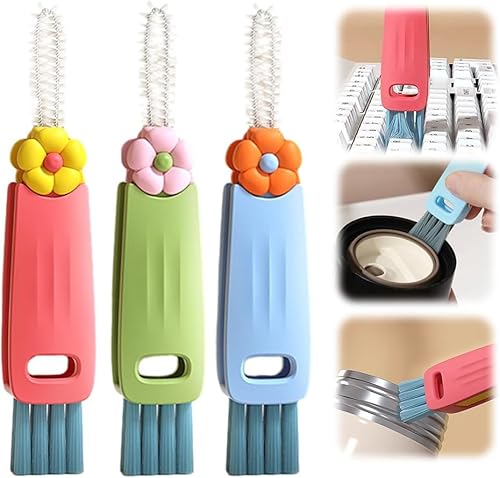
cleaning brush set exists for exactly those surfaces: its record lists three
brushes, each pairing two rows of stiff bristles with a slender soft tip for narrow
bottle holes and a built-in pry bar for lifting sealing rings, in PP plastic, with
a 180 degree rotatable head and a hanging hole for drying. The record is candid
that no dimensions or bristle length are published and that these are detail tools
rather than anything for large surfaces. See our
review of the
brush set, and the method is in
how to clean cup
lids, bottle spouts and rubber seals. A seal you cannot reach will affect what
you drink more reliably than a few hundred ppb either way.
The honest limit
The limit here is unusually clean, because it is set by physics rather than by
engineering. No bottle, at any price, with any electrode, holds water much above
about 1.6 milligrams per litre of hydrogen once it has had a chance to come to
equilibrium with the air in the room, and every open container is losing hydrogen
continuously towards a level near zero. A better machine can reach a higher peak
and reach it faster. It cannot change where the water ends up, and it cannot stop
the clock that starts the moment you unscrew the lid.
So if you are comparing bottles on their ppb figures, you are comparing peaks,
which is the one specification the physics makes least durable. And if what you
actually wanted was to drink more water, which is the honest answer for a lot of
people asking about these, then a bottle you like carrying and remember to refill
does that job completely, and the electrolysis is beside the point.
How Much Hydrogen Can Water Actually Hold? Reading the PPB Figure on a Hydrogen Bottle at a glance
3-in-1 Cup Lid and Bottle Cleaning Brush Set (3 Pack)
reaching cup lid grooves and narrow bottle holes
Three cleaning functions in a single compact tool
Facts here are maker-stated, not lab verified
Why you can trust this guide
We compared these picks using verified manufacturer specifications, current retailer listings, and patterns in owner feedback, alongside editorial research. We focus on measurable differences such as performance, capacity, usability, and build quality. Pickpedia does not present editorial research as laboratory testing, and we do not claim hands-on testing unless it was actually performed.
Best for portable single-serve hydrogen water on the go
8.0/ 10 Pickpedia editorial score
This 8 oz portable generator infuses water with molecular hydrogen using SPE/PEM electrolysis. It fits daily use at home, office, gym, or travel. The maker states concentration reaches up to 4780 PPB, verified through hydrogen-specific testing. Build is BPA-free PCTG, and operation is one-touch. Rechargeable and lightweight, it targets wellness and hydration routines rather than filtration. Facts here follow the listing, not our own lab work.
Capacity8 oz
Hydrogen concentrationUp to 4780 PPB (maker-stated)
TechnologySPE/PEM electrolysis
Chamber designDual-chamber
MaterialBPA-free PCTG
OperationOne-touch
PowerRechargeable
UseHome, office, gym, travel
Pros
One-touch operation is beginner friendly
BPA-free PCTG body is built for daily use
Dual-chamber SPE/PEM targets cleaner hydrogen
Maker states up to 4780 PPB output
Compact 8 oz size travels easily
Rechargeable, so no tethered plug
Cons
Small capacity needs frequent refills
Infuses hydrogen but does not filter water
Concentration figures are maker-stated, not lab-verified here
Power adapter details are not specified in the listing
Best for reaching cup lid grooves and narrow bottle holes
8.4/ 10 Pickpedia editorial score
This 3-in-1 cup lid cleaning brush set targets the grooves, holes, and seals that a sponge misses. Each of the three brushes pairs two rows of stiff bristles with a slender soft tip and a built-in pry bar. Made from PP plastic, they suit cups, bottles, lunch boxes, keyboards, and window frames. A rotatable head and hanging hole aid storage and drying.
Design3 in 1 cleaning brush
Pack size3 brushes
BristlesTwo rows of stiff bristles
Soft tipFor narrow bottle holes
Pry barBuilt in for sealing rings
MaterialPP plastic
Head180 degree rotatable
StorageHanging hole for drying
Pros
Three cleaning functions in a single compact tool
Stiff bristles reach into cup lid grooves
Slender soft tip cleans narrow bottle holes
Built-in pry bar lifts stubborn sealing rings
PP plastic is made to resist wear per the maker
Hanging hole helps each brush dry between uses
Cons
Facts here are maker-stated, not lab verified
No dimensions or bristle length listed
Small brushes suit detail work, not large surfaces