Home ›
Home & Kitchen › Can a Wooden Cutting Board Make You Sick? What the Risk Actually Runs Through
Home & Kitchen
Can a Wooden Cutting Board Make You Sick? What the Risk Actually Runs Through
PBy the Pickpedia Team·3 picks compared·Last verified October 2026
Affiliate disclosure: As an Amazon Associate, Pickpedia earns from qualifying purchases. Links on this page are paid links, and we may earn a commission at no extra cost to you. This never affects our picks or scores.
This page contains affiliate links. If you buy through one we may earn a
commission, at no cost to you.
In principle yes, and in practice it is very rarely what did it. That gap is the
interesting part, because the worry almost always attaches to the wrong object. People
picture bacteria living deep in the grain and surviving everything. What actually makes
people ill in home kitchens is a sequence, and the board is only one step in it.
The board is one of three routes, and the other two never get washed
Here is the picture that reframes it. Raw chicken touches three things more or less at
once: the board, the knife, and your hands. All three then go on to touch whatever you
prepare next. Along the way your hands also touch the tap you turn on to wash them, the
tea towel you dry them on, and the fridge door you open to get the salad out.
Now ask which of those gets cleaned between the two jobs. The board, usually. The knife
gets wiped. The tap handle and the towel get nothing at all. The board has the strongest
reputation for danger and the best cleaning record in the kitchen, and the things with no
cleaning record at all are invisible.
Where the risk actually travels. The board gets the blame and the scrubbing. The knife
and your hands get neither.
The genuine risk with wood is water, not bacteria
When a wooden board does become a real problem, the cause is almost always physical
rather than microbiological. A board that has been left soaking, run through a dishwasher
it was not meant for, or stood in a puddle on the worktop will swell, then dry unevenly,
then split. A board made of glued strips can open along a glue line. Once there is a
crack or a gap, there is a place for food residue and water to sit where no cloth
reaches, and that is a surface you can no longer clean rather than a surface that is
mysteriously contaminated.
Which turns the care advice into something more concrete than ritual. Wash it promptly,
do not leave it to soak, and stand it on edge so both faces dry rather than lying it flat
on a wet counter where one face stays damp for hours. Oiling is the same story: it is not
polish, it is what keeps water from being drawn into the wood, and a dry unoiled board is
the one that opens up.
And the honest endpoint of that. A board that is split, cracked, or furred with deep
cuts has stopped being a cleanable surface. No amount of scrubbing, oiling or sanding
brings it back to something you should prepare raw chicken on, and the correct move is the
bin.
The change that does the most, and it is about sequence
Order your prep so raw meat is last. Cut the salad, the bread and the vegetables first
on a clean board, then do the chicken, then wash everything in one go. It costs nothing,
it removes the step where contamination can travel forwards, and it is more reliable than
any amount of mid-cook washing, because the washing is the step people rush.
The second best change is a board that is reserved for raw meat and can genuinely be
cleaned at a temperature your hands could not stand. A
three board set in plastic,
bamboo and stainless steel with a holder is a tidy way to do that, with the materials
splitting by job: the plastic board carries a deep juice groove, which is the one that
matters for raw meat because the point is to keep liquid off the worktop. Its listed
sizes are 15 by 10.2 inches for the bamboo, 13.4 by 9 for the steel and 12 by 7.2 for the
plastic, and the record says all three are dishwasher safe. Two things to be straight
about: the plastic and steel boards are thin at 0.32 inches, and a dishwasher safe claim
for bamboo is the maker's, not a tested one, so treat a bamboo board that goes through a
lot of cycles as something that will eventually need replacing. More in our
review of
the three board set.
If what you actually want is one big board that feels like wood and can still be washed
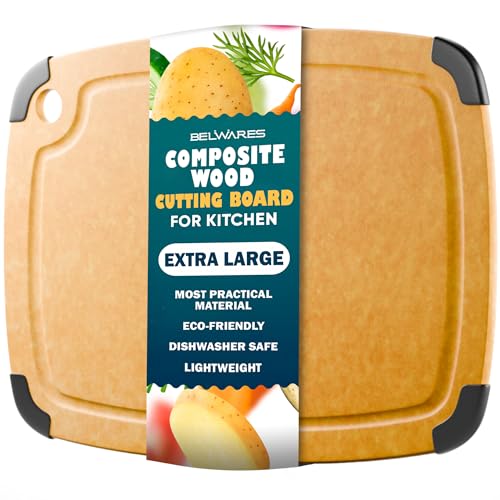
properly, a composite is the compromise that exists for this. An
18 by 12 inch composite wood board
with a deep juice groove is made from compressed wood fibre with a non porous surface
and non slip feet, and its record lists it as dishwasher safe, which solves the drying
problem that causes most wooden board failures. The honest notes are that the knife feel
is not the same as a solid hardwood block, there is no thickness or weight figure
published at all, and the durability claims come from the maker. Our
review
of the composite board goes through what it does and does not publish.
Cleaning the cuts, not the surface
A cloth skates over the top of knife scores without going into them, which is the whole
reason deeply cut boards are a problem on any material. Mechanical scrubbing is what gets
into them, along the grain and across it. A stiff
bamboo handled cutting board scrub
brush is shaped for the leaning weight that job needs, and bristles get into score
lines in a way a sponge does not. Its own record is modest about itself in a way worth
repeating: it is a cleaning accessory and not a replacement for soap and hot water, the
bristles wear with heavy use, and it needs rinsing and drying after use like anything
else that lives wet. Details in our
cutting board scrub brush
review.
What the honest answer costs you, which is nothing
If you are worried enough to be reading this, the changes that cut the risk most are
all free. Do raw meat last. Wash the knife, not just the board. Wash your hands before you
touch the tap again and after, and change the tea towel more often than feels necessary,
because a damp towel used all week is doing more work against you than any board. Stand
the board on its edge to dry. Bin the one with a crack in it.
A new board is the most visible response to this worry and close to the least
effective. If someone in the house is pregnant, recovering, very young or very old, then
yes, a separate board for raw meat that goes through the dishwasher is a sensible and
cheap piece of insurance. Beyond that, the thing standing between you and a safer kitchen
is the order you do things in and the state of the tea towel, and neither of those is for
sale.
Can a Wooden Cutting Board Make You Sick? What the Risk Actually Runs Through at a glance
We compared these picks using verified manufacturer specifications, current retailer listings, and patterns in owner feedback, alongside editorial research. We focus on measurable differences such as performance, capacity, usability, and build quality. Pickpedia does not present editorial research as laboratory testing, and we do not claim hands-on testing unless it was actually performed.
This three-piece cutting board set pairs plastic, bamboo, and stainless steel boards with a storage holder. Each material suits different tasks, helping separate meat, fruit, and vegetables. The plastic board has a juice groove, bamboo resists nicks, and 304 stainless steel stays hygienic. All are dishwasher safe. Listed sizes range from 12 to 15 inches for flexible daily prep.
Set3 boards plus holder
Bamboo board15 x 10.2 x 0.82 in
Stainless board13.4 x 9 x 0.32 in
Plastic board12 x 7.2 x 0.32 in
Steel grade304 stainless steel
Plastic featureDeep juice groove
CleaningDishwasher safe
StorageIncluded holder
Pros
Three materials separate meat, produce, and serving
Plastic board juice groove keeps counters clean
Bamboo surface resists nicks and gouges
304 stainless steel wipes clean and resists stains
Best for Home cooks wanting a large, easy-clean prep board
8.6/ 10 Pickpedia editorial score
This composite wood cutting board gives you an 18 by 12 inch surface for carving, slicing, and serving. Made from high density compressed wood fiber, it resists warping while staying thin and light. A deep juice groove catches liquid, non-slip rubber feet add stability, and the non-porous surface is dishwasher safe. It suits daily cooks who want hardwood strength with easier cleanup.
Surface size18 x 12 inches
MaterialHigh density composite wood fiber
Juice grooveDeep integrated channel
FeetNon-slip rubber
SurfaceNon-porous, moisture resistant
CareDishwasher safe
ProfileThin and lightweight
StorageDrawer, cabinet, or hang
Pros
Large 18 x 12 inch prep surface
Deep juice groove captures liquids
Non-slip feet improve stability
Non-porous, dishwasher-safe cleanup
Slim profile stores and hangs easily
Composite fiber resists warping, per maker
Cons
Durability claims are maker-stated, not lab-tested
Best for Cleaning wood cutting boards and butcher blocks
8.4/ 10 Pickpedia editorial score
The Block & Board Company scrub brush is a bamboo cleaning brush for cutting boards, butcher blocks, and countertops. The maker states it balances rigidity and elasticity to scrub tough grime while staying gentle on wood. Made from all-natural bamboo with an ergonomic design, it also suits cast iron, wooden utensils, and other kitchen surfaces.