Wide Angle Lens Best Wide Angle Lens: 9 Top Picks for Every Mount
P
By the Pickpedia Team
·9 picks compared
·Last verified November 2026
Affiliate disclosure: As an Amazon Associate, Pickpedia earns from qualifying purchases. Links on this page are paid links, and we may earn a commission at no extra cost to you. This never affects our picks or scores.
Quick answer
For most Sony E shooters the VILTROX 9mm F2.8 E is our top wide angle pick, thanks to its 113.8 degree view and 175g body. Canon RF-S users should look at the Canon RF-S10-18mm, while Nikon DSLR owners get a strong zoom in the Nikon AF-P DX 10-20mm.
Best Wide Angle Lens: 9 Top Picks for Every Mount at a glance
Why you can trust this guide
We compared these picks using verified manufacturer specifications, available manuals and documentation, current retailer listings, and patterns in owner feedback, alongside editorial research. We focus on measurable differences such as performance, capacity, usability, and build quality. Pickpedia does not present editorial research as laboratory testing, and we do not claim hands-on testing unless it was actually performed.
A wide angle lens changes how much of a scene you can hold in one frame, which is why it suits landscapes, tight interiors, group shots and vlogs. The right pick depends on your mount, whether you need autofocus, and how much weight you want to carry.
We compared nine real lenses across Sony E, Canon RF, Canon EF, Nikon F and L mount. The list below ranks them by how well each one serves common wide angle jobs, from a 175g prime to a 900g manual focus full frame lens.
Our top picks
The VILTROX 9mm F2.8 E pairs a 113.8 degree field of view with a 175g body, so it disappears in a bag. Its F2.8 aperture helps in dim rooms, and the 0.13m minimum focus distance lets you push foregrounds close to the glass. Autofocus comes from an STM motor, which suits vlogging and handheld walkaround work.
MountSony E (APS-C)
Field of view113.8 degrees
ApertureF2.8
Weight175g
Minimum focus0.13m
Optics13 elements in 11 groups
Pros
- Very light 175g body for all-day carrying
- F2.8 aperture suits low light and night scenes
- Close 0.13m focus distance for dramatic foregrounds
Cons
- Designed for APS-C Sony bodies, not full frame
- Prime lens, so no zoom range to fall back on
Check price on Amazon ›
This Canon zoom covers 10-18mm, which works out to 16-29mm equivalent, so tight rooms and group frames fit easily. Maximum magnification reaches 0.23x in AF and 0.5x in manual focus for close-up video and stills. The compact, lightweight build makes it a natural travel companion.
MountCanon RF-S
Focal range10-18mm (16-29mm equivalent)
Max magnification0.23x AF, 0.5x MF
TypeMirrorless ultra-wide zoom
Pros
- Zoom range covers tight spaces and group shots
- Strong close-up magnification in manual focus
- Compact and lightweight for travel
Cons
- Narrower maximum aperture than a fast prime
- Built for RF-S bodies rather than full frame RF
Check price on Amazon ›
The Nikon 10-20mm covers a 109 to 70 degree angle of view across its zoom range. Vibration reduction helps handheld landscape and travel shots, and the compact, lightweight design is built for outings. Minimum focus sits at 0.22m from the focal plane at every zoom position.
MountNikon F (DX)
Focal range10-20mm
Angle of view109 to 70 degrees
Minimum focus0.22m
StabilizationVR
Pros
- Vibration reduction aids handheld shooting
- Lightweight and durable for travel
- Consistent 0.22m close focus across the zoom
Cons
- Aperture range is modest for low light
- Made for DX format bodies
Check price on Amazon ›
Panasonic builds this 14-28mm zoom from 14 elements in 10 groups, including aspherical and two ED lenses to suppress chromatic aberration. It weighs about 345g and offers 0.25x to 0.5x macro capability. The dust- and splash-resistant body is rated to work at 10 degrees below zero.
MountL mount (Lumix S)
Focal range14-28mm
WeightApprox. 345g
Macro0.25x at 14mm to 0.5x at 28mm
Optics14 elements in 10 groups
Weather sealingDust and splash resistant
Pros
- Dust- and splash-resistant for harsh conditions
- Macro capability adds close-up flexibility
- Relatively light for a full frame wide zoom
Cons
- Aperture narrows to F5.6 at the long end
- Sealing does not guarantee protection from direct water contact
Check price on Amazon ›
Sigma's 10-20mm keeps a constant F3.5 maximum aperture across the zoom, which is useful in low light. The Hyper Sonic Motor delivers silent, high-speed autofocus, and the lens is built for Nikon digital SLRs. It is an ultra-wide zoom with a brighter aperture than most kit alternatives.
MountNikon F (DX)
Focal range10-20mm
Max apertureF3.5
AutofocusHSM
OpticsELD, SLD and aspherical elements
Pros
- Constant F3.5 aperture across the zoom
- Silent HSM autofocus
- Built-in motor suits D40, D40x, D60, D3000 and D5000 bodies
Cons
- DSLR-only design
- Heavier than a compact prime
Check price on Amazon ›
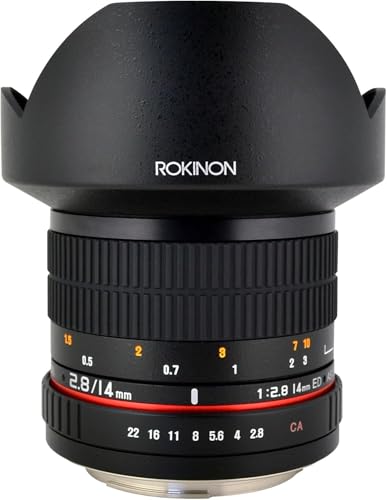
The Rokinon 14mm F2.8 uses 14 elements in 10 groups and covers a 115.7 degree angle of view. Its F2.8 aperture helps with astrophotography and dim interiors, and the manual focus ring allows fine control. It weighs 31.7oz and focuses as close as 10.8 inches.
MountCanon EF
Focal length14mm
Max apertureF2.8
Angle of view115.7 degrees
Weight31.7oz (900g)
FocusManual, 10.8 inch minimum
Pros
- Fast F2.8 aperture for low light
- Very wide 115.7 degree view
- Robust build for regular use
Cons
- Manual focus only
- Heavy at 900g
Check price on Amazon ›
Samyang's 14mm F2.8 covers roughly 115 degrees and works on full frame or APS-C Canon bodies. The manual focus ring gives smooth control for photo and video, and the lens focuses as close as 10.8 inches. It is aimed at landscapes, architecture and interiors.
MountCanon EF
Focal length14mm
Max apertureF2.8
Angle of viewApprox. 115 degrees
FocusManual, 10.8 inch minimum
Pros
- Full frame coverage with a wide 115 degree view
- Fast F2.8 aperture
- Close 10.8 inch focus for creative framing
Cons
- Manual focus only
- No autofocus for fast-moving subjects
Check price on Amazon ›
The 7Artisans 4mm F2.8 delivers a 225 degree circular fisheye view with strong visual impact. Its metal body weighs only 201g and measures about 60mm by 54mm, so it travels easily. The 0.085m closest focus distance lets you get extremely close to subjects.
MountSony E
Focal length4mm
Field of view225 degrees circular fisheye
ApertureF2.8 to F16
Weight201g
Minimum focus0.085m
Optics10 elements in 8 groups
Pros
- Distinctive 225 degree circular fisheye look
- Very light 201g metal body
- Extremely close 0.085m focus
Cons
- Manual focus only
- Fisheye distortion is not for every scene
Check price on Amazon ›
Meike's 8mm f3.5 is a manual focus rectangle fisheye with a 200 degree field of view. The optical design uses 8 groups and 11 elements, and minimum focus is 35cm. It fits EF-mount APS-C bodies such as the Rebel line and the 70D, 77D and 80D.
MountCanon EF (APS-C)
Focal length8mm
Field of view200 degrees
FocusManual, 35cm minimum
Optics8 groups, 11 elements
Pros
- Wide 200 degree rectangle fisheye view
- Fits a broad range of Canon EF-S bodies
- Simple manual focus design
Cons
- Manual focus only
- Produces a circular image with black borders on full frame
Check price on Amazon ›
What to look for
Match the lens to your camera mount first
A wide angle lens only works if it fits your body, so start there. Sony E, Canon RF-S, Canon EF, Nikon F and L mount each have different options in this list. Mount adapters can bridge some gaps, but native fit keeps autofocus and stabilization working as intended.
Decide between a prime and a zoom
Primes like the VILTROX 9mm and Rokinon 14mm give a wider aperture and simpler optics. Zooms like the Canon RF-S10-18mm and Nikon 10-20mm let you reframe without moving your feet. For interiors and travel, a zoom is often more flexible, while a fast prime suits low light and night skies.
Weigh autofocus and aperture against your subjects
Fast autofocus matters for vlogging, events and moving subjects, which is where STM and HSM motors help. A bright F2.8 aperture helps in dim rooms and for astrophotography. If you shoot mostly landscapes on a tripod, manual focus and a slower aperture can be perfectly workable.
Check weight, sealing and close focus
A 175g lens is easy to carry all day, while a 900g lens is a deliberate choice. Dust- and splash-resistant designs like the Panasonic 14-28mm suit harsh conditions, though no sealing guarantees full protection. Close focus distances from 0.085m to 0.35m open up foreground and macro-style compositions.
Frequently asked questions
Which wide angle lens has the fastest autofocus for low light?
The VILTROX 9mm F2.8 E pairs an STM motor with an F2.8 aperture, which helps in dim conditions. The Sigma 10-20mm f/3.5 uses an HSM motor for silent, high-speed focus on Nikon DSLRs.
Does a wide angle lens with optical stabilization work for handheld video?
Stabilization helps reduce shake, and the Nikon 10-20mm includes VR for handheld work. For video, a light body and smooth autofocus like the Canon RF-S10-18mm STM also matter.
Can I use a wide angle lens with lightweight build on an APS-C camera?
Yes. The VILTROX 9mm is built for Sony APS-C bodies at 175g, and the Canon RF-S10-18mm is designed for RF-S mirrorless cameras. The Meike 8mm fisheye also fits Canon EF-S bodies.
What should I check before choosing a wide angle lens for landscapes?
Look at the field of view, edge sharpness and whether you need filters or a tripod. A 109 to 115 degree view suits expansive scenes, and weather resistance like the Panasonic 14-28mm helps in wet or dusty conditions.
Is a wide angle lens with weather resistance good for indoor portraits?
Sealing does not matter much indoors, but a wide view can include more of a room. For portraits, a fast aperture and close focus like the VILTROX 9mm at 0.13m give more creative control.
How do I pick a wide angle lens for astrophotography?
A fast aperture and wide view are the priorities. The Rokinon 14mm F2.8 and Samyang 14mm F2.8 both offer F2.8 and roughly 115 degrees, which gathers light across a broad sky.
Which wide angle lens combines fast autofocus and a lightweight build?
The VILTROX 9mm F2.8 E weighs 175g and uses an STM motor, making it a strong match for both. The Canon RF-S10-18mm is also compact and uses STM autofocus.
Should I buy a fisheye or a rectilinear wide angle lens?
A fisheye like the 7Artisans 4mm or Meike 8mm bends straight lines for a creative effect. Rectilinear lenses such as the Nikon 10-20mm keep lines straighter, which suits architecture and interiors.
The verdict
VILTROX 9mm F2.8 E
9.2/10/10
The VILTROX 9mm F2.8 E wins our top spot for its 113.8 degree view, 175g body and close 0.13m focus, all with STM autofocus for Sony E. Canon RF-S users should lean toward the RF-S10-18mm, while Nikon DSLR owners get a reliable travel zoom in the AF-P DX 10-20mm. Match the mount and your subject first, then choose the aperture and weight that fit how you shoot.
Check price on Amazon ›
Our top pick, secure checkout via Amazon
Note: Availability and specifications change often. Always confirm the current details on Amazon before buying.