Vlog Cameras Best Vlog Cameras: 9 Picks for Travel, Hiking and YouTube
P
By the Pickpedia Team
·9 picks compared
·Last verified November 2026
Affiliate disclosure: As an Amazon Associate, Pickpedia earns from qualifying purchases. Links on this page are paid links, and we may earn a commission at no extra cost to you. This never affects our picks or scores.
Quick answer
The DJI Osmo Pocket 3 Creator Combo tops our list thanks to its 1-inch sensor, 4K at 120fps and 3-axis stabilization. The Canon PowerShot V10 and Sony ZV-E10 follow for compact and lens-swapping options. We compared nine cameras across stabilization, screens and portability.
Best Vlog Cameras: 9 Picks for Travel, Hiking and YouTube at a glance
Why you can trust this guide
We compared these picks using verified manufacturer specifications, available manuals and documentation, current retailer listings, and patterns in owner feedback, alongside editorial research. We focus on measurable differences such as performance, capacity, usability, and build quality. Pickpedia does not present editorial research as laboratory testing, and we do not claim hands-on testing unless it was actually performed.
Choosing a vlogging camera comes down to how you shoot. Some creators want a pocketable gimbal-stabilized device, others want a flip screen and a mic jack for sit-down YouTube videos. We compared nine real cameras on stabilization, sensor size, screen design and recording formats to sort them by use case.
Every pick below is a camera you can buy today, from a 1-inch pocket model to an APS-C mirrorless body with interchangeable lenses. Scores reflect our editorial judgment about how well each suits vlogging, not customer ratings. Match the camera to where you film and how much gear you want to carry.
Our top picks
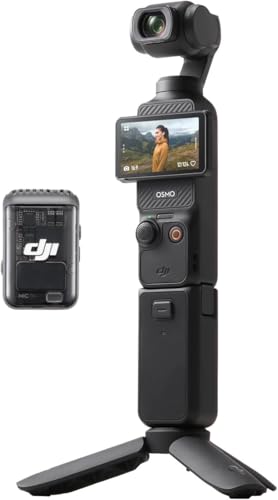
A pocket camera with a 1-inch CMOS sensor that records 4K at up to 120fps, paired with 3-axis mechanical stabilization. The 2-inch touch screen rotates for horizontal or vertical shooting, and ActiveTrack 6.0 keeps you centered when the camera sits on a tripod. A mic is included for clear sound.
Sensor1-inch CMOS
Max video4K at 120fps
Stabilization3-axis mechanical
Screen2-inch rotating touch screen
TrackingActiveTrack 6.0
Pros
- Mechanical stabilization smooths walking and movement
- Rotating screen switches between horizontal and vertical
- Included mic handles audio without extra gear
Cons
- Fixed lens limits framing options
- Small body means fewer physical controls
Check price on Amazon ›
A pocket-sized vlogging camera built around a 15.2-megapixel 1-inch back-illuminated CMOS sensor. It records 8-bit 4K at up to 30fps and Full HD at up to 60fps, with a retractable front-facing screen for framing yourself. The fixed 19mm wide-angle lens suits tight interiors and handheld framing.
Sensor15.2MP 1-inch back-illuminated CMOS
Video4K at 30fps, Full HD at 60fps
LensFixed 19mm wide-angle
StabilizationIS Off, IS On, IS Enhanced
PortsMicro-HDMI, external mic, USB-C
Pros
- Retractable front screen makes self-framing simple
- Built-in subject detection helps keep focus
- External mic port and USB-C charging add flexibility
Cons
- Fixed lens cannot be swapped
- 4K tops out at 30fps
Check price on Amazon ›
An APS-C mirrorless camera with a 24.2MP Exmor CMOS sensor and a fast BIONZ X processor. It records UHD 4K at 30p, oversampled from 6K with full pixel readout and no pixel binning. A 3.0-inch side flip-out touchscreen and 425-point autofocus make self-recording practical.
Sensor24.2MP APS-C Exmor CMOS
ProcessorBIONZ X
VideoUHD 4K at 30p
Screen3.0-inch side flip-out touchscreen
Autofocus425-point AF
Pros
- Side flip-out screen frames you clearly
- 4K oversampled from 6K with full pixel readout
- Interchangeable lens mount opens up lens choices
Cons
- Kit lens limits low-light performance
- Larger than pocket cameras
Check price on Amazon ›
A mirrorless body with a 26.1MP X-Trans CMOS 4 sensor and X-Processor 5. It offers up to 7 stops of internal body image stabilization, useful for handheld vlogging and walking shots. Recording reaches 6.2K at 30p and 4K at 60p in 4:2:2 10-bit internally, with a 3.5mm mic and headphone jack.
Sensor26.1MP X-Trans CMOS 4
ProcessorX-Processor 5
StabilizationUp to 7 stops IBIS
Video6.2K at 30p, 4K at 60p 4:2:2 10-bit
Audio3.5mm mic and headphone jack
Pros
- Up to 7 stops of in-body stabilization
- 10-bit internal recording at 4K 60p
- Separate mic and headphone jacks
Cons
- Heavier than compact vlogging cameras
- Lens adds bulk to a walk-around kit
Check price on Amazon ›
A compact mirrorless camera with a 20.9MP DX format sensor, supplied with a 16-50mm and a 50-250mm lens. Video reaches 4K UHD at 60p with in-camera 120p slow motion in Full HD and built-in electronic VR. Autofocus detects and tracks nine subject types, and 31 Picture Control presets shape the look in camera.
Sensor20.9MP DX format
Video4K UHD at 60p, Full HD 120p slow motion
StabilizationBuilt-in electronic VR
LensesNIKKOR Z DX 16-50mm and 50-250mm
SharingNikon SnapBridge app
Pros
- Two lenses cover wide to telephoto
- Nine subject detection types for autofocus
- Wireless transfer through SnapBridge
Cons
- Electronic VR only, no in-body stabilization
- Two-lens kit means more to pack
Check price on Amazon ›
A rugged action camera waterproof down to 16ft (5m) with 4K video at up to 60fps and 12MP photos. A built-in light with three brightness settings illuminates dark scenes and works even when the camera is off or charging. HyperSmooth stabilization and a touch screen round out the package.
WaterproofTo 16ft (5m)
Video4K at 60fps
Photos12MP, up to 11MP from video
LightBuilt-in, 3 brightness settings
StabilizationHyperSmooth
Pros
- Waterproof to 16ft without a housing
- Built-in light helps in total darkness
- 60fps allows 2x slow motion playback
Cons
- Small sensor limits low-light depth
- Wide action framing suits fewer sit-down shots
Check price on Amazon ›
A point-and-shoot with a 60x optical zoom and POWER O.I.S. optical stabilization that suppresses handshake at the telephoto end. It records 4K video at up to four times Full HD resolution, and 4K Photo extracts an 8-megapixel still from footage. A 2,360K-dot LVF keeps the view clear in bright sunlight.
Zoom60x optical
StabilizationPOWER O.I.S.
Video4K, 4K Photo at 8MP
Viewfinder2,360K-dot LVF, 0.74x
TypePoint and shoot
Pros
- 60x zoom reaches distant subjects
- Optical stabilization helps at the tele end
- Clear viewfinder for sunny outdoor shooting
Cons
- Larger body than pocket vlogging cameras
- Small sensor compared with 1-inch models
Check price on Amazon ›
A compact camera with a 24-720mm LEICA lens and 30x zoom that slips into a pocket. It records 4K video at 30p, captures 4K PHOTO bursts at 30fps and shoots HD high-speed video at 120fps for slow motion. A 1,840k-dot tiltable touchscreen and USB Type-C charging support shooting on the go.
Lens24-720mm LEICA, 30x zoom
Video4K at 30p
Slow motionHD at 120fps
Screen1,840k-dot tiltable touchscreen
ChargingUSB Type-C
Pros
- 30x zoom covers wide to far subjects
- Tiltable touchscreen helps with odd angles
- USB Type-C charging while traveling
Cons
- No front-facing screen for self-framing
- Small sensor limits low-light video
Check price on Amazon ›
A mini camcorder measuring 5.35 x 1.56 inches with one-button recording and no app or setup required. It includes a 32GB memory card and a 2000mAh battery rated for up to 7 hours of continuous recording. The lens rotates 180 degrees manually for POV and self-recording.
Size5.35 x 1.56 inches
Battery2000mAh, up to 7 hours
Storage32GB card included
Lens180-degree manual rotation
SetupOne-button recording
Pros
- Records immediately with no app or pairing
- Long battery life for long recording sessions
- Rotating lens handles POV and self shots
Cons
- Manual lens rotation rather than a flip screen
- Image quality below larger-sensor cameras
Check price on Amazon ›
What to look for
Start with stabilization and sensor size
Stabilization decides how usable handheld footage looks. Mechanical gimbals like the Osmo Pocket 3 cancel walking motion, while in-body systems such as the Fujifilm X-S20 claim up to 7 stops. Sensor size then governs low light. A 1-inch or APS-C sensor gathers more light than a small point-and-shoot chip.
Match the screen to how you film
A flip or rotating screen lets you frame yourself without guessing. The Sony ZV-E10 uses a side flip-out touchscreen, the Canon V10 has a retractable front-facing screen, and the Osmo Pocket 3 rotates its screen for vertical or horizontal video. Cameras without a front screen suit tripod or second-camera work better.
Think about audio and power
Built-in mics vary widely. The Osmo Pocket 3 Creator Combo includes a mic, the Canon V10 offers an external mic port, and the Fujifilm X-S20 adds a headphone jack for monitoring. USB-C charging, found on the Canon V10 and Lumix ZS99, makes topping up from a power bank straightforward on trips.
Weigh portability against lens flexibility
Pocket cameras such as the Lumix ZS99 and CGXUED go anywhere but lock you to one lens. Mirrorless bodies like the Nikon Z50 II and Sony ZV-E10 accept other lenses, and the Nikon kit ships with two. If you film hiking, family travel or bird photography, decide whether zoom range or lens swapping matters more.
Frequently asked questions
Is a vlog camera with image stabilization worth buying for hiking?
Yes, for most hikers. Walking footage without stabilization looks jittery. Mechanical systems like the Osmo Pocket 3 and optical systems like the Lumix FZ80D POWER O.I.S. both reduce handshake, and the Fujifilm X-S20 offers up to 7 stops of in-body stabilization.
How do I choose a vlog camera for family travel?
Prioritize a front-facing or flip screen, light weight and easy charging. The Canon PowerShot V10 packs a retractable front screen into a pocket body, and the Lumix ZS99 charges over USB Type-C. A two-lens kit like the Nikon Z50 II covers wide and telephoto shots.
Can a vlog camera with weather sealing be used for hiking?
Check the rating before you rely on it. Among these picks, the GoPro LIT Hero is explicitly waterproof to 16ft (5m) and built for mud, snow and water. Other models should be protected from rain unless the maker states a sealing rating.
Which vlog camera with a flip screen is best for YouTube videos?
The Sony ZV-E10 pairs a 3.0-inch side flip-out touchscreen with 4K at 30p oversampled from 6K. The Canon PowerShot V10 uses a retractable front-facing screen instead. Both let you see yourself while recording talking-head segments.
Does USB-C charging matter for a vlog camera?
It helps on long days away from outlets. The Canon PowerShot V10 and the Lumix ZS99 both charge over USB Type-C, so a power bank can top them up between shoots. Cameras without it need their own charger or spare batteries.
Which vlog camera is best for bird photography?
Reach matters most. The Panasonic Lumix FZ80D offers a 60x optical zoom, and the Lumix ZS99 covers 24-720mm with 30x zoom. The Nikon Z50 II kit includes a 50-250mm lens and can track birds as one of its nine detection subjects.
How do I choose a vlog camera as a beginner?
Start simple. The CGXUED records with one button and includes a 32GB card, while the Canon PowerShot V10 keeps controls minimal with a front-facing screen. Move to a mirrorless body once you want different lenses and manual settings.
Should I pick a pocket camera or a mirrorless body for vlogging?
Pick pocket if you film spontaneously and want stabilization built in, as with the Osmo Pocket 3. Pick mirrorless if you want lens choice and larger sensors, as with the Sony ZV-E10 or Fujifilm X-S20. The trade-off is size and setup time.
The verdict
DJI Osmo Pocket 3 Creator Combo
9.4/10/10
The DJI Osmo Pocket 3 Creator Combo earns our top spot by combining a 1-inch sensor, 4K at 120fps and 3-axis mechanical stabilization in a body you can carry all day. The Canon PowerShot V10 suits pocket-first creators, and the Sony ZV-E10 is the pick when you want to change lenses. Match the camera to where and how you film.
Check price on Amazon ›
Our top pick, secure checkout via Amazon
Note: Availability and specifications change often. Always confirm the current details on Amazon before buying.