Home & Kitchen 6 Vegetable Spiralizers for Fun, Fresh Veggie Noodles
P
By the Pickpedia Team
·6 picks compared
·Last verified October 2026
Affiliate disclosure: As an Amazon Associate, Pickpedia earns from qualifying purchases. Links on this page are paid links, and we may earn a commission at no extra cost to you. This never affects our picks or scores.
Quick answer
Pick a spiralizer by how you cook. Hand-crank models like Brieftons give the widest blade range for zoodles, ribbons, and sweet potato noodles. Electric or stand-mixer options suit high-volume prep, while pocket handhelds win for quick single portions and tiny kitchens.
6 Vegetable Spiralizers for Fun, Fresh Veggie Noodles at a glance
Why you can trust this guide
We compared these picks using verified manufacturer specifications, available manuals and documentation, current retailer listings, and patterns in owner feedback, alongside editorial research. We focus on measurable differences such as performance, capacity, usability, and build quality. Pickpedia does not present editorial research as laboratory testing, and we do not claim hands-on testing unless it was actually performed.
How we chose: We compared six vegetable spiralizers across blade variety, stability, capacity, and cleanup to match different kitchens and cooking habits.
Turning firm vegetables into noodles and ribbons sounds simple, yet the right tool depends on how much you prep and where you store it. A crank-style tabletop unit gives you many cut sizes and steady control. Handheld twisters trade range for a footprint that hides in a drawer.
This roundup looks at six spiralizers spanning manual, electric, and stand-mixer designs. Every claim below stays grounded in the maker specifications and how owners describe daily use, so you can match blades, capacity, and cleanup to your own routine rather than to a spec sheet you never read.
Our top picks
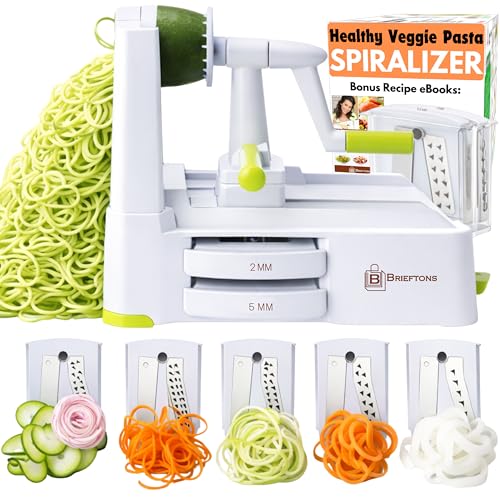
Five labeled Japanese 420-grade stainless steel blades cover angel-hair, spaghetti, fettuccine, pappardelle, and flat ribbons, so you grab the right cut without guessing. The oversized suction lever locks the base to granite, tile, or glass and reportedly holds firm enough to lift a heavy marble board. Blades snap into a safety-locking rack, and owners with limited grip strength note it needs little force. The body and blades go on the top dishwasher rack. One catch: it needs firm produce at least 1.5 inches wide, so celery, thin carrots, and eggplant will not spiral.
Blades5 labeled cuts
Blade steelJapanese 420-grade stainless
BaseSuction lever lock
CleaningTop-rack dishwasher safe
Pros
- Widest labeled blade range for varied noodles and ribbons
- Strong suction lever keeps it steady mid-crank
- Safety-locking blade storage keeps sharp edges contained
Cons
- Skips thin, spongy, or seed-heavy produce
- Takes counter space during use
Check price on Amazon ›
Turn one knob and this pocket-sized twister switches between three noodle thicknesses from long, round vegetables like carrots, zucchini, and cucumbers. Its open design feeds produce straight through, and the whole tool pulls apart to rinse clean under running water. Stainless steel blades handle the cutting, and a non-slip cover shields your hand while trimming waste. Reviewers like that it stores almost anywhere and fits comfortably in the palm. Because it is handheld and small, it suits single portions and garnishes rather than family-sized batches, and it will not tackle wide produce the way a tabletop crank does.
Modes3 noodle sizes
OperationTwist knob, handheld
BladesStainless steel
CleaningRinse under water
Pros
- Compact enough to stash in any drawer
- Non-slip cover protects hands during use
- Disassembles fully for fast rinsing
Cons
- Handheld design suits small batches only
- Limited to long, round vegetables
Check price on Amazon ›
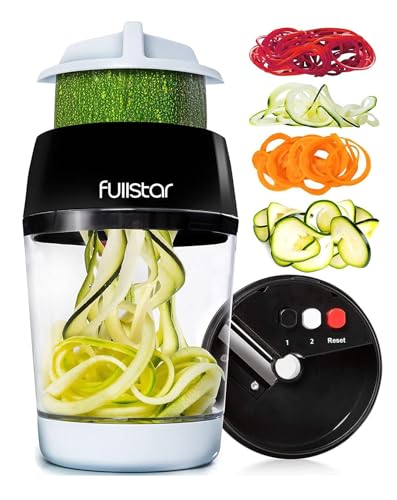
Four cutting options live in one compact body, so you switch between thick spirals, thin noodles, ribbons, and combination cuts without swapping tools. A built-in catch container with a lid keeps prep tidy and lets you store fresh zucchini noodles for later. Multi-pronged finger guards protect hands while the sharp stainless blades and non-slip grip keep control steady. Everything comes apart for dishwasher cleaning, and the BPA-free body slips into a drawer. Owners find it quick for weeknight portions. One limitation: the four-blade format offers fewer cut styles than larger five-blade crank units.
Cutting options4 blade styles
StorageCatch container with lid
SafetyMulti-pronged finger guard
CleaningDishwasher safe
Pros
- Catch container keeps counters clean
- Fully disassembles for easy dishwasher cleanup
- Finger guard adds control and safety
Cons
- Fewer cut styles than five-blade rivals
- Small chute needs pre-trimmed produce
Check price on Amazon ›
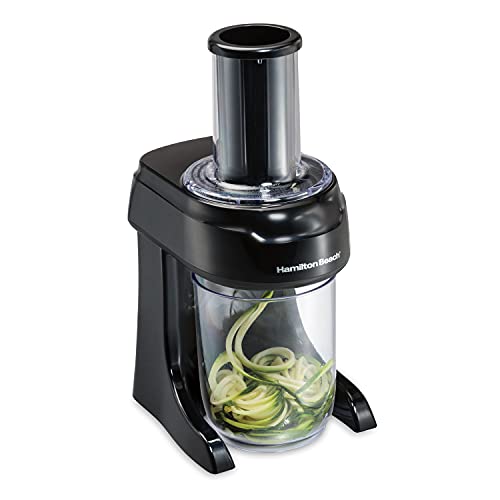
This electric model skips the hand crank entirely, spinning three cutting cones for spaghetti, linguine, or ribbon noodles at the flip of a switch. Its wide 2.5-inch chute swallows whole zucchini, squash, and cucumbers, so you skip most precutting. A metal food grip on the pusher holds produce steady while the motor does the work, and the large bowl catches up to six cups of noodles for family meals. Removable parts are dishwasher safe, with an included brush for the cones. Being a countertop electric unit, it takes more storage room and outlet access than a folding handheld.
Cones3 cutting shapes
Bowl capacityUp to 6 cups
Chute2.5 inch whole-food
CleaningDishwasher-safe parts
Pros
- Motorized cones handle big batches hands-free
- Wide chute fits whole vegetables uncut
- Six-cup bowl suits family recipes
Cons
- Larger footprint needs counter and outlet space
- More parts to rinse than a handheld
Check price on Amazon ›
Designed to snap onto any household KitchenAid stand mixer power hub, this attachment borrows the motor to drive five quick-change blades: medium and fine spiralizing, large and small core slicing, plus an optional peeling blade. Premium metal construction gives it a durable feel, and mounting on the mixer adds real stability during use. The blades and accessories tuck into a dedicated storage case, blades ride the top dishwasher rack, and the body wipes clean with a damp cloth. The obvious limitation: it does nothing on its own, since you must already own a compatible KitchenAid stand mixer to run it.
Blades5 quick-change plus peeler
BuildPremium metal
PowerKitchenAid mixer hub
StorageDedicated case
Pros
- Metal build feels durable and stable
- Five blades add slicing and peeling options
- Storage case keeps parts organized
Cons
- Requires a compatible KitchenAid stand mixer
- Mixer is sold separately
Check price on Amazon ›
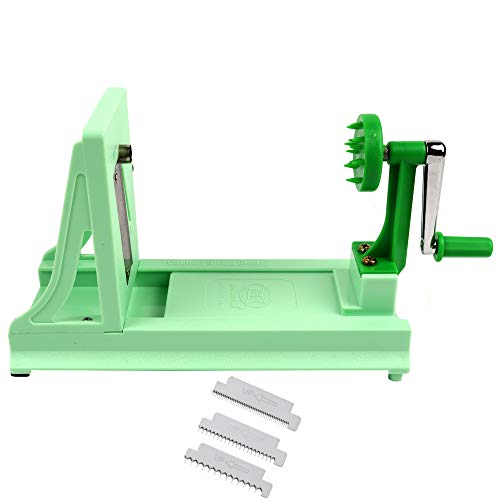
Aimed at drinks, sushi, and salad garnishes, this turning slicer pairs one straight blade for wide slices with three serrated blades whose tooth count sets fine, medium, or coarse strands. It handles zucchini, butternut squash, sweet potato, beet, radish, carrot, cabbage, and potato. Two rubber feet plus edge projections hook over a table or board to stop it sliding as you press. The tough ABS and nylon-reinforced resin body feels nearly unbreakable and rated for restaurant-speed work. One drawback stands out: unlike several rivals here, it is not dishwasher safe, so cleaning means washing by hand.
Blades1 straight, 3 serrated
BodyABS and nylon resin
StabilityRubber feet and edge hooks
CleaningHand wash only
Pros
- Serrated blades create varied garnish textures
- Sturdy resin body resists breaking
- Edge hooks steady it on a table
Cons
- Not dishwasher safe, hand wash only
- Garnish focus over large noodle batches
Check price on Amazon ›
What to look for
Match the tool to your volume
Volume shapes the right pick more than blade count. Cooking single portions or garnishes favors a handheld twister that stores in a drawer. Feeding a family points you toward an electric unit with a large bowl or a stand-mixer attachment that runs hands-free while you prep the rest of dinner.
Understand blade variety
More labeled blades mean more noodle shapes, from angel-hair to wide pappardelle ribbons. Five-blade crank models cover the broadest range, while three and four-blade handhelds keep things simple. Serrated blades, as on the Vollum, add textured garnish strands that smooth blades cannot produce.
Check stability and safety
A spiralizer that slides is frustrating and risky. Suction levers, rubber feet, and edge hooks all fight movement, so look for whichever suits your counter. Finger guards, blade caddies, and locking racks keep sharp edges away from hands during use and storage, which matters in busy kitchens.
Plan for cleaning and produce limits
Most crank and electric models break down for the dishwasher, though a few, like the Vollum, need hand washing. Firm produce at least 1.5 inches wide spiralizes best. Thin carrots, celery, eggplant, and seed-heavy vegetables tend to shred or jam rather than form clean spirals.
Frequently asked questions
Which spiralizer style is easiest for beginners?
Handheld twist models and multi-blade crank units are the gentlest starting points. They need no setup beyond attaching a base or blade, and labeled blades remove the guesswork. Electric versions are simple too, since the motor does the pushing while you feed produce in.
Do I need an electric spiralizer?
Not usually. Manual crank and handheld models handle most home cooking well. An electric unit like the Hamilton Beach shines when you regularly prep six cups or more, since it spins cones hands-free and swallows whole vegetables without precutting.
What vegetables work in a spiralizer?
Firm, dense produce spiralizes cleanly: zucchini, carrots, sweet potatoes, beets, cucumbers, squash, and potatoes. Softer picks like apples and onions also work. Owners report thin carrots, celery, eggplant, and spongy or seed-heavy vegetables tend to shred instead of forming spirals.
Are spiralizer blades dishwasher safe?
Many are, but not all. The Brieftons and Fullstar list dishwasher-safe parts, usually top-rack only. The Vollum is hand wash only. Always check the maker guidance, since high-heat cycles can dull or warp some blades and plastic bodies over time.
Why does my spiralizer slide around?
Weak or dirty suction is the usual cause. Clean, flat, non-porous surfaces like granite or glass grip best. Levered suction pads, rubber feet, and edge hooks all reduce slipping, so choose a model whose base style matches your counter material.
What is the difference between blades and cones?
Crank and handheld models use flat or serrated blades you swap by hand. Electric units like the Hamilton Beach use cone-shaped cutters that spin. Both create noodles and ribbons; cones simply route whole produce through a motor instead of a hand crank.
Can a spiralizer make wide ribbons, not just noodles?
Yes. Flat or straight-edge blades cut ribbon shapes, useful for salads and layered dishes. The Brieftons includes a dedicated ribbon slicer, and the Vollum straight blade makes wide slices, so check that a model lists ribbon or flat cutting if that matters.
How much counter space do I need?
It varies by type. Handhelds like the SUREWIN store in a drawer and need only hand space. Tabletop crank models want a clear stretch of counter. Electric units and stand-mixer attachments claim the most room, plus an outlet or mixer nearby.
The verdict
Brieftons 5-Blade Vegetable Spiralizer and...
9.3/10
For most kitchens, the Brieftons 5-Blade earns the top spot with its wide labeled blade range and strong suction base. Cooking big family batches hands-free? The Hamilton Beach electric handles volume with ease. KitchenAid owners get durable metal build from the attachment, while the SUREWIN and Fullstar suit small spaces and tidy prep. The Vollum rewards anyone plating serrated garnishes who does not mind hand washing.
Check price on Amazon ›
Our top pick, secure checkout via Amazon
Note: Availability and specifications change often. Always confirm the current details on Amazon before buying.