Electronics 7 Turntable Preamps for Warm, Balanced Playback
P
By the Pickpedia Team
·7 picks compared
·Last verified September 2026
Affiliate disclosure: As an Amazon Associate, Pickpedia earns from qualifying purchases. Links on this page are paid links, and we may earn a commission at no extra cost to you. This never affects our picks or scores.
Quick answer
The Fosi Audio Box X5 is our top turntable preamp for most listeners, handling both MM and MC cartridges with four gain levels and a clean, standards-based sound. A good preamp lifts a weak phono signal to line level while applying accurate RIAA equalization. Match it to your cartridge type, MM or MC, and pick added features like adjustable gain, a rumble filter, or a headphone output. Warm, quiet output matters most.
7 Turntable Preamps for Warm, Balanced Playback at a glance
Why you can trust this guide
We compared the real specifications from each manufacturer and retailer listing against patterns in owner feedback, focusing on cartridge support, gain, RIAA accuracy, filtering, and outputs.
Solid-state boxes and tube preamps were judged on their own terms, since each suits a different sound goal and cartridge type rather than competing head to head.
How we chose: We compared seven phono preamps across cartridge support, gain flexibility, noise handling, and connection options.
Most modern receivers skip a dedicated phono input, so a separate preamp bridges your turntable to speakers, an amplifier, or a computer. Choosing well means matching your cartridge, controlling noise, and getting equalization right so records sound the way they were cut.
This roundup ranges from tiny plug and play boxes to a tube unit with a headphone stage. We grouped picks by who they suit, from first vinyl setups to listeners chasing extra warmth and control. Every note below stays grounded in the published specifications.
Our top picks
The Fosi Audio Box X5 covers both moving-magnet and moving-coil cartridges through a front toggle, and its four gain steps of 38, 48, 56, and 66 decibels let you match nearly any cartridge output. It follows the RIAA standard with a stated 92 decibel signal-to-noise ratio and a near-flat 20Hz to 20kHz response, so records come through clean and balanced rather than colored. Input impedance sits at 47k ohms for MM and 100 ohms for MC, the two figures those cartridge types expect. The all-aluminum chassis and RCA jacks feel a step above plastic boxes. Two honest caveats: it is built around a 120V supply, and the small footprint leaves room for only the essential controls.
CartridgeMM and MC, front toggle
Gain settings38/48/56/66 dB
Impedance47k ohm MM, 100 ohm MC
Signal to noise92 dB
ChassisAll-aluminum alloy, RCA jacks
Pros
- Four-level gain adjustment
- Supports MM and MC cartridges
- Quality internal components
Cons
- Built around 120V input
- Small footprint limits controls
Who should buy it
- You run either a moving-magnet or moving-coil cartridge and want one box for both
- You want four gain steps to dial in any cartridge output
- You want a metal chassis and a clean, standards-based RIAA sound
Skip it if
- You need a preamp built for a 230V supply
- You want a larger unit with more front controls
Check price on Amazon ›
Douk's T9 leans into vintage character with two 6E2 tubes driving a magic-eye signal display and two 6A2 tubes shaping a warm, full-bodied sound. Backlights switch between cold green and warm orange for an expressive look. Phono inputs support both MM and MC cartridges, while RCA inputs welcome phones, tablets, or a computer. A dedicated 3.5mm headphone output with its own amplifier drives 16 to 300 ohm cans, and adjustable treble and bass fine-tune the tone. An all-metal case with gold-plated interfaces guards against interference. Tube gear runs warmer and needs a little care, so it suits deliberate listeners more than grab-and-go setups. For rich, tunable warmth, it stands apart.
Tubes2x 6E2, 2x 6A2
CartridgeMM and MC
Headphone3.5mm, 16 to 300 ohms
ToneAdjustable treble and bass
Pros
- Warm tube sound signature
- Built-in headphone amplifier
- Tone controls and MM/MC support
Cons
- Tubes run warm and need care
- Larger than simple boxes
Who should buy it
- You want a warm tube sound signature from your records
- You want a built-in headphone amplifier for 16 to 300 ohm cans
- You like tone controls and MM plus MC support
Skip it if
- You want a small box over a larger tube unit
- You would rather not care for warm-running tubes
Check price on Amazon ›
Fluance built the PA10 around precise RIAA equalization, converting the phono signal with an ultra high-accuracy frequency response meant to track the original recording. Premium components, a low-noise power supply, and a low-impedance output stage target strong gain performance and low distortion. Separate left and right op-amps give clean channel separation with very little crosstalk. A selectable high-pass filter rolls off frequencies below 20Hz to tame subsonic rumble at loud volumes, and internal metal shielding blocks electromagnetic interference. It is engineered for moving-magnet cartridges, so moving-coil users should look elsewhere. For listeners who prize measured accuracy and clean staging, the PA10 is a focused, well-shielded choice.
CartridgeMoving magnet
EqualizationRIAA standard
FilterSelectable below 20Hz
ShieldingInternal metal enclosure
Pros
- High-accuracy RIAA response
- Rumble filter for loud playback
- Metal shielding cuts interference
Cons
- No moving-coil support
- No adjustable gain levels
Who should buy it
- You want high-accuracy RIAA response above all
- You want a selectable rumble filter below 20Hz for loud playback
- You want metal shielding to cut interference
Skip it if
- You run a moving-coil cartridge
- You want adjustable gain levels
Check price on Amazon ›
Jancane's mini preamp converts phono signals to line level and pairs stereo RCA inputs with both RCA and TRS outputs, so it slots into varied home systems. It accommodates magnetic pickups at 3mV into 50K ohms and reaches a 2V maximum output at 10K ohms, with low-noise amplifiers reducing hum when placed near the source. A 12V DC adapter is included, and the maker adds a one-year warranty plus a 30-day money-back window for a low-worry purchase. Playback stays plug and play across speakers, laptops, and receivers. It is limited to magnetic cartridges, so moving-coil owners will need another unit. For everyday vinyl duty, it balances features and support well.
Input sensitivity3mV at 50K ohms
Max output2V (p-p) at 10K ohms
OutputsRCA and TRS
Included12V DC adapter
Pros
- RCA and TRS output options
- One-year warranty coverage
- Quiet amplifier stage
Cons
- Magnetic cartridges only
- No gain adjustment
Who should buy it
- You want a quiet everyday preamp with both RCA and TRS outputs
- You run a standard moving-magnet cartridge
- You want a bundled 12V adapter and a one-year warranty
Skip it if
- You run a moving-coil cartridge
- You want adjustable gain
Check price on Amazon ›
This compact preamp converts phono signals to line level and pairs stereo RCA inputs with both RCA and TRS style handling, useful when gear on either end differs. It accepts magnetic pickups at 3mV into 50K ohms and outputs up to 2V at 10K ohms, with low-noise amplifiers holding hum down. A 12V DC adapter comes in the box, and the maker backs it with a 30-day return window plus a one-year guarantee. Owners are reminded it should not feed a turntable that already has a built-in preamp, since doubling stages causes bad noise. For versatile connections and a reassuring warranty, it earns a spot.
Input sensitivity3mV at 50K ohms
Max output2V (p-p) at 10K ohms
OutputsRCA and TRS
Included12V DC adapter
Pros
- Flexible output options
- Bundled power adapter
- One-year manufacturer guarantee
Cons
- Not for turntables with built-in preamp
- Magnetic cartridges only
Who should buy it
- You need both RCA and TRS outputs for mixed gear
- You run a moving-magnet cartridge
- You want a bundled 12V DC adapter
Skip it if
- Your turntable already has a built-in preamp
- You run a moving-coil cartridge
Check price on Amazon ›
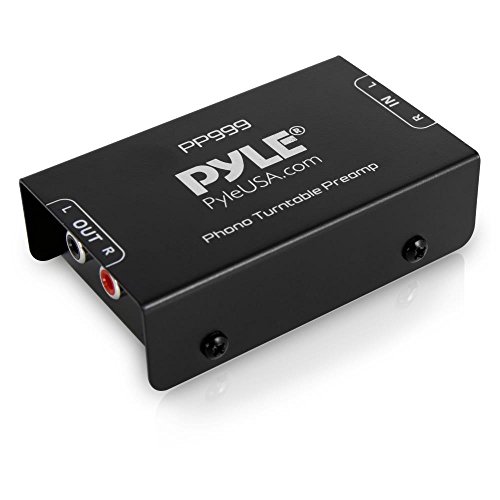
Pyle keeps things straightforward, converting phono signals to line level so any turntable can reach speakers, a computer, or a laptop. It accepts magnetic pickups at 3mV input sensitivity into 50K ohms, with a 2V maximum output at 10K ohms. Low-noise operational amplifiers keep the signal clean when the box sits close to the source. Stereo RCA inputs and outputs plus a ground terminal make wiring quick. The design targets basic magnetic cartridges only, so owners running moving-coil pickups will need a different unit. For a plain, honest first step into separate phono amplification, it covers the essentials without extras.
Input sensitivity3mV at 50K ohms
Max output2V (p-p) at 10K ohms
ConnectionsStereo RCA in and out
CartridgeMagnetic (MM)
Pros
- Simple plug and play wiring
- Low-noise amplifier stage
- Works with many audio devices
Cons
- No moving-coil support
- No adjustable gain
Who should buy it
- You want the simplest plug-and-play wiring for a first setup
- You run a moving-magnet cartridge
- You want a low-noise stage that works with many devices
Skip it if
- You run a moving-coil cartridge
- You want adjustable gain
Check price on Amazon ›
ART keeps the DJPREII pared back to what a phono stage really needs. It offers left and right RCA-type inputs, left and right RCA-type outputs, a ground terminal, and an included power adapter. That short feature list makes setup fast for listeners who just want their records amplified without menus or switches. Reviewers often point to its steady, unfussy behavior in a small enclosure. Because the published details stay minimal, buyers looking for adjustable gain or moving-coil support will find those absent here. For a clean, ready-to-wire stereo preamp that gets straight to playback, this pick keeps things honest and direct.
InputsRCA-type L/R
OutputsRCA-type L/R
GroundingGround terminal
PowerAdapter included
Pros
- Very simple to connect
- Included power adapter
- Compact stereo design
Cons
- No gain adjustment listed
- No moving-coil detail
Who should buy it
- You want the most compact box that just connects and works
- You want an included power adapter and a ground terminal
- You have limited shelf space near the turntable
Skip it if
- You want documented gain adjustment
- You run a moving-coil cartridge
Check price on Amazon ›
What to look for
Match Your Cartridge
Preamps split into moving-magnet and moving-coil support, and some handle both. Check what your turntable uses before buying. MM cartridges are common on most consumer decks, while MC pickups need extra gain, which units like the Fosi Box X5 and Douk T9 provide through switchable settings.
Watch the Noise Floor
A quiet preamp lets fine detail through without hum. Low-noise operational amplifiers, shielding, and short cable runs all help. Several picks recommend placing the box close to the source, and the Fluance PA10 adds internal metal shielding to block electromagnetic interference during playback.
Connections That Fit
Most units use stereo RCA in and out, but a few add TRS outputs for pro or mixed gear. Confirm your receiver, speakers, or computer accept the outputs offered. A bundled power adapter, included with several picks here, saves an extra step at setup.
Extra Features Worth Having
Gain adjustment, a rumble filter, tone controls, or a headphone jack change how flexible a preamp feels day to day. The Fluance filters subsonic rumble below 20Hz, while the Douk T9 adds a headphone amplifier and treble and bass controls for closer tuning.
Frequently asked questions
Do I need a separate preamp if my turntable has one built in?
No. Running a signal through two phono stages usually causes distortion and bad noise. Several models here warn against connecting to a deck with a built-in preamp, so use only one stage.
What does a phono preamp actually do?
It converts a weak phono signal to line level and applies RIAA equalization, which restores the correct tonal balance cut into the record. Without it, playback sounds thin and very quiet.
What is the difference between MM and MC support?
Moving-magnet cartridges are common and need less gain, while moving-coil types output a weaker signal and need more. Units like the Fosi Box X5 and Douk T9 switch between both.
Why does a rumble filter matter?
A high-pass filter, such as the one on the Fluance PA10, rolls off frequencies below 20Hz. That reduces subsonic resonance and feedback, which helps most when listening at loud volumes.
Can I connect a preamp to my computer or laptop?
Yes. Most picks here output to speakers, receivers, computers, and laptops through standard RCA connections. Some add TRS outputs, giving more flexibility when your other gear uses different jacks.
What does a tube preamp add?
Tube units like the Douk T9 aim for a warm, full-bodied tone and often include displays and tone controls. They run warmer than solid-state boxes, so they suit patient, deliberate listeners.
Where should I place the preamp?
Position it close to the turntable to reduce unwanted noise and interference, as several makers advise. Keeping cable runs short and away from power supplies also keeps the signal clean.
Do these come with a power supply?
Many do. The RCA and TRS models here include a 12V DC adapter, and the ART DJPREII lists an included adapter. Always confirm the input standard matches your region before use.
The verdict
Fosi Audio Box X5 Phono Preamp
9.2/10
The Fosi Audio Box X5 is our top pick, earning Best Overall for MM and MC support, four gain levels, and a metal-chassis build that reviewers tie to a warm, detailed sound. The Fluance PA10 suits accuracy seekers with its precise RIAA response and rumble filter, while the Douk T9 rewards those chasing tube warmth and a headphone stage. First-time setups can start simple with the Pyle or ART, both easy to wire. Match the preamp to your cartridge and features first.
Check price on Amazon ›
Our top pick, secure checkout via Amazon
Note: Availability and specifications change often. Always confirm the current details on Amazon before buying.