Electronics 6 SSD Docking Stations for Quick Drive Swaps
P
By the Pickpedia Team
·6 picks compared
·Last verified October 2026
Affiliate disclosure: As an Amazon Associate, Pickpedia earns from qualifying purchases. Links on this page are paid links, and we may earn a commission at no extra cost to you. This never affects our picks or scores.
Quick answer
Pick a SATA dock for classic desktop drives, or a dual-protocol M.2 dock when you run NVMe. For quick swaps, tool-free bays and offline cloning matter most. Match transfer speed, USB 3.0 near 5Gbps or USB 3.2 near 10Gbps, to how often you move large files.
6 SSD Docking Stations for Quick Drive Swaps at a glance
Why you can trust this guide
We compared these picks using verified manufacturer specifications, available manuals and documentation, current retailer listings, and patterns in owner feedback, alongside editorial research. We focus on measurable differences such as performance, capacity, usability, and build quality. Pickpedia does not present editorial research as laboratory testing, and we do not claim hands-on testing unless it was actually performed.
How we chose: We compared six docking stations across drive support, transfer speed, cloning ability, cooling, and how fast drives slot in and out.
Swapping drives should take seconds, not a screwdriver session. A good docking station lets you drop a bare SATA or M.2 SSD into an open bay, then read, back up, or clone it without opening a case. This roundup leans on published specifications, owner reports, and cross-listing comparisons rather than any lab claim.
Choices split into two camps. SATA docks handle familiar 2.5 and 3.5 inch drives and often clone offline with a button press. M.2 docks target faster NVMe sticks and push toward 10Gbps. Which suits you depends on the drives already sitting in your drawer.
Our top picks
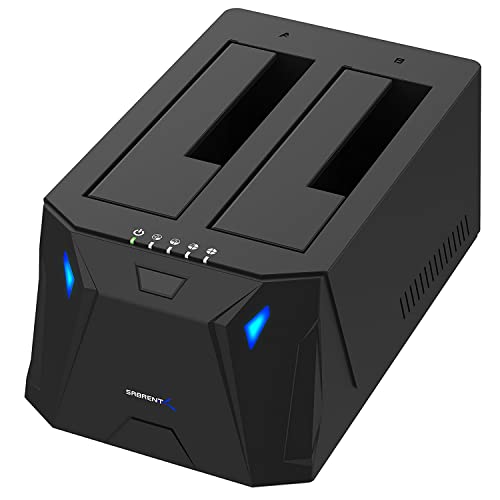
Two open bays accept standard 2.5 and 3.5 inch SATA drives, so you can read two disks at once or copy one to another. SABRENT lists support for drives up to 10TB and plug and play use with no drivers. Offline cloning runs near 60Mbps without a computer attached, handy for backing up spare disks unattended. USB 3.0 transfers reach up to 5Gbps, with fallback to older USB modes. The main limit is scope: this dock reads SATA only, so NVMe M.2 sticks stay out. Owners describe it as a steady daily workhorse for archiving.
Drive support2.5 / 3.5 inch SATA
Max capacityUp to 10TB
Transfer speedUp to 5Gbps
CloningOffline, up to 60Mbps
Pros
- Dual bays read two SATA drives at once
- Offline cloning works without a PC
- Plug and play, no drivers
Cons
- No NVMe or M.2 support
- Clone speed near 60Mbps feels slow for huge disks
Check price on Amazon ›
Built around USB 3.2 Type-C, this dock reaches up to 10Gbps with M.2 NVMe sticks, enough to move a full movie in seconds per ACASIS. The aluminum body doubles as a heat sink, which reviewers note keeps drives cooler than plastic shells during long transfers. A toaster-style open top makes inserting and pulling drives fast and tool-free. It fits M.2 PCIe NVMe M Key and B+M Key sizes 2230 through 2280, backs up to 8TB, and also accepts SATA. Wide OS coverage spans Windows, Linux, and macOS. One catch: it takes a single drive, so simultaneous multi-drive work is out.
Drive supportM.2 NVMe + SATA
Transfer speedUp to 10Gbps
BodyAluminum, toaster-style
Max capacityUp to 8TB
Pros
- Fast 10Gbps NVMe transfers
- Aluminum shell aids cooling
- Tool-free open-top insertion
Cons
- Single drive slot only
- Does not clone offline
Check price on Amazon ›
FIDECO keeps things straightforward with two SATA bays and USB 3.0 speeds up to 5Gbps for reading or writing. Its offline clone is genuinely hands-off: insert two drives, hold Clone for five seconds until the LED flashes, and copying runs with no computer. Setup stays simple thanks to plug and play with no driver install. Compatibility spans Windows, macOS, and Linux, and FIDECO offers firmware updates plus support. Note the maker's own reminder that new drives must be initialized before a computer recognizes them, an easy step some first-timers miss. It reads SATA disks only, so NVMe owners should look elsewhere.
Drive support2.5 / 3.5 inch SATA
Transfer speedUp to 5Gbps
CloningOne-button offline
OSWindows, macOS, Linux
Pros
- One-button offline clone
- Simple plug and play setup
- Firmware updates and support offered
Cons
- SATA only, no NVMe
- New drives need initializing first
Check price on Amazon ›
Three independent bays set this one apart, taking M.2 PCIe NVMe SSDs alongside 2.5 and 3.5 inch SATA drives at the same time. One-touch offline cloning migrates data with no software, and it copies flexibly, NVMe to NVMe or SATA to NVMe. USB 3.2 Gen 2 carries transfers up to 10Gbps, and the included USB-C to USB-C and USB-C to USB-A cable removes the adapter hunt. It runs on Windows and macOS and even connects to game consoles. The box includes a power adapter and a 24-month warranty. With three bays and a power brick, it takes more desk room than single-slot readers.
BaysTriple, mixed formats
Drive supportM.2 NVMe + SATA SSD/HDD
Transfer speedUp to 10Gbps
CloningOne-touch, cross-format
Pros
- Three bays run at once
- Cross-format NVMe and SATA cloning
- Combo USB-C and USB-A cable included
Cons
- Larger footprint on the desk
- Needs external power brick
Check price on Amazon ›
This pocketable enclosure turns a 2.5 inch SATA drive into portable storage for a laptop, PC, or PS4. It supports UASP for transfers up to 5Gbps, which BENFEI says runs meaningfully quicker than plain USB 3.0. A push-out cover means tool-free, hot-swappable installs: pop it open, seat the drive, close, and go. Both USB Type-C and Type-A connections are covered for phones, tablets, and laptops. It fits 7 and 9.5mm SATA drives up to 6TB and works with Windows, Linux, and macOS. Backed by an 18-month warranty. Being 2.5 inch only, it will not house 3.5 inch desktop disks or NVMe sticks.
Drive support2.5 inch SATA, up to 6TB
Transfer speedUp to 5Gbps, UASP
ConnectionUSB Type-C and Type-A
InstallTool-free, hot-swap
Pros
- Compact and portable
- Tool-free hot-swap cover
- Type-C and Type-A both covered
Cons
- Fits 2.5 inch drives only
- No cloning function
Check price on Amazon ›
Tiny at 66 by 51 by 13mm and around 61g, this adapter slips into a bag while still hitting up to 10Gbps on NVMe over USB 3.1 Gen 2. It reads both NVMe and SATA NGFF sticks across sizes 2230 to 22110, with M.2 SATA and NVMe transfers rated up to 10 and 6Gbps. A silicone pad keeps it from sliding on a desk, and tool-free loading means drives seat in seconds. It ships with a USB-A to USB-C cable and works with Windows, macOS, Linux, and Android. Two limits stand out: capacity tops out at 4TB, and it will not read M.2 SATA AHCI B Key SSDs.
Drive supportM.2 NVMe + SATA NGFF
Transfer speedUp to 10Gbps
Max capacityUp to 4TB
Size66 x 51 x 13mm, 61g
Pros
- Very compact and light
- Fast 10Gbps NVMe reads
- Non-slip silicone base
Cons
- Capacity capped at 4TB
- No M.2 SATA AHCI B Key support
Check price on Amazon ›
What to look for
SATA dock or M.2 dock
Start with the drives you already own. Bare 2.5 and 3.5 inch disks need a SATA dock, while newer M.2 NVMe sticks need an M.2 reader. Dual-protocol docks accept both, which future-proofs a mixed drawer of drives.
Transfer speed that fits your files
USB 3.0 tops out near 5Gbps, plenty for documents and photos. If you regularly move video or clone big disks, a USB 3.2 Gen 2 dock near 10Gbps saves real waiting time. UASP support squeezes extra speed from SATA links.
Cloning without a computer
Offline cloning copies one drive to another with a button press and no PC. It shines for scheduled backups or migrating a system disk. Check clone throughput, since some docks copy slowly, and remember cross-format cloning needs a dock that supports both drive types.
Cooling, bays, and swap speed
Aluminum bodies shed heat better than plastic during long transfers. Open-top, toaster-style bays make quick swaps painless, and extra bays let you read several drives at once. Weigh those against desk space, since triple-bay units with power bricks take more room.
Frequently asked questions
Can one dock read both NVMe and SATA drives?
Yes, dual-protocol docks accept M.2 NVMe sticks and SATA drives, sometimes in separate bays. The ICY BOX triple-bay and the ACASIS reader both handle NVMe plus SATA, while classic two-bay docks stay SATA only.
Do I need to install drivers?
No. Every dock here is plug and play with no driver install on Windows, macOS, or Linux. You seat the drive, connect USB, and the disk appears once the operating system mounts it.
Why does my new drive not show up?
Brand-new drives usually need initializing and formatting before the operating system recognizes them. FIDECO notes this directly. Open Disk Management on Windows or Disk Utility on macOS to initialize the drive first.
What does offline cloning actually do?
It copies one drive to another with no computer attached. On docks like the SABRENT and FIDECO you insert two drives and press Clone. It is handy for backups and moving a system disk to a larger one.
Are these docks hot-swappable?
Many are. The BENFEI enclosure and tool-free M.2 readers let you insert or remove drives while connected. Still, always eject a drive in your operating system before pulling it to avoid data loss.
What is the largest drive these support?
It varies by model. The SABRENT lists up to 10TB, the ACASIS up to 8TB, the BENFEI up to 6TB, and the compact AMZPILOT up to 4TB. Check each spec against your drive.
Will USB-C docks work with older USB-A ports?
Usually yes. Several include a USB-C to USB-A cable or backward compatibility with USB 2.0. Speeds drop on older ports, so a 10Gbps dock runs slower on a USB 2.0 connection.
Does aluminum construction really matter?
For long transfers, yes. Aluminum draws heat away from the drive better than plastic, which reviewers link to steadier performance and drive longevity. For quick, occasional reads the difference is smaller.
The verdict
SABRENT USB 3.0 Dual Bay Hard Drive Dockin...
9.0/10
For a mixed drawer of NVMe and SATA drives, the ICY BOX triple-bay dock is the most flexible pick, cloning across formats at up to 10Gbps. Choose the SABRENT dual-bay for straightforward SATA backups and offline cloning, or the ACASIS reader when NVMe speed is the priority. Travelers wanting the smallest kit should grab the AMZPILOT or the pocketable BENFEI enclosure for single-drive duty on the move.
Check price on Amazon ›
Our top pick, secure checkout via Amazon
Note: Availability and specifications change often. Always confirm the current details on Amazon before buying.