Home & Kitchen 5 Spiralizers That Turn Veggies Into Noodles
P
By the Pickpedia Team
·5 picks compared
·Last verified September 2026
Affiliate disclosure: As an Amazon Associate, Pickpedia earns from qualifying purchases. Links on this page are paid links, and we may earn a commission at no extra cost to you. This never affects our picks or scores.
Quick answer
Pick a countertop crank model with labeled blades and strong suction if you spiralize often, like the Brieftons. Handheld twist tools suit quick zoodles and tiny kitchens. Stand-mixer owners get the smoothest experience from the KitchenAid attachment. Match blade count and produce range to how you actually cook.
5 Spiralizers That Turn Veggies Into Noodles at a glance
Why you can trust this guide
We compared these picks using verified manufacturer specifications, available manuals and documentation, current retailer listings, and patterns in owner feedback, alongside editorial research. We focus on measurable differences such as performance, capacity, usability, and build quality. Pickpedia does not present editorial research as laboratory testing, and we do not claim hands-on testing unless it was actually performed.
How we chose: We compared five spiralizers across blade selection, stability, produce range, cleanup, and storage safety to see which suits different kitchens.
Turning zucchini, carrots, and sweet potatoes into noodles is one of the simplest ways to lighten a plate without giving up a pasta-style meal. A good spiralizer makes even strands that cook at the same rate, so the results look and taste consistent. What separates the field is blade variety, how well the tool grips your counter, and how safely it stores when the drawer gets crowded.
This roundup covers three styles: countertop crank machines, pocket handheld twisters, and a stand-mixer attachment. Each one leans toward a different cook, whether you batch meal prep on Sundays or just want a fast zoodle for one. All notes below draw from manufacturer specifications and what reviewers commonly report, not lab testing on our end.
Our top picks
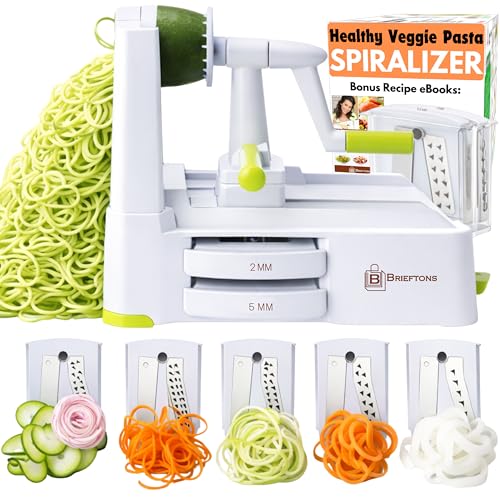
Five clearly labeled Japanese 420-grade stainless steel blades let you grab the right cut every time, from 2mm angel-hair through 5.5mm pappardelle plus a flat ribbon slicer. The oversized suction pad locks to granite, tile, or glass and reportedly grips strongly enough to lift an 11-pound board, so it stays put while you crank. Blades snap into a safety-locking rack and a slide-stop protects fingers, which owners appreciate for daily use. It handles firm produce at least 1.5 inches wide, but skips celery, thin carrots, eggplant, and spongy or seedy vegetables, so plan your prep around that.
Blades5 labeled, 420-grade steel
Cuts2mm to 5.5mm plus ribbon
MountingOversized suction lever
CleaningDishwasher safe, top rack
Pros
- Five labeled blades cover fine to wide cuts
- Strong suction lever keeps it steady
- Safety-locking blade storage rack
Cons
- Will not handle celery, thin, or seedy produce
- Needs produce at least 1.5 inches wide
Check price on Amazon ›
Handheld and simple, the Veggetti turns zucchini, squash, carrots, and cucumbers into noodles with a twist, so there is no counter setup to fuss with. Two separate stainless steel blades give you a thick strand on one side and a thin one on the other, covering the cuts most weeknight meals need. A spiked holder grips the vegetable once it gets short, which reviewers say cuts down on waste and keeps fingers clear. Its main limit is scope: you twist by hand, choices stay basic with just two thicknesses, and long or very hard vegetables can tire your grip compared with a crank machine.
Blades2 stainless steel
CutsThick and thin strands
StyleHandheld twist
Best produceZucchini, squash, carrots
Pros
- Tiny footprint stores anywhere
- Two thicknesses cover common cuts
- Spiked holder reduces waste
Cons
- Only two blade options
- Hand twisting tires on hard produce
Check price on Amazon ›
Turn a knob and this pocket-sized tool switches between three modes for three noodle sizes, giving more variety than a plain two-blade twister. It fully disassembles and rinses clean under running water, and the compact body tucks into almost any drawer. Sharp stainless steel blades come with a non-slip cover for safer handling, and the open design accepts long round vegetables like carrots, zucchini, and cucumbers. Because it is handheld and small, it works best on slimmer produce and shorter sessions; large batches or very wide vegetables suit a countertop crank model better. Reviewers like it as a grab-and-go option.
Modes3 adjustable sizes
MaterialStainless steel blade
CleaningRinses, disassembles
SafetyNon-slip cover
Pros
- Three cut sizes from one knob
- Compact and easy to store
- Fully disassembles for rinsing
Cons
- Handheld design suits smaller batches
- Wide produce fits a crank tool better
Check price on Amazon ›
This attachment connects to any household KitchenAid stand mixer power hub and lets the motor do the spiralizing, so there is no hand cranking. Five quick-change blades cover medium and fine spiralizing, large and small core slicing, plus an optional peeling blade for creative prep. Premium metal construction gives durable, stable performance, and everything fits inside its own storage case for tidy access. Blades are top-rack dishwasher safe and the body wipes clean with a damp cloth. The obvious catch is that you must already own a compatible KitchenAid stand mixer, since the attachment relies on it and the mixer sells separately.
Blades5 quick-change plus peel
PowerStand mixer hub
BuildPremium metal
StorageIncluded case
Pros
- Motor drives it, no cranking
- Durable metal construction
- Comes with its own storage case
Cons
- Requires a compatible KitchenAid mixer
- Mixer sold separately
Check price on Amazon ›
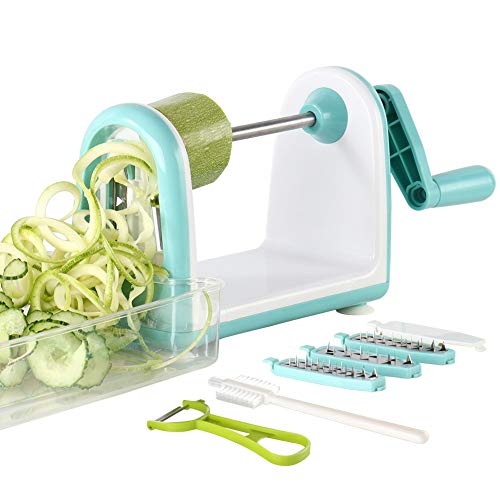
Ourokhome packs multiple blade options, including 2, 3, 5, and 6mm plus a flat slice, so you can shift from thin spaghetti strands to wide ribbons. Heavy-duty stainless steel blades resist rust for a long life, while the ABS handle and body stay strong against the hardest vegetables. It handles onions, carrots, zucchini, cucumbers, cabbage, beets, turnips, radishes, and potatoes, making it a flexible everyday tool. Four suction cups add stability, a blade caddy stores cutters safely, and a catch container keeps the counter tidy. One caveat: the ABS body is plastic rather than metal, so treat it gently to keep it lasting.
Blades2/3/5/6mm plus flat
MaterialSteel blades, ABS body
MountingFour suction cups
ExtrasBlade caddy, container
Pros
- Wide blade range for many cuts
- Catch container keeps counter clean
- Blade caddy for safe storage
Cons
- ABS body is plastic, not metal
- Suction cups can loosen on some surfaces
Check price on Amazon ›
What to look for
Match the style to how you cook
Countertop crank machines suit big batches and firm produce, giving even strands with less effort. Handheld twisters win when you want one quick serving and almost no storage space. If you own a stand mixer, an attachment removes the manual work entirely. Start by picturing your typical session, then choose the format that fits it.
Blade count and range
More blades mean more textures, from fine angel-hair to wide pappardelle ribbons. A two-blade handheld covers thick and thin, which is plenty for casual zoodles. Cooks who like variety, garnishes, or curly chips benefit from four or five labeled options. Labeling matters too, since grabbing the right cut quickly saves fumbling mid-recipe.
Stability and safety
A tool that slides is frustrating and risky, so strong suction or a mixer mount helps. Look for locking blade storage racks and slide-stops that keep fingers away from sharp edges. Non-slip covers on handheld models serve the same purpose. Secure blade storage also keeps loose cutters out of your drawer between uses.
Cleaning and produce limits
Dishwasher-safe blades and bodies that rinse clean save real time after dinner. Check the top-rack guidance and avoid high-heat cycles that can warp plastic parts. Remember most spiralizers need firm produce at least an inch or so wide, and skip celery, eggplant, and spongy or seedy vegetables. Knowing these limits up front prevents wasted attempts.
Frequently asked questions
Which vegetables spiralize well?
Firm, solid produce works best: zucchini, carrots, sweet potatoes, beets, cucumbers, squash, potatoes, and apples. Reviewers note soft or seedy vegetables like eggplant, celery, and cauliflower do not hold a spiral. Aim for pieces at least an inch and a half wide for the smoothest strands.
Do I need electricity to make veggie noodles?
No. Most models here are fully manual, working with a hand crank or a simple twist and no power needed. Only the KitchenAid attachment uses a motor, and that comes from a stand mixer rather than the spiralizer itself. Manual tools give you full control over speed and pressure.
How many blades do I really need?
It depends on variety. Two blades handle thick and thin strands, which suits most weeknight zoodles. Four or five labeled blades open up ribbons, angel-hair, and slicing for garnishes and curly chips. If you cook a range of dishes, more blades add flexibility without much extra bulk.
Are these spiralizers dishwasher safe?
Several are. The Brieftons body and blades go on the top rack, and the KitchenAid blades are top-rack safe with the body wiped clean. Handheld models often rinse clean under running water. Always check the manual and avoid high-heat cycles that can damage plastic parts.
Which model suits a very small kitchen?
Handheld twisters like the Veggetti and the SUREWIN take up almost no room and tuck into a drawer. Both skip the counter setup a crank machine needs. If storage is your top concern, a pocket-sized twister is the practical answer, though it handles smaller batches at a time.
Can a spiralizer handle hard vegetables like beets and sweet potatoes?
Yes, with the right tool. The Brieftons pairs its widest blades with firm produce like raw beets and butternut squash. Crank machines and sturdy bodies generally manage hard vegetables better than lightweight handhelds, which suit softer, slimmer produce more comfortably.
Why do my noodles come out uneven?
Uneven strands usually trace back to produce that is too soft, too thin, or not centered on the holder. Pick firm, straight pieces and press steadily. Consistent spiral sizes help vegetables cook at the same rate, so centering and steady pressure make a real difference to the final plate.
Is a stand-mixer attachment worth it over a manual tool?
If you already own a compatible KitchenAid mixer, the attachment removes hand cranking and adds hands-off ease with five quick-change blades. Without that mixer, a manual crank or handheld tool makes more sense, since the attachment relies on a machine sold separately.
The verdict
Brieftons 5-Blade Vegetable Spiralizer and...
9.2/10
For most kitchens, the Brieftons stands out as the top pick, pairing five labeled steel blades with suction that genuinely stays put and safe blade storage. Tight-space cooks will be happy with the handheld Veggetti or the three-mode SUREWIN for fast single servings. KitchenAid mixer owners get effortless, motor-driven results from the attachment, while the Ourokhome suits families wanting many cuts plus a tidy catch container. Choose by your space, produce, and how often you spiralize.
Check price on Amazon ›
Our top pick, secure checkout via Amazon
Note: Availability and specifications change often. Always confirm the current details on Amazon before buying.