Portable DACs Best Portable DACs: 9 Top Picks for Every Listener
P
By the Pickpedia Team
·9 picks compared
·Last verified November 2026
Affiliate disclosure: As an Amazon Associate, Pickpedia earns from qualifying purchases. Links on this page are paid links, and we may earn a commission at no extra cost to you. This never affects our picks or scores.
Quick answer
For most people the FIIO KA15 is the best portable DAC, thanks to its ten-band lossless PEQ, 0.96-inch color screen and 560mW balanced output. The iFi iDSD GR 2 suits high-power headphone owners, and the SHANLING UA7 brings JAN6418 tube sound in a pocketable body.
Best Portable DACs: 9 Top Picks for Every Listener at a glance
Why you can trust this guide
We compared these picks using verified manufacturer specifications, available manuals and documentation, current retailer listings, and patterns in owner feedback, alongside editorial research. We focus on measurable differences such as performance, capacity, usability, and build quality. Pickpedia does not present editorial research as laboratory testing, and we do not claim hands-on testing unless it was actually performed.
A portable DAC turns a phone or laptop into a cleaner, louder source for wired headphones. The models here differ in chipset, output power, EQ tools and battery design, so the right pick depends on your headphones and how you listen.
We compared the supplied specs and features across nine dongles and battery-powered units, from slim USB-C sticks to desktop-style portables. The ranking weighs drive power, connectivity, controls and the features that matter most on the move.
Our top picks
The KA15 packs a ten-band high-precision lossless PEQ, a 0.96-inch IPS color screen and a retro dynamic UI into a small dongle. Desktop Mode raises balanced output to 560mW+560mW, a 207% increase over the KA5. Real-time voltage and current monitoring cuts power draw and adds an ultra-low power sleep mode.
EQTen-band lossless PEQ
Display0.96-inch IPS color LCD
Balanced power560mW+560mW in Desktop Mode
Power featureReal-time voltage and current monitoring
Pros
- Ten-band lossless PEQ with import and export
- Color screen with retro dynamic UI
- Desktop Mode adds substantial balanced power
Cons
- Screen and menus add complexity for simple use
- Desktop Mode power depends on the source device
Check price on Amazon ›
The iDSD GR 2 uses a Burr Brown PCM1795 DAC and reaches up to 2,173mW peak output, enough for sensitive IEMs and demanding headphones. K2/K2HD processing, multiple digital filters, XBass+ and XSpace shape the sound. A 4,900mAh battery gives up to 7 hours of playback with smart battery management.
DACBurr Brown PCM1795
Peak output2,173mW
BluetoothaptX Lossless
Battery4,900mAh, up to 7 hours
Pros
- Very high 2,173mW peak output
- K2/K2HD and analog sound shaping
- SPDIF and analog inputs plus OLED touch display
Cons
- Larger and heavier than a simple dongle
- Many processing options take time to learn
Check price on Amazon ›
The UA7 houses two JAN6418 vacuum tubes and switches between Tube and Solid-State modes. An ES9069 DAC and OP+BUF architecture deliver 577mW at 32 ohms balanced. A 0.87-inch OLED shows sample rate, output mode, volume and gain.
TubesTwo JAN6418 vacuum tubes
DACES9069
Balanced power577mW at 32 ohms
Display0.87-inch OLED
Pros
- Switchable tube and solid-state modes
- Strong 577mW balanced output
- OLED shows key status at a glance
Cons
- Tube mode may not suit every headphone
- App control needed for deeper customization
Check price on Amazon ›
The G5 combines a USB DAC, Bluetooth DAC and NFCA headphone amp with a built-in 4000mAh battery, so it does not draw from the phone. It supports PCM32bit768kHz and DSD512 native over USB and LDAC over Bluetooth. Three gain steps and under 0.1 ohm output impedance suit both sensitive IEMs and high-impedance headphones.
InputsUSB Type C, Bluetooth, AUX
Battery4000mAh built-in
USB decodingPCM32bit768kHz, DSD512 native
Outputs3.5mm and 4.4mm headphone, 6.35mm line out
Pros
- Does not drain the phone battery
- LDAC Bluetooth plus wired USB
- Three gain settings for varied headphones
Cons
- Bigger than a cable-style dongle
- Bluetooth codec support depends on the source
Check price on Amazon ›
This G5 version uses a single piece of CNC-machined aluminum for a sturdy case and a faux leather base to prevent scratches. It pairs an ES9068AS DAC with a modified NFCA amp and a 4000mAh battery. USB handles PCM32bit768kHz and DSD512 native, while Bluetooth adds LDAC.
CaseCNC-machined aluminum
DACES9068AS
Battery4000mAh built-in
BluetoothLDAC 24bit96kHz
Pros
- Sturdy aluminum body
- ES9068AS decoding for Bluetooth and USB
- Three gain settings for IEMs and full-size headphones
Cons
- Shares the G5 size rather than a slim dongle shape
- Bluetooth quality depends on the paired device
Check price on Amazon ›
The Tea Pro combines an ES9039Q2M DAC, XMOS XU316-1024 USB chip and Qualcomm QCC5181 wireless decoder in a 96g, 7.85mm body. Magnets hold it to MagSafe-compatible iPhones, and a 0.95-inch AMOLED shows playback info. A 2100mAh battery gives up to 11 hours wireless and 8 hours wired.
DACESS ES9039Q2M
Weight96g, 7.85mm thin
Battery2100mAh, up to 11 hours wireless
Outputs3.5mm and 4.4mm
Pros
- Magnetic mounting for MagSafe iPhones
- Slim, light 96g body
- Long wireless playback life
Cons
- AMOLED adds a display to maintain
- Magnetic fit is aimed at compatible phones
Check price on Amazon ›
The Sonata BHD offers 3.5mm single-ended and 4.4mm balanced outputs with a three-position hardware gain switch. Dedicated volume buttons give smooth hardware volume control instead of phone software steps. It decodes native DSD256 and PCM up to 32-bit/384kHz and works plug-and-play across iOS, Android, Mac and Windows.
Outputs3.5mm SE and 4.4mm balanced
GainThree-position hardware switch
DecodingNative DSD256, PCM 32-bit/384kHz
ControlsPhysical volume buttons
Pros
- Hardware volume buttons
- Three gain levels for varied headphones
- Balanced and single-ended outputs
Cons
- No battery, so it draws from the host device
- Windows support starts at version 1703
Check price on Amazon ›
The Martha uses an ES9038Q2M chip with PCM up to 32-bit/768kHz and offers six filter options. Output is 138mW+138mW at 32 ohms single-ended and 180mW+180mW balanced. Distortion is listed at 0.0019% single-ended and 0.0008% balanced.
DACES9038Q2M
Max PCM32-bit/768kHz
Balanced power180mW+180mW at 32 ohms
FiltersSix options
Pros
- Six selectable filters
- Balanced 4.4mm output
- Very low listed distortion
Cons
- Modest power next to battery-powered units
- No onboard battery
Check price on Amazon ›
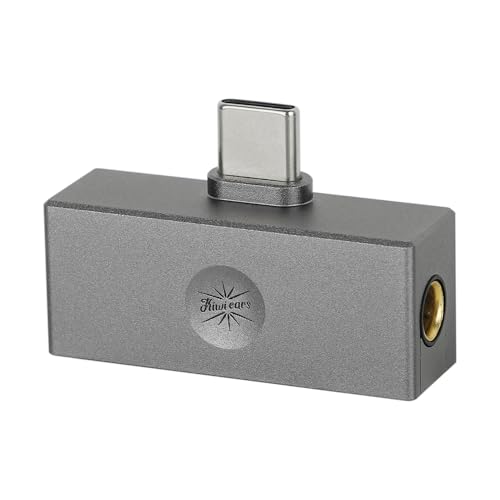
The Allegro Mini is a USB-C dongle with 3.5mm single-ended and 4.4mm outputs and a custom chip. It supports PCM up to 32bit/384kHz and DSD up to DSD128, with THD+N listed at 0.004% at 32 ohms. Plug-and-play works with Android 5.1 and above.
Outputs3.5mm SE and 4.4mm
Max PCM32bit/384kHz
DSDUp to DSD128
THD+N0.004% at 32 ohms
Pros
- Very small USB-C form
- Balanced 4.4mm output
- Low listed distortion
Cons
- No onboard battery or display
- Android compatibility starts at version 5.1
Check price on Amazon ›
What to look for
What a portable DAC does
A portable DAC converts digital audio from a phone, tablet or computer into an analog signal and amplifies it for headphones. It bypasses the built-in audio of the host device, which often limits volume and clarity with better headphones. Models here range from slim USB-C dongles to battery-powered units with Bluetooth.
Power and headphone matching
Output power decides which headphones a DAC can drive well. The iFi iDSD GR 2 lists 2,173mW peak, while the SHANLING UA7 lists 577mW at 32 ohms balanced. Sensitive IEMs need low noise and low output impedance more than raw power, so check both figures before choosing.
Wired, Bluetooth or battery
Cable-style dongles draw power from the host device and stay light. Battery units like the Topping G5 and Khadas Tea Pro keep the phone battery free and add Bluetooth. If you want the smallest possible setup, a dongle is simpler; if you want untethered listening, pick a battery model.
Features that matter day to day
Screens, EQ and physical controls change how a DAC feels in use. The FIIO KA15 offers a ten-band PEQ and a color screen, while the TempoTec Sonata BHD adds hardware volume and gain buttons. Decide whether you want to tune sound or just plug in and listen.
Frequently asked questions
What is the best portable DAC overall?
The FIIO KA15 leads our ranking. It combines a ten-band lossless PEQ, a 0.96-inch color screen and 560mW+560mW balanced output in Desktop Mode, all in a small dongle.
Which portable DAC has the most power?
The iFi iDSD GR 2 lists up to 2,173mW peak output, the highest figure among the models compared here. That suits demanding full-size headphones as well as sensitive IEMs.
Do portable DACs work with iPhones?
Several models here list iOS support. The Khadas Tea Pro adds MagSafe-compatible magnets for iPhone 12 and later, and the TempoTec Sonata BHD lists plug-and-play iOS support.
Is a battery-powered DAC better than a dongle?
A battery unit like the Topping G5 does not draw power from the phone and can add Bluetooth. A dongle is smaller and lighter but relies on the host device for power.
Can I use a portable DAC with Bluetooth headphones?
Bluetooth on models like the Topping G5 and Khadas Tea Pro sends audio from a phone to the DAC, which then feeds wired headphones. Bluetooth headphones connect to the phone directly and bypass the DAC.
What does a tube mode add?
The SHANLING UA7 uses two JAN6418 vacuum tubes for a warm, vocal-rich character in Tube Mode. You can switch to Solid-State mode when you want a different presentation.
How much power do IEMs need?
Most IEMs need little power but benefit from low noise and low output impedance. The Topping G5 lists under 0.3uVrms noise and under 0.1 ohm output impedance for sensitive IEMs.
Which portable DAC is easiest to carry?
The Khadas Tea Pro weighs 96g and measures 7.85mm thin, while the Linsoul Kiwi Ears Allegro Mini is a small USB-C dongle. Both are built for pocket use.
The verdict
FIIO KA15 Portable DAC and Headphone Ampli...
9.4/10/10
The FIIO KA15 is our top portable DAC for most listeners, pairing a ten-band lossless PEQ and color screen with 560mW+560mW balanced output in Desktop Mode. Choose the iFi iDSD GR 2 for maximum power and Bluetooth, or the SHANLING UA7 if you want switchable tube sound.
Check price on Amazon ›
Our top pick, secure checkout via Amazon
Note: Availability and specifications change often. Always confirm the current details on Amazon before buying.