Sports & Outdoors 6 Portable Battery Stations for RV Adventures
P
By the Pickpedia Team
·6 picks compared
·Last verified September 2026
Affiliate disclosure: As an Amazon Associate, Pickpedia earns from qualifying purchases. Links on this page are paid links, and we may earn a commission at no extra cost to you. This never affects our picks or scores.
Quick answer
The LIBRIDS 640Wh station is our top power station for RV trips, the largest reserve here with four AC outlets, fast recharge, and UPS backup. Beyond that, match capacity to your run time and weight to how far you carry it. A LiFePO4 unit near 250Wh handles phones, cameras, and a CPAP overnight, while a 640Wh station with four AC outlets covers longer stays. Fast solar input matters most off grid.
6 Portable Battery Stations for RV Adventures at a glance
Why you can trust this guide
We compared the real specifications from each retailer listing against patterns in owner feedback, focusing on capacity, output, outlets, recharge speed, weight, and battery chemistry.
Portable stations, a raw core battery, and a mounted 12V hub were judged on their own terms, since each fits a different RV setup and level of DIY rather than competing head to head.
How we chose: We compared six portable battery stations across capacity, weight, port count, charge chemistry, and recharge speed to see which suits real RV use.
Powering an RV off grid means balancing three things that pull against each other: how much energy a unit stores, how heavy it is to lift, and how quickly it refills from wall, car, or sun. A compact station keeps phones and a camera alive for a weekend. A larger one runs a mini fridge or CPAP through the night.
Every claim below draws from published specifications and features, not lab testing on our part. Owners report that battery chemistry drives longevity, and LiFePO4 packs tend to outlast older lithium cells by a wide margin. We flag one honest limitation on each pick so you can weigh trade offs before deciding.
Our top picks
With 640Wh behind a 600W output and a 1200W surge, the LIBRIDS station carries the largest reserve here, so it stretches further across a multi night trip. Four AC outlets plus USB ports feed up to eight devices, and a 10ms UPS switches to battery during outages to keep a router or CPAP running. Ultra fast AC charging fills it in about 1.5 hours, while a pure sine wave inverter keeps power clean for sensitive electronics. The automotive grade LiFePO4 cells are rated for 4,000 plus cycles inside a metal enclosure. One limitation: the bigger pack and metal shell add weight, making it less nimble for foot travel than the compact picks.
Capacity640Wh
Output600W, 1200W surge
Outlets4 AC plus USB
AC rechargeAbout 1.5 hours
Pros
- Largest capacity in this lineup
- Four AC outlets and UPS backup
- Pure sine wave with LCD readout
Cons
- Heavier than compact rivals
- Bulkier metal enclosure
Who should buy it
- You take longer trips and want the largest reserve at 640Wh
- You want four AC outlets plus USB and 10ms UPS backup for a router or CPAP
- You want fast AC recharge in about 1.5 hours with clean pure sine wave power
Skip it if
- You carry gear on foot and want the lightest station
- You want a compact plastic unit over a heavier metal enclosure
Check price on Amazon ›
Weighing 7.5 pounds, the Explorer 300 stays easy to grab thanks to an integrated handle, and Jackery lists it as 17 percent lighter than the industry average. Its 292Wh LiFePO4 pack drives two AC outlets, a 100W USB-C PD port, two USB-A ports, and a 120W car port, powering up to six devices at once. Rated output sits at 300W with a 600W surge, enough for laptops, drones, and a CPAP on the road. Paired with a 100W panel it reaches 80 percent in roughly 2.8 hours. One limitation: 292Wh drains fast under heavier loads like a mini fridge, so plan run time accordingly.
Capacity292Wh
Weight7.5 lb
Rated output300W, 600W surge
BatteryLiFePO4, 4,000+ cycles
Pros
- Very light with a comfortable handle
- Long life LiFePO4 chemistry
- Fast solar charging with a 100W panel
Cons
- Modest capacity for large appliances
- Only two AC outlets
Who should buy it
- You carry gear on foot and want a 7.5-pound station with a handle
- You power phones, a laptop, or a CPAP overnight
- You want fast solar charging with a 100W panel
Skip it if
- You run larger appliances like a mini fridge for long stretches
- You need more than two AC outlets
Check price on Amazon ›
ECOFLOW's RIVER 2 leans on X-Stream charging to refill fully from an AC outlet in about one hour, a standout for short layovers. Its 256Wh LFP pack supports up to 600W output, running six essential appliances at once across AC, USB-C, and USB-A ports. At 7.7 pounds with a built-in handle, it travels easily, and solar input reaches full in roughly 2.3 hours with a 110W panel. Advanced BMS protection watches voltage, current, and temperature, and the cells hold up past 3,000 cycles before hitting 80 percent. One limitation: 256Wh is on the smaller side, so heavy overnight loads will need a recharge or solar top up.
Capacity256Wh
Weight7.7 lb
Output300W AC, up to 600W
AC rechargeAbout 1 hour
Pros
- Extremely fast AC recharge
- Solar full in about 2.3 hours
- BMS monitors voltage and temperature
Cons
- Smaller capacity than rivals
- Fewer cycles than some LiFePO4 packs
Who should buy it
- You refill quickly between stops and want about a one-hour AC recharge
- You want fast solar input, full in roughly 2.3 hours
- You want BMS protection watching voltage, current, and temperature
Skip it if
- You need a larger reserve than 256Wh for heavy overnight loads
- You want the most charge cycles from your battery
Check price on Amazon ›
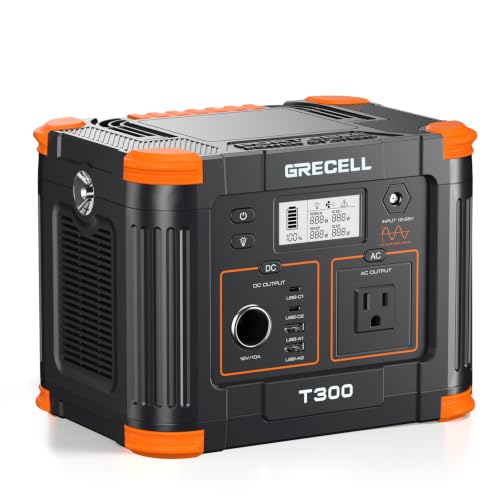
GRECELL packs a wide port menu into 230.88Wh: one AC outlet, a 60W USB-C, three USB-A fast charge ports, a DC car port, two DC 5521 ports, and 5W wireless charging, feeding up to nine devices together. Rated at 330W with a 600W surge, its pure sine wave output suits laptops, a CPAP, or a mini refrigerator under 330W. Three recharge modes cover wall, solar, and car, and a built in LED flashlight with an SOS mode helps during outages. Upgraded BMS adds overload and short circuit protection with dual cooling fans. One limitation: at 230.88Wh it holds the least energy here, so it favors small gear over sustained heavy draw.
Capacity230.88Wh
Output330W, 600W surge
PortsCharges up to 9 devices
RechargeWall, solar, or car
Pros
- Broad port selection with wireless pad
- Built in flashlight with SOS mode
- Three flexible recharge modes
Cons
- Smallest capacity of the group
- Single AC outlet only
Who should buy it
- You charge many small devices at once and want a wide port menu
- You want wall, solar, and car recharge options
- You like a built-in flashlight with an SOS mode for outages
Skip it if
- You need more than one AC outlet
- You want the largest energy reserve for sustained heavy draw
Check price on Amazon ›
This 24V, 120Ah LiFePO4 pack is a raw building block rather than a plug and play station, aimed at owners wiring their own RV power system. Its large capacity keeps outdoor gear running steadily over long stretches, and an impact resistant shell shrugs off drops, bumps, and scratches. Strong weather resistance lets it perform in freezing cold or scorching heat, and built in temperature protection guards the cells. The maker lists international safety certifications and a plug and play connection once wired. One limitation: it lacks the AC outlets, USB ports, and display of a finished power station, so you supply an inverter and controller to make it useful on the road.
Voltage24V
Capacity120Ah
ChemistryLiFePO4
ProtectionTemperature and impact resistant
Pros
- Rugged impact resistant shell
- Wide temperature tolerance
- Large amp hour reserve for builds
Cons
- No outlets or ports on its own
- Needs an inverter and wiring
Who should buy it
- You are wiring your own RV power system and want a rugged core battery
- You want a large 120Ah reserve with wide temperature tolerance
- You want an impact-resistant shell with temperature protection
Skip it if
- You want a plug-and-play station with outlets and a display
- You do not want to add your own inverter and wiring
Check price on Amazon ›
Mqetly's 12V power box mounts into a car, RV, or yacht as a fixed charging hub rather than a portable pack. Its compact design fits tight cabin corners, and the panel carries two 12V socket outlets, six USB ports spanning USB-C and older USB, four input and output points, a built in LED, and an LCD display. Installation is simple: screw the bracket to the back, pick a spot, and secure it. Running from a 12V source, it distributes charge to six USB devices at once. One limitation: it has no internal battery, so it only works while connected to your vehicle or house 12V supply, unlike the standalone stations here.
InputDC 12V
Sockets2x 12V outlets
USB6 ports, USB-C and USB
MountingBracket and screws
Pros
- Compact fit for tight RV spaces
- Six USB ports with a display
- Simple bracket mounting
Cons
- No built in battery of its own
- Needs a live 12V source to run
Who should buy it
- You want a fixed 12V charging hub mounted in an RV or boat
- You charge up to six USB devices at once with a display
- You want a compact unit that fits tight cabin corners
Skip it if
- You need a built-in battery for off-grid use
- You want a portable pack rather than a mounted hub
Check price on Amazon ›
What to look for
Match Capacity to Run Time
Watt hours tell you roughly how long a unit lasts under load. A 250Wh pack keeps phones, a camera, and a CPAP going overnight, while 640Wh stretches toward a mini fridge or a multi day stay. Add up the wattage of what you run, then divide capacity by that draw to estimate hours before a recharge.
Weigh Portability Against Reserve
Bigger reserves come with heavier packs. Compact stations near 7 to 8 pounds move easily on foot, while a 640Wh unit in a metal shell rewards you with outlets and backup with the tradeoff of heft. Decide whether you carry the unit far or leave it parked in the RV.
Prioritize Battery Chemistry
LiFePO4 cells, listed here at 3,000 to 4,000 plus cycles, outlast older lithium by years of regular use. For a station you keep for many seasons, that longevity matters more than a small capacity edge. Owners report LiFePO4 also handles heat and repeated cycling more gracefully.
Plan Your Recharge Path
Off grid, recharge speed decides whether you stay powered. Some units refill from AC in about an hour, others in 1.5, and solar input varies with panel size and sun. Confirm the station accepts solar and check the panel wattage needed to hit a useful charge in daylight hours.
Frequently asked questions
How much capacity do I need for RV camping?
It depends on your devices. For phones, cameras, and a CPAP overnight, 250Wh to 300Wh usually suffices. Running a mini fridge or powering several nights points toward 640Wh or a wired battery bank. Total your device wattage first, then choose a reserve that clears it with margin.
What makes LiFePO4 batteries better?
LiFePO4 cells last far longer, rated here from 3,000 up to 4,000 plus charge cycles before dropping to 70 to 80 percent capacity. That translates to roughly a decade of regular use. They also tolerate heat and repeated cycling well, which suits the temperature swings of RV travel.
Can these power a CPAP overnight?
Several picks list CPAP support. The Jackery Explorer 300, RIVER 2, LIBRIDS, and GRECELL all note medical device or CPAP use within their output limits. A pure sine wave inverter, found on the LIBRIDS and GRECELL, keeps power clean for sensitive electronics. Check your CPAP's wattage against the station's rating.
How fast can I recharge off grid?
Solar input varies by panel. The Jackery reaches 80 percent in about 2.8 hours with a 100W panel, and the RIVER 2 fills in roughly 2.3 hours with 110W. From AC, the RIVER 2 refills in about an hour and the LIBRIDS in about 1.5. Confirm the panel wattage each unit needs.
Which pick is best for tight RV spaces?
The Mqetly 12V power box mounts flat into a cabin or boat and takes little room, acting as a fixed USB and 12V hub. Among standalone stations, the compact GRECELL and Explorer 300 also fit small storage bays while still offering AC outlets.
Do I need solar panels to use these?
No. Every station recharges from a wall outlet, and most also accept a car port. Solar is optional but useful for long off grid stays where no outlet is near. Panels are typically sold separately, so plan for one only if you plan extended trips away from power.
Is the 24V LiFePO4 battery a power station?
No, it is a bare battery for DIY builds, not a plug and play station. It has no AC outlets, USB ports, or display. You add an inverter and wiring to turn it into a usable RV power source. Choose it only if you are comfortable assembling a system.
Can I run multiple devices at once?
Yes, all the stations support several devices together. The GRECELL charges up to nine, the Explorer 300 handles six, and the LIBRIDS feeds up to eight across four AC outlets. Just keep the combined wattage under each unit's rated output to avoid overload.
The verdict
LIBRIDS Portable Power Station 640Wh, 1200...
9.3/10
The LIBRIDS 640Wh station is our top pick, earning Best Overall for the largest reserve, four AC outlets, fast recharge, and 10ms UPS backup. Choose the Jackery Explorer 300 or ECOFLOW RIVER 2 when weight and quick refills matter more than raw capacity. The GRECELL suits port-heavy charging, the Mqetly fits tight mounted setups, and the 24V LiFePO4 pack serves DIY builders wiring their own system.
Check price on Amazon ›
Our top pick, secure checkout via Amazon
Note: Availability and specifications change often. Always confirm the current details on Amazon before buying.