Party Word Games Best Party Word Games for Game Night and Groups
P
By the Pickpedia Team
·9 picks compared
·Last verified November 2026
Affiliate disclosure: As an Amazon Associate, Pickpedia earns from qualifying purchases. Links on this page are paid links, and we may earn a commission at no extra cost to you. This never affects our picks or scores.
Quick answer
Spin Master Games wins for stackable tiles and a rotating board that keep every round strategic. Poetry for Neanderthals is the funniest pick for big groups, and Last Word rounds out the top three with randomized subject-and-letter prompts for 2 to 8 players.
Best Party Word Games for Game Night and Groups at a glance
Why you can trust this guide
We compared these picks using verified manufacturer specifications, available manuals and documentation, current retailer listings, and patterns in owner feedback, alongside editorial research. We focus on measurable differences such as performance, capacity, usability, and build quality. Pickpedia does not present editorial research as laboratory testing, and we do not claim hands-on testing unless it was actually performed.
A party word game has to do two things well: get everyone talking fast and keep the rules out of the way. The nine games here come from different angles, from stacking tiles to shouting one-syllable clues at your friends, but each one turns a group into a noisy room of half-formed answers.
We compared them on player count, setup time, age range, and how well they hold up across repeated game nights. Some fit a couple on a couch, others need a crowd. The list below runs best first, with the details that matter for matching a game to your group.
Our top picks
Upwords turns Scrabble-style play into a stacking contest: you build words across or down, then pile tiles on top to change existing words for more points. The lazy Susan board rotates to whoever is playing, which keeps a table of 2 to 4 moving without passing anything around. It plays solo too, and the 100 letter tiles plus four racks give every player room to plan.
Players1 to 4
Ages8 and up
ContentsGame board, 100 letter tiles, 4 racks, tile bag, instructions
Special featureRotating lazy Susan board
Pros
- Stacking tiles changes existing words, so every turn reshuffles the board
- Rotating board keeps play moving in any seat
- Bonus for using all 7 tiles adds a push-your-luck decision
Cons
- Best with exactly 3 or 4 players
- Tile stacking rewards spelling skill more than speed
Check price on Amazon ›
You give clues using only single-syllable words, and slip up with a big word and you get bopped with a 2-foot inflatable No! Stick. The 200 double-sided cards and two game boards support 2 to 6 players ages 7 and up. It is quick to learn and the penalty mechanic does most of the entertaining for you.
Players2 to 6
Ages7 and up
Contents200 double-sided cards, 2 game boards, inflatable No! Stick, repair patch, instructions
PenaltyInflatable stick for multi-syllable words
Pros
- Single-syllable rule creates instant comedy
- Works for kids and adults in the same round
- Two game boards keep teams separated and moving
Cons
- The stick is a physical prop some hosts will skip
- Clue quality drops fast for players short on vocabulary
Check price on Amazon ›
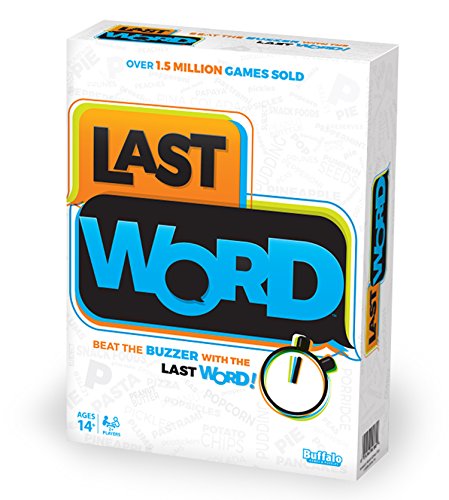
Last Word pairs a randomized timer with subject-and-letter prompts, so players race to shout answers that fit both. It supports 2 to 8 players and ships with 230 subject cards and 56 letter cards. The game has sold over 1.5 million copies, which speaks to how reliably it lands with a mixed-age table.
Players2 to 8
Contents230 subject cards, 56 letter cards
TimerRandomized
Made inUSA
Pros
- Handles up to 8 players without teams
- Randomized timer keeps rounds unpredictable
- Subject-and-letter prompts suit quick thinkers over spellers
Cons
- Shouting matches can get chaotic
- Needs a table big enough for everyone to see the cards
Check price on Amazon ›
This portable card game removes text and spelling from the equation, so new players grasp it instantly. It plays 1-on-1 or with any number of players, which makes it the most flexible option on this list for a group that keeps growing. Average playtime runs about 10 minutes, and the box holds 250 cards plus a rulebook.
Players2 or unlimited
PlaytimeAbout 10 minutes
Contents250 cards, rulebook
Reading requiredNone
Pros
- No text or spelling barrier for younger or reluctant readers
- Scales from two players to a whole party
- Short rounds fit between other activities
Cons
- Less word-focused than tile or clue games
- Quick rounds may feel slight to players who want depth
Check price on Amazon ›
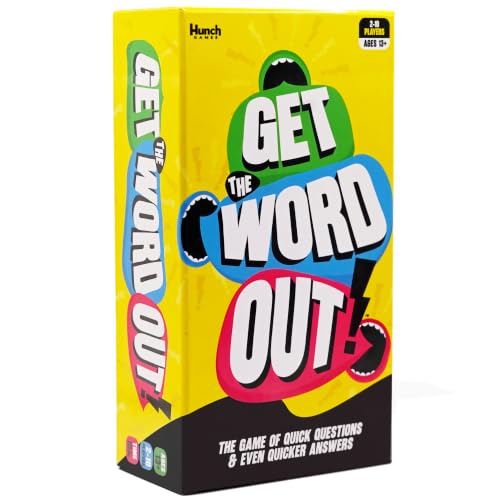
Get The Word Out is a fast team game for 2 to 10 players ages 13 and up. It includes 600 prompts, so rounds stay varied across repeated sessions. Quick rounds and team competition give it a natural party rhythm for holidays, vacations, and family hangouts.
Players2 to 10
Ages13 and up
Contents600 prompts
FormatTeam competition
Pros
- 600 prompts keep replay value high
- Team play suits big groups
- Fast rounds fit a party schedule
Cons
- Ages 13 and up rules out younger kids
- Team play needs an even split to feel fair
Check price on Amazon ›
5 Letter Wordlet brings the guess-the-secret-word format to the table with dry erase boards and markers. Unlike the online version, there is no one-puzzle-a-day limit, and the set includes 200 secret words, 90 guessing chips, and three boards. It plays 2 to 4 players ages 8 and up and sets up in about five minutes.
Players2 to 4
Ages8 and up
Contents3 dry erase boards, 3 markers, 90 guessing chips, 200 secret words, instructions
SetupFive minutes or less
Pros
- Unlimited puzzles in one box
- Boards are designed to pick up and hold
- Familiar format for anyone who plays word puzzles online
Cons
- Quiet, heads-down play rather than loud party energy
- Capped at 4 players
Check price on Amazon ›
A to Z gives players 30 seconds to answer, then flip letters and shout responses as the timer runs. Simple rules mean kids and adults can jump in together, and games run 10 to 20 minutes for 2 or more players ages 8 and up. It is the easiest game here to teach a brand new group.
Players2 or more
Ages8 and up
Playtime10 to 20 minutes
Timer30 seconds per turn
Pros
- 30-second timer keeps energy high
- Rules take seconds to explain
- Works with a wide age range
Cons
- Light on strategy
- Fast pace can overwhelm slower thinkers
Check price on Amazon ›
Word Snag uses seven dice, a dice cup, and 30 category cards to build words against the clock. It plays 2 to 4 players ages 8 and up and includes a score pad to track rounds. The dice element adds a tactile twist that card-only word games lack.
Players2 to 4
Ages8 and up
Contents7 dice, dice cup, 30 category cards, score pad, rules
FormatDice and category cards
Pros
- Dice rolling adds physical fun
- Score pad keeps rounds organized
- Straightforward rules for ages 8 and up
Cons
- Fewer category cards than some rivals
- Four-player cap limits party use
Check price on Amazon ›
Don't Say Duck is a forbidden-word challenge for 2 to 4 players ages 12 and up. The set includes 20 rubber ducks, 175 question cards, a dry erase board, marker, and instructions. It won the grand prize in the University Games 2025 National Game Design Contest, and the duck pieces give it a visual hook most word games skip.
Players2 to 4
Ages12 and up
Contents20 rubber ducks, 175 question cards, dry erase board, marker, instructions
RecognitionUniversity Games 2025 National Game Design Contest grand prize
Pros
- Rubber duck pieces make it stand out on a shelf
- 175 question cards give plenty of rounds
- Dry erase board adds a writing element
Cons
- Small player count
- Ages 12 and up excludes younger family members
Check price on Amazon ›
What to look for
Start with how many people are playing
Player count is the first filter. Upwords and Word Snag cap at 4, while Last Word takes 8 and Words Are Hard takes any number. Get The Word Out sits in the middle at 2 to 10 players. If your guest list changes every time, pick a game that scales rather than one that fits only tonight's table.
Match the age range to your group
Most games here start at 8 and up, which suits family nights with older kids. Poetry for Neanderthals goes down to 7, and Get The Word Out and Don't Say Duck start at 13 and 12. A lower age minimum usually means simpler rules, so a game rated 7 and up can often carry a mixed table of kids and adults.
Weigh setup time and rule complexity
A party game that takes 20 minutes to explain loses the room. Words Are Hard has no text or spelling, and A to Z teaches in seconds. 5 Letter Wordlet sets up in about five minutes. Tile and dice games take a bit longer to lay out, but the rules themselves stay simple enough for new players.
Decide between loud and heads-down play
Shouting games like Poetry for Neanderthals and Last Word fill a room with noise, which suits a party. 5 Letter Wordlet and Upwords are quieter and reward careful thinking. Neither style is better, but matching the game to the mood of the night matters more than any feature list.
Frequently asked questions
Which party word game works best for family game nights?
Upwords is the safest family pick because it plays 1 to 4 players ages 8 and up and keeps everyone at the table involved. Poetry for Neanderthals is the alternative if your family prefers laughing over scoring.
Is a travel-friendly word game a good choice for kids ages 8 to 12?
Yes. Words Are Hard requires no reading or spelling, and 5 Letter Wordlet packs three dry erase boards into a grab-and-go set. Both suit that age range without needing an adult to run the rules.
Can these games handle a small group of couples?
Several can. Words Are Hard plays 1-on-1 or with any number, and 5 Letter Wordlet and Upwords both work well with two players. Poetry for Neanderthals also plays with just two.
What problems come up with word games for kids ages 8 to 12?
Spelling pressure is the common one, which is why Words Are Hard removes text entirely and A to Z leans on quick recall rather than written answers. Check the age minimum before buying, since Don't Say Duck and Get The Word Out start at 12 and 13.
How long does a typical round last?
A to Z runs 10 to 20 minutes per game, and Words Are Hard averages about 10 minutes. Tile and card games like Upwords and Last Word run longer, which suits a full evening rather than a quick filler.
Do any of these games support more than six players?
Yes. Last Word plays 2 to 8, Get The Word Out plays 2 to 10, and Words Are Hard has no player cap at all. Team-based games like Get The Word Out handle a crowd more comfortably than individual-turn games.
How should I compare games before buying for a holiday gathering?
Check player count first, then age range, then how long setup takes. A holiday table with mixed ages usually needs a game rated 8 and up that seats 6 or more, which points toward Last Word or Words Are Hard.
Are dice or card formats better for a party?
Dice games like Word Snag add a tactile element and a score pad to track rounds. Card games like Poetry for Neanderthals and Don't Say Duck are easier to carry and set up. Choose based on whether your group likes rolling or reading.
The verdict
Spin Master Games
9.2/10/10
Spin Master Games takes the top spot because the stacking rule keeps every turn interesting and the rotating board keeps a table of four engaged. Poetry for Neanderthals is the pick when laughter matters more than scoring, and Last Word covers the biggest group. Match the player count and age range to your room, and the rest follows.
Check price on Amazon ›
Our top pick, secure checkout via Amazon
Note: Availability and specifications change often. Always confirm the current details on Amazon before buying.