Lenses 3 Nikon Z Lenses Built for Wildlife Photography
P
By the Pickpedia Team
·3 picks compared
·Last verified October 2026
Affiliate disclosure: As an Amazon Associate, Pickpedia earns from qualifying purchases. Links on this page are paid links, and we may earn a commission at no extra cost to you. This never affects our picks or scores.
Quick answer
For serious reach, the NIKKOR Z 180-600mm f/5.6-6.3 VR suits most wildlife shooters with its long zoom range and internal design. Photographers who hike long distances lean toward the compact 600mm f/6.3 VR S. Travelers wanting a light kit pick the Tamron 70-300mm.
3 Nikon Z Lenses Built for Wildlife Photography at a glance
Why you can trust this guide
We compared these picks using verified manufacturer specifications, available manuals and documentation, current retailer listings, and patterns in owner feedback, alongside editorial research. We focus on measurable differences such as performance, capacity, usability, and build quality. Pickpedia does not present editorial research as laboratory testing, and we do not claim hands-on testing unless it was actually performed.
How we chose: We compared three Nikon Z mount telephotos, weighing reach, stabilization, portability, and close focusing for wildlife work.
Wildlife photography rewards reach, quick handling, and steady optics when subjects rarely wait. Nikon Z shooters have several telephoto paths, each trading focal length against weight and framing flexibility. Choosing well depends on whether you stalk birds on foot or shoot from a fixed hide.
Below we break down three Z mount options grounded in their published specifications and owner feedback. One favors versatility across a wide zoom span, another chases pure portability at long distance, and the third keeps things light for travel. Match the tool to how and where you shoot.
Our top picks
This zoom covers 180mm to 600mm with a short 70 degree ring turn, so you can locate a subject wide then snap to tight framing quickly. Built-in Vibration Reduction rates a stabilization effect equal to roughly 5.5 stops, which helps when panning with fast birds. A 4.27 ft minimum focus at 180mm and 0.25x reproduction let you grab sudden close encounters. Internal zooming keeps the size and balance steady while limiting dust intrusion. It also pairs with Z teleconverters for extra reach. The variable aperture narrows toward the long end, so dim light demands higher ISO or slower shutter speeds.
Focal Range180 to 600mm
Aperturef/5.6 to 6.3
StabilizationVR, about 5.5 stops
Min Focus4.27 ft at 180mm
Pros
- Wide zoom span covers many wildlife scenarios
- Internal zoom holds balance and blocks dust
- Works with 1.4x and 2x Z teleconverters
Cons
- Aperture narrows toward 600mm in low light
- Long zoom body adds noticeable weight
Check price on Amazon ›
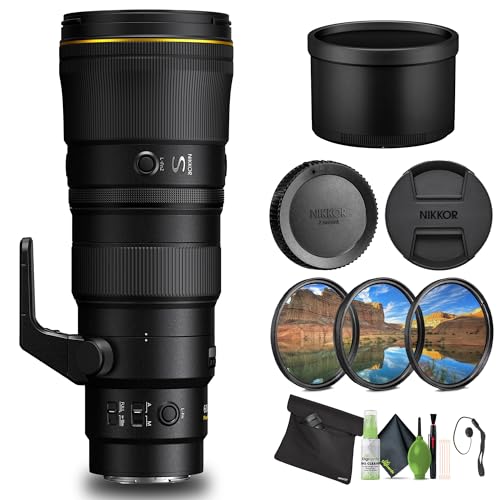
A Phase Fresnel design shrinks this 600mm well below traditional super-telephotos, so owners report genuine handheld capability on the trail. The short barrel helps you maneuver while tracking fast birds or athletes, and ED glass with Nikon coatings keeps contrast consistent outdoors. Integrated VR tuned for distant subjects supports sharp frames at slower shutter speeds during dawn or dusk. It pairs with in-body stabilization on Z bodies for multi-axis correction while panning. A 95mm front thread accepts protective filters and polarizers, and the bundle adds a filter kit and cleaning gear. As a fixed 600mm, it offers no zoom flexibility, so you compose by moving.
Focal Length600mm fixed
Aperturef/6.3
OpticsPhase Fresnel, ED glass
Front Thread95mm
Pros
- Compact and light for a 600mm reach
- VR tuned for distant subject tracking
- Bundle includes filter and cleaning kits
Cons
- Fixed focal length limits framing options
- Large 95mm filters run scarce
Check price on Amazon ›
Tamron calls this the lightest and most compact telephoto zoom for full-frame mirrorless, so it slips easily into a day bag. An optical formula of 15 elements in 10 groups aims for clean image quality across the range. Close focusing reaches 31.5 inches at the wide end and 59.1 inches at 300mm, handy for larger nearby wildlife. The RXD stepping motor stays exceptionally quiet, which suits video and skittish subjects, and moisture-resistant construction adds field confidence. It also works with Tamron Lens Utility software for customization. Reach tops out at 300mm, so distant small birds may still sit too far for tight frames.
Focal Range70 to 300mm
Aperturef/4.5 to 6.3
Optics15 elements, 10 groups
Min Focus31.5 in wide
Pros
- Very light and compact for travel
- Quiet RXD motor suits video and shy subjects
- Moisture-resistant build for field use
Cons
- 300mm reach falls short for distant birds
- No built-in stabilization listed
Check price on Amazon ›
What to look for
Reach Versus Portability
Long focal lengths pull distant animals close, but they add weight and bulk. Decide how far you must carry gear before chasing maximum millimeters. A shorter zoom you actually bring beats a heavy one left at home.
Stabilization Matters
Wildlife often appears at dawn or dusk when light fades. Optical Vibration Reduction, especially paired with in-body correction on Z bodies, helps you hold sharpness at slower shutter speeds while panning with moving subjects.
Aperture and Light
Variable aperture telephotos narrow toward their long end. Plan for higher ISO or steadier support in dim conditions, since these lenses trade some brightness for compact size and extended reach.
Zoom Versus Prime
A zoom lets you reframe without moving, useful when subjects shift distance. A fixed prime like the 600mm rewards you with lightness at one focal length, so you compose by repositioning yourself instead.
Frequently asked questions
Which lens gives the most reach?
The NIKKOR Z 600mm f/6.3 VR S and the 180-600mm both reach 600mm. The zoom adds flexibility, while the prime stays lighter. With Z teleconverters the 180-600mm can extend further still.
Do these lenses work on all Nikon Z cameras?
The 600mm f/6.3 VR S lists compatibility spanning Z30, Z50, Z5, Z6 and Z6 II, Z7 and Z7 II, Z8, Z9, Zf, and Zfc. The others use the same Z mount across current bodies.
Can I shoot handheld with a 600mm lens?
Yes, owners report the compact Phase Fresnel 600mm supports handheld work thanks to its short barrel and VR. Pairing it with a body that has in-body stabilization improves multi-axis correction while panning.
Is the Tamron good for distant birds?
It reaches 300mm, which suits larger or nearby wildlife better than small, far birds. For distant subjects, the 180-600mm or the 600mm prime provide far greater reach.
Do teleconverters help extend range?
The 180-600mm pairs with Z teleconverters, reaching up to 840mm with the 1.4x or up to 1200mm with the 2.0x, both sold separately. Expect some light loss when using them.
Are these lenses weather resistant?
The Tamron 70-300mm features moisture-resistant construction. The Nikon telephotos use robust builds, with the 180-600mm using internal zooming that helps minimize dust intrusion during outdoor sessions.
How close can these lenses focus?
The 180-600mm focuses to 4.27 ft at 180mm with a 0.25x reproduction ratio. The Tamron focuses to 31.5 inches at the wide end and 59.1 inches at 300mm.
Which is quietest for video?
The Tamron RXD stepping motor is described as exceptionally quiet, and the 600mm f/6.3 VR S also emphasizes quiet operation, both helpful for wildlife videographers and shy subjects.
The verdict
NIKON NIKKOR Z 180-600mm f/5.6-6.3 VR
9.2/10
For most Nikon Z wildlife shooters, the 180-600mm f/5.6-6.3 VR earns our top pick with its flexible reach, internal zoom, and teleconverter support. Choose the compact 600mm f/6.3 VR S if you hike far and want long handheld reach at lower weight. Pick the Tamron 70-300mm when travel size and a quiet motor matter more than maximum distance. Match each to your terrain and subjects.
Check price on Amazon ›
Our top pick, secure checkout via Amazon
Note: Availability and specifications change often. Always confirm the current details on Amazon before buying.