Midi Keyboards Best Midi Keyboards: 8 Top Controllers Compared
P
By the Pickpedia Team
·8 picks compared
·Last verified November 2026
Affiliate disclosure: As an Amazon Associate, Pickpedia earns from qualifying purchases. Links on this page are paid links, and we may earn a commission at no extra cost to you. This never affects our picks or scores.
Quick answer
For most players, the M-Audio Keystation 49 MK3 is the best midi keyboard, with 49 full-size keys and a strong software bundle. The Arturia KeyLab Essential mk3 adds deep DAW control, while the Studiologic SL88 MK2 suits players who want weighted keys.
Best Midi Keyboards: 8 Top Controllers Compared at a glance
Why you can trust this guide
We compared these picks using verified manufacturer specifications, available manuals and documentation, current retailer listings, and patterns in owner feedback, alongside editorial research. We focus on measurable differences such as performance, capacity, usability, and build quality. Pickpedia does not present editorial research as laboratory testing, and we do not claim hands-on testing unless it was actually performed.
Choosing a midi keyboard comes down to key count, key action, and how much hands-on control you want over your software. A 25-key controller fits a small desk, while an 88-key weighted model feels closer to an acoustic piano.
We compared eight real controllers on the features that matter: velocity sensitivity, bundled software, DAW integration, and connectivity. The picks below cover compact travel boards, studio centerpieces, and beginner-friendly options.
Our top picks
The Keystation 49 MK3 pairs 49 full-size velocity-sensitive keys with assignable controls and pitch and mod wheels. Its bundled software includes MPC Beats, Ableton Live Lite, and several virtual instruments. Free lessons from Skoove and Melodics help new players get started.
Keys49 full-size velocity-sensitive
ControlsAssignable controls, pitch and mod wheels
SoftwareMPC Beats, Ableton Live Lite, Velvet, XPand2, Mini Grand, Touch Loops
LessonsSkoove and Melodics
Pros
- Full-size keys suit piano-style playing
- Generous software and lesson bundle
- Pitch and mod wheels for expressive performance
Cons
- No weighted action
- Fewer pads than some controllers
Check price on Amazon ›
The KeyLab Essential mk3 offers custom DAW scripts for Ableton Live, Logic Pro X, FL Studio, and more. Its 2,000 Analog Lab V presets span vintage, modern, orchestral, and hybrid sounds. RGB-backlit pads with velocity and pressure sensitivity and a 2.5-inch LCD screen give real-time feedback.
Keys49
Presets2,000 in Analog Lab V
PadsRGB-backlit, velocity and pressure sensitive
Screen2.5-inch LCD
Pros
- Deep DAW integration with custom scripts
- Large preset library and extra pianos
- Bright LCD screen for feedback
Cons
- Software subscriptions required for Loopcloud and Melodics
- No weighted keys
Check price on Amazon ›
The SL88 MK2 is an 88-key controller with weighted keys, aimed at players who want piano-like resistance. Seven encoders provide hands-on control over software parameters. It suits a home studio desk where a full-size keyboard can stay in place.
Keys88 weighted
Encoders7
TypeMIDI keyboard controller
Pros
- Weighted keys for piano-style practice
- Full 88-key range
- Seven encoders for parameter control
Cons
- Large footprint
- Fewer pads and sliders than some rivals
Check price on Amazon ›
The SWING has 32 compact-sized keys with velocity and after-touch. Its 64-step sequencer offers 8-note polyphony with rest, tie, and legato entry. Chord Play mode handles up to 16 notes, and the arpeggiator runs 8 simultaneous notes per step across 8 styles.
Keys32 compact-sized, velocity and after-touch
Sequencer64-step, 8-note polyphony
Chord modeUp to 16 notes
Arpeggiator8 notes per step, 8 styles
Pros
- Powerful built-in sequencer
- Chord and arpeggiator modes inspire ideas
- After-touch adds expression
Cons
- Compact keys may feel small for pianists
- No weighted action
Check price on Amazon ›
The LPK25 packs 25 velocity-sensitive mini keys into a USB-powered controller. Eight programmable preset slots recall mappings for DAWs and virtual instruments. Plug-and-play compatibility with Mac or PC keeps setup simple.
Keys25 mini, velocity-sensitive
Preset slots8 programmable
PowerUSB
CompatibilityMac or PC
Pros
- Very portable and USB powered
- Preset slots speed up workflow
- Simple plug-and-play setup
Cons
- Mini keys limit piano-style playing
- No pitch or mod wheels listed
Check price on Amazon ›
The M32 has 32 compact keys for controlling instruments and effects. Its software package includes synths, basses, drums, effects, and Ableton Live 10 Lite. USB 2.0 bus power means one cable handles connection and power.
Keys32 compact
SoftwareSynths, basses, drums, effects, Ableton Live 10 Lite
PowerUSB 2.0 bus powered
Pros
- Strong software bundle
- Bus powered over USB
- Compact footprint
Cons
- Only 32 keys
- No weighted action
Check price on Amazon ›
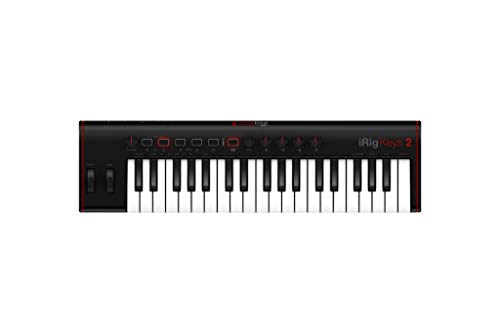
The iRig Keys 2 has 37 velocity-sensitive mini keys and a headphone output for private practice. It connects via Micro-USB and includes MIDI input and output on 2.5mm TRS jacks. At 30.7 oz and 20.4 by 5.5 by 2.13 inches, it is built for travel.
Keys37 velocity-sensitive mini
ConnectivityMicro-USB, MIDI in/out (2.5mm TRS), headphone out (1/8-inch TRS)
Audio16 or 24-bit D/A, up to 96kHz
Weight30.7 oz
Pros
- Headphone output for quiet practice
- Works with phones, tablets, and computers
- Lightweight and travel friendly
Cons
- Mini keys
- No weighted action
Check price on Amazon ›
The Donner N-25 offers 25 mini velocity-sensitive keys and a beginner-friendly layout. Four user-programmable banks join an arpeggiator, sustain, octave, and tap tempo controls. Forty keyboard-teaching courses cover arrangement essentials for novices.
Keys25 mini, velocity-sensitive
Banks4 user programmable
ControlsArpeggiator, sustain, octave, tap tempo
Lessons40 teaching courses
Pros
- Built-in teaching courses
- Simple layout for new players
- Light-up rocker keys
Cons
- Mini keys
- Limited key range
Check price on Amazon ›
What to look for
How key count shapes your choice
A 25-key controller fits a small desk and covers melodies and bass lines. A 32 or 37-key model gives more room for chords. A 49-key board suits fuller playing, while an 88-key model gives the full piano range for practice and arrangement.
Weighted versus synth-action keys
Weighted keys resist like an acoustic piano and help build finger strength, which matters for lessons and piano-style playing. Synth-action keys are lighter and faster, often preferred for drum programming and synth parts. Match the action to how you plan to play.
Software and DAW integration
Many controllers ship with Ableton Live Lite, virtual instruments, or preset libraries. Custom DAW scripts let controls map to your software with less manual setup. Check that the bundled software fits your computer and your workflow before you commit.
Connectivity and portability
USB bus power keeps cable clutter down, and a headphone output lets you practice without disturbing others. Mobile-friendly models connect to phones and tablets as well as computers. If you move between rooms, weight and size matter as much as key feel.
Frequently asked questions
Are weighted keys worth it for music lessons?
Weighted keys build finger strength and feel closer to an acoustic piano, which helps students transfer skills. If lessons are the main goal, the Studiologic SL88 MK2 is the strongest fit here.
Can I use a midi keyboard with a headphone output for quiet practice?
Yes. The IK Multimedia iRig Keys 2 has a headphone output, so you can play without speakers. That makes it useful for small bedrooms and shared spaces.
How do I pick a midi keyboard for a small bedroom?
Measure your desk first, then choose a compact model like the Akai LPK25 or Donner N-25. Mini keys save space, and USB power reduces cable clutter.
What should adult beginners look for?
A simple layout, built-in lessons, and a manageable key count help beginners start fast. The Donner N-25 includes 40 teaching courses, while the Keystation 49 MK3 adds free Skoove and Melodics lessons.
Does USB MIDI work well for church musicians?
USB MIDI connects to laptops and tablets for soft synths and organ sounds. A 49 or 61-key board usually covers hymns and contemporary worship parts, and the Keystation 49 MK3 offers full-size keys for that role.
Which controller is best for home studios?
The Arturia KeyLab Essential mk3 offers deep DAW control and a large preset library. The Studiologic SL88 MK2 suits studios that need weighted keys and a full range.
How do I compare midi keyboards with weighted keys?
Check the key count, the action type, and the controls. The SL88 MK2 pairs 88 weighted keys with seven encoders, which suits piano-focused work.
Is a mini-key controller good for travel?
Yes. The iRig Keys 2 weighs 30.7 oz and runs from USB, and the LPK25 is USB powered with plug-and-play setup. Both fit a bag for mobile writing sessions.
The verdict
M-AUDIO Keystation 49 MK3 USB MIDI Control...
9.2/10/10
The M-Audio Keystation 49 MK3 earns our top spot with full-size keys and a complete software and lesson bundle. Choose the Arturia KeyLab Essential mk3 for DAW control, or the Studiologic SL88 MK2 if weighted keys are your priority.
Check price on Amazon ›
Our top pick, secure checkout via Amazon
Note: Availability and specifications change often. Always confirm the current details on Amazon before buying.