Memory & Storage 5 Memory Card Readers That Speed Up Transfers
P
By the Pickpedia Team
·5 picks compared
·Last verified October 2026
Affiliate disclosure: As an Amazon Associate, Pickpedia earns from qualifying purchases. Links on this page are paid links, and we may earn a commission at no extra cost to you. This never affects our picks or scores.
Quick answer
For most photographers, a dual-slot USB-C reader that handles SD and microSD together moves an entire shoot in one pass. Choose CF support only if your camera writes to Compact Flash. Match the reader to your ports, then confirm your card format is supported before buying.
5 Memory Card Readers That Speed Up Transfers at a glance
Why you can trust this guide
We compared these picks using verified manufacturer specifications, available manuals and documentation, current retailer listings, and patterns in owner feedback, alongside editorial research. We focus on measurable differences such as performance, capacity, usability, and build quality. Pickpedia does not present editorial research as laboratory testing, and we do not claim hands-on testing unless it was actually performed.
How we chose: We compared five card readers across slot count, supported card types, connector options, and stated transfer speeds.
A card reader sits between your camera and your edit, so a slow or fussy one drags every shoot. Photographers usually want two things: slots that fit the cards they already own, and a connector that matches their laptop or phone. Everything else is convenience.
Below we rank five readers based on their listed specifications and how owners describe daily use. Some juggle four card types at once, others keep things slim for a camera bag. We flag one real limitation on each so you can rule out the wrong fit fast.
Our top picks
Acer pairs SD and microSD slots with both USB-A and USB-C headers, so it plugs into nearly any laptop or phone without a second dongle. The listing rates transfers at 5Gbps over USB 3.0, with USB 2.0 fallback. Dual slots read and write both cards at once, which suits pulling stills and video off separate media in one session. Heat-resistant aluminum and protective port covers aim at travel durability. One catch owners flag: thick card cases can block full insertion, and the SD slot skips CFexpress, XQD, and Memory Stick. For SD-based shooters, it covers the essentials cleanly.
Card slotsSD and microSD
ConnectorsUSB-A and USB-C
Rated speed5Gbps (USB 3.0)
HousingHeat-resistant aluminum
Pros
- Dual USB-A and USB-C headers fit most devices
- Reads and writes both cards simultaneously
- Slim aluminum build with dust covers
Cons
- Thick card cases may block full insertion
- No CFexpress, XQD, or Memory Stick support
Check price on Amazon ›
BENFEI reads four card types, SD, microSD, Memory Stick, and Compact Flash, from one integrated body with both USB-C and USB 3.0 connectors. The listing quotes UHS-I transfers up to 160MB per second, with backward USB 2.0 compatibility. All four slots can be read at the same time, handy if you run several cards per assignment. Broad device compatibility spans recent MacBooks, Surface, and Galaxy phones, and an 18-month warranty backs it. Worth noting: it excludes standard Memory Stick, M2, and CF Type I, and larger SDXC cards need exFAT support on older operating systems. A strong pick if your gear mixes CF with SD.
Card slotsSD, microSD, MS, CF
ConnectorsUSB-C and USB 3.0
Rated speedUp to 160MB/s (UHS-I)
Warranty18 months
Pros
- Handles four card types in one unit
- Reads all slots simultaneously
- Backed by an 18-month warranty
Cons
- Excludes standard MS, M2, and CF Type I
- Large SDXC cards need exFAT on older systems
Check price on Amazon ›
SmartQ keeps things straightforward with a four-in-one layout for microSD, SD, MS, and CF, reading each card independently. It runs on USB 3.0 with USB 2.0 compatibility, and the listing cites fast transfer at USB 3.0 speeds. No driver install is needed across Windows, Mac, and Linux, so it suits users who just want to plug in and copy. A blue LED confirms power and activity at a glance. The box adds a cable organizer and manual. Its main limit is the single USB-A style connector, so USB-C only laptops and phones will need an adapter. For desktop and older laptop workflows, it stays reliable and fuss-free.
Card slotsmicroSD, SD, MS, CF
InterfaceUSB 3.0
CompatibilityWindows, Mac, Linux
IndicatorBlue LED
Pros
- Four card types with independent reading
- No driver install on major systems
- LED clearly shows power and activity
Cons
- USB-A style connector needs an adapter for USB-C only devices
- No integrated USB-C header
Check price on Amazon ›
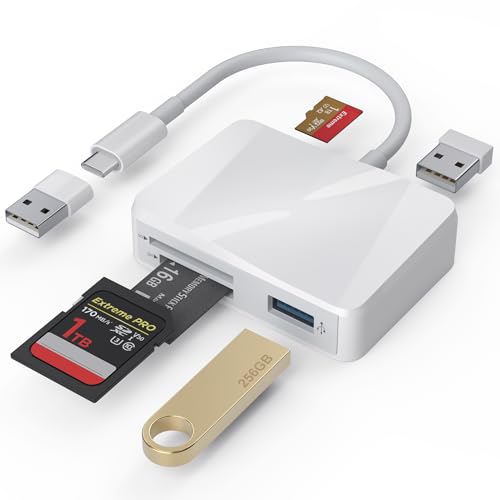
This 5-in-1 pairs triple card slots, SD, microSD, and Memory Stick, with two USB-A ports, so you can pull photos while a flash drive or mouse stays connected. A detachable USB-C to USB adapter lets it swing between phones, MacBooks, and older PCs with full OTG support. The listing claims read and write for cards up to 2TB across SDHC, SDXC, and UHS-I media, plus over-current and short-circuit protection. Reviewers note it works across iOS, Android, Windows, and macOS. The trade-off is bulk: adding dual USB ports makes it larger than a plain reader, and it targets SD-family cards rather than CF. Great for hybrid desk-and-travel setups.
Card slotsSD, microSD, MS
Extra portsDual USB-A
ConnectorsUSB-C plus USB adapter
Card capacityUp to 2TB
Pros
- Adds two passthrough USB-A ports
- Detachable adapter fits old and new devices
- Full OTG across iOS, Android, and desktop
Cons
- Bulkier than a plain card reader
- No Compact Flash slot
Check price on Amazon ›
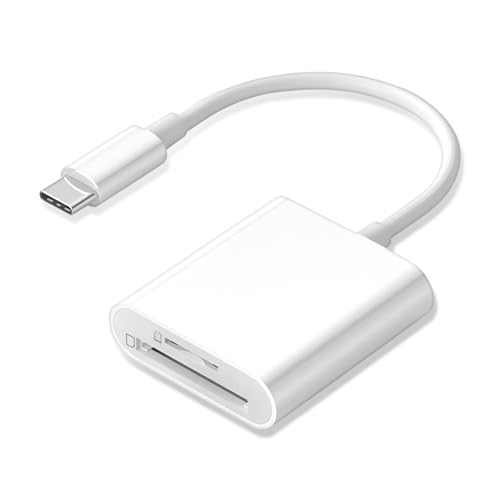
This slim 2-in-1 reads SD and microSD over a built-in USB-C cable, aimed squarely at iPhone, iPad, and MacBook users who want to review shots on the spot. Bi-directional transfer moves batches of photos and video onto a phone or back onto a card, cutting waiting between locations. It runs plug-and-play across macOS, Windows, Linux, and Chrome, and on iPad you just use the Files app. The short expansion cable helps it sit alongside other ports without crowding. Its scope is deliberately narrow: only SD and microSD, with no CF, MS, or extra USB ports, and it depends on OTG support. For a light travel companion, it does the core job well.
Card slotsSD and microSD
ConnectorBuilt-in USB-C cable
TransferBi-directional
CompatibilitymacOS, Windows, Linux, Chrome
Pros
- Compact with an integrated USB-C cable
- Two-way transfer between phone and card
- Simple plug-and-play, no software
Cons
- Only SD and microSD, no CF or MS
- Requires OTG support on the device
Check price on Amazon ›
What to look for
Match slots to your cards
Start with the media your camera actually writes to. SD and microSD cover most mirrorless and action cameras, while some professional bodies still use Compact Flash. Pick a reader whose slots fit those cards, and skip paying for formats you will never load.
Check the connector on your device
A reader is only useful if it plugs in. USB-C dominates recent laptops and phones, but many desktops and older machines still expect USB-A. Dual-header readers or ones with a detachable adapter save you from carrying a separate dongle.
Read the speed rating honestly
Listed transfer figures assume an ideal card and port. Your real throughput is capped by the slower of the reader, the card, and the slot. Treat quoted numbers as a ceiling, and expect everyday results to sit below them.
Weigh size against features
Multi-slot readers with passthrough USB ports do more but take up room. A slim two-slot unit slips into a camera bag with less bulk. Decide whether you value an all-in-one hub or a pocketable single-purpose tool.
Frequently asked questions
Do I need a dual-slot reader?
If you shoot to both SD and microSD, or copy from two cards per session, dual slots let you read them at once and save trips. Single-slot readers are fine when you only ever use one card type.
Will these work with my iPhone or iPad?
Several models here list USB-C connectors and OTG support for recent iPhones and iPads. On iPad you import through the built-in Files app. Always confirm your device has a USB-C port, since Lightning devices are not supported.
What does the quoted transfer speed really mean?
It is the maximum the reader can handle under ideal conditions. Actual speed is limited by your card's rating and your computer's port. A fast reader cannot make a slow card move quicker.
Can these readers connect directly to my camera?
No. These devices read cards you remove from the camera, not the camera body itself. You take the card out, insert it, and transfer files to your computer or phone.
Do they support Compact Flash?
The BENFEI and SmartQ four-in-one models list CF support, while the SD-and-microSD readers do not. Check the slot list against your camera before buying if you rely on CF media.
Do I need to install drivers or software?
Every reader here is described as plug-and-play across Windows, macOS, and often Linux and Chrome. You connect it and start transferring, with no separate driver download required in most cases.
Why won't my card fully insert?
Some readers note that thick protective card cases can block full insertion. Remove any bulky sleeve or case from the card first, then seat it gently until it clicks into the slot.
Are large-capacity cards supported?
One model lists support up to 2TB, and several handle SDXC. Very large SDXC cards use the exFAT format, which older operating system versions may not read, so verify your system supports it.
The verdict
acer SD Card Reader USB C, Dual Slots USB...
9.1/10
For most photographers, the acer dual-slot reader is our top pick, pairing SD and microSD with both USB-A and USB-C headers. Choose BENFEI when your kit still includes Compact Flash, and the 5-in-1 if you want extra USB passthrough at your desk. iPhone and iPad shooters wanting something pocketable will like the slim USB-C two-slot reader. Match slots and connector to your gear first, then compare listed speeds.
Check price on Amazon ›
Our top pick, secure checkout via Amazon
Note: Availability and specifications change often. Always confirm the current details on Amazon before buying.