Macro Camera Lens Best Macro Camera Lens: 9 Top Picks for Close-Up Work
P
By the Pickpedia Team
·9 picks compared
·Last verified November 2026
Affiliate disclosure: As an Amazon Associate, Pickpedia earns from qualifying purchases. Links on this page are paid links, and we may earn a commission at no extra cost to you. This never affects our picks or scores.
Quick answer
For most shooters the Sony FE 100mm F2.8 GM OSS Macro is the best macro camera lens, pairing 1.4x magnification with optical stabilization. The Nikon NIKKOR Z MC 105mm f/2.8 VR S is the Z-mount pick, and the Fujinon XF30mmF2.8 R LM WR Macro suits X Series bodies.
Best Macro Camera Lens: 9 Top Picks for Close-Up Work at a glance
Why you can trust this guide
We compared these picks using verified manufacturer specifications, available manuals and documentation, current retailer listings, and patterns in owner feedback, alongside editorial research. We focus on measurable differences such as performance, capacity, usability, and build quality. Pickpedia does not present editorial research as laboratory testing, and we do not claim hands-on testing unless it was actually performed.
A macro camera lens earns its place by getting you close without losing sharpness. Magnification ratio, working distance and focus speed matter more here than in almost any other lens category, and the right answer depends on your mount and what you shoot.
We compared nine lenses across Sony E, Nikon Z, Fujifilm X, Micro Four Thirds and Nikon DSLR mounts, weighing magnification, aperture, stabilization, sealing and handling. The picks below range from 1:1 workhorses to a 2x ultra macro and a cine optic.
Our top picks
This G Master macro reaches 1.4x magnification natively, going to 2.8x with an optional teleconverter. The f/2.8 aperture and built-in OSS help in low light and at close range. It is the most capable all-around macro camera lens on this list for Sony bodies.
MountSony E-mount
Max magnification1.4x, up to 2.8x with teleconverter
Max aperturef/2.8
StabilizationOSS
Pros
- 1.4x native magnification exceeds standard 1:1
- Optical SteadyShot aids handheld close-ups
- Teleconverter support extends reach to 2.8x
Cons
- Teleconverter needed for the highest magnification
- Large 100mm barrel
Check price on Amazon ›
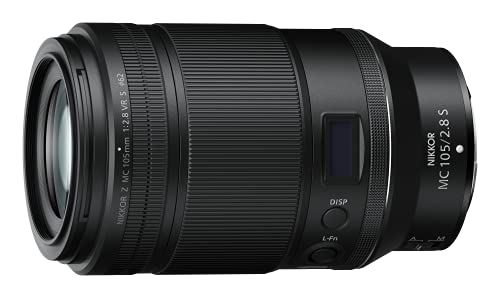
Nikon's 105mm macro delivers life-size 1:1 magnification with a bright f/2.8 aperture. The 105mm reach gives comfortable working distance from insects and skittish subjects. It doubles as a portrait lens thanks to the flattering focal length and blurred backgrounds.
MountNikon Z
Max magnification1:1
Max aperturef/2.8
Focal length105mm
Pros
- 1:1 life-size magnification
- 105mm working distance suits insects and nature
- Also strong for portraits
Cons
- No magnification beyond 1:1
- Prime focal length only
Check price on Amazon ›
A 46mm equivalent standard macro with a 10cm minimum focusing distance from the sensor and 1:1 magnification. Eleven rounded aperture blades produce smooth bokeh, and the linear motor focuses in as little as 0.02 seconds. The barrel is weather sealed in nine places down to -10°C.
MountFujifilm X
Equivalent focal length46mm
Min focus distance10cm from sensor
Weather sealingNine points, to -10°C
Pros
- 1:1 magnification at a very close 10cm
- Fast 0.02 sec linear motor autofocus
- Weather sealed and aperture ring lock
Cons
- Short working distance can shadow subjects
- Standard focal length less ideal for skittish insects
Check price on Amazon ›
The Laowa reaches 2x magnification with a 6.69 inch minimum focus distance, revealing textures standard 1:1 lenses miss. A 14-element, 10-group design with ED glass keeps chromatic aberration low. At 11.82 oz it is easy to carry for field sessions.
MountFujifilm X
Max magnification2x
Min focus distance6.69 in
Weight11.82 oz
Pros
- 2x magnification beyond life-size
- APO design with ED elements
- Light 11.82 oz build
Cons
- Manual focus only
- Short working distance at 2x
Check price on Amazon ›
A dust and splash-proof 60mm macro with 1:1 life-size magnification and a 7.4 inch minimum focusing distance. Internal focusing keeps the barrel length fixed at close range, which matters for working clearance. Thirteen elements in ten groups reproduce fine detail faithfully.
MountMicro Four Thirds
Max magnification1:1, 1x 35mm equivalent
Min focus distance7.4 in
SealingDust and splash-proof
Pros
- Weather-sealed barrel
- Internal focusing keeps length constant
- Close 7.4 inch working distance
Cons
- Micro Four Thirds sensor only
- No stabilization in the lens
Check price on Amazon ›
The renewed version of the 60mm f/2.8 macro carries the same 7.4 inch working distance and 1x 35mm equivalent magnification. Thirteen elements in ten groups handle fine detail. It is a sensible route for buyers who want this focal length without the new-unit packaging.
MountMicro Four Thirds
Max magnification1x 35mm equivalent
Min focus distance7.4 in
ConditionRenewed
Pros
- Same optics as the standard 60mm macro
- Close 7.4 inch working distance
- Renewed condition option
Cons
- Renewed, not new
- No lens stabilization listed
Check price on Amazon ›
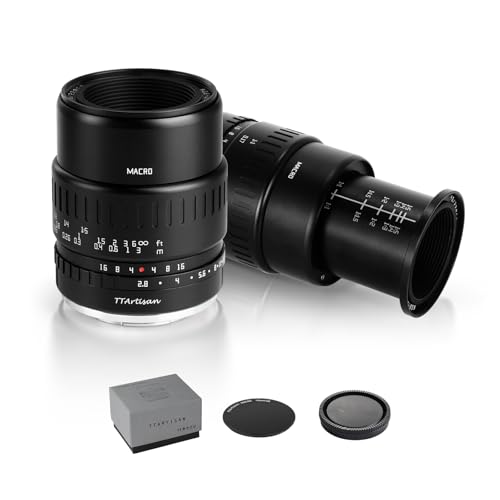
A 40mm f/2.8 manual focus macro with 1:1 magnification and a 6.7 inch minimum focus distance. The 11-blade aperture gives creamy background blur, and the all-metal body weighs 371g, about 30% lighter than similar options. Dual LD glass in a 7-group, 8-element design limits aberrations.
MountFujifilm X
Max magnification1:1
Min focus distance6.7 in
Weight371g
Pros
- 1:1 magnification at 6.7 inches
- Light 371g all-metal build
- 11-blade bokeh
Cons
- Manual focus only
- No weather sealing listed
Check price on Amazon ›
A full frame 105mm macro that focuses to 1:1 at a 12.3 inch working distance. On APS-C bodies the effective focal length grows to about 150mm, which adds reach for wary subjects. Optical stabilization and HSM focusing are part of the design.
MountNikon DSLR
Max magnification1:1
Min focus distance12.3 in
FormatFull frame, APS-C compatible
Pros
- 1:1 at a comfortable 12.3 inches
- Longer effective reach on APS-C
- Optical stabilization
Cons
- DSLR mount only
- Heavier full frame build
Check price on Amazon ›
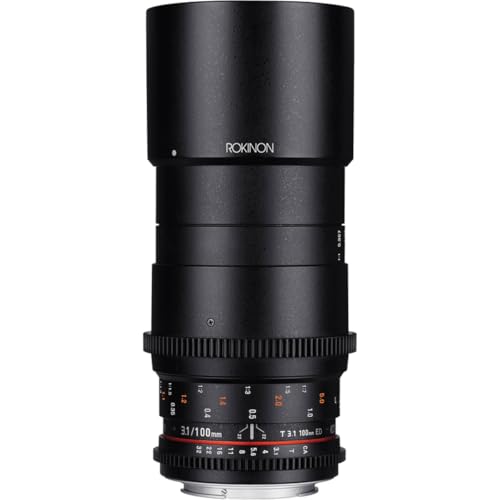
A 100mm telephoto macro cine lens with a T3.1 to T32 aperture range and nine diaphragm blades. Fifteen glass elements in twelve groups and a 1.0 ft minimum focusing distance support close video work. The 16.4 degree angle of view suits tighter compositions.
MountMicro Four Thirds
Aperture rangeT3.1 to T32
Min focus distance1.0 ft
Elements15 in 12 groups
Pros
- Cine-style geared controls
- Close 1.0 ft minimum focus
- Nine-blade diaphragm
Cons
- Manual cine lens, not stills autofocus
- Narrow 16.4 degree view
Check price on Amazon ›
What to look for
Magnification and working distance come first
Macro lenses are defined by magnification, and 1:1 life-size is the baseline. Some lenses go further: the Sony reaches 1.4x natively and 2.8x with a teleconverter, while the Laowa hits 2x. Working distance matters just as much, because a 10cm close focus can block your own light.
Match the mount before anything else
Sony E, Nikon Z, Fujifilm X and Micro Four Thirds each need their own lens, and the Sigma 105mm is built for Nikon DSLR bodies. Buying outside your mount is the most common mistake. Confirm the mount, then compare focal length and sealing within that system.
Autofocus, stabilization and sealing
Fast linear motors, as on the Fujinon XF30mm, help with handheld close-ups and moving subjects. Optical stabilization in the Sony and Sigma lenses steadies low-light work. Weather sealing, found on the Fujinon and the OM SYSTEM 60mm, matters for field and landscape shooting in dust or drizzle.
Focal length shapes your subjects
Short macros around 30 to 40mm suit tabletop, product and flat-lay work where you can get close. Lenses in the 60mm to 105mm range give more room for insects and nature. The 105mm options also double as portrait lenses thanks to flattering compression and blurred backgrounds.
Frequently asked questions
Which macro lens combines fast autofocus and weather sealing?
The Fujinon XF30mmF2.8 R LM WR Macro is the clearest match, with a linear motor focusing in as little as 0.02 seconds and a barrel sealed in nine places. The OM SYSTEM 60mm macro is also dust and splash-proof for Micro Four Thirds.
Is a weather-sealed macro lens a good choice for APS-C cameras?
Yes, if your body is sealed too. The Fujinon XF30mm is built for X Series APS-C bodies, and the TTARTISAN 40mm offers a lighter manual alternative for the same mount.
Does optical stabilization help a macro lens for wildlife?
It helps in low light and at close range, as with the Sony FE 100mm and Sigma 105mm. For fast-moving insects, a longer focal length and quick autofocus usually matter more than stabilization alone.
What matters most when choosing a macro lens for low light?
A bright f/2.8 or T3.1 aperture, stabilization where available, and reliable autofocus. The Sony FE 100mm pairs f/2.8 with OSS, while the Nikon 105mm relies on its bright aperture and blurred-background rendering.
Can a lightweight macro lens work for wildlife shooting?
It can for slow or stationary subjects. The Laowa 65mm weighs 11.82 oz and the TTARTISAN 40mm 371g, both easy to carry on long walks, though their manual focus asks more patience with moving subjects.
Should I choose a stabilized macro lens for indoor portraits?
A stabilized 105mm like the Nikon or Sigma doubles well as a portrait lens. Indoors, the bright aperture and blurred backgrounds do most of the work, and stabilization adds margin when light is low.
How do I compare macro lenses for landscape photos?
Look at sealing, focal length and how the lens renders distant detail. The OM SYSTEM 60mm and Fujinon XF30mm are sealed for outdoor use, and the Laowa's APO design keeps chromatic aberration low in high-contrast scenes.
Is a manual macro lens worth considering?
Yes, when you shoot static subjects and want 2x magnification or a light carry. The Laowa 65mm and TTARTISAN 40mm are manual focus, so you gain reach and portability but give up autofocus.
The verdict
Sony FE 100mm F2.8 GM OSS Macro Lens
9.6/10/10
The Sony FE 100mm F2.8 GM OSS Macro wins on magnification and stabilization, making it the best macro camera lens for most Sony shooters. Nikon Z owners should take the 105mm VR S, and Fujifilm users get a sealed, fast-focusing standard macro in the XF30mm. Match your mount first, then pick the magnification and sealing you need.
Check price on Amazon ›
Our top pick, secure checkout via Amazon
Note: Availability and specifications change often. Always confirm the current details on Amazon before buying.