Lenses 6 Lens Cases That Guard Your Glass on the Go
P
By the Pickpedia Team
·6 picks compared
·Last verified October 2026
Affiliate disclosure: As an Amazon Associate, Pickpedia earns from qualifying purchases. Links on this page are paid links, and we may earn a commission at no extra cost to you. This never affects our picks or scores.
Quick answer
Pick a lens case by lens size and how you carry it. Neoprene drawstring pouches suit fast lens swaps, thick padded zip pouches guard against knocks and moisture, and a divided hard case protects a whole kit. Match interior diameter and height to your longest lens first.
6 Lens Cases That Guard Your Glass on the Go at a glance
Why you can trust this guide
We compared these picks using verified manufacturer specifications, available manuals and documentation, current retailer listings, and patterns in owner feedback, alongside editorial research. We focus on measurable differences such as performance, capacity, usability, and build quality. Pickpedia does not present editorial research as laboratory testing, and we do not claim hands-on testing unless it was actually performed.
How we chose: We compared six lens cases across padding thickness, closure type, carry hardware, and stated lens compatibility.
A lens rides through backpacks, car seats, and dusty trails, so the right case matters. Some photographers want a single padded pouch for a prime, while others need a set covering everything from a pancake to a telephoto. Closure style, padding, and carry options separate the options here.
Every pick below is grounded in the maker's stated features rather than lab testing. We flag interior dimensions, padding material, and how each attaches to a bag or belt. One honest limitation is called out per product so you know the tradeoff going in.
Our top picks
ARVOK sells this pouch in small, medium, large, and extra large so you can match one lens closely. Padding runs 15mm thick, layering water repellent nylon, foam, pearl cotton, and a soft velvet lining to fend off moisture, sand, dust, and bumps. A metal zipper seals it fully, and an included carabiner clips it to a strap or belt loop. Reviewers note it works with Sony, Nikon, Pentax, Olympus, and Panasonic glass, and a bonus cleaning cloth is packed in. The single limitation is that each unit covers one size range, so a varied kit means buying several.
Padding15mm four-layer
ClosureMetal zipper
SizesSmall to X-Large
CarryCarabiner clip
Pros
- Thick multi-layer water resistant padding
- Full zipper closure seals out dust
- Bonus lens cloth included
Cons
- Each case fits only one size range
- Sold as a single pouch, not a set
Check price on Amazon ›
K&F Concept bundles four pouches from small to extra large, covering most DSLR and mirrorless glass in one purchase. Abrasion resistant polyester resists impacts, dust, and moisture while staying light and scratch resistant for travel or daily carry. A drawstring closure lets you swap lenses in seconds and helps guard against accidental drops. Each pouch adds a side belt strap for hand carry plus a hook for a backpack or tripod. Owners appreciate the size spread, though the drawstring top is less sealed than a zippered case, so blowing grit can still work its way in during rough conditions.
Pack4 pouches
MaterialAbrasion resistant polyester
ClosureDrawstring
CarryBelt strap plus hook
Pros
- Four sizes cover a full kit
- Lightweight scratch resistant polyester
- Quick drawstring lens swaps
Cons
- Open top less sealed than a zipper
- Bag only, no lens included
Check price on Amazon ›
Lightdow's four pack uses 5mm soft neoprene bags that flatten and compact when empty, which helps them tuck into a packed bag. Sizes span small to extra large, so you can protect lenses, ballheads, and small camera extras during field travel. Reinforced sewing adds durability, and a pull cord opens each pouch fast. A heavy duty snap hook clips to a belt, jacket, or camera bag for easy carry. The tradeoff is thinner neoprene than heavily padded cases, so these cushion against scuffs and light knocks more than hard impacts. Owners like how little space they take when stored.
Pack4 pouches
Material5mm neoprene
ClosurePull cord
CarrySnap hook
Pros
- Flattens flat for compact storage
- Reinforced stitching for durability
- Snap hook clips onto gear
Cons
- Thinner padding than rigid cases
- Cord top lets in fine dust
Check price on Amazon ›
JJC's single pouch fits a lens up to 3.3 by 5.1 inches, sized for glass like the Canon RF 85mm f2 or Sony E 18-105mm f4G. Flexible neoprene measures 3.5mm thick, shielding against shock and scratches on hikes or trips. A drawstring cord opens and closes in seconds while keeping out dust, dirt, and debris. An included carabiner clips it to a backpack strap or belt loop, and the soft interior slips into a camera bag without adding bulk. Its clear limitation is the fixed capacity, since the maker advises against storing a lens hood alongside the lens.
FitsUp to 3.3 x 5.1 in
Material3.5mm neoprene
ClosureDrawstring
CarryCarabiner
Pros
- Compact fit for a single prime
- Soft interior guards against scratches
- Carabiner adds easy clip carry
Cons
- No room for a lens hood
- One fixed size only
Check price on Amazon ›
This divided hard case moves beyond single pouches, holding a camera body plus lenses and extras in one shell. Three movable dividers let you shape the interior around Canon, Sony, Nikon, and Panasonic gear, with internal dimensions near 8.6 by 6 by 3.1 inches. An inner mesh pocket organizes batteries, chargers, cables, and memory cards, while a 360 degree zipper opens smoothly. A soft handle and shoulder strap make it easy to carry on trips. The limitation is footprint, since a structured case this size is bulkier than a slim pouch and is built for kit transport rather than a quick single lens grab.
TypeDivided hard case
Dividers3 movable
Interior8.6 x 6 x 3.1 in
CarryHandle plus strap
Pros
- Holds body, lenses, and accessories
- Adjustable dividers customize layout
- Mesh pocket organizes small extras
Cons
- Bulkier than a slim pouch
- Overkill for one lens
Check price on Amazon ›
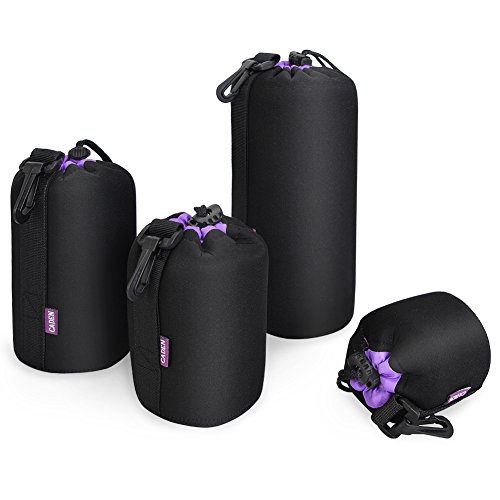
CADeN's four pack pairs 5mm SBR foam with a waterproof neoprene shell and zig zag lock stitching for a rugged build. The maker rates the buckle to hold up to 12kg, so clipping a filled pouch to a bag feels secure. A soft inner fabric cradles the lens, and the insulating rubber layer even lets a pouch double as a holder for a bottle or thermos. You can hang each one from a D ring, waist belt, or suitcase for flexible carry across four sizes. Reviewers value the sturdy stitching, though the neoprene body is more flexible than a rigid shell, so it resists crushing less than a hard case.
Pack4 pouches
Padding5mm SBR foam
BuildWaterproof neoprene
BuckleRated to 12kg
Pros
- Waterproof shell and reinforced stitching
- Strong buckle rated for weight
- Four sizes plus insulating use
Cons
- Flexible body over rigid protection
- Bag only, lens not included
Check price on Amazon ›
What to look for
Measure Your Longest Lens First
Interior diameter and height decide whether a lens even fits, so measure your longest and widest lens before shopping. Manufacturers list sizes like inner diameter times height, and leaving a small margin helps with padding and easy insertion. A snug case protects better than an oversized one where the lens shifts around.
Match Padding to Your Risks
Thick multi-layer pouches near 15mm cushion hard knocks, while 3mm to 5mm neoprene handles scuffs and light bumps. If gear rides in a padded backpack already, thinner neoprene may be enough. For loose transport in a car or checked bag, choose heavier padding that absorbs real impacts.
Zipper Versus Drawstring
A full zipper seals out dust and moisture but slows access, so it suits storage and rough conditions. A drawstring opens in seconds for fast lens swaps in the field, though the top stays less sealed. Think about how often you switch lenses versus how harsh your environment is.
Carry Hardware and Sets
Carabiners, snap hooks, and belt straps let a pouch ride outside a bag for quick reach. Multi packs covering small through extra large protect a full kit in one purchase, while a single pouch suits one prime. A divided case fits those hauling a body and several lenses together.
Frequently asked questions
How do I know which size lens case I need?
Measure your lens diameter and length, then compare against the listed interior dimensions. Add a little margin so padding and easy insertion are accounted for. Many sets label sizes small through extra large to help you match closely.
Are neoprene pouches enough protection?
Neoprene between 3mm and 5mm guards well against scratches, dust, and light bumps. For harder impacts or loose transport, a thicker multi-layer padded pouch or a divided hard case offers more cushioning. Match the padding to how roughly your gear travels.
Zipper or drawstring, which is better?
Zippers seal fully against dust and moisture and suit storage or rough conditions. Drawstrings open in seconds and favor fast lens swaps in the field. Pick based on how often you change lenses versus how harsh your surroundings are.
Can I store a lens with its hood attached?
Often no. Several makers, including JJC here, advise against storing a lens and hood together because it changes the required length. Reverse the hood onto the lens or measure the combined size before buying.
Do these cases fit mirrorless lenses too?
Yes. Most pouches here list compatibility across DSLR and mirrorless glass from Canon, Nikon, Sony, Pentax, Olympus, and Panasonic. As always, confirm your specific lens dimensions fall within the stated interior size.
Is a set better than a single pouch?
A four pack covers a range of lens sizes in one purchase, handy for a growing kit. A single pouch works if you carry just one extra lens. A divided case fits those transporting a body and several lenses together.
Are these cases water resistant?
Several use water repellent or waterproof materials to shield against moisture, and some add sealed zippers. Water resistance is not the same as submersion proof, so treat it as protection from rain, dust, and splashes rather than immersion.
How do I attach a pouch to my bag?
Most include a carabiner, snap hook, or belt strap. Clip it to a backpack strap, belt loop, tripod, or D ring for quick access. Some rate the buckle for weight, so a filled pouch stays secure while moving.
The verdict
ARVOK Camera Lens Case, Water Resistant Pr...
9.1/10
For most photographers, the ARVOK padded pouch stands out with thick multi-layer protection and a size choice, earning our top pick. Carrying several lenses at once, the K&F Concept four pack covers a whole kit conveniently. Travelers wanting packable pouches suit the Lightdow set, a single prime fits the compact JJC, rough handling favors the waterproof CADeN, and a full body-plus-lenses haul belongs in the divided hard case.
Check price on Amazon ›
Our top pick, secure checkout via Amazon
Note: Availability and specifications change often. Always confirm the current details on Amazon before buying.