Handheld Gaming Consoles Best Handheld Gaming Consoles: 9 Top Picks Ranked
P
By the Pickpedia Team
·9 picks compared
·Last verified November 2026
Affiliate disclosure: As an Amazon Associate, Pickpedia earns from qualifying purchases. Links on this page are paid links, and we may earn a commission at no extra cost to you. This never affects our picks or scores.
Quick answer
The ASUS ROG Ally (Renewed) is our top pick among the best handheld gaming consoles, with a 7 inch 120Hz display and AMD Z1 power. The Lenovo Legion Go S and MSI Claw A8 follow, each pairing a larger 8 inch 120Hz screen with a newer AMD chip.
Best Handheld Gaming Consoles: 9 Top Picks Ranked at a glance
Why you can trust this guide
We compared these picks using verified manufacturer specifications, available manuals and documentation, current retailer listings, and patterns in owner feedback, alongside editorial research. We focus on measurable differences such as performance, capacity, usability, and build quality. Pickpedia does not present editorial research as laboratory testing, and we do not claim hands-on testing unless it was actually performed.
Handheld gaming consoles now split into two camps. Windows handhelds like the ROG Ally, Legion Go S and MSI Claw run full PC games, while Android and Linux devices such as the Retroid Pocket 5 and Anbernic RG40XX H lean on emulation and mobile titles.
We compared the supplied specs on screen size, refresh rate, processor, memory and battery, then weighed how each design suits couch sessions, flights and family play. Scores are our own editorial judgement, not customer ratings.
Our top picks
The Ally pairs AMD's Z1 APU with RDNA 3 graphics and 2.8 TFLOPs, enough for PC games in the palm of your hand. Its 7 inch Full HD touchscreen runs at 120Hz with FreeSync Premium, and 90 days of Xbox Game Pass Ultimate are included.
ProcessorAMD Z1 APU with RDNA 3 graphics
Graphics2.8 TFLOPs
Display7 inch Full HD touchscreen, 120Hz
ExtrasAMD FreeSync Premium, 90 days Game Pass Ultimate
Pros
- 120Hz Full HD screen with FreeSync Premium
- Z1 APU with RDNA 3 graphics
- Game Pass Ultimate included for 90 days
Cons
- Renewed unit rather than new stock
- 7 inch screen is smaller than the 8 inch rivals
Check price on Amazon ›
Lenovo fits an 8 inch PureSight IPS panel at 120Hz into the Legion Go S, with 500 nits of brightness and 100% sRGB color. The Ryzen Z2 Go chip and Radeon graphics are backed by 16GB of memory, 512GB of storage and a 55.5Whr battery, plus three months of PC Game Pass and EA Play.
ProcessorAMD Ryzen Z2 Go
Display8 inch PureSight IPS, 120Hz, 500 nits
Memory and storage16GB memory, 512GB storage
Battery55.5Whr
Pros
- Large 8 inch 120Hz touchscreen
- 500 nits brightness and 100% sRGB
- 55.5Whr battery for extended sessions
Cons
- Z2 Go sits below the Z2 Extreme in the range
- 8 inch body is bulkier to pack
Check price on Amazon ›
MSI's Claw A8 runs an AMD Ryzen Z2 Extreme with 24GB of LPDDR5x memory and a 1TB NVMe SSD. The 8 inch FHD+ display refreshes at 120Hz, and Thunderbolt 4 plus an SD card reader cover expansion.
ProcessorAMD Ryzen Z2 Extreme
Display8 inch FHD+ 120Hz
Memory and storage24GB LPDDR5x, 1TB NVMe SSD
PortsThunderbolt 4, SD card reader
Pros
- Z2 Extreme processor
- 24GB memory and 1TB SSD
- Thunderbolt 4 and SD card reader
Cons
- Windows 11 Home rather than Pro
- Largest memory loadout comes with a heavier chassis
Check price on Amazon ›
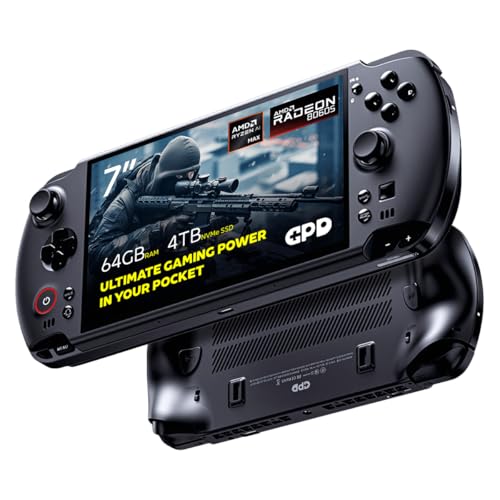
The GPD Win 5 uses a 16-core Ryzen AI Max+ 395 with XDNA 2 AI acceleration rated at up to 126 TOPS. A Radeon 8060S GPU on RDNA 3.5 handles visuals with FreeSync Premium and FSR 3.1, and 64GB of LPDDR5X at 8000 MT/s feeds it all.
ProcessorAMD Ryzen AI Max+ 395, 16-core
GraphicsRadeon 8060S, 40 CUs, RDNA 3.5
Memory and storage64GB LPDDR5X at 8000 MT/s, 4TB SSD
ExtrasXDNA 2 AI up to 126 TOPS, FreeSync Premium, FSR 3.1
Pros
- Desktop-class 16-core processor
- 64GB fast memory and 4TB SSD
- Radeon 8060S with FreeSync Premium and FSR 3.1
Cons
- Very large spec sheet to manage in a handheld
- Windows 11 brings desktop-style upkeep
Check price on Amazon ›
The Pocket FIT runs a Snapdragon G3 Gen 3 at up to 15W with 12GB of LPDDR5X and 256GB of UFS 4.0 storage. Its 6 inch 1920x1080 IPS screen refreshes at 144Hz, and an 8000mAh battery supports 40W PD charging while a slim fan and copper heat spreader keep performance steady.
ProcessorQualcomm Snapdragon G3 Gen 3, up to 15W
Display6 inch 1920x1080 IPS, 144Hz
Memory and storage12GB LPDDR5X, 256GB UFS 4.0
Battery8000mAh, 40W PD charging
Pros
- 144Hz 1080p display
- 8000mAh battery with 40W PD charging
- Hall triggers and linear haptics
Cons
- Android library rather than full PC titles
- 256GB storage fills quickly with large games
Check price on Amazon ›
This Pocket FIT variant steps up to 16GB of memory and 512GB of storage in a 386g frame with Super FIT ergonomic grips. AYASpace software and Free Feel Key Mapping 1.5 let you remap buttons for touchscreen titles, and the 8400mAh battery supports PD fast charging.
ProcessorQualcomm Snapdragon G3 Gen 3
Display6 inch 1080P LCD, 144Hz
Memory and storage16GB, 512GB
Battery and weight8400mAh, 386g
Pros
- 16GB memory and 512GB storage
- 8400mAh battery with PD fast charging
- Hall sensing joystick and triggers with dual-click lock
Cons
- Android only, no Windows PC library
- LCD panel rather than OLED
Check price on Amazon ›
The Retroid Pocket 5 pairs a Snapdragon 865 with an Adreno 650 GPU, 8GB of memory and 128GB of storage on Android 13. Its 5.5 inch 1080p touchscreen suits retro and modern indie titles, and a 5000mAh battery plus microSD slot cover long sessions.
ProcessorSnapdragon 865 with Adreno 650 GPU
Display5.5 inch 1080p touchscreen
Memory and storage8GB, 128GB, microSD slot
Battery5000mAh
Pros
- Sharp 5.5 inch 1080p screen
- WiFi 6 and Bluetooth 5.1
- microSD expansion for ROMs and apps
Cons
- No games are preloaded
- Smaller screen than the 6 inch and 8 inch rivals
Check price on Amazon ›
The RG40XX H weighs about 200g and carries a 4 inch IPS screen at 640x480 with OCA full fit. A quad-core ARM Cortex-A53 chip with PowerVR SGX544MP graphics and 1GB of RAM runs the Linux system, and the 3200mAh battery is rated for up to 8 hours of play. A 64GB TF card comes preloaded with over 5000 games.
Display4 inch IPS, 640x480, OCA full fit
ProcessorQuad-core ARM Cortex-A53, PowerVR SGX544MP
Battery3200mAh, up to 8 hours
Storage64GB TF card, 5000+ games preloaded
Pros
- Around 200g and pocket sized
- Up to 8 hours on a 3200mAh battery
- HD output, WiFi and Bluetooth
Cons
- 1GB of RAM limits heavier systems
- 640x480 screen is low resolution next to the others
Check price on Amazon ›
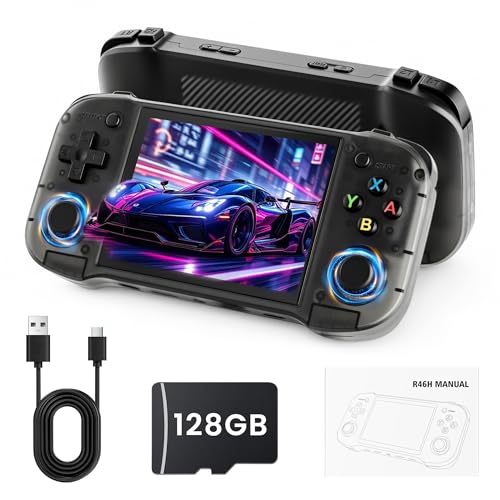
The R46H ships with a 128GB TF card holding over 20,000 classic games and support for emulators including PS1, PSP, N64, MAME, GBA and more. Its 4.2 inch IPS screen runs at 1024x768 with OCA full lamination, and an RK3326 quad-core processor keeps arcade and adventure titles responsive.
Display4.2 inch IPS, 1024x768, OCA lamination
ProcessorRK3326 quad-core
Storage128GB TF card, 20,000+ games preloaded
EmulatorsPS1, PSP, N64, MAME, GBA, FC, SFC
Pros
- 20,000+ games preloaded on a 128GB card
- Sharp 1024x768 IPS panel
- WiFi multiplayer for travel and gifts
Cons
- Linux emulation only, no PC games
- Quad-core RK3326 is modest for heavier systems
Check price on Amazon ›
What to look for
Windows versus Android versus Linux
The biggest decision is the software platform. Windows handhelds such as the ROG Ally, Legion Go S, MSI Claw A8 and GPD Win 5 run full PC titles from stores and Game Pass. Android devices like the Pocket FIT and Retroid Pocket 5 lean on mobile games, streaming and emulation. Linux handhelds such as the Anbernic RG40XX H and R46H focus on retro libraries.
Screens, refresh rates and latency
Refresh rate matters for low latency play. The Pocket FIT models hit 144Hz, while the ROG Ally, Legion Go S and MSI Claw A8 sit at 120Hz, all well above the 60Hz many older handhelds used. Panel size runs from 4 inches on the retro units up to 8 inches on the Legion Go S and Claw A8. Brightness and color coverage also separate them, with the Legion Go S rated at 500 nits and 100% sRGB.
Battery, weight and travel
For long flights, check the battery figure and the charging spec. The Pocket FIT carries 8000mAh to 8400mAh with PD fast charging, the Legion Go S uses a 55.5Whr pack, and the RG40XX H is rated for up to 8 hours. Weight matters too: the RG40XX H is about 200g and the Pocket FIT is 386g, while Windows handhelds with big screens are heavier still.
Matching a console to how you play
Couch players benefit from a large, bright screen and low latency, which points to the 8 inch Windows units or the 144Hz Pocket FIT. Family and casual play favors compact, simple devices with games already loaded, like the RG40XX H and R46H. Emulation fans should weigh memory and storage, since the Retroid Pocket 5 offers 8GB and a microSD slot while the GPD Win 5 goes to 64GB and 4TB.
Frequently asked questions
Can a handheld gaming console with a rechargeable battery handle long flights?
Yes, if the capacity and charging spec fit the trip. The Pocket FIT models list 8000mAh and 8400mAh with PD fast charging, the Legion Go S uses a 55.5Whr battery, and the RG40XX H is rated for up to 8 hours on 3200mAh.
Which of these is best for couch gaming with low latency?
Look at refresh rate first. The two Pocket FIT models run 144Hz panels, and the ROG Ally, Legion Go S and MSI Claw A8 all use 120Hz screens, which keeps motion smooth for living room sessions.
Are these consoles good for casual gamers and family play?
The retro Linux units are the simplest entry. The RG40XX H comes with over 5000 games on a 64GB card and the R46H ships with over 20,000 on a 128GB card, so there is nothing to set up before playing.
Do any of these handhelds come with games preloaded?
The Anbernic RG40XX H and the R46H both ship with games on a TF card. The Retroid Pocket 5 explicitly does not preload games, and the Windows handhelds rely on stores and subscriptions such as the Game Pass offers on the ROG Ally and Legion Go S.
How do I compare battery life across these models?
Match the listed figure to your session length. Capacities range from 3200mAh on the RG40XX H to 8400mAh on the KONKR Pocket FIT, and the Legion Go S quotes 55.5Whr, a different unit that reflects a larger pack.
What should buyers know about compact designs?
Smaller bodies trade screen size for portability. The RG40XX H weighs about 200g with a 4 inch screen, the Retroid Pocket 5 uses a 5.5 inch panel, and the Pocket FIT sits at 6 inches and 386g. The 8 inch Windows units are the least pocketable.
Which handheld has the most storage for emulation and big games?
The GPD Win 5 lists a 4TB SSD and 64GB of memory, the largest combination here. The MSI Claw A8 follows with a 1TB SSD and 24GB, and the KONKR Pocket FIT variant offers 512GB with a microSD slot.
Is cross platform compatibility a reason to choose a Windows handheld?
It can be. Windows models such as the ROG Ally, Legion Go S, MSI Claw A8 and GPD Win 5 run PC game stores and subscriptions, while Android and Linux handhelds focus on mobile titles and emulators, so the library you already own should guide the choice.
The verdict
ASUS - ROG Ally Gaming Handheld Console -...
9.2/10/10
The ASUS ROG Ally (Renewed) remains our top pick among the best handheld gaming consoles, pairing a 120Hz Full HD screen and AMD Z1 graphics with included Game Pass time. Step up to the Lenovo Legion Go S or MSI Claw A8 for an 8 inch display, or pick a Pocket FIT or retro unit if Android and emulation are your focus.
Check price on Amazon ›
Our top pick, secure checkout via Amazon
Note: Availability and specifications change often. Always confirm the current details on Amazon before buying.