Home & Kitchen 4 Food Mills for Smooth Sauces and Purees
P
By the Pickpedia Team
·5 picks compared
·Last verified October 2026
Affiliate disclosure: As an Amazon Associate, Pickpedia earns from qualifying purchases. Links on this page are paid links, and we may earn a commission at no extra cost to you. This never affects our picks or scores.
Quick answer
A food mill turns cooked tomatoes, apples, and potatoes into smooth sauce while trapping seeds, skins, and cores. Pick one by disc range and capacity. Households wanting texture control favor three-disc stainless models, while heavy canning batches benefit from a larger bowl and steady, foldable legs.
4 Food Mills for Smooth Sauces and Purees at a glance
Why you can trust this guide
We compared these picks using verified manufacturer specifications, available manuals and documentation, current retailer listings, and patterns in owner feedback, alongside editorial research. We focus on measurable differences such as performance, capacity, usability, and build quality. Pickpedia does not present editorial research as laboratory testing, and we do not claim hands-on testing unless it was actually performed.
How we chose: We compared four stainless steel food mills across disc range, capacity, stability, and cleanup based on their listed specifications.
Smooth sauces and silky purees start with separating pulp from seeds, skins, and cores, and a food mill does exactly that with a hand crank instead of electricity. Every option here uses stainless steel, resists rust, and handles hot food straight from the pot.
Choosing comes down to how much you process at once and how fine you want the result. We looked at disc selection, bowl capacity, leg stability over pots, and how easily each breaks down for washing, all grounded in what the listings actually state.
Our top picks
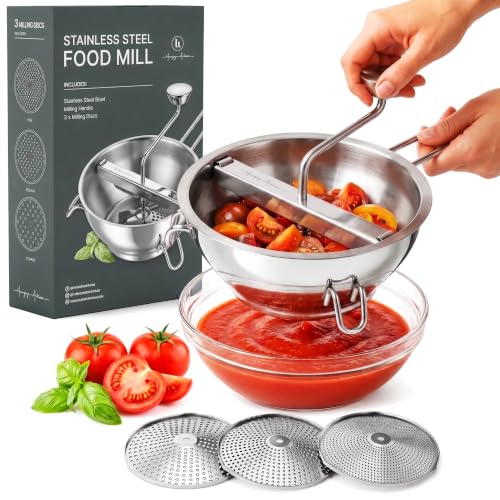
Three interchangeable stainless steel discs move from fine to coarse, so one tool covers tomato sauce, applesauce, baby food, and mashed potatoes. An ergonomic rotary crank reduces effort during batch cooking and seasonal prep, and the all-stainless body is dishwasher-safe for faster cleanup. The maker frames it as household-sized, which is honest but vague, so check the listed dimensions and capacity before committing to large canning runs. For everyday texture control it covers most from-scratch kitchen tasks without electricity or fuss.
MaterialStainless steel
Discs3 (fine to coarse)
CrankErgonomic rotary
CleanupDishwasher-safe
Pros
- Three discs cover fine to coarse textures
- Comfortable rotary crank for batch work
- Fully dishwasher-safe stainless build
Cons
- Capacity described vaguely, so confirm dimensions
- Manual cranking still tires hands on big batches
Check price on Amazon ›
This mill doubles as a ricer and ships with fine, medium, and coarse discs, and its funnel shape steers ingredients toward the blade for effective milling. Heavy-duty stainless resists rust and warping, tolerates hot food, and washes in the dishwasher. Fold-out legs steady it over bowls and pots, then tuck under while the handle detaches for compact storage, which owners appreciate in tight kitchens. Legs fit pots around 8.75 inches, so very wide stockpots may need a different rest. Listed dimensions run about 14 by 9.25 by 7.13 inches.
Discs3 (fine, medium, coarse)
Dimensions14 x 9.25 x 7.13 in
Legs fit8.75 in pots
StorageDetachable handle, folding legs
Pros
- Collapses small for tight storage
- Funnel shape feeds ingredients efficiently
- Handles hot food straight from the pot
Cons
- Legs suit narrower pots only
- Extra parts to track when disassembled
Check price on Amazon ›
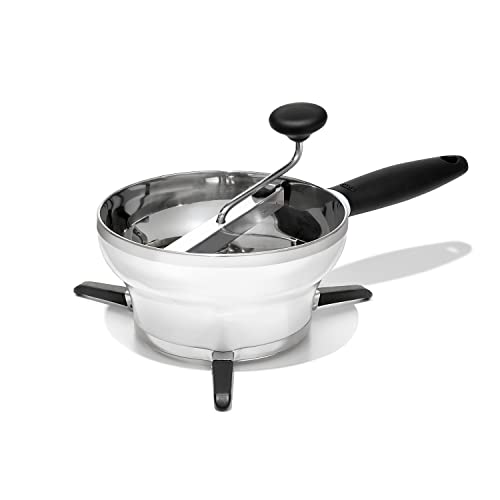
OXO leans on a simple spring-loaded lever, so swapping among the three stainless discs and taking the mill apart takes seconds rather than fiddling. Its stainless bowl suits hot foods and resists staining, and three non-slip legs grip bowls and pots up to 11 inches wide to keep the mill from slipping into your food. The roughly 2.3-quart bowl handles everyday sauce and puree batches, and the legs fold flat for storage. Reviewers who process very large canning loads may find that capacity limiting compared with wider-bowl rivals.
CapacityAbout 2.3 quarts
Discs3 stainless textures
Legs fitUp to 11 in
Disc swapSpring-loaded lever
Pros
- Spring lever makes disc changes fast
- Non-slip legs span wide pots
- Stain-resistant bowl handles hot foods
Cons
- Mid-size bowl limits huge batches
- Fewer instructions for first-time millers
Check price on Amazon ›
A generous 3.5-quart bowl makes this Foley-style mill the roomiest option here, so large hauls of tomatoes or apples move through in fewer refills. Stainless construction keeps cleanup simple and holds up to steady kitchen use, while multiple discs let it mash, strain, grate, and rice for applesauce, tomato sauce, and mashed potatoes. The listing stays light on exact disc counts and dimensions, so confirm those details if precise fine texture matters to you. For cooks who preserve in volume, the extra bowl room is the standout reason to choose it.
Capacity3.5 quarts
MaterialStainless steel
FunctionsMash, strain, grate, rice
FinishSilver, easy-clean
Pros
- Largest bowl for volume batches
- Handles mashing, straining, and ricing
- Durable stainless resists staining
Cons
- Disc details underspecified in listing
- Bigger footprint needs more storage room
Check price on Amazon ›
Every other mill here is hand cranked, which is the real argument for this one. A 250 watt two speed motor does the work, with a forward speed for removing skins and seeds and the second speed for clearing the screen. The 1 gallon hopper takes large batches without constant refilling, which is what separates preserving a harvest from making a single sauce. Three stainless steel screens are included, a 1.5mm for tomatoes and berries and a 3mm for pureeing larger vegetables among them, and a stomper pushes food safely into the hopper and head. It is a bigger, heavier thing to store than a crank mill, and it needs a socket.
Motor250 watts, two speed
Hopper1 gallon
Screens3 stainless steel
IncludedStomper
Pros
- Motorised, so large batches do not depend on arm work
- 1 gallon hopper suits preserving a whole harvest
- Three screens including 1.5mm and 3mm
- Stomper included for safe feeding
Cons
- Bulkier to store than a hand crank mill
- Needs mains power, so it is tied to a socket
Check price on Amazon ›
What to look for
How a food mill works
Cooked fruit or vegetables drop into the bowl, and turning the crank presses them against a perforated disc. Soft pulp passes through while seeds, skins, and cores stay behind, giving you a smooth result no blender can match, since a blender simply chops those bits back in.
Match discs to your dishes
Fine discs suit silky tomato sauce and baby food, medium handles applesauce, and coarse works for rustic mashed potatoes. Every mill here includes three interchangeable stainless discs, so you can dial texture up or down without buying separate tools.
Size the bowl to your batches
Capacity ranges widely, from roughly 2.3 quarts to 3.5 quarts across these picks. Small households milling a jar or two are fine with a compact bowl, while seasonal canning goes faster with a larger one that needs fewer refills.
Stability and cleanup
Look for non-slip or folding legs that grip your pot rim so the mill will not slide into the food. Stainless steel bodies rinse easily and most here are dishwasher-safe, though detachable handles and loose discs are worth counting before you wash.
Frequently asked questions
What can I make with a food mill?
Tomato sauce, applesauce, baby food, mashed potatoes, fruit purees, and jams are common uses. Because it removes seeds, skins, and cores, it excels at smooth sauces you would otherwise strain by hand.
Do I need to peel produce first?
Usually no. A key benefit is that skins and seeds stay behind on the disc, so you can core apples or halve tomatoes, cook them soft, then mill without tedious peeling.
How is a food mill different from a blender?
A blender chops everything, including seeds and skins, back into the mix. A food mill separates them out, producing a cleaner texture for sauces and purees while a blender only smooths what you feed it.
Are these food mills dishwasher-safe?
Several here state dishwasher-safe stainless construction. Even so, rinsing pulp off the discs right after use makes any wash cycle easier and helps prevent dried-on residue.
Which disc should I use for tomato sauce?
Reach for the fine disc. It holds back seeds and skin while letting smooth pulp through, which is what gives passata-style sauce its silky consistency.
Will the mill fit over my pot or bowl?
Check the leg span against your cookware. Options here rest on pots up to about 8.75 to 11 inches, so measure your widest bowl before choosing.
Can a food mill handle hot food?
Yes. Stainless steel models here are made to work with hot foods straight from the pot, which is convenient when you mill sauce right after cooking.
How much effort does hand cranking take?
Soft cooked produce mills with light effort, especially on models with an ergonomic rotary crank. Large batches naturally tire your hand more, so pace longer preserving sessions.
The verdict
Hungry Artisan Stainless Steel Food Mill f...
9.1/10
The Hungry Artisan mill is our overall pick, pairing three discs with a comfortable crank for from-scratch cooks. Choose the folding-leg model if storage is tight, the OXO for its quick spring-lever disc swaps and smooth everyday use, and the roomy Mirro Foley when you preserve in large batches. All four use rust-resistant stainless steel and separate seeds and skins, so your choice mostly comes down to bowl size and how you store it.
Check price on Amazon ›
Our top pick, secure checkout via Amazon
Note: Availability and specifications change often. Always confirm the current details on Amazon before buying.