Food Storage & Preservation Food dehydrator best one picks for home drying
P
By the Pickpedia Team
·7 picks compared
·Last verified October 2026
Affiliate disclosure: As an Amazon Associate, Pickpedia earns from qualifying purchases. Links on this page are paid links, and we may earn a commission at no extra cost to you. This never affects our picks or scores.
Quick answer
The Nesco FD-1018P is the best overall pick, with the Cosori Food Dehydrator and Hamilton Beach Digital Food Dehydrator close behind. We compared tray capacity, temperature control, drying power, and convenience, then ranked the models for jerky, fruit, herbs, and everyday batch drying.
Food dehydrator best one picks for home drying at a glance
Why you can trust this guide
We compared these picks using verified manufacturer specifications, available manuals and documentation, current retailer listings, and patterns in owner feedback, alongside editorial research. We focus on measurable differences such as performance, capacity, usability, and build quality. Pickpedia does not present editorial research as laboratory testing, and we do not claim hands-on testing unless it was actually performed.
Choosing a food dehydrator best one comes down to capacity, temperature control, and how much control you want over batch drying. Some models suit small kitchens, while others are built for bigger loads and more trays.
We compared real options for jerky, fruit, vegetables, herbs, and dog treats. The strongest picks balance drying power, adjustable settings, and tray flexibility without making the process complicated.
Our top picks
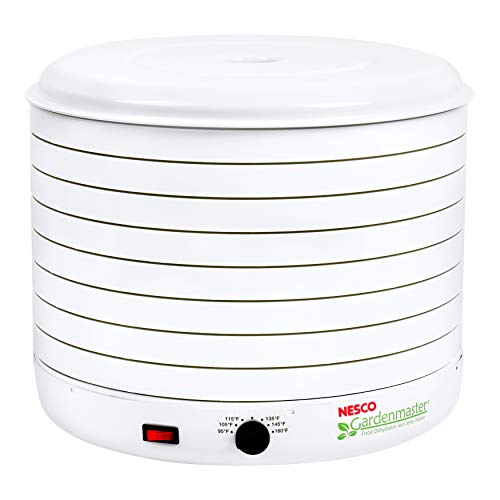
This is the strongest all-around choice for larger drying projects. It brings 1000 watts of drying power and expands to 30 trays, so it stands out for volume.
Drying power1000 watts
Tray capacityExpandable to 30 trays
Included items8 trays, fruit roll sheets, clean-a-screens
Product typeFood dehydrator kit
Pros
- Very large expandable capacity
- Strong drying power
- Good starter kit with included accessories
Cons
- Can be larger than needed for small kitchens
- More capacity than casual users may use
Check price on Amazon ›
The Cosori is a flexible compact option with fine temperature adjustment from 95 to 165 F. It can also expand to 7 trays, which makes it more versatile than its starting size suggests.
Temperature range95 to 165 F
Tray count5 trays, expandable to 7
Power350W
Noise levelLess than 47 dB
Pros
- Precise temperature adjustment
- Expandable tray setup
- Quiet operation
Cons
- Starts with fewer trays than larger units
- Less drying power than top high-capacity models
Check price on Amazon ›
This Hamilton Beach model gives you five BPA-free trays and up to 4.2 square feet of drying space. Its digital timer, auto shutoff, and even airflow make it a practical everyday option.
Tray count5 stackable BPA-free trays
Drying spaceUp to 4.2 square feet
Temperature range100 to 160 F
Timer1 hour to 48 hours
Pros
- Digital controls are straightforward
- Even drying without rotating trays
- Good space for fruit, jerky, and vegetables
Cons
- Less capacity than larger expandable machines
- Temperature range is narrower than some competitors
Check price on Amazon ›
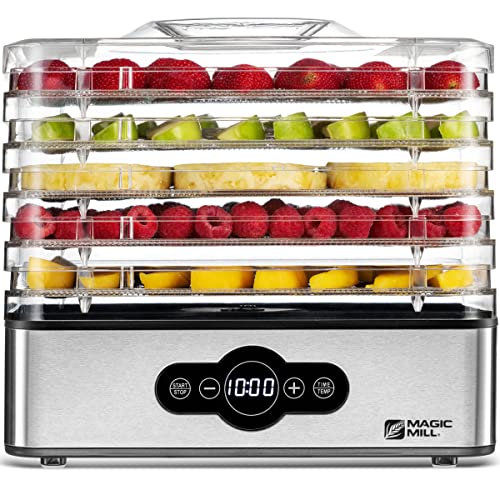
Magic Mill offers five stainless steel trays and adjustable tray height for thicker ingredients. The temperature range goes up to 167 F, and the 48-hour timer adds useful flexibility.
Tray count5 stackable stainless steel trays
Temperature range95 to 167 F
TimerUp to 48 hours
Power240W
Pros
- Adjustable tray height
- Simple touch controls
- Broad temperature range
Cons
- Lower power than some larger units
- Smaller starting capacity than the biggest models
Check price on Amazon ›
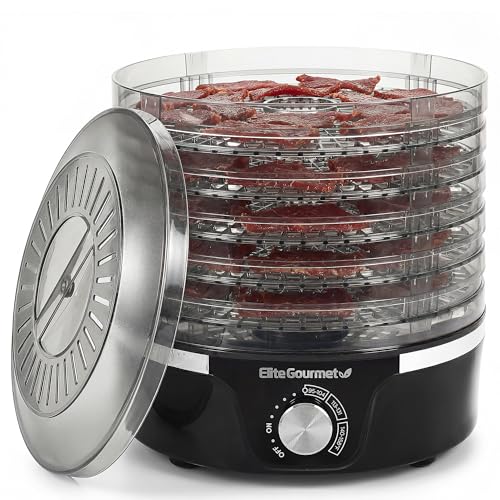
Elite Gourmet keeps the footprint compact while still offering five expandable trays. The dial control is simple, and the removable parts are easy to clean after drying sessions.
Temperature range95 F to 158 F
Tray count5 expandable BPA-free trays
Power350W
Tray size11.4 inches
Pros
- Compact footprint
- Simple dial control
- Dishwasher-safe removable parts
Cons
- Fewer advanced controls than digital models
- Lower top temperature than some competitors
Check price on Amazon ›
Weston gives you six BPA-free trays and up to 5 square feet of drying space. The 500 watt heater, digital timer, and auto shutoff make it a capable option for regular batch drying.
Tray count6 stackable BPA-free trays
Drying spaceUp to 5 square feet
Temperature range100 to 160 F
Power500 watt base-mounted heater
Pros
- Large drying space
- Digital timer with auto shutoff
- Consistent airflow
Cons
- Bulkier than compact models
- Temperature range is not the widest
Check price on Amazon ›
The Presto is a straightforward starter dehydrator with four trays that expand to eight. Its nested tray design helps with storage when the unit is not in use.
Model06300-05
Tray count4 trays, expandable to 8
Storage featureTrays nest for 22% reduction in storage space
Compatible accessories06313 fruit trays, 06314 mesh screens, 06315 trays
Pros
- Simple expandable design
- Good storage convenience
- Compatible accessory options
Cons
- Smaller starting capacity
- Fewer built-in features than digital models
Check price on Amazon ›
What to look for
How to choose a food dehydrator
Start with tray count, temperature range, and drying power. Bigger batches need more space, while precise control helps with jerky, herbs, and mixed ingredients. Think about whether you want a simple dial or digital controls.
Best for large batches
Higher-capacity machines are easier when you dry a lot at once. Expandable tray systems are especially useful because they let you add capacity as your needs grow. Stronger wattage also helps support larger loads.
Best for precise drying
If you make jerky or want repeatable results, adjustable temperature settings matter. Digital timers and shutoff features also make long drying sessions easier to manage. Those controls help keep batches consistent.
Best for kitchens with limited space
Compact models fit more easily on counters and are easier to store between uses. Stackable trays and nestable designs help when storage space is tight. Simple controls can also make small units easier to live with.
Frequently asked questions
What should matter most in a food dehydrator?
Tray capacity, temperature control, and airflow matter most. Those features shape how much food you can dry and how evenly it dries.
Is a digital timer useful?
Yes. A digital timer makes long drying runs easier to manage and helps the machine shut off automatically when finished.
How many trays do most home users need?
Many home users are happy with five or six trays. Larger families or frequent batch makers often prefer expandable systems.
Why does temperature range matter?
Different foods dry best at different temperatures. A wider range gives you more flexibility for jerky, fruit, herbs, and vegetables.
Are expandable trays worth it?
They are helpful if your needs may grow. You can start smaller and add trays when you want more drying space.
Do quieter models have an advantage?
They do if the dehydrator sits near living spaces. Quieter operation makes overnight drying easier to live with.
What foods can these dehydrators handle?
The listed models are suited for jerky, fruit, vegetables, herbs, mushrooms, and dog treats. Some are also useful for snack chips and fruit leathers.
Which type is best for beginners?
A simple model with straightforward controls is usually best for beginners. The Presto and Elite Gourmet are easy places to start.
The verdict
Nesco FD-1018P 1000 Watt Food Dehydrator K...
9.5/10/10
The Nesco FD-1018P is the best overall choice because it combines strong drying power with major expandable capacity. The Cosori and Hamilton Beach are the next best picks for buyers who want compact control or an easy digital setup.
Check price on Amazon ›
Our top pick, secure checkout via Amazon
Note: Availability and specifications change often. Always confirm the current details on Amazon before buying.