Sewing Machines 11 Fabric Measuring Tools for Precise Cutting Work
P
By the Pickpedia Team
·11 picks compared
·Last verified September 2026
Affiliate disclosure: As an Amazon Associate, Pickpedia earns from qualifying purchases. Links on this page are paid links, and we may earn a commission at no extra cost to you. This never affects our picks or scores.
Quick answer
For accurate cutting, most sewers need two tool types: a rigid acrylic ruler for straight rotary cuts and a flexible tape for body and curve measuring. Add a seam gauge for hems and a French curve set for pattern work, and nearly every fabric project stays precise.
11 Fabric Measuring Tools for Precise Cutting Work at a glance
Why you can trust this guide
We compared these picks using verified manufacturer specifications, available manuals and documentation, current retailer listings, and patterns in owner feedback, alongside editorial research. We focus on measurable differences such as performance, capacity, usability, and build quality. Pickpedia does not present editorial research as laboratory testing, and we do not claim hands-on testing unless it was actually performed.
How we chose: We compared ten fabric measuring tools across rigidity, marking clarity, grip stability, and how well each handles curved versus straight measuring work.
Measuring is where most cutting mistakes begin, so the right tool matters more than many sewers expect. Acrylic rulers keep rotary cuts straight, flexible tapes wrap around bodies and curves, and seam gauges lock in repeatable hems. No single item covers every job, which is why sewing rooms usually hold several.
This roundup groups the picks by what they actually do well, based on their published specifications and how reviewers describe daily use. Some suit beginners drafting patterns, others suit quilters trimming blocks. Read each honest breakdown, including its main limitation, before deciding which mix fits your projects.
Our top picks
Four square acrylic rulers in 3.5, 5, 6.5, and 10.5 inch sizes cover patchwork details through full block finishing. High contrast green markings include 1/8 inch scales plus 90 and 45 degree guides, and the maker says they read clearly on both light and dark fabric. Smooth polished edges protect hands, and the flat design stays put under rotary cutters. The set covers a wide size range, though squares alone will not handle long strip cuts, so many quilters pair it with a longer straight ruler.
Pieces4 squares
Sizes3.5 to 10.5 in
MaterialThick acrylic
Markings1/8 in, 45 and 90 degree
Pros
- Covers small to large blocks
- Green scale reads on dark fabric
- Stays stable during cutting
Cons
- Squares only, no long strips
- Larger sizes need storage room
Check price on Amazon ›
Fiskars builds this 3 by 18 inch acrylic ruler for long straight cuts, with highlighted seam allowances and broken grid lines that keep fabric edges visible. Removable non-slip vinyl feet let you add grip for secure rotary work or take them off for tracing. Thick acrylic and a full lifetime warranty back its durability claims, which owners tend to praise. Its narrow 3 inch width limits how much fabric you can square at once, so it complements rather than replaces a wide quilting square.
Size3 x 18 in
MaterialThick acrylic
FeetRemovable non-slip
WarrantyLifetime
Pros
- Long reach for straight cuts
- Removable grip feet
- Lifetime warranty
Cons
- Narrow 3 inch width
- Not sized for large squares
Check price on Amazon ›
This two pack pairs a soft pink tape and a retractable black tape, each 60 inches with double sided inch and centimeter markings. Reviewers find the large numbers easy to read for waist, body, and curved surface measuring. The retractable model tucks into a bag, and a center button pulls or retracts the tape. iBayam notes the retract mechanism can be loud, so press the button while pulling. Soft tapes can stretch over years of heavy use, a common trait worth watching for exact tailoring.
Pack2 tapes
Length60 in / 150 cm
ScaleInch and cm
TypeSoft plus retractable
Pros
- Wraps around body and curves
- Dual inch and centimeter scale
- Retractable tape is portable
Cons
- Retract button can be loud
- Soft tape may stretch over time
Check price on Amazon ›
Nine pieces bring together metric curve rulers, straight rulers, and French curves for pattern drafting and garment design. The curves shape armholes, collars, and sleeves, while straight pieces handle everyday measuring. Flexible shatter resistant PVC bends without breaking and resists warping, which reviewers say holds up through regular use. Clear non fading metric scales support precise drafting. Anyone who works mainly in inches will need to convert, since the markings are metric, and the flexible PVC is less rigid than acrylic for rotary cutting.
Pieces9
IncludesCurves plus straight
MaterialFlexible PVC
ScaleMetric
Pros
- Full curve and straight kit
- Flexible, break resistant
- Great for drafting patterns
Cons
- Metric only, needs converting
- Too flexible for rotary cuts
Check price on Amazon ›
A T shaped sliding ruler anchors this five piece kit, combining measuring for hems, seam allowances, button spacing, and fabric marking. Move the adjustable marker to set a distance, then reuse it for consistent spacing across a project. The set also packs a separate seam gauge, two triangular chalks, and forty positioning pins, so marking and pinning come together in one purchase. The small sliding ruler suits detail work rather than long cuts, and the included chalk and pins are basic extras.
Pieces5
Main tool5-in-1 sliding ruler
ExtrasChalk plus 40 pins
UsesHems, seams, spacing
Pros
- Sets repeatable measurements
- Bundles chalk and pins
- Handy for hems and buttons
Cons
- Too small for long cuts
- Basic chalk and pins
Check price on Amazon ›
Five laser cut acrylic rulers span 3 by 17, 1.5 by 17, 3 by 12, 1.5 by 10, and 1 by 6 inches, giving strip widths for many quilting and piecing tasks. Smooth laser cut edges and roughly 3mm thickness make them durable enough to resist easy breakage. Fifteen non slip grip rings stick to any ruler back to stop sliding during cutting. The rulers are long and narrow strips, so none serves as a wide square for trimming large blocks, which some quilters will still want.
Pieces5 rulers
Widths1 to 3 in
ThicknessAbout 3 mm
Extras15 grip rings
Pros
- Range of strip sizes
- Laser cut smooth edges
- Grip rings reduce sliding
Cons
- Narrow strips only
- No wide square included
Check price on Amazon ›
This nine piece kit mixes straight rulers, an L shaped ruler, and curves aimed at people new to pattern making. HLZC marks the straight and L shaped pieces in inches while the rest use metric, with a printed conversion to ease the switch. Reviewers find the pieces flexible and bendable yet not flimsy, and each arrives in its own bag for tidy storage. The mixed inch and metric scales can confuse beginners at first, and flexible rulers are not meant for rotary cutting.
Pieces9
IncludesStraight, L, curves
ScaleInch and metric mix
StorageIndividual bags
Pros
- Beginner friendly variety
- Flexible without feeling flimsy
- Each ruler bagged separately
Cons
- Mixed inch and metric scales
- Not for rotary cutting
Check price on Amazon ›
BoAn packs eight tapes, seven soft and one retractable black, across pink, blue, white, red, black, and yellow. Each soft vinyl tape runs 60 inches with clear double scale markings, and metal tabs on both ends guard against wear. The generous count lets you keep one in a bag and others at home, office, or school. Soft vinyl resists stretching per the maker, though it stays less rigid than a ruler. With so many tapes, some may go unused unless you spread them across spaces.
Pack8 tapes
Length60 in / 150 cm
MaterialSoft vinyl
EndsMetal tabs
Pros
- Eight tapes to spread around
- Metal tab ends resist wear
- Clear dual scale markings
Cons
- More tapes than many need
- Soft tapes lack rigidity
Check price on Amazon ›
This small thumb worn gauge sets 2, 3, or 4mm edge distances for straight lines, curves, and decorative stitching. Sliding it onto your thumb keeps a steady reference and, the maker says, reduces hand fatigue over long sessions. Premium PLA plastic is built to resist warping and cracking through repeated use, and it doubles as a seam guide or hemming template. Its niche edge stitching focus means it will not replace a standard ruler, and the thumb fit may not suit every hand size.
Distances2, 3, 4 mm
Wear styleThumb mounted
MaterialPLA plastic
UsesEdge stitch, seam guide
Pros
- Consistent edge distances
- Steadies the stitching hand
- Compact and light
Cons
- Niche edge stitching only
- Thumb fit varies by hand
Check price on Amazon ›
Dritz makes this 4-1/8 by 18 inch clear ruler for measuring and marking, with edge markings that improve accuracy and printing on the underside to avoid parallax distortion. Its markings are designed to show on both light and dark fabrics. Laser cut from durable 1/8 inch acrylic, it includes a hang hole for tidy storage and has a technique tutorial available. A single long ruler like this does not cover square trimming, so quilters squaring blocks will still reach for a dedicated square.
Size4-1/8 x 18 in
Material1/8 in acrylic
MarkingsEdge, underside printed
StorageHang hole
Pros
- Underside print cuts distortion
- Reads on light and dark fabric
- Durable laser cut acrylic
Cons
- No square trimming ability
- Single width only
Check price on Amazon ›
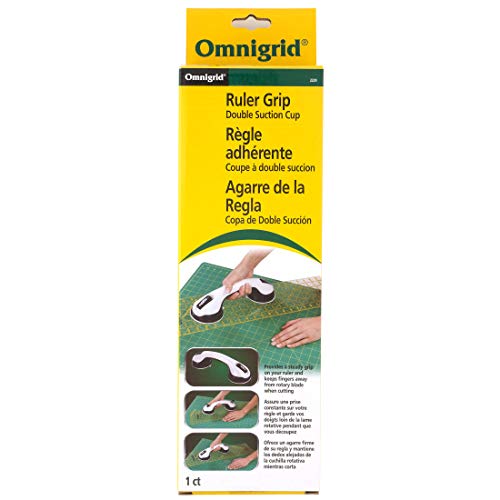
Omnigrid solves ruler shifting with two large suction cups fitted with lock and release levers. Press to attach, then lift and reposition a ruler quickly and hold it exactly where you need it. A comfortable handle keeps hands and fingers away from rotary blades, adding a safety margin during cutting. It attaches best on rulers or templates at least 2.25 inches wide. This is an add on rather than a measuring tool itself, and very narrow strip rulers fall below its size range.
Cups2 suction
LeversLock and release
Min ruler width2.25 in
BenefitGrip and safety
Pros
- Holds ruler firmly in place
- Keeps fingers from blades
- Repositions quickly
Cons
- Not a measuring tool itself
- Needs a wider ruler to attach
Check price on Amazon ›
What to look for
Match the tool to the cut
Rigid acrylic rulers guide rotary blades for straight, square cuts, while flexible tapes wrap around bodies and curves. Seam gauges and thumb guides handle small repeatable distances like hems and edge stitching. Most sewing rooms need at least one from each group rather than a single do everything item.
Read markings that show on your fabric
Contrast decides accuracy. Green or high contrast scales stand out on both light and dark cloth, and underside printing reduces the parallax error that skews a reading when you look from an angle. Look for 1/8 inch increments and clear angle guides if you piece or square blocks often.
Weigh rigidity against flexibility
Thick acrylic stays flat under a rotary cutter and resists warping, making it right for cutting. Flexible PVC and vinyl bend for curves and pattern drafting but are not meant to guide a blade. Choosing the wrong stiffness for the job is a common reason cuts drift off line.
Add grip and stability
Sliding rulers cause crooked cuts and near misses with the blade. Removable non slip feet, adhesive grip rings, and suction cup handles all keep a ruler planted, and a raised handle keeps fingers clear. These small additions often matter as much as the ruler markings themselves for safe, clean results.
Frequently asked questions
Do I need both a ruler and a tape measure?
Usually yes. Rigid rulers guide straight rotary cuts on flat fabric, while soft tapes measure bodies, curves, and rounded surfaces. They solve different problems, so most sewers keep at least one of each on hand.
What size ruler is most useful to start with?
A long ruler around 18 inches handles most straight cuts, and a mid sized square near 6.5 inches trims typical blocks. Starting with those two covers a wide range before you add specialty pieces.
Why do some rulers have green markings?
Green sits between light and dark tones, so the scale stays readable on pale and dark fabric alike. High contrast markings reduce misreads that lead to inaccurate cuts, especially in dim light.
Are flexible rulers safe for rotary cutting?
No. Flexible PVC and vinyl bend under a blade and can let it wander off line. Use thick, rigid acrylic for rotary work and save flexible rulers for drafting curves and patterns.
How do I stop my ruler from sliding?
Add grip. Non slip feet, adhesive grip rings, or a suction cup handle all hold a ruler in place, and a raised handle keeps fingers away from the blade for safer cutting.
What is a French curve ruler for?
It shapes smooth curved lines when drafting patterns, such as armholes, collars, and sleeves. Paired with straight rulers, it lets dressmakers draw clean garment edges that a straight ruler cannot.
Do soft tape measures wear out?
They can. Vinyl tapes may stretch slightly over years of heavy use, which affects exact tailoring. Metal tab ends help resist fraying, and replacing a stretched tape keeps measurements true.
What does a seam gauge do that a ruler does not?
A seam gauge locks a set distance with a sliding marker, so you can repeat the same hem or seam allowance again and again without re measuring each time. That speeds up consistent detail work.
The verdict
Quilting Rulers 4 Piece Acrylic Square Set
9.1/10
For most sewing rooms, the four piece acrylic square set earns Best Overall by covering small to large blocks with clear, high contrast markings. Quilters cutting long strips will lean on the Fiskars 18 inch ruler, while tailors and body measuring reach for the iBayam tapes. Pattern drafters get the most from the metric French curve set, and a seam gauge or suction handle rounds out precise, safe cutting. Choose the mix that matches how you actually sew.
Check price on Amazon ›
Our top pick, secure checkout via Amazon
Note: Availability and specifications change often. Always confirm the current details on Amazon before buying.