Home & Kitchen 8 Dough Temperature Thermometers for Perfect Proofing
P
By the Pickpedia Team
·8 picks compared
·Last verified September 2026
Affiliate disclosure: As an Amazon Associate, Pickpedia earns from qualifying purchases. Links on this page are paid links, and we may earn a commission at no extra cost to you. This never affects our picks or scores.
Quick answer
For dough proofing, pick an instant-read probe with roughly one to two second response and near one degree accuracy. A long food-grade probe reaches into thick dough safely. Waterproof housing and a hold button make repeated checks during fermentation quick and consistent.
8 Dough Temperature Thermometers for Perfect Proofing at a glance
Why you can trust this guide
We compared these picks using verified manufacturer specifications, available manuals and documentation, current retailer listings, and patterns in owner feedback, alongside editorial research. We focus on measurable differences such as performance, capacity, usability, and build quality. Pickpedia does not present editorial research as laboratory testing, and we do not claim hands-on testing unless it was actually performed.
How we chose: We compared eight instant-read and infrared thermometers, weighing probe length, response speed, stated accuracy, waterproofing, and how easily each reads dough during proofing.
Dough temperature quietly decides how your loaf rises, so a reliable reading beats guesswork. Bakers who track fermentation want a probe that lands fast and stays close to true, not a slow readout that leaves them hovering over the bowl.
We lined up eight thermometers spanning quick probes and one infrared model, then judged them on specifications and what owners report. Each pick below suits a slightly different baker, from sourdough regulars to anyone juggling grilling and baking in one kitchen.
Our top picks
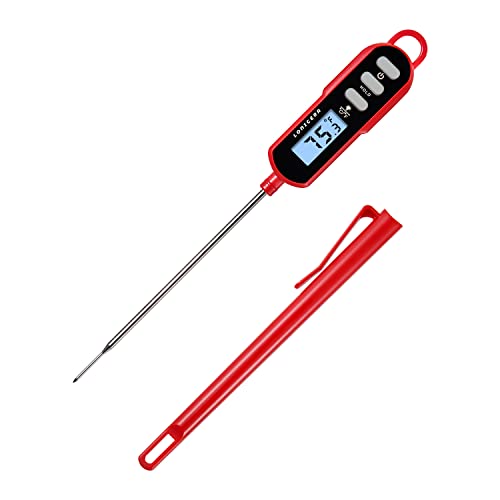
Built with sourdough in mind, this LONICERA reads dough in one to two seconds at a stated one degree accuracy, so you catch fermentation targets without lingering. Its 5-inch probe reaches into deep bowls and keeps hands clear of heat, while IPX6 waterproofing lets you rinse it under the tap. A backlit screen helps in dim kitchens, and a hold button locks the number. The built-in magnet parks it on any metal surface. One caveat: the long probe suits thick dough and liquids more than thin cuts, and the magnet adds a little bulk during storage.
Response1 to 2 seconds
Accuracyplus or minus 1F
Range-58F to 572F
Water ratingIPX6
Pros
- Long 5-inch probe reaches into deep bowls
- Rinsable IPX6 body
- Magnet and hold button for quick repeat checks
Cons
- Long probe is less handy for thin cuts
- Magnet adds slight bulk
Check price on Amazon ›
Speed is the headline here, with a thermocouple sensor that reports in about half a second and a NIST certified half-degree precision claim. That responsiveness suits bakers who dip in and out of dough repeatedly during a long proof. A 4-inch probe and temperature lock let you read away from heat, while the auto-flip LCD serves left and right handers alike. Motion sensing wakes it on pickup and sleeps it to save power, and the fully waterproof body washes clean. The trade-off is a shorter probe than dedicated bread models, so very deep bowls need a careful angle.
Responseabout 0.5 seconds
Accuracyplus or minus 0.5F
Probe4 inch
Displayauto-flip LCD
Pros
- Half-second readings
- NIST certified accuracy claim
- Motion wake and sleep saves battery
Cons
- Shorter 4-inch probe for deep bowls
- No listed magnet for storage
Check price on Amazon ›
TempPro pairs a one second readout with a generous 5.3-inch stainless probe, the longest in this group, which keeps fingers far from heat and reaches the center of tall dough. Stated accuracy sits near one degree, and a probe cover protects the tip between uses. A hanging hole clips it to hooks or a lanyard, and batteries come included. It powers down after ten minutes to preserve the cell. Owners note the extra probe length is a plus for liquids but can feel unwieldy for small tasks, and there is no magnet for fridge storage.
Response1 second
Accuracyplus or minus 0.9F
Probe5.3 inch
Range-58F to 572F
Pros
- Longest 5.3-inch probe here
- Protective tip cover included
- Hanging hole for easy storage
Cons
- Long probe feels unwieldy on small jobs
- No magnet
Check price on Amazon ›
This model leans on toughness, with an IP67 seal and drop-resistant ABS housing that shrugs off knocks around a busy counter. Readings land in one to two seconds at a stated one degree, and a bright backlit LCD stays legible day or night. A built-in magnet parks it on the fridge or stove, while motion wake and a claimed long battery life keep it ready. It covers baking, grilling, and candy making, so bakers who also cook get one versatile tool. The downside is a general-purpose design rather than a sourdough-specific probe, so bread bakers gain no dedicated features.
Response1 to 2 seconds
Accuracyplus or minus 1F
Water ratingIP67
Batterylong life, auto-sleep
Pros
- Rugged IP67 and ABS build
- Magnet plus motion wake
- Handles baking and grilling alike
Cons
- No sourdough-specific features
- General cooking focus over bread
Check price on Amazon ›
Alpha Grillers arrives pre-calibrated with a recalibration option, so new bakers can start reading dough right away. Response runs one to two seconds, and a bright blue backlight makes the dial easy to read while proofing in a dim kitchen. IP67 waterproofing means you can rinse it clean, and it doubles for liquids, deep frying, and candy work. A meat temperature chart and instructions ship in the box. Reviewers note the probe is a standard length rather than extra long, so very deep starters or tall bowls may need a steadier hand than the dedicated bread probes offer.
Response1 to 2 seconds
Accuracyhigh precision, calibratable
Water ratingIP67
Extraschart, pre-calibrated
Pros
- Ships pre-calibrated with recalibration
- Bright blue backlight
- Guide and chart included
Cons
- Standard probe length
- Fewer sourdough-focused features
Check price on Amazon ›
DOQAUS packs extras that reward careful bakers, including HOLD mode and MAX and MIN tracking to watch how dough temperature shifts through a proof. Readings arrive in two to three seconds at a stated one degree, shown on a fine 0.1F resolution, and the auto-rotating backlit screen suits either hand. A foldable probe, built-in magnet, and hanging hook keep it tidy, and auto shutoff saves the battery. It reads sourdough, candy, and roasts alike. One limitation: at two to three seconds it settles a touch slower than the quickest probes here, which matters if you check very often.
Response2 to 3 seconds
Resolution0.1F
Accuracyplus or minus 1F
FeaturesHOLD, MAX and MIN
Pros
- HOLD plus MAX and MIN tracking
- Fine 0.1F resolution
- Foldable probe with magnet and hook
Cons
- Slower two to three second reading
- Extra modes add a learning step
Check price on Amazon ›
Etekcity takes a different route, reading surface temperature without touching the dough, which helps when you want a quick check of skin temperature, a proofing box, or a warm counter. A 12 to 1 distance-to-spot ratio and a sub-half-second reading make it fast from about fourteen inches away. The backlit screen and included AAA batteries get you going, and a max display adds context. Its clear limit for bakers: infrared reads only the surface average, not the internal dough temperature, so it complements a probe rather than replacing one for true fermentation control.
Typeinfrared, non-contact
Responseunder 0.5 seconds
Range-58F to 842F
Distance-to-spot12 to 1
Pros
- No-contact surface reads
- Very fast readout
- Wide range and batteries included
Cons
- Reads surface only, not internal dough
- Needs correct distance for accuracy
Check price on Amazon ›
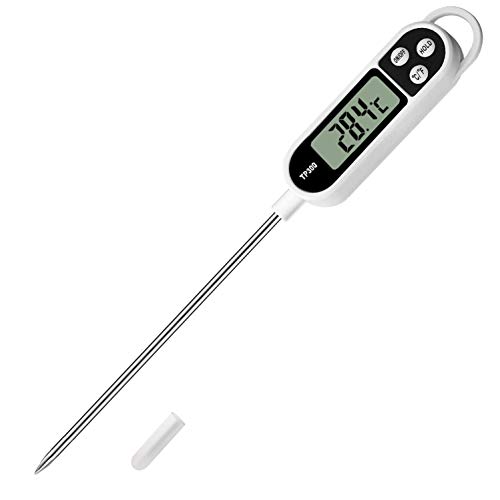
This straightforward probe covers the basics for a baker who checks dough now and then. A HOLD button freezes the reading, and auto power-off after ten minutes stretches the battery. The long 304 stainless probe keeps hands off heat, and a step-down tip with a plastic cap protects the point in a drawer. Stated accuracy sits near one degree across a wide range, and it switches between scales. Its honest weak spot is speed: readings take four to eight seconds, noticeably slower than the instant models above, so frequent proofing checks call for patience.
Response4 to 8 seconds
Accuracyplus or minus 0.9F
Probe304 stainless with cap
Range-58F to 572F
Pros
- Protected step-down probe tip
- HOLD and auto power-off
- Simple two-scale operation
Cons
- Slow four to eight second reading
- Basic feature set only
Check price on Amazon ›
What to look for
Why dough temperature matters
Yeast and sourdough cultures work at a pace set by warmth, so a couple of degrees can change rise time and crumb. Tracking the final dough temperature after mixing lets you repeat good bakes and adjust water warmth next time. A reliable reading turns fermentation from guesswork into something you can steer.
Probe length and reach
For bread, a longer probe reaches the center of a bowl or a tall proofing basket while keeping fingers clear of any warm surface. Models here run from about four inches to over five, and the longer options suit deep starters and liquids. Shorter probes stay nimble for quick surface pokes.
Speed and accuracy
Instant-read probes here settle from about half a second to a few seconds, and stated accuracy clusters around one degree or better. Faster readings help when you check dough repeatedly through a long proof. Remember that manufacturer figures come from specifications, so treat them as a guide rather than a lab-verified promise.
Cleaning and storage
Dough is sticky, so a waterproof body you can rinse under the tap saves time. Look for IPX6 or IP67 ratings, a hold button to freeze the number, and a magnet or hanging hole to keep the tool within reach. A probe cover protects the tip between bakes.
Frequently asked questions
What temperature should proofing dough reach?
Most home bread recipes aim for a final dough temperature in a warm-room band, often near the mid-seventies Fahrenheit, though sourdough and enriched doughs vary. Follow your specific recipe, then use the thermometer to hit that target consistently. Owners report that repeating the same finish temperature steadies their results.
Can an infrared thermometer measure dough?
Infrared models like the Etekcity read only the surface temperature, not the interior of the dough. That is useful for a fast check of a proofing box or counter, but for true fermentation control you want a probe inserted into the dough itself. Many bakers keep both.
How long a probe do I need for bread?
A probe around five inches reaches the center of most bowls and tall baskets while keeping hands away from heat. The TempPro at 5.3 inches and the LONICERA at five inches lead here. Shorter four-inch probes work fine for shallower doughs and everyday checks.
Are these thermometers waterproof enough for sticky dough?
Several carry IPX6 or IP67 ratings, meaning you can rinse them under running water. The LONICERA, the IP67 rugged model, and Alpha Grillers all list rinsable bodies. Always check the specific rating before submerging, and dry the probe before storage to protect it.
What accuracy should I look for?
Stated accuracy around one degree Fahrenheit is plenty for proofing dough, where small consistency matters more than laboratory precision. The Themomonster claims half a degree with NIST certification, while most others cite roughly one degree. These are specification figures, so use them as a practical guide.
Do I need a fast reading for baking?
Faster is convenient when you dip into dough repeatedly during a long ferment. Half-second and one-second models reduce waiting, while the four-to-eight-second basic pick asks for patience. For occasional checks, a slower reader still does the job at a gentler pace.
Can I use these for other cooking too?
Yes. Most listed here double as meat, candy, and liquid thermometers, so bakers who also grill or fry get one versatile tool. The rugged IP67 model and Alpha Grillers specifically highlight multi-use ranges. That flexibility makes them earn their spot in a busy kitchen.
How do I keep the reading consistent?
Insert the probe into the thickest part of the dough, wait for the number to settle, and use a hold button to freeze it. Calibratable models like Alpha Grillers let you correct drift over time. Clean and dry the probe after each use to keep readings trustworthy.
The verdict
LONICERA Digital Cooking Thermometer for S...
9.2/10
The LONICERA earns Best Overall for sourdough bakers, pairing a long rinsable probe with quick, near one degree readings tuned for proofing. Want raw speed? The Themomonster settles in about half a second. For the deepest bowls, TempPro's 5.3-inch probe reaches furthest, while the rugged IP67 model suits knock-prone counters. Beginners will like Alpha Grillers, ready out of the box. The Etekcity is a handy non-contact companion, not a probe replacement, and the simple everyday pick fits occasional bakers who accept a slower read.
Check price on Amazon ›
Our top pick, secure checkout via Amazon
Note: Availability and specifications change often. Always confirm the current details on Amazon before buying.