Electronics 6 Desktop Document Cameras for Clear Overhead Views
P
By the Pickpedia Team
·6 picks compared
·Last verified October 2026
Affiliate disclosure: As an Amazon Associate, Pickpedia earns from qualifying purchases. Links on this page are paid links, and we may earn a commission at no extra cost to you. This never affects our picks or scores.
Quick answer
For sharp overhead capture of worksheets, textbooks, and 3D objects, look at sensor resolution, focus behavior, and mounting stability. Most desktop document cameras here run 8MP at 30fps with multi-joint arms. Match your capture size to A4 or A3 needs, then check software features and platform support.
6 Desktop Document Cameras for Clear Overhead Views at a glance
Why you can trust this guide
We compared these picks using verified manufacturer specifications, available manuals and documentation, current retailer listings, and patterns in owner feedback, alongside editorial research. We focus on measurable differences such as performance, capacity, usability, and build quality. Pickpedia does not present editorial research as laboratory testing, and we do not claim hands-on testing unless it was actually performed.
How we chose: We compared six desktop document cameras across resolution, focus speed, stand design, capture area, and platform compatibility using published specifications and owner reports.
A good desktop document camera turns any table into a live presentation surface. Teachers, remote workers, and hobbyists use them to project handwriting, books, and physical objects onto a screen in real time. Sensor quality, focus behavior, and a steady arm matter far more than a long spec sheet.
This roundup leans on manufacturer specifications, listing comparisons, and what owners report over daily use. Where a model has a real trade-off, we flag it plainly. Every pick here streams high-resolution video over USB and works across common conferencing and teaching apps.
Our top picks
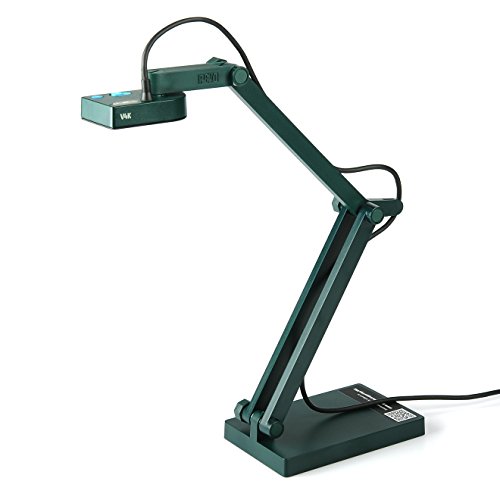
IPEVO's V4K pairs an 8 megapixel Sony CMOS sensor with a multi-jointed stand, capturing images up to 3264 x 2448 pixels. Reviewers note fast focusing that eases frequent switching between materials, plus strong noise reduction in dim rooms. Streaming reaches 30fps at full HD and 15fps at top resolution, with a shooting area near 13.46 by 10.04 inches. It runs across Mac, PC, and Chromebook with a range of software. One limitation: the recommended system requirements are fairly demanding, so older machines may not hit lag-free streaming at higher resolutions.
Sensor8MP Sony CMOS
Max resolution3264 x 2448
Frame rate30fps full HD, 15fps max
Shooting area13.46 in x 10.04 in
Pros
- Sony sensor handles dim rooms well
- Fast focus for quick material swaps
- Broad Mac, PC, and Chromebook support
Cons
- Steep system requirements for full performance
- Joints can loosen under heavy daily use
Check price on Amazon ›
This 8MP visualiser stands out for manual image reversal handled by a button, so you can flip left, right, up, or down without software. Owners point to a wide A3 capture area and three brightness levels that tame harsh or dark lighting. Autofocus triggers with a single press and holds steady as objects move, with macro capture down to 3.94 inches. Dual silicon microphones reduce noise for calls. It folds small for transport and connects plug-and-play over USB-C to Windows, Mac, and Chromebook. The main catch is the plastic-heavy folding build, which feels less rigid than metal-armed rivals.
Sensor8MP
Max resolution2448P
Capture areaA3 (16.5 in wide)
AudioDual silicon mics
Pros
- Button-based image reversal, no software needed
- Wide A3 capture area
- Foldable and travel-friendly
Cons
- Folding build feels less rigid
- Only three brightness levels
Check price on Amazon ›
The INS-1 answers tricky lighting with a built-in LED and an anti-glare sheet, backed by 7-segment brightness control. Its 8MP Sony sensor captures up to 3264 x 2448 pixels and streams a smooth 30fps across all resolutions, per the listing. A multi-joint arm gives a 14.72 by 11 inch viewing size on a compact footprint, and the autofocus lens shoots macro to 3.9 inches. The bundled Documate software adds annotation, digital zoom, and recording. It supports Windows, Mac, iPad with USB-C, and Chromebook. The trade-off is the USB-A cable, which needs an adapter on many newer USB-C only laptops.
Sensor8MP Sony
Max resolution3264 x 2448
Frame rate30fps all resolutions
Viewing size14.72 in x 11 in
Pros
- Built-in LED and anti-glare sheet
- Smooth 30fps at every resolution
- Feature-rich bundled software
Cons
- USB-A cable needs adapter on USB-C laptops
- Compact viewing size limits very large sheets
Check price on Amazon ›
PAKOTOO keeps things straightforward with button-driven image reversal and no software required for flipping. Its 8MP sensor reaches 2448P, and the arm folds into an embedded design that stores flat. Brightness runs across three levels with ten exposure steps, useful for both dark and bright rooms, plus a selfie fill function. Autofocus fires on a single press and macro captures objects near 3.94 inches, with an A3 coverage area of 16.5 by 11.6 inches. Note two real limits: it is not plug-and-play and needs manual USB camera selection, and it does not support zoom, HDMI, or iPad connection.
Sensor8MP
Max resolution2448P
Coverage area16.5 in x 11.6 in (A3)
Exposure10 levels
Pros
- Button image reversal without software
- Wide A3 coverage area
- Ten exposure levels for varied lighting
Cons
- Not plug-and-play, needs manual setup
- No zoom, HDMI, or iPad support
Check price on Amazon ›
Gawervan positions this as a 3-in-1 that works as a document camera, webcam, and visualizer. A 360 degree lens on a foldable hose captures 1080P live demos, worksheets, and 3D objects at 30fps, and the compact build packs easily for travel. Manual focus keeps text and art projects sharp, and dual built-in mics cut background noise for Zoom, Google Meet, or classroom discussion. USB-C plug-and-play covers Windows, Mac, Chromebook, and apps like Teams and Skype. The clear trade-off is resolution: at 1080P it trails the 8MP models here, so fine print on dense pages looks softer.
Resolution1080P
Frame rate30fps
Lens360 degree adjustable
AudioDual built-in mics
Pros
- Foldable, genuinely travel-ready
- Flexible 360 degree lens
- Dual mics reduce background noise
Cons
- 1080P trails the 8MP rivals on fine detail
- Manual focus only, no autofocus
Check price on Amazon ›
OKIOCAM's S-4K brings an 8MP Sony Exmor R sensor and a standout feature: OKIOPoint AI tracking that zooms and follows wherever you point in the OKIOCAM Live software. It captures up to 3264 x 2448 pixels, streams 30fps at full HD and 15fps at maximum, and fits letter-size materials in landscape despite a portable frame. Four button controls handle focus, exposure, zoom, and 180 degree flip. Hinges reportedly endured over 10,000 rotations in lab testing, and it stays plug-and-play across Windows, Mac, iOS, and Chrome. The catch is that the smartest features depend on installing the OKIOCAM Live software.
Sensor8MP Sony Exmor R
Max resolution3264 x 2448
Frame rate30fps full HD, 15fps max
ExtrasOKIOPoint AI tracking
Pros
- AI pointer zooms and follows automatically
- Letter-size capture in landscape
- Hinges rated for heavy repeated use
Cons
- Smart features require the OKIOCAM Live software
- Frame rate drops at maximum resolution
Check price on Amazon ›
What to look for
Resolution and sensor quality
Most desktop document cameras here use 8MP sensors that capture up to 3264 x 2448 pixels, sharp enough for dense text and detailed diagrams. A 1080P model like the Gawervan is lighter and simpler but shows softer fine print. If you frequently share small handwriting or fine artwork, an 8MP Sony sensor gives you more room to zoom without losing clarity.
Focus behavior and macro range
Autofocus that fires on a single press, as on the PAKOTOO and Kitchbai, keeps images crisp while you swap materials without constant refocusing. Several models capture macro subjects as close as 3.9 inches, useful for coins, circuit boards, or small science samples. Manual-focus units add less complexity but need a steadier hand and more patience in changing light.
Capture area and stand design
Match the shooting area to your work: A4 users are fine with the compact IPEVO or INSWAN, while A3 sheets suit the Kitchbai and PAKOTOO. Multi-joint metal arms tend to hold position better over years than folding plastic hoses. Foldable designs win on portability, so weigh how often you pack up against how much desk stability you need.
Connections and software
Check the cable before buying. USB-C models plug straight into modern laptops, while a USB-A unit like the INSWAN may need an adapter. Confirm support for your platform, since some cameras skip iPad or require manual USB camera selection rather than true plug-and-play. Bundled software adds annotation, recording, and AI tracking, but the best hardware still works with Zoom, Meet, and Teams out of the box.
Frequently asked questions
What is a desktop document camera used for?
It sits on your desk and points down at papers, books, or 3D objects, sending a live overhead view to your screen. Teachers use it to show worksheets and demonstrations, while remote workers share documents and physical items during video calls.
Do I need 8MP, or is 1080P enough?
For sharing fine print, detailed diagrams, or artwork, an 8MP sensor gives more clarity and zoom headroom. A 1080P camera like the Gawervan handles general demos and larger text fine, and it stays lighter and simpler for travel.
Will these work with Zoom and Google Meet?
Yes. Every model here connects over USB and registers as a standard camera, so Zoom, Google Meet, Microsoft Teams, and Skype recognize it. Some also bundle their own software with annotation and recording tools.
Are they plug-and-play?
Most are, including the IPEVO, INSWAN, Kitchbai, and OKIOCAM. The PAKOTOO is an exception and needs you to select USB Camera in your system manually, so factor that in if you want instant setup.
Can I capture A3 or oversized sheets?
The Kitchbai and PAKOTOO cover A3 with a capture area around 16.5 inches wide. The IPEVO and INSWAN target A4 and letter size, and the OKIOCAM captures letter-size material in landscape orientation.
Do any handle low light well?
The INSWAN INS-1 includes a built-in LED and anti-glare sheet plus 7-segment brightness control. Sony-sensor models like the IPEVO and OKIOCAM also reduce image noise, and several offer manual brightness and exposure steps for dark rooms.
What connection cable do they use?
The Kitchbai, PAKOTOO, Gawervan, and OKIOCAM ship with USB-C for modern laptops. The INSWAN uses USB-A, which may need an adapter on newer USB-C only machines, so check your ports first.
How close can they focus on small objects?
Several models capture macro subjects as close as 3.9 to 3.94 inches, including the INSWAN, Kitchbai, and PAKOTOO. That range suits coins, insects, small parts, and detailed craft work shown up close.
The verdict
IPEVO V4K Ultra High Definition 8MP USB Do...
9.2/10
The IPEVO V4K earns Best Overall for its proven Sony sensor, fast focus, and wide platform support, making it a safe pick for most teachers. Choose the OKIOCAM S-4K if AI pointer tracking and landscape letter capture appeal to you. Go with the INSWAN INS-1 for built-in lighting, the Kitchbai or PAKOTOO for A3 sheets, and the Gawervan when portability outweighs raw resolution.
Check price on Amazon ›
Our top pick, secure checkout via Amazon
Note: Availability and specifications change often. Always confirm the current details on Amazon before buying.