Craft Cutting Mats Best Craft Cutting Mats: 9 Self-Healing Mats Ranked
P
By the Pickpedia Team
·9 picks compared
·Last verified November 2026
Affiliate disclosure: As an Amazon Associate, Pickpedia earns from qualifying purchases. Links on this page are paid links, and we may earn a commission at no extra cost to you. This never affects our picks or scores.
Quick answer
The best craft cutting mat is the Fiskars 18 x 24 self-healing mat, with bias lines sized for full fabric widths. For smaller projects, the OLFA 12 x 18 RM-CG and the ARTEZA 18 x 24 are strong runners-up.
Best Craft Cutting Mats: 9 Self-Healing Mats Ranked at a glance
Why you can trust this guide
We compared these picks using verified manufacturer specifications, available manuals and documentation, current retailer listings, and patterns in owner feedback, alongside editorial research. We focus on measurable differences such as performance, capacity, usability, and build quality. Pickpedia does not present editorial research as laboratory testing, and we do not claim hands-on testing unless it was actually performed.
A craft cutting mat does two jobs at once: it protects the table and it gives you a grid to measure against. The wrong one skates under your rotary cutter, loses its grid, or is too small for the fabric you cut most often.
We compared nine mats on size, layer construction, grid detail, angle guides and how the surface is meant to recover from blade marks. The picks below cover quilting, card making, scrapbooking and classroom use, from a compact A4 mat to a full 24 x 36 workhorse.
Our top picks
Fiskars sizes this mat for cutting full widths of fabric right off the bolt, which is the job most quilting mats are asked to do. The measuring grid is easy to read and the 30, 45 and 60 degree bias lines make angle cuts straightforward. A full lifetime warranty backs it.
Size18 x 24 inches
GridMeasuring grids plus 30, 45 and 60 degree bias lines
SurfaceSelf-healing
WarrantyFull lifetime warranty
Pros
- Bias lines at 30, 45 and 60 degrees for angle cutting
- Sized to cut full fabric widths off the bolt
- Full lifetime warranty
Cons
- Must be stored flat and away from sunlight, heat and cold
- Gray surface offers less contrast than a bright green mat
Check price on Amazon ›
OLFA invented the rotary cutter in 1979, and this 12 x 18 mat is built to pair with that family of tools. The triple-layer heat-welded construction is double-sided, so you get two working surfaces. At 1.5 mm thick it suits small and medium projects rather than heavy multi-layer cutting.
Size12 x 18 inches
Thickness1.5 mm
ConstructionTriple-layer heat welded, double-sided
SurfaceSelf-healing
Pros
- Double-sided for extended use
- Heat-welded triple-layer build
- Made by the company that invented the rotary cutter
Cons
- 1.5 mm thickness is on the thin side
- Smaller area limits full-width fabric cutting
Check price on Amazon ›
ARTEZA prints inch rulers, grid lines and angle guides at 15, 30, 45, 60 and 75 degrees, the widest angle range in this group. The 3 mm triple-layer mat is PVC-free and the non-slip surface helps hold fabric, paper, vinyl and leather steady. It covers an 18 x 24 inch work area.
Size18 x 24 inches
Thickness3 mm
ConstructionTriple-layer, PVC-free
Angles15, 30, 45, 60 and 75 degrees
Pros
- Five angle guides for bias and pattern work
- Non-slip surface steadies fabric and vinyl
- PVC-free construction
Cons
- Self-healing is described for shallow blade marks only
- Large footprint for a crowded desk
Check price on Amazon ›
TrueCut prints grain, bias and true-bias directions on one side, which helps when you are laying out bias strips. Measurements along the top and bottom run in both directions, so you can measure left to right or right to left. The five-layer PVC core is designed to heal cuts faster and keep the surface smooth.
Size24 x 36 inches
Construction5 layers of PVC plastic
Angles45, 60 and 90 degrees
Increments1/8 inch
Pros
- Bias and true-bias markings on one side
- Bidirectional measurements along top and bottom
- Double-sided for extended use
Cons
- Guidelines appear on one side only
- Large mat needs a dedicated table
Check price on Amazon ›
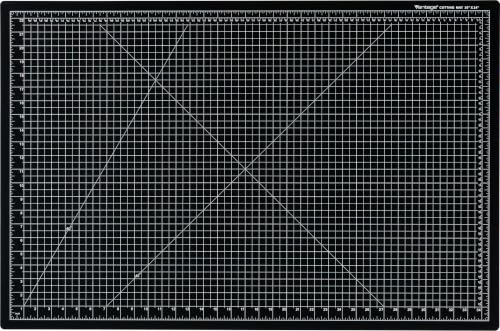
Dahle builds this mat from five layers for maximum healing and adds a 1/8 inch PVC layer to protect the work surface. The 24 x 36 inch mat carries a 22 x 34 inch measurement grid with a 1/2 inch pattern for trimming and sizing. It is the largest option here.
Size24 x 36 inches
Layers5-layer design
Thickness1/8 inch PVC
Grid22 x 34 inches, 1/2 inch grid
Pros
- Five-layer self-healing build
- Thick 1/8 inch PVC protects the table
- Large 22 x 34 inch measurement grid
Cons
- Black surface may show blade dust
- Takes up most of a table
Check price on Amazon ›
ALVIN grids both sides of this 3 mm reversible mat, green on one face and black on the other. The printed grid includes 45 and 60 degree angle lines, 0.5 inch grid lines and zero centering lines. All four edges are numbered and graduated in 0.125 inch hash marks that extend past the zero base line.
Size18 x 24 inches
Thickness3 mm vinyl
SidesReversible, green and black, both gridded
Graduations0.125 inch hash marks on all four edges
Pros
- Both sides gridded for extended use
- Zero centering lines help find the middle of a project
- Doubles as a desk blotter or general work mat
Cons
- Angle guides stop at 45 and 60 degrees
- Vinyl surface is heavier than fabric-style mats
Check price on Amazon ›
anezus uses a five-layer PVC build with a hard white PVC core in the middle to help prevent cutting through. The special finish reseals surface cuts so the mat stays smooth for repeated projects. At roughly A3 size it suits small to medium craft and sewing work.
Size12 x 18 inches (A3)
Construction5-layer PVC
SurfaceSelf-healing finish reseals cuts
UseSmall, medium and large craft and sewing projects
Pros
- Five-layer PVC with a hard center core
- Durable and reusable for repeat projects
- Compact A3 footprint
Cons
- No angle guide detail listed
- Small area for full-width fabric
Check price on Amazon ›
DIYSELF numbers all four edges and prints 0.5 inch gridlines with 45 and 60 degree angle lines on both sides. That makes it easy to line up paper cutting or fabric trimming from any corner. The A3 size fits home, office or studio workspaces.
Size12 x 18 inches (A3)
Grid0.5 inch gridlines, both sides
Angles45 and 60 degrees
EdgesAll four fully numbered
Pros
- Measurements on both sides
- All four edges numbered
- 45 and 60 degree angle lines
Cons
- No layer construction specified
- A3 size limits larger quilting cuts
Check price on Amazon ›
At 9 x 12 inches this A4 mat fits crowded office cubicles, school desks and home desks. It is light enough to carry to craft classes or workshops and store between sessions. Screen-printed centimeter and inch grids, 45 and 60 degree angle lines and center positioning lines are printed on the surface.
Size9 x 12 inches (A4)
GridCentimeter and inch double unit
Angles45 and 60 degrees
ExtrasCenter positioning lines
Pros
- Fits small desks and stores easily
- Lightweight for carrying to classes
- Dual-unit grid with center positioning lines
Cons
- Smallest surface in this group
- Not suited to rotary cutting full fabric widths
Check price on Amazon ›
What to look for
Match the mat size to the cut you make most
An 18 x 24 inch mat handles full widths of fabric off the bolt, which is why it is the common quilting size. A 12 x 18 inch mat covers bias strips, triangles and squaring up blocks. A 9 x 12 inch mat is for card making and desktop work. Buying larger than your table allows is the usual mistake.
Read the grid, not just the size
Grids differ more than shoppers expect. Some mats print 0.5 inch lines, others use 1/2 inch patterns, and edge graduations range from 0.125 inch hash marks to fully numbered borders. Angle guides run from 45 and 60 degrees up to a 15 to 75 degree spread. Pick the grid that matches how you measure.
Layer count and thickness affect healing
Self-healing mats rely on a layered core. Five-layer PVC designs and triple-layer heat-welded mats both aim to close shallow blade marks and keep the surface smooth. Thickness runs from 1.5 mm up to 1/8 inch PVC. Thicker mats protect the table better but weigh more.
Portability and classroom use
For classroom projects and craft classes, a light A4 or A3 mat that slips into a bag makes more sense than a 24 x 36 mat. Check that both sides are gridded so the mat can be flipped when one face wears. Non-slip surfaces help keep paper and vinyl steady on shared desks.
Frequently asked questions
Can a self-healing mat be used for classroom projects?
Yes. A compact A4 or A3 mat is the easier fit for shared desks, and the self-healing surface closes shallow blade marks so the mat stays smooth across many students. Look for numbered edges and angle lines so students can measure without extra tools.
Is a 12 x 18 mat enough for small craft businesses?
It depends on what you cut. A 12 x 18 mat covers bias strips, triangles, card panels and scrapbook pages. If you routinely cut full widths of fabric off the bolt, step up to 18 x 24 or larger.
Which mat is best for card making?
A smaller mat with fine grids works well for card making. The A4 9 x 12 mat has centimeter and inch grids plus center positioning lines, and the DIYSELF A3 mat numbers all four edges. Both keep card stock aligned without a large table footprint.
What should I look for in a mat for scrapbook beginners?
Start with a mat that has clear 0.5 inch gridlines and 45 and 60 degree angle lines. A 12 x 18 size fits most scrapbook pages. Double-sided grids let you flip the mat when one face shows wear.
Do angle guides matter on a cutting mat?
They do if you cut bias strips or mitered corners. The Fiskars mat prints 30, 45 and 60 degree bias lines, while the ARTEZA mat adds 15 and 75 degree guides. More angle options mean fewer separate measuring steps.
How thick should a craft cutting mat be?
Thickness in this group runs from 1.5 mm to 1/8 inch PVC. Thicker mats protect the work surface better and suit utility blades as well as rotary cutters. Thinner mats are lighter to carry but offer less protection.
Can I use a cutting mat for t shirt and vinyl projects?
Yes. Mats with a non-slip surface, like the ARTEZA 18 x 24, help hold vinyl and fabric steady while you trim. A mat with a large grid also helps you line up repeated cuts for multiple shirts.
How do I store a self-healing cutting mat?
Store it flat and away from sunlight, heat and cold, as Fiskars advises for its mat. Wipe it with warm water and mild soap. Rolling or standing a mat on edge can warp the surface over time.
The verdict
Fiskars 18" x 24" Self Healing Cutting Mat
9.4/10/10
The Fiskars 18 x 24 self-healing mat wins because its size and bias lines fit the way most crafters actually cut fabric and paper. Choose the OLFA 12 x 18 for compact spaces, the ARTEZA 18 x 24 for the widest angle guide range, or the A4 mat if the mat has to travel to class.
Check price on Amazon ›
Our top pick, secure checkout via Amazon
Note: Availability and specifications change often. Always confirm the current details on Amazon before buying.