Water Filters 5 Countertop RO Systems for Renters and Kitchens
P
By the Pickpedia Team
·5 picks compared
·Last verified September 2026
Affiliate disclosure: As an Amazon Associate, Pickpedia earns from qualifying purchases. Links on this page are paid links, and we may earn a commission at no extra cost to you. This never affects our picks or scores.
Quick answer
For most renters, a plug-and-play countertop reverse osmosis unit wins, since it needs no plumbing and sits on the counter. Pick a six-stage model with UV and remineralization if taste matters. Two under-sink options here suit owners who can drill and want a permanent tap.
5 Countertop RO Systems for Renters and Kitchens at a glance
Why you can trust this guide
We compared these picks using verified manufacturer specifications, available manuals and documentation, current retailer listings, and patterns in owner feedback, alongside editorial research. We focus on measurable differences such as performance, capacity, usability, and build quality. Pickpedia does not present editorial research as laboratory testing, and we do not claim hands-on testing unless it was actually performed.
How we chose: We compared five reverse osmosis systems across filtration stages, waste ratio, installation effort, and remineralization, based on manufacturer specifications and owner reports.
Reverse osmosis strips out contaminants that basic pitchers miss, from lead and arsenic to PFAS and dissolved solids. Renters often skip these systems because older designs demand plumbing. Countertop RO units changed that, running from a wall outlet with water stored in a carafe.
This roundup spans three no-install countertop machines and two under-sink builds for owners who can drill. We grounded every claim in the listed features and flagged one real limitation per pick, so you know the trade-offs before committing counter space or cabinet room.
Our top picks
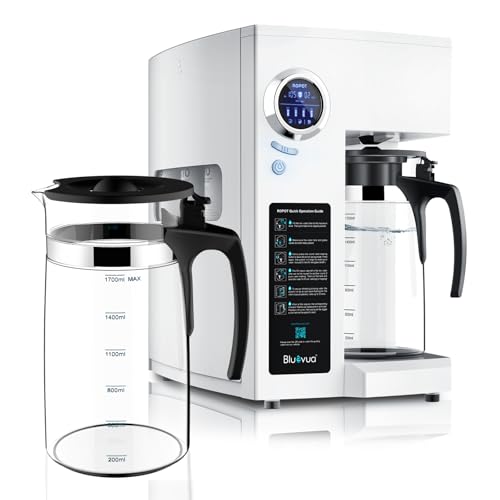
Bluevua bundles a second borosilicate glass carafe, so two containers double your ready supply for guests or a full family. Its six-stage setup pairs a 0.0001 micron RO membrane with UV light and a remineralization filter, reducing TDS, PFOA, PFOS, chlorine, fluoride, arsenic, and lead while adding minerals back for taste. Owners like the plug-and-play design with no plumbing, plus a 2:1 pure to drain ratio and standby power saving. An LED display tracks filter life and water quality. One limitation: the glass carafe format means you refill and pour manually rather than drawing from a tap.
Filtration6-stage with UV
Membrane0.0001 micron RO
Waste ratio2:1 pure to drain
ExtrasSecond glass carafe, LED display
Pros
- Doubled storage with two glass carafes
- UV plus remineralization for taste
- No plumbing or drilling needed
Cons
- Manual refill and pour with carafe
- Counter footprint for two containers
Check price on Amazon ›
This countertop unit folds active refrigeration into RO filtration, chilling water to a 43 to 59 degree range without a fridge. Six-stage progressive filtration meets NSF/ANSI 58, uses a 0.0001 micron membrane, and adds UVC sterilization, with contaminant removal verified by SGS testing. A 3:1 pure to wastewater ratio beats many traditional builds, and it pours 34 ounces in about a minute. Real-time TDS display, three output sizes, and auto flushing round it out, along with two glass pitchers. Reviewers note the refrigeration draws more power and adds bulk, so it suits people who prioritize cold water over the smallest footprint.
Filtration6-stage with UVC
Cold water43 to 59 degrees
Waste ratio3:1 pure to drain
Output8, 16, 40 oz options
Pros
- Built-in chilling, no fridge needed
- Strong 3:1 water efficiency
- SGS-verified contaminant removal
Cons
- Refrigeration adds bulk and power draw
- Larger counter footprint
Check price on Amazon ›
Philips takes a dispenser approach, holding a 6-liter tap tank and auto-filling a 1.8-liter jug so clean water waits on demand for a family of two to five. Six-stage RO uses Aquaporin Inside technology to capture particles down to 0.0001 microns, then remineralizes for taste, with the filter rated up to 12 months. It carries NSF/ANSI/CAN 372 certification and an SGS-certified core, and the panel shows both TDS in and TDS out. Output runs near 6.8 ounces per minute. One drawback stands out: it dispenses at room temperature only, so cold-water fans should look elsewhere.
Tap tank6 L (1.59 gal)
Filtered jug1.8 L (0.48 gal)
Filter lifeUp to 12 months
CertificationNSF/ANSI/CAN 372
Pros
- Large tank serves whole families
- Long 12-month filter interval
- Shows TDS in and out
Cons
- Room-temperature water only
- Slower per-minute output
Check price on Amazon ›
iSpring moves under the counter, delivering a dedicated lead-free faucet and food-grade tubing for a permanent setup. Its five-stage RO reduces more than 1,000 contaminants, including PFAS, chlorine, fluoride, lead up to 98 percent, and arsenic, while cutting TDS by 80 to 90 percent down to 0.0001 microns. Certified to NSF/ANSI 58, it uses a transparent first-stage housing for quick inspection and a check valve against backflow. Owners praise the low-maintenance, leak-resistant build and long support history. The catch: this system needs installation under the sink, so renters who cannot drill or modify plumbing should skip it.
Stages5-stage RO
CertificationNSF/ANSI 58
TDS reduction80 to 90 percent
ExtrasLead-free faucet, check valve
Pros
- Dedicated faucet for on-demand flow
- Broad contaminant reduction
- Transparent housing eases inspection
Cons
- Requires under-sink installation
- Not suited to no-drill renters
Check price on Amazon ›
APEC's ROES-50 produces up to 50 gallons daily and targets removal of up to 99.99 percent of impurities, from arsenic and chlorine to lead, fluoride, PFAS, and microplastics. Its five-stage filtration relies on long-lasting, large-capacity cartridges. Quick-connect fittings and colored tubing make self-installation and service approachable, which reviewers rate as its strongest point. The box includes a filter set, brushed nickel faucet, tank, and install kit, with filter swaps suggested every 6 to 24 months. Backed by two decades of build experience, it stays a reliable choice. Like other under-sink units, it needs cabinet space and plumbing access, ruling out no-install renters.
Output50 gallons per day
Stages5-stage RO
FittingsQuick-connect, colored tubing
Filter swapEvery 6 to 24 months
Pros
- Simple quick-connect installation
- High daily output
- Complete kit with faucet and tank
Cons
- Requires plumbing and cabinet space
- Not portable for renters
Check price on Amazon ›
What to look for
Countertop versus under-sink
Countertop units plug into an outlet and store water in a carafe or tank, so renters avoid drilling and plumbing. Under-sink systems mount a permanent faucet but need cabinet space and setup. Match the format to whether you can modify your kitchen.
Filtration stages and what they catch
More stages usually mean broader coverage, but the RO membrane does the heavy lifting at 0.0001 microns. Look for reduction of PFAS, lead, arsenic, chlorine, and fluoride. A UV stage adds sterilization, and remineralization improves flat RO taste.
Waste ratio and efficiency
RO sends some water to drain. A 3:1 pure to drain ratio wastes less than a 2:1 setup or older under-sink builds. Renters on metered water and anyone conscious of waste should weigh this figure closely.
Certification and maintenance
Independent marks like NSF/ANSI 58 and SGS testing add confidence a system performs as claimed. Check filter life and swap intervals too, since they shape long-term upkeep. A TDS display helps you confirm filtration is still working.
Frequently asked questions
Do countertop RO systems need plumbing?
No. The countertop models here run on a standard outlet with water poured into a carafe or tank, so no drilling or pipe connection is required. That makes them a natural fit for renters and small kitchens.
What does reverse osmosis actually remove?
RO membranes reduce dissolved solids and contaminants down to 0.0001 microns, including lead, arsenic, chlorine, fluoride, and PFAS according to manufacturer specifications. Reduction levels vary by model, so check each listing's stated figures.
Why does RO water taste flat to some people?
Reverse osmosis strips minerals along with contaminants, which can leave water tasting flat. Systems with a remineralization stage add beneficial minerals back, which owners report improves taste for drinking, coffee, and tea.
How much water do these systems waste?
RO always sends some water to drain. Ratios here range from 2:1 to 3:1 pure to drain, so a 3:1 unit wastes less. Some designs let you reuse drain water for other tasks.
Can I get cold water from a countertop unit?
Only one model here includes active refrigeration, chilling water to a 43 to 59 degree range. The others, including the Philips, dispense at room temperature, so plan accordingly if cold water matters.
Are under-sink systems better than countertop ones?
Neither is strictly better. Under-sink units give a permanent faucet and hide the hardware, but require installation. Countertop models trade that for portability and zero plumbing, which suits renters who cannot modify a kitchen.
How often do filters need replacing?
It depends on the model and your incoming water quality. Intervals here range from around 12 months for the Philips core to every 6 to 24 months for the under-sink kits. A filter-life indicator helps you track it.
Which system is easiest for a renter?
Any of the three countertop picks, since they need no installation. The Bluevua and Philips are fully portable, while the refrigerated unit adds cold water at the expense of a larger footprint.
The verdict
Bluevua RO100ROPOT(UV) Reverse Osmosis Sys...
9.2/10
The Bluevua RO100ROPOT stands as our top pick, blending six-stage UV filtration, remineralization, and a bonus carafe with true no-install convenience for renters. Want cold water without a fridge? The refrigerated 3:1 unit delivers. Large families lean toward the Philips tank dispenser. Owners who can drill and want a permanent faucet should choose the iSpring or the DIY-friendly APEC under-sink systems. Match format to your kitchen first, then filtration needs.
Check price on Amazon ›
Our top pick, secure checkout via Amazon
Note: Availability and specifications change often. Always confirm the current details on Amazon before buying.